Also note that, the photographer won a Pulitzer(which means he's be vetted more thoroughly then most), while this reviewer has a history of making strongly worded claims that are disproved.
If interested look at this post which was soundly rebuked, and proved to be misleading.
Can we stop the negativity toward the forensic expert here? He's doing his job. Trying to find out fake pictures. If you disagree, just give a counter point. Stop the Ad-hominem.
Here are my counter-arguments:
1. Blood gets very dry: Not necessarily. Blood requires a sufficient level of platelets to get dry quickly. This can be the case, and it's not a rare condition. (I have it and my nose bleed frequently).
2. Blood color: Same argument. Depend on the constituents of the blood; and whether it's oxygenated or not.
3. Look at her right eye-brow. It looks like she was hit there and blood was bleeding from that place all over her right face. It can be the source of fresh, red blood.
Without casting any aspersions on the veracity of the photo, being talked about, it has to be said that there was plenty of amateur footage making the rounds in the early stages of the conflict, right about the time the UK parliament put the commitment of British forces in a potential military involvement, to vote.
The integrity of photos and video evidence (filmed mostly by amateurs in the early stages of the military strikes by Syrian security forces) was disputed.
Regardless of all the criticism of the analysis, or whether the analysis is "worth it": this post is a really interesting look into how someone that does photographic forensics professionally operates. I thought it was pretty nifty :)
Might be slow to trust this as professional forensic analysis.
Previous claims, which were more extensive, were refuted by independent review of professionals.
From the following article on other case:
"The results of the expert analysis are in, and it looks like Hansen’s photo does indeed stand up to serious forensic scrutiny."
Totally different. The OP is not claiming the work was photoshopped. In fact, if you actually read the post, he confirms that there's nothing suspicious with the post-processing.
He's claiming the subject was fake. She has blood trickles drawn as if coming from wounds on her face (not spatter from someone else). Yet when he uncovered the original high resolution photo and zoomed in, there are clearly no wounds.
That's on top of the other issues with the paint looking more like paint than blood on close inspection. But the lack of wounds at the origin of the streams makes it very clear that the streams were painted on.
The photographer isn't explicitly implicated in this.. it's possible that he just saw her in the crowd and was tricked too. We don't know.
I wasn't there. But I'm unconvinced and a little offended by some of this "reasoning."
As far as I can tell, there is no consistent angle that matches all of the blood drips.
Why must she have stood (or lain) still while the blood finished dripping?
Her eyes show no sign of pain.
Have you ever been bombed, or shot, or in a car accident, or fallen down stairs? The pain often doesn't kick in immediately. The pop explanation for that is "adrenalin" - I don't know the scientific reasoning. But it's a very real effect.
While I realize you intend your tone to be scientific and dispassionate, it is a little too reminiscent of those you use "rational analysis" to deny, well, just about anything.
Cut the "offended" bit. It's either a fake or it isn't. This is a factual question. To claim to be offended is to say that you consider certain areas of thought morally off limits.
Wow. He seems like an all-around shithead especially considering the fact that he's been proven wrong before yet that does not prevent him prevent him from doing the same thing again.
To claim to be offended is to say that you consider certain areas of thought morally off limits.
Thought isn't the issue. It's the public expression of that thought.
When people claim to have been victims of a serious crime, for a third party to jump in with a pompous "analysis," in a faux dispassionate tone ... is offensive. Similarly, it's offensive when the male judge asks a rape victim "why didn't we hear more screams?" It's offensive to Holocaust victims (and, frankly, most people) when Holocaust deniers launch into a lengthy analysis of the chemical properties of Zyklon B.
If you don't see this, then I can't help you.
(And yes, claims of crime and attack should be open to examination. Who does the examination, and in what manner, determines whether it is offensive.)
I agree that the sheer volume of not completely airtight reasons detracted from its cogency and echoes the style of "conspiracy theories".
But for me there was a very solid point that seals the deal: zooming in on the high-resolution source, there were no visible sign of wounds. The blood trickles appear out of nowhere. His "second opinions" agreed on this point as well.
It's clearly a fake. The photographer may or may not have been in on it, but the woman sure was.
It doesn't have to be spatter, there are lots of possible scenarios where the liquid is being spilled on her from some other source (a small incidental pool), it doesn't make it staged. But maybe we just have different types of imagination :)
Yeah, I hate everything about the article, especially the self-assured 'expertise'. At no point does he address e.g. the possibility that the blood was not hers but someone else's.
Both of these second opinions gave the option of blood splatter from another person. Assuming that this is spray from another victim, then there should be droplets all over her face. I count seven possible drops on her forehead, one on her nose, and no others. Searches on Google Images for "arterial spray" and "blood spray" turn up a lot of disturbing photos. But all the photos have something in common: lots of droplets. If her face got splattered, then she should have droplets all over her face. I would have also expected her clothing to have visible droplets.
There's a conveniently placed disclaimer to how he got the "arterial" part (projected image, hardly color correct). From that follows "spray" - so it doesn't really hold water.
Edit: missed the part where you were agreeing with the article, apologies for assuming. He does indeed address that, poorly!
Doctors and police are unqualified to have an opinion on what blood looks like? They seem to be the two groups most likely to have an accurate opinion.
There's nothing in this article that jumps to conclusions. He's saying it looks off to him. He did some analysis to look for obvious ways it could have been altered and reports that he didn't find any of those. He then investigated the possibility that it's a real but staged photo and offers some possibilities with just slightly more validity than "it looks off" and doesn't overstep the actual data and evidence he has.
> While it may seem obvious that something is wrong, these issues went unnoticed by a veteran photographer, the Associate Press, and every news outlet that ran the photo. If they are not noticing details like this, then what other forms of media hacking are they not noticing?
He concludes
1) It's fake
2) He's smarter than everyone else.
It went far beyond "offers some possibilities" way into "making wild assumptions on the basis of a single photo" territory.
And excuse me fake photo can push a war too. Look at the whole Iraq war. Any hard evidences have been disproved after the war. If you think a photo can't kill more people, think about cyberbullying. A single comment can trigger a death. Fake media has a larger effect. And you know the word "propaganda".
So his whole argument boils down to him thinking it looks fake? It seems irresponsible to publish accusations like this without any hard evidence and without considering the consequences of being wrong.
Studies have shown that people are likely to remember accusations of wrong doing and forget retractions or corrections. His insinuation that either the subject or photographer is "faking it" is damaging their credibility just so this guy can get his kicks playing PhotoShop detective.
Sounds like you didn't read past the first couple of paragraphs.. while he isn't offering any conclusive proof, his argument consists a lot more than "I think it looks fake".
I find it interesting that the author of the article mentions Malcolm Gladwell, who has been accused of stretching reality (scientific studies) to fit his theories. It appears that author is taking a scientific approach, but the argument would be better supported by analyzing a number of photographs as opposed to focusing on one. It would also surprise me if the author was surprised that there may have been some alteration to reality as the act of taking a photo alters reality in and of itself and news, like it or not, is a story medium, subject to exaggeration. Surely there are more examples from which he can draw to make his case.
That's my point. He hasn't offered any conclusive proof yet the existence of the article is structured in a way that suggests there is something untoward to be discovered. Are we to assume that he wrote the article with the hope we'd read it and come away without any bias whatsoever?
The inclusion of the filters, despite them showing no significant manipulation, sets up the narrative that we are on our way to discovering how the pictures were faked.
If this were someone's Instagram pictures of their lunch that would be fine but we're talking about a respected photographer documenting a major news event. If there is something fake about the pictures then, yes, that needs to be uncovered. But not by amateur internet sleuths Googling pictures of blood to compare splatter patterns.
> we're talking about a respected photographer documenting a major news event.
Respected photographers have been duped before, and the post addresses this. I think jontas' assertion may be accurate.
> But not by amateur internet sleuths Googling pictures of blood to compare splatter patterns.
I'm sure there are valid criticisms of his analysis, but I'm not quite sure calling Dr. Krawetz an "amateur internet sleuth" is fair if his biographical posting is in fact true [1]. On the other hand, if his qualifications are exaggerated, then his findings are assuredly suspect.
My comment about sleuths was directed at other commenters in this thread.
I don't know much about Neal Krawetz, but his bio seems awfully inflated. Two of the books he's authored are about Ubuntu customization. It appears as though he's a relentless self-promoter. That kind of fits with the original article; he levels some vauge accusations while asserting that he's an expert all in the name of promoting his personal brand.
> It appears as though he's a relentless self-promoter.
That's true. The (linked) article is almost as much about analyzing an image on a hunch as it is about his giving talks and to whom those talks have been delivered.
On the other hand, there is a lesson in this: It's important to be critical of all media we consume.
> I ran this photo by a few other people: professional photographers and artists.
There is no information about who these professionals were, their affiliations, their experience or their expertise. I would rather be interested if this was a detailed post about the analysis of at least one of these professionals, and possibly more interested if they were not anonymous.
It's likely not her own blood, could have been from the probably crowded ambulance, so you can ignore some things relying on that, swelling, pain, cuts.
It's possible she wiped her own eyebrow, and she may have tried to clean her chin while the blood was partially dry (maybe with saliva, diluting the blood a little).
It's possible the blood dried at different rates, considering sweat.
Either way, it would make a lot more sense to stage this with animal blood rather than acrylics.
Edit: posting this here because I agree. Also needs more clear proof on why the blood color is true to camera.
Quick Summery on previous case:
"The results of the expert analysis are in, and it looks like Hansen’s photo does indeed stand up to serious forensic scrutiny."
I know of allegations that Palestinians frequently make stuff up about their war zone (which does not take away from the real harm that they endure at the hands of the Israelis, but does make it hard to evaluate the extent of that harm). http://www.youtube.com/watch?v=awYMPzSrh5o Maybe that is simply common to all war zones? People want to draw arms and money to their side of the war, so it makes sense to do whatever you can to engender empathy in the viewer. It's just another form of propaganda. But props for doing this breakdown and helping us recognize it for what it is.
Keep in mind there has already been precedent for faking photos and videos in the Syria conflict, as well as other conflicts around the world.
It's very much in the interest of militants, and other actors (cough Saudis) to topple the Assad regime, and of course the only way to do that is to get the West involved...
In Iraq you have Sunni-Shia conflict, and that's pretty much what's going on in Syria right now too (with the same actors funding the conflict behind the scenes...).
What would the motive be to fake an injury when we all appear to agree there really were injured people there? True or not, this reasoning based on things that cannot be objectively tested smacks of conspiracy theory.
You have to take into account sweat as well. A boxer's face is probably going to be sweaty as they exert themselves quite a bit during a fight. As a result, the blood is going to get watered down.
I tried to find pictures to verify my idea, but every head injury picture I found was of an athlete.
The first time it happened it came as a shock to me just how bright red blood can be and just how fast it can bleed from a cut on the head. The color is startlingly different from the color I am used to seeing on cuts on hands and legs. I had read about the fact that arterial / oxygenated blood is brighter, but I never expected it to be that bright. I am very susceptible to vaso-vagal syncopes at the sight of blood so the second surprise was that I did not black out seeing it on my nephew. Maybe adrenaline changes that dynamics.
Back to the article, it seems to me it seems that the author strongly wants to believe in a particular hypothesis and trying hard to make a case for it. Not very convinced.
I enjoyed the analysis, and lots of good points were made, and now has me believing it was faked. But I'll be honest, when I clicked the link, I was kinda hoping for some sort of image processing/hyperspectral article.
photo six: is she wearing braces? If so... is that common over there? I spent the better part of my 2011 paycheck to get Invisalign in my mouth and find that a little odd if that's the case. Maybe Morris' book has officially corrupted me!
Getting medical/dental work done in a "3rd world country" is ironically so much cheaper and more accessible than it is here in the USA. The quality isn't as great, but you can't have everything in life.
While the author seems to know something about photo analysis (he believes the photo was not tampered with) he know jack shit about blood or wound analysis. And neither do the "professional photographers and artists" he knows.
I find it rather disturbing that someone would suggest that it was staged based on such flimsy evidence. And the subtitle "Just A Flesh Wound" is a reference to an extremely bloody but hilarious scene in Monty Python and the Holy Grail - nice.
The Syrian Civil War is a tragedy and the civilians are not the villains.
Re: wiping, isn't it possible that she wiped it herself initially (as author suggest she would, consciously or not) and then eventually left it alone and it streamed down past where she had wiped?


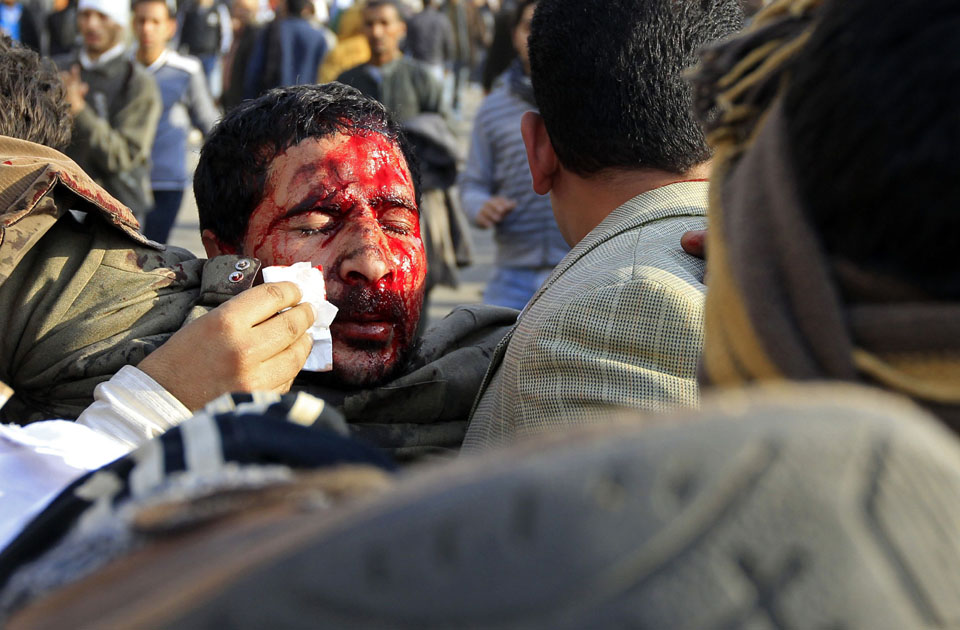
In fact there are: http://www.timesunion.com/news/article/Syrian-warplanes-bomb...
Now the "staging" looks a lot more complicated.
Also note that, the photographer won a Pulitzer(which means he's be vetted more thoroughly then most), while this reviewer has a history of making strongly worded claims that are disproved.
If interested look at this post which was soundly rebuked, and proved to be misleading.
http://www.hackerfactor.com/blog/index.php?/archives/549-Unb...
Note this response: http://petapixel.com/2013/05/14/forensics-expert-claims-worl...