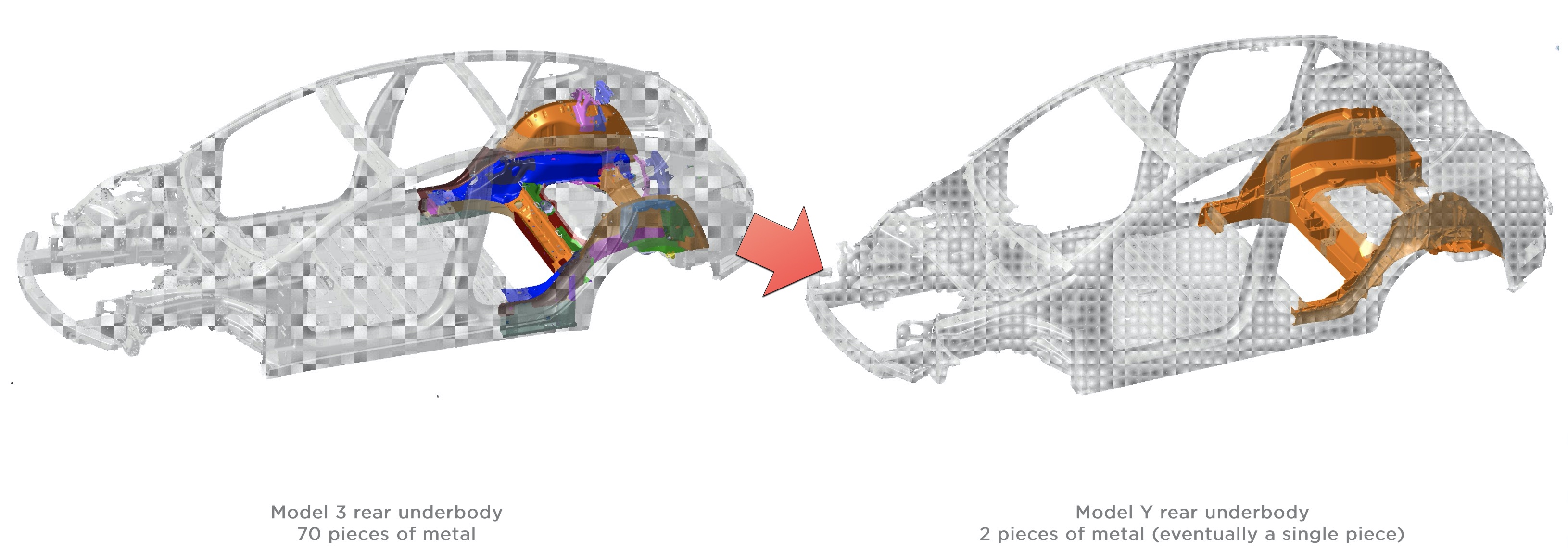
I’m sure Tesla has done a good job but it doesn’t make much sense to compare them to the behemoths because it’s much easier to navigate the shortages as a low volume (but still high priority) manufacturer. If everyone gets shorted 5% of their order for some part, Tesla might have to go source a few tens* of thousands of parts in the gray market to close the shortfall. GM would have to find hundreds of thousands… that amount of product might simply be unavailable.
It's not volume, it's vertically integrated agility. Can't get Continental radar hardware anymore? Tesla updates their vehicle software to use vision only. Tesla can't get certain chips? They have motivated engineers (culture!) in house able to refactor the vehicle software to support a new silicon configuration.
This is a symptom of legacy automaker stagnation, believing their role is to make a profit from bolting together a bunch of external supplier parts, which works until it doesn't. Their supply chain failure is Tesla's opportunity. This is really no different than SpaceX versus Blue Origin, and how each approaches their culture and management.
EDIT (HN throttling, can't reply directly to your comment): @filereaper Musk is an engineer at his core, and sets the culture of his organizations (high expectations but respect for engineering talent). Bezos and Blue Origin are what you'd expect if McKinsey & Company (the consulting firm) were building a space exploration company. Check out upwardbound's comment below, it's spot on, specifically the section on finding talent.
@malcolmgreaves: There is a delta between what we believe makes a good engineer.
Also probably willingness to not restrict themselves to silicon parts rated for an automotive environment. They did this for the LED display...going with "industrial" vs "automotive". Where industrial has a more narrow acceptable operating temperature range, etc. Probably works fine in a lot of cases, but they are taking on some risk.
This is objectively false. He has great advertising and PR, but Musk is a business person through and through.
He has never been, is not, and never will be an engineer. His hostile take to engineering -- from the fact that he OKs unsafe technology and brands it as "autopilot" to half-baked, rushed assembly processes that produces terrible quality in the Model 3s -- is the most obvious evidence that he ultimately only cares about getting richer, whatever the cost.
He has Degrees in physics, and many people with such degrees end up getting positions in engineering companies and are called engineers. He was accepted at Standford PHd program for materials science. That would natural lead into an Materials engineering position in some company if completed.
Of course instead of doing that, he left and started companies, as a software engineer he was the core developer one Zip2 and early on on PayPal. If that doesn't qualify you as an engineer I don't know what does.
Literally he has been the Chief Engineer at SpaceX since its founding. And the argument that its just an empty title just don't work. They were a small company for quite a while and somebody made all the final decisions. The are multiple stories where he works directly with other engineers on the rocket as well if 'making engineering decisions' is not enough. Multiple former employees have directly contradicted these sort of 'not engineer claim'.
Just recently former lead engineer at Ford with 50 years experience in automotive, defense and aerospace was allowed to sit in on a meeting for Starship. He said he had never seen anybody CEO be that involved in detailed decisions, about manufacturing processes and design choices and so on.
So just because you don't like him or his product, doesn't make him not an engineer. He has the education many other people that call themselves engineers have, and he has the title of engineer and that title has been officially recognized by NASA and DoD.
---------------
    Elon is both the Chief Executive Officer and Chief Technology Officer of SpaceX, so of course he does more than just ‘some very technical work’. He is integrally involved in the actual design and engineering of the rocket, and at least touches every other aspect of the business (but I would say the former takes up much more of his mental real estate). Elon is an engineer at heart, and that’s where and how he works best.

    Former Head of Software Quality Assurance at SpaceX
I think Elon being a true polymath scares a lot of insecure engineers out there. They’ve gotten used to being pampered and told they’re special, and here is a goddamn billionaire business guy who could do their job also. It’s just too much to swallow.
People see what he's done as a criticism of their own failings and missed opportunities. I've never seen grapes more sour than the ones devoured by anti-Tesla/Musk folks (apparently by the electric truckload.)
This is interesting. I suppose Bill Gates and Mark Zuckerberg are less threatening since they don’t work on hardware but other polymaths exist. Certainly I believe John Carmack of Id Software and Armadillo Aerospace is one - and the latter is hardware.
I think he's referring to his tendency to pick weird twitter fights.
I have tons of respect for what Musk has done with Tesla and SpaceX, but it's undeniable that some of his tweets should not have been sent. And while I generally appreciate weirdos, he's a bit much sometimes.
Ok, somebody being competitive on twitter means that person is mentally unstable?
I mean you want to call him a asshole fine, but doesn't mean he is unstable.
If everybody that gets on fight on twitter or is sending tweets that shouldn't be sent is considers 'unstable' then most people on twitter are unstable.
I’ve had a model 3 for 2 years, I keep hearing from people who don’t own teslas about “poor build quality” but I have never witnessed it myself. It’s certainly been a lot better than the Ford and Lexus I previously owned.
I could give you heaps of anecdotal evidence to the contrary but they ranked almost last in a survey [1] and even Musk admitted it was a problem at the company [2]
Maybe I am just not that picky. I remember my friend almost got a Tesla but he was complaining about the stitching in the seat, I could not care less about that. So he got a Lexus instead, now he complains about rising gas prices.
I obviously can't speak to your experiences, but this conversation is one you see quite often around any popular luxury product.
Teslas are popular, so for many it's the first expensive car they've splurged to get. This also means they don't know what that amount of money could've gotten them from another manufacturer. Whether another manufacturer would win over a given customer considering a Tesla is up to the personal taste of the customer, but most people splurge for the Tesla, and not any car at a given price point, looking at the pros and cons, then choosing the Tesla as the best option.
It's also one you'll see with Apple laptops. You'll see someone swear that a MacBook is the best computer they've ever owned. However, the MacBook is $2500 and their last many computers were $600 from Walmart. Of course the MacBook is better, the question is if it's better than everything comparable. I personally think the new MBPs with M1 Pro/Max chips will be, but was a MBA pre-M1 better than the comparable XPS? I'm less inclined to agree.
I think you have a good point here. Anecdotally, I had been waiting for the electric cars to hit the markets for over 10 years before even getting a driver’s license (yes, I’m a treehugger) when I finally decided to buy, it dawned on me that for the same amount of money as a model 3, I could get a nice BMW, Mercedes or Audi. After testing them all the Tesla didn’t make the grade and I’m the happiest BMW-hybrid owner.
Opportunity cost is a very real thing when buying anything in this price range.
Tesla's build quality issues spans the range from "the stitching and panel gaps weren't right" to "the roof fell off on the way home from the dealership"[0] and "the steering wheel pulled right off the column"[1]. It depends a lot which sample you get. People with good examples seem to love them, but the range of outcomes is shockingly big.
>His hostile take to engineering -- from the fact that he OKs unsafe technology and brands it as "autopilot" to half-baked, rushed assembly processes that produces terrible quality in the Model 3s -- is the most obvious evidence that he ultimately only cares about getting richer, whatever the cost.
Funny, these are the attributes that I think make him a good engineer. An engineer incapable of building to a minimum viable product spec is not a good engineer.
The fact that he is also amazing at business and PR is besides the point.
He clearly has an engineering and physics mindset and the very DNA of his companies is all about engineering. He attracts excellent engineers in large numbers. I think they would disagree with your assertion.
> from the fact that he OKs unsafe technology and brands it as "autopilot" to half-baked, rushed assembly processes that produces terrible quality in the Model 3s
Engineers don't get to put themselves up on a pedestal and claim they never do wrong, are never subject to incompetence, negligence, or other personal pressure in their lives like money.
But they do take responsibility and are open to scrutiny by their peers when they actually do wrong. In this sense, it's impossible to be a CEO making profit decisions (where loss of life is a balance sheet issue), and maintain the scruples of an engineer at the same time.
> But they do take responsibility and are open to scrutiny by their peers when they actually do wrong. In this sense, it's impossible to be a CEO making profit decisions (where loss of life is a balance sheet issue), and maintain the scruples of an engineer at the same time.
I don't know what you're saying. Engineers absolutely have been involved in everything from turning a blind eye to problems, shirking responsibility, and the normalization of deviance, all the way to deliberate coverups and crimes.
You are naive about engineers. They're people pretty much like everybody else.
Tesla Full-Self Driving - advertising full self driving capability when it's at best assisted and has led to multiple deaths
https://www.tesladeaths.com/
And that's just the tip of the iceberg.
> all the way to deliberate cover-ups and crimes.
I don't doubt that engineers have done monstrous things, but only when the engineer is a stakeholder. In this case, they aren't your typical employee.
I fail to see where any of your examples feature engineers speaking out, taking responsibility, and opening themselves to scrutiny before the problems became known. These are good examples of engineers being complicit or worse.
> Tesla Full-Self Driving - advertising full self driving capability when it's at best assisted
Since you have a bone to pick with Tesla though, I looked up how they're advertising full self driving. From their website "While no Tesla cars are fully autonomous today and require active driver supervision,".
This page does not appear to keep track of "Full Self Driving" deaths. Autopilot deaths are 5-10% of the deaths from Tesla wrecks, however they keep track of data. Doesn't really seem outlandish but it's obviously very hard to know -- it could be anywhere from a lot worse to a lot better than human only drivers, going by these numbers.
You do know though that no company advertises these driver assists as offering complete protection from death. I don't think that's quite in the same category as the first two examples.
> I don't doubt that engineers have done monstrous things, but only when the engineer is a stakeholder. In this case, they aren't your typical employee.
No, this is not true. As well as being unintentionally incompetent, lazy, not keeping up with best practices etc., people get emotionally invested in their company, their teams, their project, their careers and cause them to knowingly and actively participate in these things even if they may not directly (or at all) stand to gain financially.
> No, this is not true. As well as being unintentionally incompetent, lazy, not keeping up with best practices etc., people get emotionally invested in their company, their teams, their project, their careers and cause them to knowingly and actively participate in these things even if they may not directly (or at all) stand to gain financially.
Once again, my assertion is that the motivation is typically not coming bottom-up from the engineers themselves, but top-down from senior management and stakeholders. Competent engineers who work in aviation, automotive, construction, etc. are generally motivated to avoid failure conditions. I'd actually be keen to know if you have any significant examples to the contrary - undoubtedly they exist.
I'm not sure how you could fill the role of CEO, with a strong profit motive, and not be at conflict with an engineering mindset. It's possible that Elon is more scrupulous than most, and better placed to anticipate failure modes with his engineering background, but his messaging particularly on FSD has been leaned more towards market optimism, driving sales, generating investment, than the safety of passengers.
> Since you have a bone to pick with Tesla
I don't, but I don't lionize Tesla or Elon either.
Your assertion was that it never comes from engineers. If you accept that was too strong and want to adjust your claim okay, but don't make as though that's what I was arguing about.
> I don't, but I don't lionize Tesla or Elon either.
If you don't address or retract any of the seemingly incorrect claims you made about Tesla, that suggests to me that you do.
> don't make as though that's what I was arguing about
You were arguing that that engineers are often unscrupulous, I'd counter argue that actually their managers and the stakeholders are often unscrupulous and force them into complicity. My claim is that the responsibility ought to be at the top.
Edit: But I think I agree that even if peers hold each others to account in engineering, it doesn't really matter. They don't hold the power to change institutions. I know there are Engineering societies... and I think in some domains you need a licence to practice that could be revoked, but this isn't true of your typical aerospace firmware coder.
> seemingly incorrect claims you made about Tesla
Such as? Regarding FSD, the deaths stats only break out numbers for autopilot. You might argue that the drivers are responsible for their actions if they leave their hands off the steering wheel, but encouraging any kind of overconfidence or complacency is putting other drivers and pedestrians at risk - all for marketing purposes.
As for having a bone to pick, I provided 3 examples of well publicized engineering failures in recent years. You zeroed in on Tesla which is fair given the OP, but not evidence of me having a bone to pick, an axe to grind, or what have you :)
Maybe you're thinking of black hats? But they aren't operating as engineers. Still, from you, no examples, no evidence, but intransigence. Such a mindset would not be becoming of a scrupulous engineer, so you might be right after all - or you're less qualified on the subject than even me
I commend the response by user panick21 and would add that you can watch Elon Musk demonstrate his acumen in this three part interview on Everyday Astronaut. You can't fake this kind of breadth and depth of knowledge.
My favourite moment is from part one (linked above) about the Tesla production line. Discussion of Elon's principles of simplification (as applied to SpaceX) begins at 13:30 and those principles lead to three contextually relevant anecdotes about Tesla between 22:00—28:20.
I'd recommend interested folks to listen to Musk on Joe Rogan's podcast. Musk gives detailed explanations on the challenges they face and how they solve them.
>It's not volume, it's vertically integrated agility.
Which is easier at low volume...
>They have motivated engineers (culture!)
I love the implication that 100+ year old companies that build race cars don't have solid engineering culture. Aren't ICE vehicles far more complicated?
> I love the implication that 100+ year old companies that build race cars don't have solid engineering culture. Aren't ICE vehicles far more complicated?
Depends on what kind of engineering. Having an old company that is good at mechanical engineering struggling when it comes to software is not surprising, it's the norm.
I'd also disregard the race cars; that is often a wildly different group with its own unique culture and specialists. Tech can and does move back and forth between the two, but if we're evaluating culture, you have to acknowledge that the racing divisions are just different teams with different cultures.
So only a million vehicles a year, eh? That's not really an easy problem. Your door handle motor manufacturer ran out of ics. Please build 20,000 new door handle motor controllers. It's not documented, it needs to work reliably.
Tesla doubled their sales because there is lots of demand (as there is for legacy 'makers) but also because they are at heart a scrappy, innovative company.
> I love the implication that 100+ year old companies that build race cars don't have solid engineering culture. Aren't ICE vehicles far more complicated?
They are complicated, but in a different way. They don't get radically re-architectured from the ground up the way software does. An ICE car today has some fantastically complicated components, but by and large they're recognisably the same components doing recognisably the same things, as you would see going back decades.
> It's not volume, it's vertically integrated agility. Can't get Continental radar hardware anymore? Tesla updates their vehicle software to use vision only. Tesla can't get certain chips? They have motivated engineers (culture!) in house able to refactor the vehicle software to support a new silicon configuration.
If these are all true, why not implement these your proposed way anyway? There has to be a tradeoff somewhere...
> It's not volume, it's vertically integrated agility. Can't get Continental radar hardware anymore? Tesla updates their vehicle software to use vision only.
Given that radar is functionally blind[1] to static objects when travelling at high speeds, I'd argue it's not just a good thing, it's a necessary thing. Tesla have demonstrated the superiority of their vision approach and validated it with 1,000 years of real-world driving, running it in shadow mode on customer vehicles.[2]
[1] Technically radar isn't blind to static objects, but since it cannot disambiguate them from tunnel entrances and highway overpasses, the data is useless. Therefore it's functionally blind.
This kind of agility has some interesting knock ons in terms of support and maintenance complexity later on and the need to maintain spare parts inventory for different vehicle configurations.
> motivated engineers (culture!) in house able to refactor the vehicle software to support a new silicon configuration
I feel like this is overstated. I say this as someone who's done a fair whack porting work, compiling for a new platform isn't really that technically challenging - at least not at the talent you'd expect in the embedded space. Typically you'd have abstractions around maths, GPU compute, UI, rendering, etc. and a retargetable RTOS/kernel. That said, it's quite likely other auto-makers shot themselves in the foot by not having these abstractions.
No. Newer versions of Tesla's software disable the radar on cars that shipped with it.[1] Vision has gotten so much better (thanks in part to training from radar data) that radar adds noise to their model of the outside world. Andrej Karpathy explained the issues in a talk this summer.[2]
But at some point it stops being the car that I ordered as they strip parts from it. Arguably it stops being the car that I ordered the moment they decide to start taking stuff out of it.
You're buying the final product, not specific components when you place your order. As long as it functions as advertised and meets warranty requirements, it is what you were sold.
At least in the case of my Model Y, I was given the option to decline my order as it was placed before the vision transition [1], so there is disclosure and the ability to opt out.
“Cost as a design constraint and important variable is embraced by their culture, instead of being viewed as an evil metric that leads to a sub-optimal outcome," one [Blue Origin] executive wrote [about SpaceX].
"I believe we study a little too much and do too little," one [Blue Origin] executive wrote. "More test [rather than] more analysis will allow us to progress more quickly, iterate, and eventually succeed."
SpaceX does business with the DoD, which can give them supply-chain priority over everyone else for so-called "DPAS rated" purchase orders. [1] If I'm fulfilling a rated order, I not only have the ability, but the obligation, to inform my suppliers that I'm at the front of the line.
They didn't have that for all the development of Falcon 9. SpaceX deliberately vertically integrated and moved to automotive and other suppliers because space suppliers were so bad.
I would be surprised if they have to use this process all that often, specially now that they have reduced construction rates.
GM revenue in Q2 2021 was $34.2 billion ([1]). Tesla Q3 2021 revenue is $13.7 billion ([2]). Tesla is still smaller, but it's in the same order of magnitude with GM.
I suppose parent's argument is in relation to number of units produced, not revenue. From a comment below, Toyota sold about 7-8 times as many cars as Tesla on the US market. _Almost_ an order of magnitude, I'd argue.
but still, given the size of Toyota and GM that’s remarkable volume. certainly firmly in the mass manufacturing territory. and then you look at their upcoming additional production capacity - this is still not their end game.
The fact that Tesla has more revenue per car, higher profit margin per car, and less debt are all benefits -- they can more readily "buy" their way out of supply chain problems compared to others. Combined with more agility, you have a hell of a positive feedback loop.
The goal isn't revenue per se. It's kinda like Apple taking 75% of smartphone market's profits despite selling fewer handsets that Samsung.
The other thread about earnings was talking about moats and this is a big one. The dinosaur car makers have many layers of entrenched suppliers all optimizing for just-in-time. If you do enough in-house you can redesign around shortages instead of depending on some contract 3 parties removed from you.
Every vehicle needs ten thousand parts from hundreds of suppliers in order to be fully assembled and shipped. Tesla could outrun the supply chain crunch on 9,999 parts and still it only takes one missing part to halt production.
Hence the problem for every manufacturer of consumer technology. The guy who almost outruns a hungry lion still gets eaten. Not sure how we can call that "outrunning the supply chain crunch."
It appears they have successfully "outrun the supply chain crunch" on the high volume Models 3/Y but not so much on the much lower volume Models S/X. My guess is the OP's order is for the latter.
I am just window shopping to some extent, but I just looked to see how long it would take to get the no-frills (standard wheels), cheapest Tesla 3 delivered - August ( https://www.tesla.com/model3/design ).
Similar story with golf clubs these days. Swapping out shafts on a new set when you order usually adds no time at all. You do anything but the default shaft you might be waiting until next year. Companies are probably in a rush to get inventory of their most common SKUs and the edge cases are put on the back burner.
There's actually a workaround for WSJ's paywall: submit the original URL to archive.md and you get the full text of the article. Here's the link for this one: https://archive.md/fSpLd
In general yes, they solved their manufacturing issues on the Model 3 line and it reached the required speeds and saved the company. See the cashflow turnaround in 2018-2019. They managed to scale that line far beyond their initial targets.
However that experience did teach them that their design was flawed and for future vehicles after Model 3 they did switch to large castings anyway rather then traditional welding of stamping.
If you are interested in the flaws of the initial Model 3, see this interview with Elon and Sandy Munro where the discuss this:
They still use some sort of chips (on which you can play Cyberpunk 2077 in some cases), which is the main issue why many manufacturers ie Skoda are stopping/slowing down production
So is Apple and every other company with premium, high-margin products. How many automakers have a shortage in their highest-end vehicle trims? Turns out when you aren't relying on volume sales to make a profit you are in a much better position to make up for supply shortfalls.
There's nothing in the article to support that title. "outrunning" it's not. article literally states it had been impacted by the supply chain situation
Ah yes the "flexibility" and "ingenuity" to declare you don't need RADAR (my mistake, not LIDAR as I originally wrote) anyway, supply chain problem fixed!
Elon Musk was always against Lidar, well before any supply crunch, or Covid for that matter. See for example [1], published in 2019, and called "Elon Musk's war on Lidar"
At that point he had spent three years selling cars that he claimed had all of the necessary hardware for FSD. He was also already years later on his promise of coast to coast automation.
Elon may be a negative press magnet, and Tesla may not be a perfect vehicle, but for a company to go from concept car being made fun of on Top Gear to the car I see most on the street here in my city (more than corollas and camrys even), is unheard of.
I just hope that critical mass is reached AFTER the supercharger infrastructure is set in place.
OP claims they've seen more Teslas than Camries and Corollas. English tends to be imprecise when 'and' can mean 'or' or 'combined', I'm pretty sure we can assume 'or' here.
It's perfectly reasonable for some markets to have more of a similar volume of vehicle either purchased or seen out on the street. Not all vehicles are driven the same amount or at the same time of day. If moms are using Corollas to pick up their kids at 3:30, I probably won't see those. If tech workers are driving them home at 6, I'll probably see more of those.
> Frequency illusion, also known as the Baader–Meinhof phenomenon or frequency bias, is a cognitive bias in which, after noticing something for the first time, there is a tendency to notice it more often, leading someone to believe that it has a high frequency (a form of selection bias)[1]
What you are looking for you will see more of especially if new to you or new in general. For instance, most people see Teslas because they are looking for them. No one is looking for a Camry or Corolla unless you know someone that owns one.
When you get a new car, you suddenly see all of those styles on the street, they were always there though. If you start looking for Camrys or Corollas you will see tons, same with any vehicle really that is even slightly mass produced.
I always notice Teslas myself because I was looking for them. Some of them like the Model 3/X/Y models also are just bigger/taller than most cars and they stand out.
There are definitely lots more Teslas on the road today than just a few years ago, but if you look for others you'll see them as well.
In Arizona, people are on the lookout for Waymos as they are the self-driving cars being tested there, people see them all the time because they are looking for them, and they are big and have the sensors on top and around. Seems like everyone sees them all the time. There are tons of Camrys and Corollas which no one sees unless you own one or have a friend/family member that has one.
Where I live (Norway) it's correlated to wealth and lifestyle. Wealthier areas in cities are not surprisingly full of Tesla and other premium vehicles. Tons of etron, I-Pace, Taycan, etron gt, eqc,...
You will find the self charging Toyotas in the country side but the sales are doing downhill fast.
Or Seattle area. On east coast, even in big places like NYC or Chicago, seeing a Tesla still feels like an uncommon occurrence. In Seattle or Bay Area, you cannot drive through an intersection without seeing at least one (or, more often, more than one) Tesla.
They seem to be common in RI and more generally in Atlantic New England. Not sure if it has something to do with state incentives or just a culture thing.
You're assuming they are in the US. In Norwegian cities (e.g. Oslo, Stavanger), Teslas are everywhere because of the high value of the Norwegian Kroner, high local wages, and government subsidies on EVs.
In some European cities they seem to be over-represented too, such as Amsterdam.
I'm now much more convinced of their observations than before I saw your numbers. It seems very plausible that among cars with similar sales figures that one might be dominant in particular neighborhoods, especially when it is associated with status, wealth, taste, and some political affiliations instead of being utterly utilitarian with almost no connotation beyond thrift and sensibility.
Seemed perfectly fair to me. If the car's range is 200 miles then a consumer-oriented review should point out that the range is a lot shorter than you might expect, and if you have a trusted source for that figure there's nothing to be gained from actually driving it 200 miles to test that point before illustrating it on screen.
It was funny to see the transition gear heads went through with electric vehicles. 15 years ago they loved to race and had a "fastest wins" mindset. But now that their $300k ICE cars are blown out of the water by a $50k consumer car, it's now "your car needs to be LOUD and fast"
>But now that their $300k ICE cars are blown out of the water by a $50k consumer car
The Tesla Model 3 Performance goes around the Nordschleife in pretty much the same time as a 2005 Volkswagen Golf GTI. "Blown out of the water" seems a tad bit generous.
Maybe it is just the gearheads in my area of the northeast, but no one drove on tracks and everyone wanted to drag race down the highway after meeting up in a grocery store parking lot late at night.
You could probably try to push a faster lap out of the Model 3 if you dare. However it seems like the brakes are a bottleneck, so emphasis on the word "dare".
>A total of two laps, less than half of the first lap of the brake alarm temperature is too high, but also can feel the obvious thermal attenuation