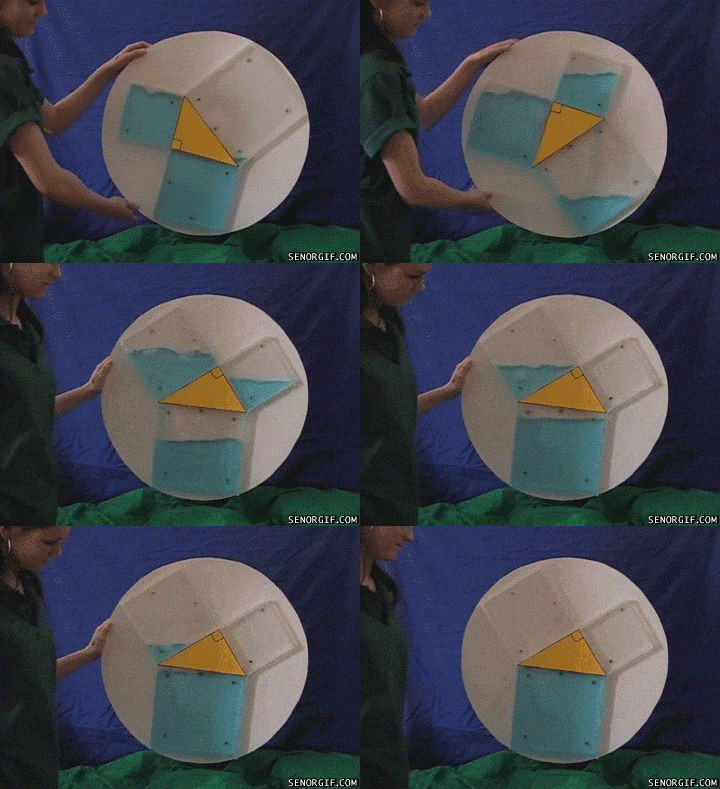
Euclid has two proofs. The first is the one submitted here. The second one uses the complicated theory of proportion from Book V. However, it's very simple and intuitive when recast in modern terms. Take a right triangle ABC, drop an altitude onto the hypotenuse, note the two smaller right triangles are similar to ABC, calculate the area of ABC in two different ways using this decomposition, and compare the results.
This is showing a^2 + b^2 + 2ab (left image) = c^2 + 2ab (right image), since they both have area (a + b)^2. This implies that a^2 + b^2 = c^2, since 2ab is constant across sides.
That's not a mathematical proof, for example it doesn't show why the theorem holds for all a, b and c, and not just the values used in the demonstration.