Byrne's Elements is pretty remarkable. It's an interesting juxtaposition of old 19th century typesetting (complete with initials) and comparatively "modern" graphic design. Some pages look like they could be right out of De Stijl.
Euclid has two proofs. The first is the one submitted here. The second one uses the complicated theory of proportion from Book V. However, it's very simple and intuitive when recast in modern terms. Take a right triangle ABC, drop an altitude onto the hypotenuse, note the two smaller right triangles are similar to ABC, calculate the area of ABC in two different ways using this decomposition, and compare the results.
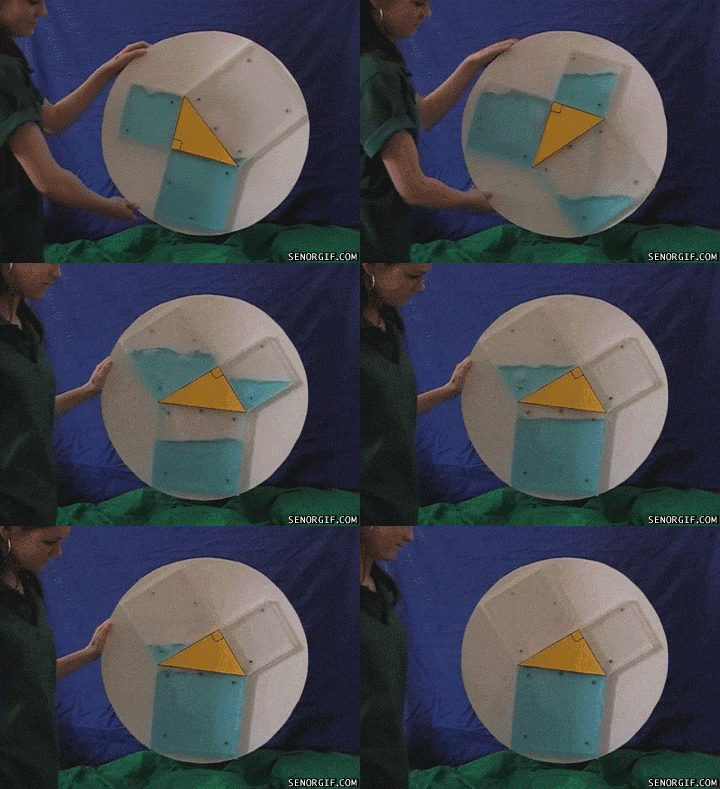
This is showing a^2 + b^2 + 2ab (left image) = c^2 + 2ab (right image), since they both have area (a + b)^2. This implies that a^2 + b^2 = c^2, since 2ab is constant across sides.
That's not a mathematical proof, for example it doesn't show why the theorem holds for all a, b and c, and not just the values used in the demonstration.
> Still, trying to understand Euclid makes you thankful for the more than 2000 years of advancements in mathematical notation and theory.
The importance of notation is greatly underestimated, IMO. Even when programming, an arguably mathematical activity, many people still resist improvements to notation that allow for clearer expressions. The contortions some of my colleagues have gone through in Fortran or C++ (because they refuse to use libraries that would clean up their code significantly, they roll their own versions) to express their ideas.
Funny, few days ago I wanted to write it from scratch starting through the geometric 'interpretation', just to see if I remembered. I had to use `square of sum` identity though.
A bit OT, but I'm interesting in going through Euclid by drawing it with a compass and ruler.
Is there any good guide to doing this? I have Byrne's copy of Euclid. But I found there were multiple points I got stuck when trying to draw it myself.
Well done, but it would have been better if the graphics depicted a right scalene triangle -- the more general case -- rather than a right isosceles triangle.


http://www.math.ubc.ca/~cass/Euclid/byrne.html
Example: http://www.math.ubc.ca/~cass/Euclid/book1/images/bookI-prop1...
(I found this to be one of the most impressive examples used by Edward Tufte in his books).