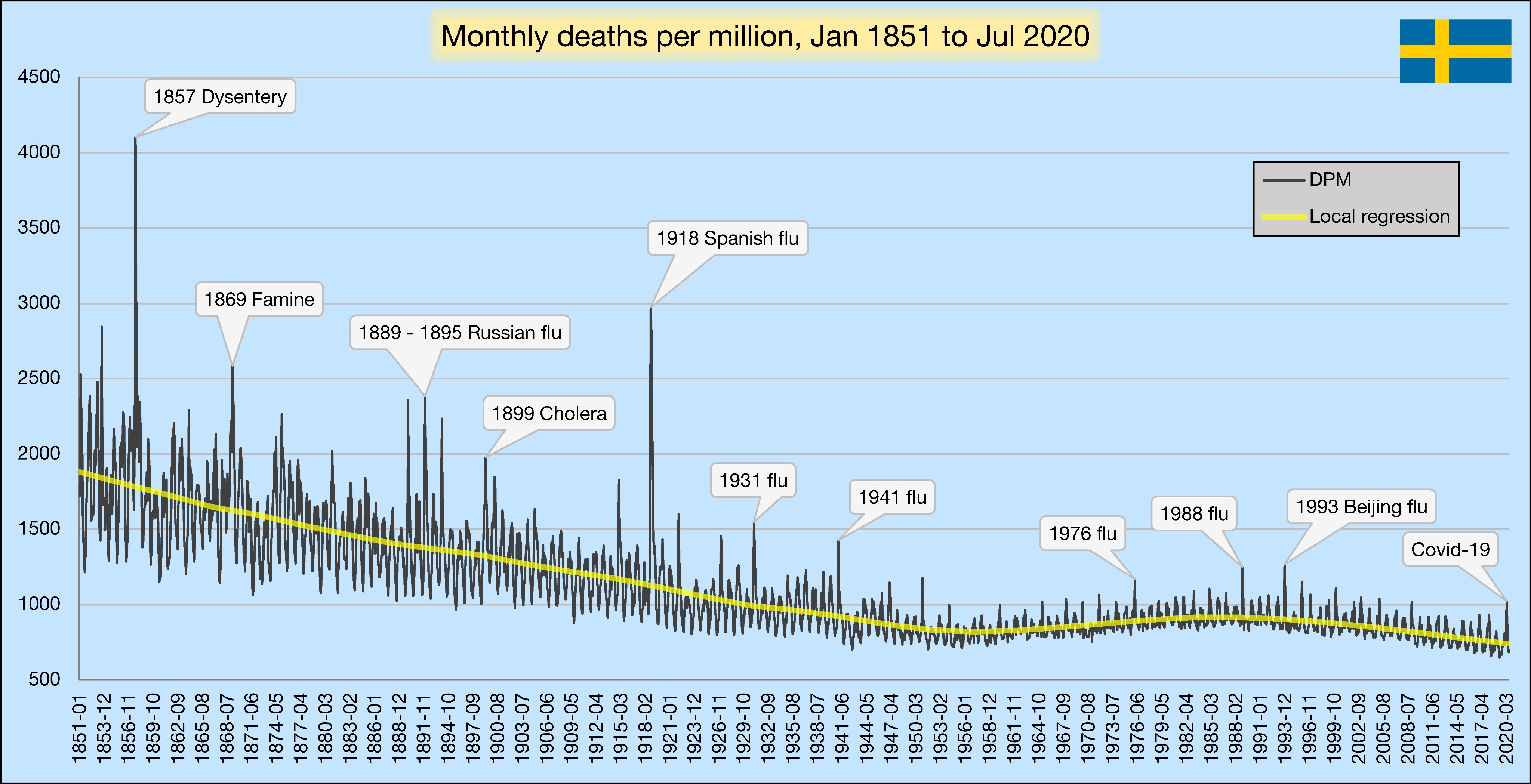
Which other pandemic do you think is even remotely comparable to Covid-19? (All pandemics with a comparable transmission rate happened in times that simply aren't comparable to the modern world in terms of mobility, which obviously affects the way this goes.)
COVID is different because it is occurring against a backdrop of extremely aged and obese populations, in a year (2020) which followed a weak flu season (2019), and in an election year in the USA (2020) where all health decision were heavily politicised.
"In Sweden, the observed increase in all-cause mortality during Covid-19 was partly due to a lower than expected mortality preceding the epidemic and the observed excess mortality, was followed by a lower than expected mortality after the first Covid-19 wave. This may suggest mortality displacement."
Despite their hands-off measures legally, Swedes still socially distanced aggressively. The government has been encouraging people there to take active measures in a manner unlike during swine flu. So we are still comparing the spread, and damage from spread, of a virus where significant behavioural change/mitigation efforts were made, against a virus with significantly less efforts to mitigate it.
Except when discussing poor results in Sweden, then its because they congregated, held events and allowed the virus to spread. I’m not buying either of these no true swedesman arguments.
There's nothing to buy. Data exists for this. Go check out Google's data on people's movements. It went down in Sweden significantly. Maybe less than elsewhere, and that's a rabbit hole you can get lost in. But I think the point stands that it is not a one to one comparison.
You are correct. The pandemic may end after about 20-30 months, but this novel coronavirus will stick around. It is going to be a community virus, such as the Spanish flu turned into seasonal influenza. People pushed back hard against the experts when they started talking about preparing for herd immunity and 70%+ infected. So, this messaging has become more careful.
A few months later the debate will turn to this being leaky vaccines (vaccinated still shed virus, but may not get really sick). Officially, this is also: We just don't know, we are monitoring it. But all the monkeys showed shedding. Trial participants showed shedding. This is a leaky vaccine. What happened to the targeted disease, when we used a leaky vaccine in life stock can be read here: https://en.wikipedia.org/wiki/Marek%27s_disease
Edit: I'd like a single expert predicting that our current vaccines will eradicate novel coronavirus. That would prove the downvoted post wrong. You'll find many experts agreeing that novel coronavirus is going to mutate and live among humans for a long long time after the crisis is over. Facts, people.
It's the first time we have mRNA vaccines available, which makes it much easier to update / mix different variations of the virus than earlier technologies. The mass production is still not optimized, but at least the incentives are huge at this point.
> A few months later the debate will turn to this being leaky vaccines
Made a bit more complicated by the fact that not all vaccines have the same properties here...somehow seems the mRNA vaccines do better at preventing shedding than the adenovirus-based ones [0].
Made way more complicated that it basically depends on what China did to restart Wuhan or Russia did to push through Sputnik (How much did these vaccines shed? Poor answers right now!). All of America can be mRNA while SARS-nCov keeps evolving elsewhere, just one flight away importing it. Surefire way to get vaccinated though :)
> Under normal conditions, highly virulent strains of the virus are not selected. A highly virulent strain would kill the host before the virus would have an opportunity to transmit to other potential hosts and replicate. Thus, less virulent strains are selected. These strains are virulent enough to induce symptoms but not enough to kill the host, allowing further transmission. However, the leaky vaccine changes this evolutionary pressure and permits the evolution of highly virulent strains.[12] The vaccine's inability to prevent infection and transmission allows the spread of highly virulent strains among vaccinated chickens. The fitness of the more virulent strains are increased by the vaccine.
(...)
> Highly virulent strains have been selected to the point that any chicken that is unvaccinated will die if infected. Other leaky vaccines are commonly used in agriculture. One vaccine in particular is the vaccine for avian influenza. Leaky vaccine use for avian influenza can select for virulent strains which could potentially be transmitted to humans.[13]
I never heard this discussed as a big "risk". As far as I know this was always more or less known to be the endgame and not even a dangerous outcome but the "good" scenario.
Once it's an established coronavirus, it can be like the other known human coronaviruses we already have. The reason you don't die from OC43 at age 75 now is because you probably cought it a few times before that. It's not necessarily because OC43 doesn't have a high IFR at high ages. We don't know that because we don't have a large sample of it. For all we know, one or more of the existing HCOVs may have been quite a deadly disease back when it entered the population.
We aren't going to exterminate SARS-COV2. Especially obvious since it's not limited to humans (present in mink, cats, primates, ...). And that's not going to be a big problem.
> I never heard this discussed as a big "risk". As far as I know this was always more or less known to be the endgame and not even a dangerous outcome but the "good" scenario.
The endgame is for the virus to turn into a community virus. This is not the big "risk". The big risk is in using leaky vaccines to combat the mortality and morbidity until we get there (or can reset economy). In chickens, use of leaky vaccines lead to the evolution of a disease which kills nearly all non-vaccinated. That's nothing like the seasonal flu (which would be a "good" outcome, indeed).
> Vaccines have saved millions of human lives, but according to evolutionary biologist Andrew Read they sometimes may also cause pathogens to turn deadlier. Read first put forward the theory 15 years ago. Now, in a new paper, he presents evidence that that is what happened with the virus causing Marek's disease, an infectious disease in chickens. Read acknowledges that the effect has never been seen with human vaccines, but he argues that future vaccines that prevent disease rather than infection could have the same effect. Other researchers say that no general conclusions should be drawn from the paper. Even if he turns out to be right, the study offers no support whatsoever for those who oppose vaccination, Read stresses. If "leaky" vaccines are proven safe and effective, they should be used, he says, but perhaps with closer monitoring and additional measures to reduce transmission, such as bed nets for malaria.
And for all the solid risk management in the West, China, a country where:
- SARS-1 leaked twice from a lab,
- which re-sentences Australian citizens to a death penalty as diplomatic punishment for Australia wanting joint investigation into the origin of a disease with still unknown zoonotic basis
- which would not allow WHO full access, and put information blackout its scientists
- informed the world way too late of an upcoming pandemic, pressuring the WHO to geopolitics and trade instead of world health.
That country will vaccinate a billion people with a leaky vaccine that skipped a trial with a poorly estimated 50.5% efficiency. Risky as all-living hell.
> Under normal conditions, highly virulent strains of the virus are not selected. A highly virulent strain would kill the host before the virus would have an opportunity to transmit to other potential hosts and replicate. Thus, less virulent strains are selected.
This is not correct. What is selected against is deadliness, which is not correctly referred to as "virulence."
By example, the virulence of the kind of herpes that most Americans call "cold sores" is off the charts: you can get it from a single kiss. But because the host barely notices, it's not a big deal.
Similarly, a great number of diseases occur to AIDS patients because they're omnipresent, but cause no harm in normal conditions.
Don't even get me started on mononucleosis.
And then, of course, this is just a generalization; measles and many kinds of meningitis are ridiculously virulent, as well as extremely deadly.
The response to Covid has also been night-and-day compared to AIDS - e.g. Trump was - I would argue - criminally negligent and disrespectful to the victims, but the Reagan admin were cracking jokes about it for example.
It's crazy to think about how HIV has killed some ~32 million people, and yet we rarely hear about it anymore. COVID probably won't even hit 4 million deaths (barring some much deadlier variant that we can't easily produce a new vaccine for).
Right, I don't mean to downplay the severity of COVID at all. It's just interesting that we generally don't hear a lot about HIV/AIDS anymore, even though there were still 690,000 deaths associated with it in 2019.
I also realize that probably depends largely on where you live.
The treatments for HIV are incredibly effective, if you can afford them. It can even reduce your viral load to undetectable. There is a campaign that Undetectable=Untransmittable, to reduce the stigma associated with it. I have to admit I don't know if I'm comfortable with having unprotected sex with someone who had the virus, but the data says it's safe.
There is also pre exposure prophylaxis, which isn't a vaccine but does dramatically reduce the risk.
Between the two, the disease just isn't the problem it used to be -- assuming you can afford it. In poor counties it's still a problem.
HIV is not a proximity transmissible disease so the reality is it's well controlled anywhere you've managed to get the use of barrier contraception methods into widespread adoption.
And at the end of the day if it can't spread through casual contact then it's impact on wider society will be limited once it's understood.
> I also realize that probably depends largely on where you live.
Yeah, I think this can largely be explained by the usual tendency to focus on our own backyards. Google says 'nearly 13,000 people with AIDS in the United States die each year', and I assume the rate is similar in other wealthy countries. Even if we assume the full total is causally attributable to AIDS, that's significantly less than the usual toll from flu, which we also tend to treat rather casually (which isn't to say that we should).
HIV is only transmitted during the exchange of bodily fluids.
Beyond that, we learned to treat it extremely effectively, today if someone who is HIV-positive adheres to their antiretroviral therapy they have a normal life expectancy.
With PReP and PEP HIV is preventable, containable, manageable and no longer leads to AIDS and death. It’s just a chronic infection with no health effects. Is it really still considered an ongoing pandemic?
Yes, because it continues to spread widely and access to treatment, let alone PReP, is extremely uneven across the world.
Both PReP and antivirals are also not easy. You don't just get a shot and not worry about HIV for a few years, you have to take a pill every day as long as you're sexually active, and then treatment antivirals are expensive and need to be used consistently as well. One person slipping up can mean a lot of people catch it. Even assuming you know you have it to begin with, which is often not obvious until you've been a carrier for a while.
Never mind religious groups going around vilifying condoms doesn't help.
It's getting better, but yes it is still considered a global pandemic.
I mean, it's not the same thing as COVID but like COVID it carries with it its own unique challenges and at no point has the world dumped billions of dollars into single-use vaccines for it like we've done with COVID. Its stigma has migrated (or compounded) from a "gay disease" to an "african disease".
Honestly, I really hope that one silver lining out of all this is that an mRNA vaccine for HIV might get some development now. There was some work that way before everything got diverted to COVID and now that tech has proven itself so...
If taking a pill to protect your own life every day is too much hard work we are doomed. But we aren’t, as PReP both protects people from infecting others as well as getting infected themselves.
So no, an infection does not require one person to slip up. For an infection to occur requires both persons to slip up.
Getting PReP requires regular HIV tests so it is in fact obvious that you are infected, if you get infected.
Of course this indeed only solves the issue in the developed world that can pay for (and wants to use) this medication but there really is no way around that. People that don’t want or can’t pay for this medication won’t want and be able to pay for a vaccine either.
Maybe China can help with a cite. They did have a 5-6 month head start and first encountered: brain-blood barrier pass, blood cloths and brain/lung aneurisms, reinfection, patient 0, airborne COVID, effect of mask wearing, pets getting infected, and more.
Too bad they don't allow the WHO full access to investigate, nor share critical information with the rest of the world, now suffering thousands of deaths. Most likely is a lab leak accident (Israel, UK, and US all said as much!). But unfortunately, the "China Virus" has become a political issue, and you won't find cites in the popular media anymore. Just articles about xenophobic conspiracy theories, and to listen to health experts when they tell you masks are not protective, go eat at China Town to show your support, don't worry about losing weight, and that vitamin D deficiency is a hoax.
If we're lucky the virus mutates into a very transmissible but not very symptomatic or damaging to humans variant. It's speculated that's how the 1918 flu pandemic eventually ended.
That’s true, but before that happened it appears to have mutated into a considerably more virulent and deadly form that dominated in the second wave. COVID probably would eventually burn itself out into a less lethal form, but there’s no telling how long or rocky the road to that could be.