> Some may ask why the outlets are installed upside-down, its common in commercial settings to do this as it means if the cord sags down, only the ground prong will be exposed. Things can also get lodged between the two hot prongs if the outlet is the normal way up, like this from an image I stole from reddit
This is very insightful. I've seen outlets installed upside-down to designate them as switched, but never heard any other justification.
This actually makes sense and the charred measurement tape further demonstrates what can and has happened.
It’s also a consequence of really poor American outlet design.
It’s not uncommon in other countries for the plug to be designed in such a way that by the time conductive surfaces are exposed, then the plug is far enough out that it’s no longer live. There are a few ways to accomplish this, either from recessed plugs to requiring that the exposed conductors be half coated in an insulator so that the first part exposed as the plug is removed is non-conductive.
I originally trained to be an electrician. That said, the argument for ground pin down was if a plug "falls" out due to gravity, the ground prong will be the last pin to break connection. Though honestly this is really unnecessary as if the hot and neutral have broke, what current is there to ground?
Another reason is a lot of manufactures of grounded/polarized wall-warts and GFI plugs tended to orient the damn things for ground pin down making ground up installs prone to falling out. So you wind up with electricians following ground down to accommodate this design flaw (or habit).
I dislike the nema 5-15 blade design as it doesn't hold up well to wear. I'd much prefer a pin and sleeve design with the plug recessed in the socket like CEE 7/Schuko. But that's another argument.
> That said, the argument for ground pin down was if a plug "falls" out due to gravity, the ground prong will be the last pin to break connection. Though honestly this is really unnecessary as if the hot and neutral have broke, what current is there to ground?
The ground prong being the last to lose connection means it will not lose connection while the others a plugged in. In the reverse case, where it is the first to loss connection, it will lose connection while there is something to ground.
> Another reason is a lot of manufactures of grounded/polarized wall-warts and GFI plugs tended to orient the damn things for ground pin down making ground up installs prone to falling out.
I've taken to using these kinds of 30cm / "1 foot extension cords" just to get wall worts a bit of distance away:
> Though honestly this is really unnecessary as if the hot and neutral have broke, what current is there to ground?
There could be stored charge in capacitors as in older TV sets or switching power supplies. Theoretically I suppose a short to one of these could energize other metallic components and would be immediately discharged if the ground is still connected.
No real experience with using the design but it appears a bit bulky vs the others mentioned (was it to double as a medieval weapon?). Though I like the UK's idea of putting the fuse in the plug.
You'll see outlets installed 'correctly' (with ground being the highest pin) in hospitals. I've heard that the explanation for their most common orientation is because of our fascination with faces. I'm sure there's a better reason – but I do think it attributes to it.
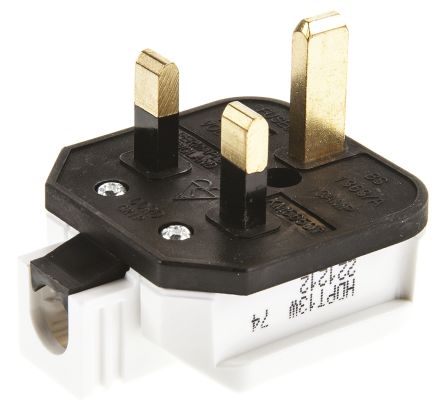
This is a benefit to our (UK) sockets, as laid out in BS 1363 and used in some other countries.
The cable exits the bottom, not the front, so it doesn't matter how thick or heavy it is, and pulling it out of the socket by the cable is very difficult.
Further, our earth pin is at the top by default, and our line and neutral pins are insulated to the extent that if the plug is far enough out of the socket to expose the uninsulated portion of the pins, it is no longer far enough into the socket to be receiving any voltage.
It's more that because the cable exits the bottom of British plugs and it's bottom-heavy, if you drop a power cable on the floor, it will invariably land pin-side up.
US sockets aren't switched, so the only way to remove power from a device is to unplug it. Most things have power switches but not everything, and some people are very keen on unplugging.
Ahhhhh that might actually explain a lot - people's behaviour is affected by the design in that they end up unplugging more frequently due to the lack of a switch in the socket, so more cables laying around unplugged, versus the UK where plugs tend to be left in the socket but can be physically disconnected using the switch.
The earth pin is also longer than line and neutral pins so it should be the last one out in most circumstances (as well as opening the shutters only after engaged)
Yep, and the line terminal is closest to the opening, so if the cable is forcibly ripped out from the plug, line gets disconnected first, and earth usually last. Along with many other benefits (like an inline fuse) that I didn't mention in my post as it wasn't relevant to the posts I was replying to. :)
Humans are lazy. Overall, it was less effort to be forced to sometimes have to deal with upside down outlets, rather than convince everyone that there is a specific and universal orientation.


This is very insightful. I've seen outlets installed upside-down to designate them as switched, but never heard any other justification.
This actually makes sense and the charred measurement tape further demonstrates what can and has happened.
Dug up the Reddit link for those also curious: https://www.reddit.com/r/OSHA/comments/ilb7wq/please_unplug_... and maybe original post was to Twitter: https://twitter.com/meyerweb/status/1289302216826925057