> “I’m not sure what will trigger a sustained sell-off in stocks, but surging [virus] infections and another round of more business closures will be difficult for investors to ignore much longer.”
An alternative place to put investments will trigger it. When your options are savings accounts paying 0.25% interest, and treasury notes paying nothing, and CD's being garbage, what are your alternatives for investing? If interest rates were 5%+ on savings/CDS's/Treasury notes then you would see a bunch of money move from stocks to these other safer more stable investments. But the safety/stability doesn't mean shit if the return is near 0.
I think you are absolutely correct and the reason that the stock market is being so weird is quite simply "what else are we doing to do with that money?"
The solution for individuals: cash, gold, options, etc, aren't viable solutions for institutional investors.
Imagine that you're in charge of a $1 billion fund, what are you going to do? You can't put that into gold, cash or treasury notes. But all sectors are affected by this so you can't simply rebalance your portfolio. You can't go out and buy an obscene amount of call options because those would still way too risky at the institutional level.
For me this is why the stock market right now is deeply troubling. Not because "the elite's are out of touch", I know quite a few people in finance, people managing these billion dollar portfolios and they also have no clue what's going on. None of these people are delusional about what's going on, they just don't know what to do.
What's troubling is that this detachment from reality seems to be based on the fact that the entire financial system is effected and there's no way for it to react in a sane way anymore.
I don't claim to have any clue as to how this will play out, but when this reality bubble bursts it's going to be a very extreme event.
Is part of the issue that there is just too much money has been printed and hoarded and its creating some weird effects?
The government has been printing money for a long time, to stimulate the economy, provide spending money, etc. Due to 80/20 rule, rich get richer effects, etc, a large portion of money the government prints ends up in the hands of a relatively small group who doesn't spend it but rather tries to invest it to get more money. Government prints money again trying to stimulate the economy and again most of it ends up in a few hands. At some point don't you have what we have today? A 1% that owns lots of wealth and doesn't know where to put it while the majority of the economy is still relatively broke? How does it play out? Do the 1% just buy all the assets at some point?
I am not trying to make a statement about inequality but rather curious about the result of printing money for 70 years and having that money end up with relatively few parties each round. Perhaps someone with more knowledge can speak to this.
It's not just "rich get richer". It's also that everybody bought into the "just buy the market" idea hook line and sinker. Pension funds, individual investors, everybody.
How retirement works on paper: you save the money by buying the market and get 20% more when you retire in 40 years. How retirement works in reality: younger people work to supply the old with food and medical care. The real transfer is happening now, while the financial transfer is happening over decades. I don't think this creates a healthy, sustainable dynamic.
The Conservative Party in Great Britain has been trying to make home ownership a reliable method of saving for the last century. They pretty much succeeded: house prices have been going up almost constantly since the war, and owning a house all but guarantees you'll be able to built generational wealth.
This came at high costs: once a large enough part of the population buys houses at inflated prices with the expectation of their price further increasing, the government needs to protect them from housing crashes and depreciation to inflate the bubble further and further.
Now that pretty much everyone has their money invested in the stock market, I see the same thing happening in the US. The Fed needs to keep the interest rate artificially low and guarantee policies to keep the stock market up so that people don't lose money, but also making sociery overall worse.
And we can say whatever we like about how the rich get richer, our current economic system do responds to what central banks do. Cheap money (an oversupply of low and even lower interest rate debt) helps persuade people to buy/invest/order things. It helps finance stimulus bills, and so on.
The savings are "just" an indicator. Sure, when the savings crash, the economy crashes too, but the causality is backwards. If/when the economy crashes (when industries stop, when people stop buying, when businesses let people go) savings will also become "worthless", because after all they represent future income, and if the economy tanks its productivity (income) tanks too.
The issue is two-fold - assuming that all the money comes at beginning, and forgetting about inflation, and not taking into account the shift in risk towards the later ten years, and assuming that your income stays the same. When taking into account the increase in income both absolute and in real terms after necessary expenses, you realize that a lot more than the majority of the money is invested in the latter 25 years.
But yes, it would be more than 20%, though a lot less than 130%.
"The average annual total return and compound annual growth rate of the S&P 500 index, including dividends, since inception in 1926 has been approximately 9.8%, or 6% after inflation" [0]. If you have a 40 year career, money you put in at the start would approximately be worth 10 times what you put in adjusting for inflation, and even money you put in midway would approximately be worth triple.
No, I came to my conclusion by putting away $100 every month for 40 years. $48000 is put in, $114000 is present at the end with a (historically unprecedented low) 4% overall return. Exactly the same amount of money is put away in the last 25 years as in the first 25 years.
The shift in risk should be accompanied by changes to the portfolio mix, of course.
But it's not how people save. The average person has too many expenses and not enough income at age 22 to save up as at age 45. And in those later years, the returns diminish.
Sure, if you have sufficient income to be able to save up enough for retirement just as soon as you get a job, that works. But that's not the reality for the average person. Most people don't get a high-paying job straight out of school.
I am not sure what you are arguing. Someone said that retirement works “on paper”, and you get 20% more. I pointed out that “on paper” you get more than double what you put in.
All of these other issues you raise have nothing to do with the financial illiteracy leading to the idea that you save for retirement just to get an incremental return rather than a multiple (or two, really, depending on timing) of what you put in. Perhaps if this were more well known, people would invest more at age 22.
tl;dr we’re talking about “on paper” here, investment works as advertised (In fact, much much better than the original poster believes it advertised). All of the things you bring up here are about scenarios that aren’t “on paper” any more.
Is there any serious idea about how a fair pension scheme could/should work without just buying the market? (So in some countries the pension system is just mandated by law, managed by the government. And might be even "guaranteed by law" to track inflation. But in this case it's again exactly the same, your purchasing power of your pension income depends on the strength of the country's economy - which depends on the global market.)
Well, as I expand in the second paragraph above - the ONLY real pension scheme is having kids, and more kids. Everything else is just an obfuscation and/or securitization of this basic fact. If you don't want to work, someone else has to. And if we (jointly as a society) decide that "old" people are more deserving to not work, then, well, we need to make & have enough non-old people.
That's why to some degree I think asset-hoarding (S&P, real estate, cashflow-positive businesses etc.) is a good idea and actually my preferred plan, because I fundamentally don't trust the governments (they're all delusional with their long-term plans re: pension obligations, education, family planning & birth rates, immigration, ...), but at the same time I'm aware of the fact that while this strategy works individually (i.e. if I own more property, I'm better off than the next retiree), it doesn't quite work for the whole society. Pension as a social transfer really is the only way to go.
Printing money has recently shown to have little impact on inflation. This is likely due in part to lack of consumer spending (can't inflate prices if nobody is buying it anyway) as well as spreading the USD across billions of people in dozens of interconnected economies that base off the dollar.
The recent $5 trillion injection from the Fed (buying bad debt/assets) and Treasury (stimulus/PPP) may simply show that we could afford universal healthcare and a bunch of other programs that cost $$$. Now is the time to spend that money and, at least it appears, avoid some long term costs. I'd argue the benefits of things like expanding education, investing in mental and physical health, and doing more to support our youth will have a much greater return than potential long term inflation or other issues from the $5 trillion.
Printing money has not had much impact on consumer prices. But it seems very plausible that it is causing inflation of asset prices, including equities, and that that is a distortion of the market that could have negative long-run repercussions.
This. For years now everyone has been saying "where is the (consumer price) inflation"? Meanwhile real estate prices are rising fast (in desirable parts of the country) and the stock market has been on an epic bull run. It's obvious that the inflation is in the asset prices.
This is a dangerous trend. The rich (who tend to own those assets) get richer and and the poor (who rent/live paycheck to paycheck) get more and more desperate. If we don't find a way to reduce the inequality, this is going to mean serious trouble down the line.
> Meanwhile real estate prices are rising fast (in desirable parts of the country)
Mainly just the west coast and that's because their cities are built in valleys with a fixed amount of land, restrictive zoning on said land causing a fixed amount of housing and thus the bidding up housing prices.
For the rest of the country, inflation adjusted price per square foot hasn't really changed [0].
> the stock market has been on an epic bull run. It's obvious that the inflation is in the asset prices.
Inflation adjusted Annualized S&P 500 Returns with Dividends Reinvested for the past 15 years are 6.738% versus 7.690% for the 15 years before that [1]. Albeit, if you just started in 2009, it has been quite epic considering it was the longest bull run in US history.
Piketty tried to analyze this, and the idea is to have a minimal wealth tax. (I have no idea what's the current best evaluation/assessment of his work and this idea, but Land Value Tax is something many economists already favor, and it'd help decouple the pain of growing cities from housing as an investment.)
So similarly there is probably some sense in trying to counteract low-interest-rate inflated asset bubbles via some kind of tax or other financial structure. (A progressive capital gains tax might help, but that might just make markets less efficient by introducing a chilling effect on the high end.)
In the end this is a purely political question, because obviously the problem is not that it's unfair that some very "desirable" assets price inflates, but that the majority of the population did not have the means to buy into it before the inflation happened to reap the capital gains.
There's already serious trouble due to inequality. (The recent protests about police brutality follow a long series of other symptoms that highlight how socioeconomic inequality manifests and persists on an ethnic level.)
Exactly this. The FED and the ECB have been printing money like crazy for years, however this money did not go to the man in the street but to banks and indirectly to other financial institutions. And those don't spend their money in the grocery store but in the stock market.
The classic economical laws are not broken, they are still in full effect and we see their effect in the inflated share prices.
So who is buying equity (so stocks)? And one argument is, that "retail investors" are driving this. (So end users, the folks on the WallStreetBets subreddit, and whoever uses RobinHood, or anyone that puts money into a passive index fund: https://www.reddit.com/r/econmonitor/comments/hnohi6/us_equi... )
Also savings increased a lot, since people were not spending (they were staying at home), so where to put the money? They put it into index funds.
Meh, most of what they are buying is just our own governments debt [0]. Now, you can certainly argue investors are buying more equities now that there aren't as many treasury securities to buy, but equity returns aren't even abnormal from historical returns. Inflation adjusted Annualized S&P 500 Returns with Dividends Reinvested for the past 15 years are 6.738% versus 7.690% for the 15 years before that [1].
You're comparing one of the strongest economic expansions in US history (1991-2001, brief, small recession, then 2001-2007, stopping at 2005 of course) to a period bookended by two of the worst recessions in US history (2007, 2020). It should be concerning that equity returns don't differ very much. That means they aren't correlated with the underlying economy.
The great recessions was definitely one of the worst, but it was followed by the longest bull run in the history of the united states and it is way to early to claim this crisis as being one of the worst recessions in US history.
This is the most important and often under-looked thing in this whole thread. This will further lead to wealth gaps and difficulty for working people to "get ahead".
And that is on top of the mismanagement of PPP funds after the IG over that was fired and replaced with a loyalist. We are only starting to see where billion of tax dollars went including a large chunk to churches and millions to Kanye West and campaign donors/supporters. If one has an issue with looting by protestors, they really need to look at the looting by the wealthy. Not just PPP loan abuse but also historically low tax rates and a pass for environmental abuse too.
This is an inherent problem with need-based things -- they are ripe for abuse. If you have universal things, the abuse is part of the design ;) IOW: if instead of PPP being only for certain kinds of companies or institutions it were all of them then a) there is far less to administer b) they get more support and c) you dont have moralistic temptations or arguments. UBI vs SSI, universal healthcare vs medicare, etc etc.
Yes, this means wealthy people will get the same checks as the poor -- but that is a feature, not a bug. Sorry for the soapbox.
There was oversight for PPP, but the president fired the IG over the program and replaced them with a loyalist right before the fund went live. The administration then refused to provide data on who got loans until sued. Now we know that the Sec of Transportation and husband Mitch McConnell, the new USPS head who appears to be trying to crush mail in voting internally, and many other government officials received loans for millions. If one was to condemn protesting due to looting, imaging the response to misappropriating billions in tax dollars to corporations, supporters, and corrupt officials.
This seems likely to me, lots and lots of money injected and consumer prices are stable yet art, real estate in desirable urban locations, equities, and some categories of luxury goods/experiences are soaring. Am I wrong?
Yes and no. You're right about what happened in the aftermath of 2008, though it took a while to get there. You're wrong (so far) about what's happening in 2020. Currently, the market (or at least the Dow) is down about 10% from its high.
People are chasing gains. TSLA has at a chance of succeeding at either autonomy or cheap energy storage. If that plays out it could be a 500B company in 8 years. Why not get in now with a hope of a 6% annual return?
Printing money to get through a recession vs printing money as the primary way of funding government programs are wildly different things. The mere suggestion that U.S. officials were serious about running a deficit of a large percentage of GDP could send people fleeing U.S. dollar denominated assets, and thanks to the exchange rate effects cause a spike in inflation before the programs even started.
The thing that makes a green piece of cloth valuable is the powerful government and the massive reserve bank behind it. If a dollar bill starts to look like an IOU from an entity that has no capacity to pay, it will be valued as such.
We haven't even rolled back the quantitive easing from the last recession. These financial rescues are now becoming permanent fixtures on our balance sheets. At least with health care, we would have something to show for these massive injections of money. Instead we just get inflated asset prices and growing wealth inequality.
Why is it a problem that they are still on the balance sheets? The instruments that have maturity will eventually vanish on their own, and the Fed can sell off the rest later.
It's better to do QE than "wait out" a recession, or wait for Congress. (Plus QE keeps the national debt service costs down too.)
The asset bubbles are not the real signs of inequality. After all, if every US citizen would have some savings and some of that in passive index funds, no one would complain about this. The problem is that people have no money, no disposable income, no savings, no job security, etc.
I think the comment above is suggesting that, either instead of or alongside, current Fed cash injections and distributions by the Treasury we need to push for and implement programs that leverage us out of the QE cycle. A universal healthcare system, student loan forgiveness and free or reduced cost education, a basic income over complex safety net benefits, that sort of thing. As it stands, QE is preventing a massive crash but it's not a long term solution.
I'm all for universal and single-payer healthcare, education reform, basic income (negative income tax is the best version of UBI), and so on.
But still, QE might be here to stay. It's hard to stay, I know very-very little about these things. (Even compared to - let's say - healthcare costs [see https://randomcriticalanalysis.com/ ].)
Have they been printing money? Has more USD been created, physically or virtually? This is something I don't understand, I'm hoping someone here can explain it.
I was under the impression the last 40 years of US deficit spending has been mostly financed by selling US bonds to China, Japan, etc., while counting on growth and inflation to take the edge off when they come due. And selling more bonds instead of defaulting, so the debt just keeps growing. Printing money causes inflation but not deficits or lingering debt.
I don't know though, I'm not an expert. I would appreciate any corrections or clarifications from anyone.
"The Fed can indeed create money "out of thin air." To be more precise, it does so with keystrokes on a computer. This was illustrated with its QE program, also known as open market operations. That's when the Fed buys an asset from a financial institution and pays for it with money it simply creates."
and i know this is technically fully legal. but conceptually, it seems like fraud. I mean, they're just creating money at will and buying up assets. if anyone else did that, they'd be in jail.
The Fed is playing off the same dynamics as fractional reserve banking. This has been the standard form of banking for ~2-3k years, and allows a bank operating in its own currency (Bank Notes) to create arbitrary amounts of money. This is the same process by which loans are generated.
It is wealth transfer from the people to the government; the Romans did it, until their economy collapsed from the strain of perpetual warfare and government spending [1]
but it's not anyone else, it's the central bank of the USA, as mandated by Congress.
they provide price stability (by keeping the money supply corresponding to the demand) and they try to maximize employment (by helping the economy through providing liquidity, every central bank is the "lender of last resort" but that's for emergencies, usually they operate simply by providing forward guidance and conducting open market operations to keep the interbank interest rate close to the target rate).
Most of those assets they are buying are just our own government's debt and the profits they make from it (100 billion dollars in 2015 for example) go right back to our government reducing our budget deficit. I don't understand why people get so upset about this especially considering basically every country is doing this.
Generally lowering the interest rate causes inflation only if the economy is already at capacity.
Printing money to keep up with economic growth is also an important function of central banks.
Deficit spending is ultimately simply financed by paying off the debt in the future via taxes. (And the growing economy and the stable but low inflation helps with this.)
Today was one of the few times I saw "social unrest" mentioned in this context. I suspect that will happen a lot more over the next few years.
The markets are a wobbling shitpile of unpayable debt just waiting to collapse. That was already true before Covid, but Covid has nailed the coffin shut while the corpse is still alive.
I wouldn't be surprised if the Fed is knowingly goosing the twitching body because the alternative is one of the biggest financial explosions in history. More free speculation vouchers at least buy a little time before the music stops, the bomb goes off, and we all run out of metaphors.
An alternative to a meltdown is what's been happening since 2008- the poor start killing themselves and maybe they vote for the wrong guy, but the trend doesn't stop. Given that the market says 30% of the workers don't really matter (and remember, that's people participating in the labor market, which is at a historic low IIRC), maybe they just ignored. They can cause some level of social unrest, but the rich are mobile, and the factories are pretty automated. What we'll see soon is more private security and automated security.
I think there's a lot of people who don't remember or realize this. And it bothers me that having conversations now takes so much effort to address that particular part of the context: "they were having econ troubles before covid was on the radar"
Some sectors are hard-hit by Covid but others are not. Furniture sales, Grocery, Tech, Entertainment are all doing quite well.
Debt is also not necessarily the time-bomb that everyone thinks it is. Debt is tied closely to the overall money supply, and world productivity has been increasing as has population. World debt is about 69 trillion with a population of 7.8 billion. That's under $9k USD per person.
>World debt is about 69 trillion with a population of 7.8 billion. That's under $9k USD per person.
That's a bizarre way to cut it for a number of reasons. For example, half of the world lives on less than $5.50 per day [0].
The more relevant statistic is the US national debt is $26 trillion [1] and the additional unfunded liabilities dwarf that. There are 143 million US taxpayers. It's something like $160k per US taxpayer [2]. Much of it can/will be printed away but not without other consequences.
Fed will continue printing until Boomers die off... there is a lot of wealth locked up in 401k that needs to be disbursed.
This block votes and they vote often and if their little pennies are threatened, they will vote people out.
Edit: If you think these market rises are anything other than a way for the rich to rinse their money before the market bombs, I have a bridge to sell you, it's very pretty.
Only half of those over 55 have any retirement savings [1], the other half have no retirement pennies to speak of.
While not great for online discussion, I can understand where the sentiment comes (the evidence is clear older generations strip mined the country economically [and continue to do so], pulled the ladder up behind them, and then are shocked when younger citizens are resentful).
I don't know, maybe I am out of touch but almost all boomers I know are extremely well off, they started as scientists or other typical professional occupations and now own assets in the millions, basically housing in California and other areas. Prop 13 has helped them(their prop. taxes do not go up) as well as dirt cheap college costs when they went to college. Housing was rather cheap as well considering salaries, I remember my Dad looking at houses in Palo Alto in the mid 90's and they were in the 300's(they are now 3-4M). I feel like gen X and Millennials are really getting the short end of the stick when it comes to alot of essential life costs. Sure economists say inflation is not happening but I think the formula to look into inflation is incorrect as Housing/Medical/College has skyrocketed where a gallon of milk and bread has not jumped in cost.
I expect housing to get a lot cheaper when the boomers actually need to wring some liquidity out of the real estate they've been holding (hoarding) to pay for elder care.
Even if they do something like barter free housing for live-in care instead of selling, you expect a big effect on the rental market and a corresponding effect on the value of investment properties.
I think this’ll be governed by how quickly their health declines, how easy it is to borrow against their equity (and the bank liquidating the property after they’ve passed), and how aggressive local jurisdictions are with clawing at assets to pay for long term care (Medicaid, five year look back). The can keeps getting kicked.
> I expect housing to get a lot cheaper when the boomers actually need to wring some liquidity out of the real estate they've been holding (hoarding) to pay for elder care.
Boomers are between 56 and 74, a lot of them already have either liquidated real estate holdings by downsizing even if not explicitly for care, or passed it on, whether inter vivos or by inheritance (because quite a lot of them have died, and you can't take it with you.)
The boomers you know (white collar professionals in the Bay Area apparently) are not a representative sample of the entire population. The group you mentioned has done well in every generation in modern times.
Some are, some are not. They are all friends parents and some family, a few others are blue collar business owners or workers. One striking example is a friend who's Dad(in the construction business) owns multiple properties and his son(late 30's) rents. They are doing the exact same job and it shows how skewed things are based on 30-40 years ago(his Dad owned a house at his age).
A "blue collar" business owner with multiple properties isn't really a great example either.
I'm not arguing against your thesis that the boomer generation overall basically extracted resources from future generations (and their parents who lived through the depression and at least 1 world war), I'm just saying that there are lots of individual boomers who didn't have lucrative careers or happen to own property in the right places, and you don't seem to know any of those people (which is fine of course).
Baby boomers were born between 1946 and 1964. They're currently between 56-76 years old (roughly 76 million in U.S.). Anything older than that is the “silent generation“ (born 1928 to 1945).
I think you are massively incorrect. Equities right now are at a pretty massive discount to future value. If anything I think the coronavirus effect on the economy has just demonstrated that economic growth is fundamentally not impacted much by around 1/3 of all jobs. The labor product and consumption activity of that 33.3% just doesn’t matter.
The implications of this seem mostly sociological to me. Is that a good state of affairs for the world? Could we use those people more productively?
The implications are not about the current stock market.
Amazon and Microsoft are pretty damn likely to keep growing in value for 10+ more years regardless of any coronavirus situation. That’s an amazing / dumbfounding situation. But it still would imply a rational longterm investors sees those stocks as being attractively priced right now.
> the coronavirus effect on the economy has just demonstrated that economic growth is fundamentally not impacted much by around 1/3 of all jobs. The labor product and consumption activity of that 33.3% just doesn’t matter.
If you're right about that we're into revolution territory. If COVID reveals that we've built an economy that not only doesn't care, but doesn't even register the existence of 1/3 of the population, the body politic may have had a poison dose.
I've been saying this for a while. There is simply a surplus of "forced buyers" for investments, so the price and yield has gone down and down, and there's no real reason why it can't be negative. The only next point is warehousing physical cash, which itself isn't cheap or liquid.
Individuals presented with this crisis could realise the problem, the disastrous future it implies, and turn to philanthropy. Institutions largely can't, and foreign oligarchs won't.
The US model of funding retirements is subsidizing (via tax breaks/structures) the middle class to buy into inflation beating assets (only stocks meet this really) or underfunding pensions that need to also beat inflation by buying into equities. There truly is “no alternative” to stocks and, to a lesser extent, real estate. These are the only two major asset classes which can provide sufficient returns to support a middle class or above lifestyle for a very large class of people who do not work or intend to not work in the near future.
This trope gets repeated over and over but it just makes no sense. Volatility is risk. What rational investor says "interest rates are too low, I MUST deploy my capital into a market that is seeing wild 30% gyrations from month to month instead of parking it safely while this global crisis plays out."
You're thinking about your personal investments, not someone managing a large investment firm or hedge fund. This simple fixes for your personal investments would be seen as absolutely insane in the professional investment world. You can't just tell your clients "oh I put $100 Billion into some nearly 0% interest investments because I think the market is crazy", especially if the DJIA is having record months. Even the people managing your 401k are expected have a steady read of return and react slowly and calmly.
Holy shit. 41x! I'm in the wrong world. Even though I'm in the overpaid-programmer-industrial-complex, in an expensive west coast town with an expensive million dollar house and expensive taxes, I can't imagine what it would take to get into evil and profitable investment vehicles like these hedge funds. I just have no exposure to that world.
I'm curious - why do you call the hedge fund world evil? I hear this quite often but where does it come from?
I've worked in both a hedge fund and in tech, and I found the former to be less evil and pretentious. People in finance think and say "I want to make a ton of money" while people in tech say "I want to save the world" while thinking "I want to make a ton of money" - resulting in misaligned incentives and imposter syndrome everywhere.
Whereas a monetary system is an essential aspect of modern civilization many people see major players in our specific system obviously working against the interests of the rest of civilization instead of simply enabling it. It's obvious that not everyone is equally bad or equally culpable but its obvious that there is also an institutional lack of what most people think of as ethics.
Take for example the creation of a market to manipulate the price of commodities most notably wheat.
Sachs is most likely mostly responsible for millions perhaps hundreds of millions of people going hungry and yet a response to outlawing this kind of manipulation provokes this response.
>I asked a handful of wheat brokers what would happen if the U.S. government simply outlawed long–only trading in food commodities for investment banks. Their reaction: laughter. One phone call to a bona-fide hedger like Cargill or Archer Daniels Midland and one secret swap of assets, and a bank’s stake in the futures market is indistinguishable from that of an international wheat buyer. What if the government outlawed all long-only derivative products, I asked? Once again, laughter. Problem solved with another phone call, this time to a trading office in London or Hong Kong; the new food derivative markets have reached supranational proportions, beyond the reach of sovereign law.
This is Bond villain proportions of villainy. We could of course continue in the same vein touching on Banks laundering money for cartels, the housing market collapse, and on and on and on.
Other people answered you well, but I could sum it up as financialization doesn't help society. It puts up barriers to free trade, monopolizes businesses, adds rentier like barriers to society. A great financial system also makes it easier to get a loan, invest in things, get credit. For wealthy or fortunate people like most programmers this is all great. For poorer people it adds to the tax or drudgery and difficulty of having a good life and affording it.
> while people in tech say "I want to save the world" while thinking "I want to make a ton of money"
Citation needed. The number of people in "tech" who say that is remarkably low -- in my experience in Silicon Valley: zero.
Far more often, I hear employees who are driven by "the mission" of the company/product. I work on a newer generation cybersecurity product because the ones that exist in the space have terrible usability and probably aren't very accurate/comprehensive/ergonomic. I'm not "saving the world", but I am making marginal improvements in a high impact space.
Personally I haven't the foggiest idea of what a Hedge Fund actually is. I've seen The Big Short, Margin Call, Barbarians at the Gate and I don't find myself sympathetic with any of those characters (except the Ben Rickert[1] in The Big Short, but only because he saw how terrible the industry was and got out years before the story takes place).
> I hear this quite often but where does it come from?
A part of it might be stereotypes and depictions in pop-culture. The drama Billions shows hedge funds getting their consistent edge from insider info. Not sure how true that is but for people outside the industry that doesn't come off as a good look.
A very large percentage of the market is required to achieve a certain return. Think insurance companies. Giant pension plans. Etc. They have all been forced further and further out the risk curve over the past decade due to low interest rates.
Everything is being forced further out on the risk curve. Everything.
This also explains wacky basketcase unicorns like WeWork, perpetually unprofitable companies raising round after round, the continued existence of the cryptocurrency world in spite of it being like 90%+ scams, real estate going up in cities where >25% of people are behind on their mortgages, etc. There's no "alpha" anywhere. Money is chasing its tail.
All this QE is just going to give us is more asset bubbles. The financial economy is completely detaching from the real economy and becoming a pure fantasy LARP for the rich and of course governments.
My guess is when the financial economy goes bust and those dollars start chasing real economy assets all the inflation we were assured wouldn't happen due to all the money printing will happen all at once.
People act like the big short guys were geniuses to see this trend come out of nowhere. I was a teenager asking questions like "How can housing prices rise nationally at a multiple of wage increases for any sustained period of time?" and was short down by the "smart money" on forums not unlike this one.
Once you allow for the fall in interest rates over the past decades, the house price rise looks less surprising. However, there's a weird corollary: what happens when rates go negative?
Will we have a choice? The Fed has tremendous influence over the economy in the short-medium term, but over long time horizons they are actually at the mercy of it.
Pension funds aren't required to achieve a certain return. If returns over a long period are below the assumed rate, then the employer simply needs to increase contributions. This is less than ideal but not a requirement in any reasonable sense.
>If returns over a long period are below the assumed rate, then the employer simply needs to increase contributions.
It's seductive to type out the word "simply" to describe a proposed solution but that doesn't mean it's simple in reality. (My previous comment about supposedly "simple" fixes:
https://news.ycombinator.com/item?id=16698821)
E.g. The employer (the state government) that pays into pension funds for teachers won't simply pay more. The taxpayers aren't sympathetic to raising taxes on themselves to pay for fully funded pensions (even if the pension is underfunded) when they perceive the teachers already getting better benefits than they do. A lot of citizen taxpayers who are not teachers also suffer from underfunded pensions themselves!
This doesn't at all address the core point I'm making: that pension funds are not required to achieve a given rate of return in any meaningful sense.
But sure, I agree that there are other ways to handle the situation if the fund doesn't achieve its assumed rate of return. There are other options than increasing employer contributions.
>This doesn't at all address the core point I'm making: that pension funds are not required to achieve a given rate of return in any meaningful sense.
You're being uncharitable in reading gp's (erentz) word "required". No, there isn't a statute or law that says the pension fund must get 8% returns or the pension administrators go to jail. Nobody is saying that.
Here's how to interpret the word "required" in a more reasonable manner...
Using Illinois Teachers Pension as an example: the pension fund manages ~$50 billion but they still have a ~$70 billion shortfall.[1] The CIO (Chief Investment Officer) is currently Stan Rupnik. His salary is ~$400k per year and he's responsible for investing the pension fund in a way that balances max returns with safety. If he just sits back and folds his arms in a defiant manner exclaiming, "hey, the pension fund is not _required_ to achieve a given rate of return so I'm just going to invest all $50 billion in T-Bills which returns a negligible 0.19% yada yada yada" ... he's not going to keep his job.
That's what a meaningful interpretation of "required" is for the context of this discussion.
You’re right. As jascode suggests I think you took a stricter definition of “required” than I intended. We have pension plans buying private equity which should never happen. We have had them selling volatility because they’re desperate to find yield, which should never happen. Etc. When I say required I mean that for whatever management reasons they decide they must continue to target the same returns, and due to the artificially low interest rates they’ve been required to go into riskier assets to find them.
Pension managers, and probably all fund managers, make stupid decisions all the time. I suspect especially so in cases where they have to be seen to be actively managing things to justify their salaries.
I don't think it has anything to do with the fact that there's an assumed long-term 8% return. Fund managers in situations where no such assumed returns exist make the same bad decisions all the time too.
I wonder how long those pension plans may make their obligations if they start paying short term obligations with their long term principals. I could see something from them triggering a correction.
The current model of having a very large fund that needs to show to an actuary that it's "fully funded" is relatively new. Defined benefit pensions existed for quite a while before "fully funded" pension funds, using a pay-as-you-go system, and could probably survive indefinitely that way if designed right.
> Defined benefit pensions existed for quite a while before "fully funded" pension funds, using a pay-as-you-go system, and could probably survive indefinitely that way if designed right.
The PBGC was created because this isn't the case. The issues with Social Security are another example of how pay as you go isn't completely sustainable.
The PBGC is an insurance system. Of course, pension plans haven't always been able to pay out, but the fact that an insurance system exists for them doesn't make them any more of a failure than a savings account backed by FDIC.
And what issues with social security do you mean? The program has taken in more than it's paid out since '83.
Yes, and the PBGC exists because so many of the pay as you go pensions went under.
Also, social security has required many changes that decrease benefits over the years to remain solvent, such as increasing the expected retirement age.
> instead of parking it safely while this global crisis plays out.
parking isn't safe. Parking is guaranteed to lose 20-30% because of the newly printed money and the resulting asset prices rise across the board. Yes, some assets may experience the swings during that money tsunami, yet on average across the board the assets would still rise 20-30% - ie. the amount of the newly printed money.
Economy and market didn't part ways. The stock market is just like speedometer that got "upgraded" from mph to kmh - the number is higher while the car and the speed are still the same.
> instead of parking it safely while this global crisis plays out
Because interest rates will never go back up, or if they do, they will be counterbalanced by inflation. This is the view of Ray Dalio at Bridgewater and (presumably) many other very smart people. I'm not that smart, but I agree.
Thus, cash and cash obligations are no longer stores of wealth. Equities are, unfortunately. High volatility is just the price you pay. Equity prices are honestly not that high if this scenario plays out.
But it is different this time. Productivity growth is slowing [1], people are aging rapidly (in the US, baby boomers are retiring at a pace of 10,000 people per day, 5,000 of them die per day) [2], and secular stagnation is taking hold in most first world countries [3]. Sort of strange to expect today or the next 50 years to look like the last 50 years.
Japan is a time machine, showing us the future of all developed countries as their population ages. No country is immune once their total fertility rate drops below replacement rate for a sustained period of time.
Dalio's point is specifically "this time looks just like all the others" but unfortunately his "this time" is referring to something much bigger and scarier than yours.
Your comment is the equivalent of a defendant in a criminal trial saying, "I'm not guilty," and then prosecutor saying, "Forgive me, but this sounds awfully like what the last guy said, and he murdered his wife!"
In other words, we have to actually look at the evidence.
Month over month volatility is a poor reason to put money there. Long term average growth is a good reason. Over the 10-20 year periods in the last century, what widely available asset classes perform better?
I suspect the parent's statement might be accurate if you invested with another currency.
The problem (or uncertainty) is that both the US and Germany left the gold-backed systems during those years and the exchange rate between our currencies changed quite a bit during the 1914-1924 period (which is probably why your parent chose that year).
If you notice your image's description, it is denominated in 3 different currencies, depending on the years you are looking at.
You've always got to consider inflation over the long term, and in this case there is a well known hyperinflation period during the Weimar days. (I don't know about the GP statistic but this graph is clearly not meaningful)
The problem is that cash is also quite risky right now. The money supply expanded by about 80% in the past few months. Stocks are more sensitive to economic conditions but less sensitive to inflation.
If the expected NPV of the riskier investment is much larger than the non-risky one, a "rational investor" would of course take it. That's literally what the words mean.
If you have a mandate to generate returns (institutional, pension funds), you have no choice but to participate. You can't sit in cash forever as returns race towards zero [1]. You may flail and fail looking for that Alpha (perhaps even making wild private equity bets), but that's what you're getting paid to suss out as an investment manager. “As long as the music is playing, you’ve got to get up and dance.”
For equities heavy strategies, there is even an acronym to describe this: TINA ("There Is No Alternative") [2]
[2] https://www.investopedia.com/terms/t/tina-there-no-alternati... ("On the other hand, if bonds offer low yields. and illiquid assets such as private equity or real estate are also unattractive, investors may hold stocks despite their concerns rather than revert to cash. If enough participants are of the same mind, the market can experience a "Tina Effect," rising gradually despite an apparent lack of drivers since there are no other options for capital increase.")
> I suspect many are sitting on cash, waiting for the other shoe to drop (or, you know, the market).
Well, MOST people can't afford an unexpected $500 bill, so most people aren't sitting on cash. Nevertheless, I don't agree that most of the people who can afford an unexpected $500 bill are sitting on large cash sum either either. Personally I have 2/3 in the market, and 1/3 cash (for liquid assets, I also have equity in my home but I am not counting that).
At some point there is going to be a critical mass of people not paying their mortgage, not paying rent, not paying loans, not paying credit cards...and simply no money and unemployment.
I think this week we will begin to see some acknowledgement of the realities because July 15 is the new tax return date, and I think there will be millions and millions of American's who just say F it, I am not filing/paying taxes.
Then again it also wouldn't surprise me if 10s of millions end up homeless before the end of the year while politicians keep parading around unemployment numbers and the stock market record highs, while these people get swept under the rug and never actually acknowledged.
$600 federal unemployment top up ends July 31st. PPP and other paycheck guarantee program layoff moratoriums end at the end of September. I expect carnage in October. United Airlines has already stated they are targeting ~36k job cuts in October when they're permitted to [1] [2], I presume other airlines and businesses will follow.
Short of a massive coordinated effort to shut down COVID spread and a herculean effort by Congress, I agree with your assessment.
About 20% of renters and homeowners in the USA are worried about evictions/foreclosures in the next 6 months[1] and that number only goes down if the economy makes massive improvements or if Congress stops playing brinksmanship.
What prevents government from paying their bills, rent and loans forever? Warren Buffett said that US gov can never go bankrupt because it owns the printing press.
The USD is the reserve currency of the world. The US maintains this status quo through a combination of soft and hard power: stir the pot a little and ambassadors tut-tut. Stir a bit more and your politicians have their US bank accounts frozen. Stir too hard and the USS Gerald R. Ford sails up off your coast and asks you to reconsider democracy. I'd be surprised if this status quo is challenged by another country for years.
What I think is far more interesting is what happens internally: the US is a powder keg of economic and racial inequality and our leaders are either throwing lit matches at it or gently disapproving of those doing the throwing. If COVID cases and deaths keep increasing I can't see how we continue without structural changes.
> Warren Buffett said that US gov can never go bankrupt because it owns the printing press.
Hyperinflation is one way to throw more fuel on the dire that is American society right now. And Trump said the quiet part out loud during his campaign[1] that we don't have to repay the whole debt (normally something that the most powerful people in a country don't say in public).
Neither of these ideas works in practice without significant tradeoffs. The US dollar only keeps its value because people around the world have faith it is worth something. A spike in inflation or a debt default would have investors scramble to move their assets elsewhere.
Without a doubt, the coming wave of evictions and foreclosures is going to pop the bubble. Once the tent cities (maybe we should call them "Trump hotels") start springing up in every metro area around the US, I think the market will finally lose this steam. The US is headed for a dire economic situation. At that point, the only thing that can save us is an effective vaccine that confers long lasting immunity. Anything less means total economic annihilation.
I mean, large scale tent encampments. Right now, you have relatively small encampments in some metro areas. I expect to see tens of thousands of people living in tent cities in every major metro area by October.
Why? Eviction processes in most cities take months, and if the 2008 crisis is any indication, even _then_ they'll be slow to leave. Just logistically, how do you physically evict tens of thousands of people in every major metro area in that short a period of time?
I'm not downplaying the seriousness of what's happening, as the economic impact will be catastrophic. But physically evicting large percentages of a population with no sudden increase in demand for those properties, seems like an unlikely outcome.
Interesting question. In theory everyone could drag it into court but most states don't provide much protection from being evicted if you can't pay your rent so such moves are merely delaying actions. The property owning class loves to share horror stories about tenants that took months to get out but renters have remarkably few protections in reality due to an imbalance of money.
Homeowners will probably find a way to catch up before losing their rear but renters could trivially find themselves in very quick perfunctory hearings where they are quickly told to put up or get out. Many with relatives with a spare couch or even a spare floor to sleep on might see the writing on the wall and get out before they are humiliated by being put out. If most evictions are carried out without a trial or hearing of any variety simply with a note on the door the courts will be able to keep up with the few that contest.
Lawful evictions take time, yes, but as the system becomes overwhelmed desperate landlords are going to take matters into their own hands. Cops, strained by lots of other problems just wont have the time or resources to respond to all the calls of people who had the locks changed on them illegally.
Sure, but who is renting the property after that? In your scenario, the answer is, noone, which significantly incentivizes at least _some_ of the landlords to negotiate with tenants, instead of mass eviction. Some income is better in the short-run than no-income, particularly for small property owners.
They might well turn to speculators willing to buy out the property even at less than current price. If you own a 250k property and haven't been paid the rent you expect for months 50%-75% on the dollar so you can pay your own expenses might look attractive.
At least on the west coast, in each major city, we have thousands of people living in tents, if not tens of thousands. Seattle has over 10k now officially (and speaking with food bank workers 20 years ago, they said it was that number then, when times were less shit). Los Angeles per their recent count has over 40k.
So what, out of fear to earn too little interest (0.25%), risk to lose 50% of your investment? +0.25% looks better than -50% to me. Don't see a rational logic here. Though humans have been shown to be irrational, especially in a group.
For a while after 2008, people weren't sure there could ever be a full recovery. To pick one issue, Lehman Brothers went from healthy to dead in basically a few months, and nobody had a good reason why this couldn't happen to any large financial institution. Maybe the risk was unavoidable, and everyone will just have to make investment decisions knowing that the financial system is at constant risk of falling over.
Confidence in this area was restored when the Federal Reserve started doing what are called "stress tests" under the Dodd-Frank Act, where large financial institutions have to prove that even if things turn bad they won't collapse.
My guess: the economic problem had an uncertain path to resolution. A pandemic is different. We are waiting for a vaccine; once that is available, it’s game on. I’m not saying this is the truth; however, it is a plausible way to think that investors are viewing the future.
While it is clear that some patients have had a positive test after an initial negative test - and even a recurrence of symptoms months after the initial symptoms - it is unclear whether the positive test and/or recurrence of symptoms is from the same virus recrudescing or from a new infection.
On This Week in Virology recently, they said that it would be invaluable to sequence the virus the first time around and the second time around (in patients who recrudesce) to see whether the two infections were caused by the same virus (in genetic terms), or from a new infection by a genetically different virus.
Either way, it's bad if immunity only lasts a few months, for obvious reasons.
There's more than one example of possible reinfection linked in the article.
>Ditchek said he encountered a second reinfected patient on Wednesday from the same family. This patient had accumulated so many antibodies from his previous COVID-19 infection that he was able to donate plasma to other coronavirus patients two times.
"He'd been negative for seven weeks and sure enough was re-exposed," Ditchek said, and diagnosed positive for COVID-19 this week.
Wall Street is looking where everyone should - at the deaths. And deaths have been going down since mid-April. It's just that recently (about a month ago) we've massively ramped up testing throughput. We're on track to become the most tested large country in the world in a few weeks. And the "lagging deaths" have so far failed to materialize.
Death counts are important, but only part of the story.
Hospitalizations are still extremely problematic because there is permanent health harm. There is also a massive cost to being in the hospital for an American. COVID hospitalizations seem to take between 1-3+ weeks, which costs more than the net worth of the average American.
Also, the economic impact is severe and has yet to fully show itself. Lots of employees are still "employed" but indefinitely furloughed. They will show up as unemployed when their company finally falls into bankruptcy or takes decisive headcount steps. In September, the PPP strings for employment expire and there will be an employment rate cliff unless Congress acts. 20% of Americans are behind on their rent/mortgage and are worried about an eviction/foreclosure in the next 6 months. This is both bad for the obvious reason and because a consumer-driven economy shrinks quickly when consumers are more judicious about spending.
We still don't understand why deaths per case are dropping yet. Until we know the variables (perhaps the weakest already died off, perhaps the colder weather amplified the worst symptoms, etc) I don't think it's safe to assume the death rate will be monotonically decreasing.
The market is reacting to the fact that half of people in the country don't bother wearing masks in the grocery store anymore, and that disneyworld is open. The market thinks everything will turn out okay.
My bet is we see deaths and disabilities skyrocket through the end of the year.
Will know within a week. It’s absolutely true that more testing means more mild cases, but hospitalization rates are going up and up and up - also not at a catastrophic rate, yet.
Interesting - in the barrage of recent pessimism about the US's covid response, I was unaware of its high testing numbers. Nice to have a little good news.
100%, this is also driving capital into the private equity markets (of which VC is a subset that is very relevant to Hacker News readers). Startup funding has remained exceptionally robust, especially for companies with traction at the later stages. All of that capital lost at sea, looking for a port in the storm.
Noob here, but doesn't this comment assume stock markets and investments outside the US do not exist?
Surely large investment funds aren't entirely in on US stocks alone and are diversified. So isn't one option to just move some money elsewhere? i.e out of the US market - to a place(s) deemed more stable or with better upside.
You can, but that exposes you to currency risk because if you live in the US, you will almost certainly want your money converted back into USD when you want sell your investment to spend it but currency exchange rates changes over time.
and when you take into account the enormous potential for inflation the "saftey" of bank accounts is completely undermined.
The market is acting rationally. You have no choice but to go all in on the market or inflation protected assets or risk loosing everything to inflation in the coming decade.
It is actually very hard to get real gold (especially in a form that you can convert back to cash in the future). Just try to get delivery of a gold bullion. And if you succeed, try selling it into the system again, without losing 30%.
Paper gold is a bet no different than a stock; it is a bet that the system and your counterparty will both be solvent when you need them.
I own physical gold, not a lot. Here are some reasons I bought it:
a) It's a store of wealth. I don't expect to be able to go buy groceries with it, however I do expect to be able to cash it in for fiat post-depression if I need to.
b) I can move it abroad easily enough if I need to. I have immediate access to it.
c) It's cool.
It has also doubled in value since I bought it.
I am old enough to remeber the chaos in the silver market a few years ago, where it went to $50 per ounce and then crashed in two or three days. I'm not one of those morons.
>And if you succeed, try selling it into the system again, without losing 30%.
In the scenario where the markets are collapsing and you need to sell gold for cash it's possible or even likely that it could be worth more than what you bought it for and even if not the discount rate you accept for selling it back may be worth it either way. If the market dropped 50-80% and you are only taking a 30% loss on gold that's clearly worth taking.
Personally, I don’t. The audits are few and far between, and I haven’t followed it closely, but there were several instances in time where the (gold ETF + physical future commitments + whatever else they counted) required more gold than was known to have been mined and not used in industry.
What this means is that, at moment in time, if the music stopped, someone would be left without gold - though with the distributed nature of everything, it’s hard to say who.
Even if they have the actual gold, they have the actual gold. If they decide not to give it to you, there needs to be enough of a functioning court system to remedy that; and even then it may take time - just because you have a legitimate claim to that gold doesn't mean a court can easily decide that you're the only one with a legitimate claim to that gold.
(Assuming you refer to paper gold) It’s a viable investment, just as stocks are. But not a financial-system-crash proof store of value, which is what the GGP meant, I think, when he recommended getting gold.
I go back and forth on gold a lot. I keep a very small amount of my money in gold, but I’m literally thinking “if things really get down to it, I can trade this for food”
But that type of mental exercise does not work well for many people. Especially imagining a system where our fiat currency is effectively useless.
Expecting that you'll be able to trade gold for food is assuming that the state after the collapse will fall into a very narrow band of "collapsed enough that the financial system is gone" and "not so collapsed that the food supply is gone." You might even call it... the Goldilocks zone. ;)
I would assume a Venezuela-like collapse would be what you're thinking? Would gold help much in that case? (Honestly don't know, probably depends if the person you're trying to trade the gold to believes it will be easy for them to trade the gold to someone else when the time comes)
Can't really speak for Venezuela but lets say if currently 1 oz of gold is as valuable as a Macbook worth ~$1800 and in a hyperinflation event a Macbook costs $200,000,000 perhaps 1 oz of gold could be worth a Macbook? You would then just trade your coin for $200,000,000 and buy the Macbook. Obviously a massively simplified scenario. Perhaps there are sources out there on how people have dealt with hyperinflation?
And for that matter, assumes you will be able to find safe places to trade gold for anything. Unless we go back to a gold-rush style economy where there are scales all over the place you can trade gold by the gram, the smallest tradeable gold will be coins which are worth $1600+ each. Try taking that to the local grocery store.
Also many people who "invest" in physical bullion also invest in things like silver. A 1 oz silver eagle is basically a $20 bill. Gold can be traded down to silver if the economy is in that state.
>the smallest tradeable gold will be coins which are worth $1600+ each
Not really accurate, you can get rounds down to 1/10 oz which are worth ~$200. In any case the USD value of a gold coin in a collapse situation is obviously irrelevant. If fiat really does collapse barter is obviously going to be the default way to trade goods and gold could easily be used as it was in the past.
In the Argentinian collapse, many preppers found their gold coins useless to trade. No one would give them anything close to fair value for it because no black market seller was able to assay it to verify that it's real gold. Junk gold like jewelry is what really moved, and preppers switched to hoarding rings and necklaces and whatnot.
I think it's more that a ring or necklace is more easily scratch tested for hardness, harder to counterfeit, and less valuable individually. If I show up with a gold krugerrand (1oz, approx. $1,800 at today's prices), expecting to get that value or even half, you're not going to give me that value without somehow testing it. A basic density test involves both scales and beaker with water for volume--who's going to carry that around in the black market where others are trading things at DVD scale prices? If I have a bunch of gold and silver wedding bands in a ziploc, though, they're the equivalent of loose change and the risk calculation is different, especially since gold jewelry is almost as common pre-collapse cash.
The lesson I took is that a pure gold economy depends upon a level of infrastructure that just isn't present in economic collapse conditions. At best you're holding something that will retain value after things become normal again.
The main prepper whose account I read had a great post-mortem on his first prep effort, that basically went "lots of chocolate and DVDs and other small luxury items". Gold jewelry wasn't even the thing he was investing in to exploit the black market: a massive DVD collection was. Accessible luxuries like a movie you haven't seen are gold in those conditions. People can sock away 100 kilos of rice, but after six month's eating only that, they'll kill their own children for a bit of chocolate.
If things have gone to shit so badly that people are trading food for gold, I hope you bought guns too because very unfair people are going to be coming for your gold.
You don’t need a complete meltdown to profit off of gold. You just need a little pandemic and some inflation to see a spike. The trick with gold is to rebalance it when it spikes. It’s not a very good “buy and hold forever” asset class.
One of the threads I read maybe a decade ago about Argentina’s financial collapse at the time, was that in hind sight they’d wished they’d bought gold and made adulterated rings out of it. There was a lot of bartering, and most gold jewelry was trading under the assuption it was the most common karet (14?) by weight, and having some rings at a slightly lesser amount (or even the same) would have been way easier than trying to trade pure gold.
I don’t have a sense for how bad things need to get before making your own rings becomes a viable hedge, but I don’t think the US is quite there yet.
If things really get that bad (and I don't think they will) you could probably trade ammunition for food as well. It also lasts a very long time (when stored properly) and arguably has more of an intrinsic use than gold.
There's a significant resale overhead to gold. Who's to say it's not tungsten somewhere in the middle? Are you going to microprobe the whole thing in the post-apocalyptic hellscape?
Probably a mistake to assume the USD value of something is relevant in a collapse situation. As you said ammo could end up being far more valuable that it currently is. Similarly Gold's utility as a way to transfer value could make it much more "valuable" in that situation.
I mean, in world where you’re trying to trade gold for food gold is a “fiat” currency as well. It has no intrinsic value and if we’re struggling to get food and water I’m not going to want to accept anything for my food except strict bartering.
If you’re buying gold for the end of the world you’d be better off buying cigarettes and tiny bottles of booze.
Gold isn't a "fiat" currency. It's a commodity that acts as a store of value. A fiat is paper which is asserted to have a specific value (likely unenforceable in a post-apocalyptic world). A commodity has a value because that's what the market will bear.
Gold does have intrinsic value. It's used for electronics plating and for jewelry. Other precious metals can augment gold as commodities, each having different intrinsic values. An example of a metal which might have no intrinsic value in a post-apocalyptic world is platinum or palladium, which are primarily used as catalysts for emissions equipment on cars (no refined petrol => no driving => no need for platinum/palladium).
I think the statement about cigarettes and booze is correct (as well as toilet paper and ammo), except they have different lifespans and durabilities. Also, consumables will get more rare as time goes on (like dollar bills that erode, tear, burn, or are lost), whereas precious metals may keep in-tact.
Would a post-apocalyptic world really care about electrical conductors and crafting new jewelry, though? It feels like everyone is making assumptions about what people would want in such a world.
I'll be the first to admit that it's a contrived model because 95% of people would perish quickly if we lost all energy and food supply chain. But if anyone survives, soon after hoarding the immediate needs (air, water, food, security, shelter) will eventually convert to specialized jobs, which is when bartering is less useful than a standardized currency.
But the idea that gold doesn't have some sort of special status is strange to me. People don't talk about doorknobs or topaz when they diversify from financial products (stocks, bonds, cash, etc). Cryptocurrency fails to be useful if there is no reliable electrical grid or network. Gold has for long recent history (until about WW1) backed almost all currencies, so it has significant precedence.
And jewelry is useless to me, but most people carry some form of jewelry and some cultures even store lots of gold in jewelry in case they need to run/escape. It's not useless to have a store of value shaped to fit your body.
Not sure that makes sense? Gold's value was typically based on scarcity and it's multi-millennial status as a thing of value? Why else would much of the world have based their currency on gold itself?
I doubt this will change though while governments are on their spending spree. AT this point you might even lose money putting money into government bonds.
There are some very strange happenings goings on with a small number of stocks. AMZN, TSLA, AAPL and a few others have seen stratospheric gains in the past few months with especially Tesla with no clear reason why. Not trying to knock tesla but there is something that I have never seen happening and given store closures, spiking covid cases and virus antibodies that seem to last months and in some cases weeks these are all very gloomy predictors. The typical explanations seem to be as follows(ordered them in my opinion has the highest probability of reality and weight):
#1 Interest rates are as low as they have been in an extremely long time, people/institutions want higher returns so they are putting money into vehicles with higher returns(stocks).
#2 Given the Govt./Treasury has been printing money like crazy dealing with the pandemic, money in cash is not great, stocks offer better returns.
#3 Given sports are mostly shut down(primarily in the US) sports betters are putting money into stocks instead and betting there so to speak.
#4 People are using their stimulus checks extra unemployment money to invest in stocks.
All of these don't seem to jibe, and alot of these stocks seem similar to what as known as a 'melt-up' which precedes a meltdown, see 2000's tech and 2008 financial crisis. I hope that is not the case but Tesla jumping 10-14% a day doesn't seem healthy for the stock and the stock market in general and something very strange is going on.
One other note on Tesla in particular, that I think the other comments here have largely missed:
Tesla is--and has been for a while now--the largest market cap company that is not included in the S&P 500. To be considered for inclusion in the S&P, companies must show at least 4 consecutive quarters of profitability.
Tesla's next earnings release (which is in roughly two weeks) has the possibility of being that fourth consecutive quarter. S&P isn't then required to include them, but it seems likely they would. Once they did so, index funds and ETFs that benchmark to the S&P (which is the biggest single benchmark of such funds, by a lot) would then be forced to buy the stock (at whatever price it traded at the time) in proportion to its ranking in the index. At one point today, Tesla was top-10.
Clearly this is a bit of a conspiracy theory, but this type of behavior (bidding up shares in front of index inclusion) isn't that unusual. What is unusual is that Tesla has gotten so large prior to inclusion: stocks normally join in the 500s - 300s or so, and grow from there.
Thanks, this is an excellent observation. One of the other stocks I watch is docusign and it has also gone parabolic for quite the same reasons(getting included in nasdaq 100) although not as much as tesla. I feel like this is a way to game the system, grow somewhat big and you can then be included in a premier index where you then have multiple funds forced to buy your stock, your market cap increases, get added to more indexes etc.
Sorry, wrote that quickly and wasn't super clear. What I meant was ranking. The S&P 500 is what's called a "cap-weighted index", where companies are ranked 1 through 500 by market capitalization, which is share price times the number of shares outstanding. Share count isn't meaningful, because (generally) increasing share count on the same company will just decrease price, and vice versa.
In most cases a company lifecycle is like, we launched a company, it's private for a few years, then it goes public. Either shortly before going public, but maybe a few years after, it becomes profitable. It then grows and grows etc, and joins the S&P by virtue of its size getting larger than the 500th-ranked firm already in the S&P ("size" here is market cap).
Tesla is different, because Tesla went public and was unprofitable, then got ~big and was still unprofitable, and now for (largely unknown) reasons would be, if it were included, the 10th largest company in the S&P, but is still unprofitable. They may cross that threshold later this month, but this process--joining the S&P at rank 10--is highly unusual.
I would expect some activity like this, but it seems implausible that it could drive up the price >2x. Surely lots of these would-be arbitrageurs will end up losing a lot of money?
#1 Interest rates are as low as they have been in an extremely long time, people/institutions want higher returns so they are putting money into vehicles with higher returns(stocks).
This isn't wrong, but it's also worth noting that (regardless of return preference / risk tolerance), higher stock prices are also, partly, a consequence of low interest rates. Stock markets are many things, but one thing they are is a discounting tool, and the discount rate you use is informed by market rates elsewhere. If interest rates are zero, simplistically, equities are the sum of their related cashflows for the next indefinite period of time.
(I'm aware there are other premia I'm not including, but, simplistically)
> #4 People are using their stimulus checks extra unemployment money to invest in stocks
Really? I'd normally guess that people with high incomes are most likely to invest, and to qualify for a stimulus check you couldn't have a really high income, right? And if you're receiving unemployment, people at the higher end of the income range will be receiving less because of benefit caps and won't have "excess" income, right?
I've heard claims in the past that a large share of stock is held by the wealthiest minority (like the top 10% owning > 80% of stock or something, the top 1% owning ~50% etc). Can the people investing their stimulus or unemployment benefits really change prices that much?
I put this at the bottom as it seems the least likely in my opinion and makes the least sense. I've heard this with robinhood traders on many financial sites as explanations for stocks jumping as people are spending their stimulus checks day trading.
Your speculation doesn't appear unfounded to me, but I think you're painting the picture with too broad of a brush here. AMZN, TSLA, and AAPL (just to limit the discussion to the ones you explicitly mentioned) are tech stocks, but have fundamentally different business dynamics that I would expect to be affected quite differently by the effects of COVID.
* AMZN: huge swaths of new and existing are customers moving their shopping online. They stand to profit from this in the short and medium term at least, and I would wager that the change in shopping habits would result in a noticeable number of long term changes sticking.
* TSLA: a lot to unwind here, but it's a combination of their recent delivery numbers and large amounts of retail investor speculation. While I believe the stock was undervalued before, quarterly delivery numbers wouldn't fully explain such large jumps.
* AAPL: I'm at a loss on this one, but I also don't know a lot about it. With many folks not able to spend their discretionary income on bars/restaurants/travel/etc. I can see more of this money being channeled to iPhones.
>AMZN: huge swaths of new and existing are customers moving their shopping online. They stand to profit from this in the short and medium term at least, and I would wager that the change in shopping habits would result in a noticeable number of long term changes sticking.
Don't forget about AWS. With a lot of people being stuck inside due to covid lockdowns, people watch more Netflix and use more online services in general. With AWS powering a gigantic chunk of the modern web, it is no surprise that they are doing so well right now.
AAPL - I expect decent macbook sales this quarter due to the fact that many roles now need to go fully online that previously didn't have their own machines to take home. Yes, businesses could go with cheap PC laptops, but a lot of businesses standardize on manufacturers and probably went with what they standardize on for those employees that need to suddenly work from home.
Something I don't see a lot of people talking about with Tesla is that over the last couple years, the writing has appeared on the wall about internal-combustion. Most developed nations have set a hard end-date for it at this point. That makes an electric car company a really appealing long-term investment.
Tesla can be explained a little easier I think. People are moving a lot of money out of oil and gas so a natural place to put it is what appears to be the successor to it.
I built a valuation model of TSLA and came up with a fair intrinsic price of less than $200.
Of course it is hard to value anything right now because coming up with a discount rate is fraught and you have government manipulation of the asset market as well.
I don't know if there are waaaay smarter and informed people than me that know something about TSLA's long-term growth prospects or it is just bing meme-ed into orbit.
Here's one way to look at TSLA. I see zero chance of Toyota, BMW, Mercedes, Volkswagon, or GM making all of their direct competitors obsolete.
With Tesla's massive monopoly on driver data (likely a prerequisite for level 5 automation) and head start in driverless tech overal there is absolutely a chance that TSLA puts all the aforementioned companies out of business.
I don't know how likely that is, but it's a hell of a lottery ticket regardless.
It is hardly a lottery ticket, the TSLA market cap is already larger than Toyota, GM and Ford combined. It is unclear to me how much room for growth there is.
Not sure how accurate it is, but the rest of the industry is only worth 773 billion combined. Which means if you invest now at a market cap of 277b, you can only 3x your money on that lottery ticket.
I'm not sure it's the case that Tesla has a massive monopoly on driver data, and even if it does it won't for long. Toyota for example has their TSS system which collects a ton of driver data. Tesla has produced around ~1 million vehicles in its lifetime. Toyota produced 10x that last year alone. If more data is the key to unlocking level 5 then Toyota or one of the other big players will get there long before Tesla does.
This assumes that the other manufacturers don't also gather data from actual cars, on actual roads, driven by actual humans. Which is not the case. Toyota for example has it's TSS system. Toyota also makes around 10 million cars a year. Tesla makes around 370k. Even if they had a head start it's not going to take long for them to get lapped.
I haven't explored Toyota's offering but Tesla's OTA updated will always give them an edge.
With all Toyota's data, you will have to buy a brand new car to get whatever improvements your data contributed to the system.
With Tesla, you get those improvements while you're asleep and maybe your car drives a bit better. For a tech-centric space where people are used to software improving overtime, Tesla will have an edge.
Toyota Motors North America (TMNA) doesn’t even use drivers data when making design decisions in their dashboard electronics so don’t worry about them. What use is all of this data if the important decision makers don’t have access to it? Contractors design most of their components but Toyota doesn’t/won’t provide their contractors (95%+ foreigners working locally on visas) with data to make decisions with or training to learn from past lessons. This leaves their contractors to just wing it for them and hopefully make the crucial decisions correctly. Many of TMNA’s insights come from frequent tear downs of competitor vehicles including the latest Model 3s.
Will it though? GM plans to add OTA to all models and Ford announced it for the new F-150. Even without OTA it is not true that you have to buy a new car to get software updates. You can take it into the dealer and get it done.
If amount of data collected and OTA are Tesla's big edge then there's even less chance they will dominate the market and put all their competitors out of business, because those advantages are going to go away over the next couple of years.
Question from someone who has no dog in this fight. If your model is right would it be in you best interest to short their stock or do you believe that the market can "remain irrational" forever?
Yes it would, but I am very, very nervous that the actions of the government and the capricious actions of retail investors would go against me, so I have no stomach to do it.
As an example, image that you shorted bitcoin half-way up its rise ... you would be broke! Possibly less than broke! On the other hand, you would have eventually been right, just the timing on a bubble stock (or possible meme stock, in this case) can make that sort of thing dangerous.
There is also the significant risk that you are wrong. I haven't seen this mentioned; maybe it's obvious and you've considered that aspect too.
A short bet means unlimited downside, and if you arrive at 1/5 of the current market cap, there seems like a significant risk the market has seen something you haven't. Tesla was at $200 one year ago.
>There is also the significant risk that you are wrong. I haven't seen this mentioned; maybe it's obvious and you've considered that aspect too.
Yes! This is maybe the most likely outcome!
However, to date I have not heard a good reason why Tesla should be valued higher the the other leading car companies combined. There is no moat for them. Anything they are doing, all of the other car companies can easily retool to do ... they don't because not everyone wants an electric car.
I can give it a shot. Maybe you've heard some of these before, it's just a list of claims. Tl;dr is there's a probability Tesla will become a tech behemoth with a tech moat that's Google/Apple/Amazon oligopoly-level unassailable. Not just in cars, but also in autonomous driving and maybe energy distribution. Dunno if I'd invest at the current valuation, but it's not obviously insane.
Established automakers are structurally incapable of competing, due to innovator's dilemma. BEVs will eventually get cheaper than fossil vehicles due to decreasing drivetrain cost (li-ion battery++), but this tech will not be a commodity for at least a decade after this point - requires billions of R&D. Means established automakers are under an existential threat they aren't facing. Their best shot at competing BEV models with inferior price/performance make this abundantly clear.
Production capacity of enough & the right batteries & motors requires both capital investment and R&D that won't materialize out of thin air just due to demand; existing manufacturers won't be able to source these at competitive price and performance. Development must be in-house at scale. Takes years, no one else is trying. Tens of billions investment. Capital is dirt cheap, so established industry's coffers does not protect them. Tesla now has 15 years lead on another startup trying the same.
Superior battery tech at such scale also has unquenchable demand from solar energy industry. As long as no one can compete on price & performance, margins are huge. Will eventually be a commodity, but that's two decades away. Might also be network effects at play here.
Must also consider fully-loaded cost of established industry -- meaning enterprise values that consider their debts & pension obligations, not just market cap.
Autonomous driving is an industry-defining strategic advantage. Autonomous driving means Uber is obsolete. It's like landing used rockets on a barge. Established industry won't be able to just lease this capability for less than their entire profit margin. Harder than making cars. Waymo approach makes centimeter-level manually curated maps of their entire area of operation; not scalable & not compatible with inclement weather. Computer vision necessary. No one but Tesla has a real-world fleet gathering data at scale any time soon. Might be a strategically critical advantage. But even if multiple autonomous approaches succeed at the same time, established automakers are over a barrel here.
Software is eating the world, established automakers don't have the culture for it. UX & software integration increasingly important both for a good driving experience & economics of maintaining a vehicle fleet. Recently saw VW slide bragging about how many lines of code they're making. It shows. Structurally incapable of competing there.
Coronavirus pandemic accelerates Tesla's advantage, as the entire established industry gets its profit margins crushed far into unprofitable territory.
Lots of misc. points: Dealer network doesn't like EVs due to lower maintenance costs, so established automakers have a sales problem there.
Charging network availability for long trips is an obvious UX problem that no one else is handling at scale. It's hard when you don't have batteries to even out load spikes; competitors without cheap multi-kWh batteries in their charging stations will get screwed by energy distributors and be prohibitively expensive. This is also abundantly clear from existing industry dynamics.
> Software is eating the world, established automakers don't have the culture for it.
I remembered that WeWork was evaluated as Software company but not. For Tesla?
If that's the worst criticism you find in my rather speculative wall-of-text, I actually find that pretty promising :P
But yes: Autopilot/autonomous driving, data collection & curating for this, OS controlling all actuators & sensors in the cars, car UX, OTA updates of this, management of fleet sensor data for health monitoring/preventive maintenance of common problems, custom software controlling manufacturing hardware and supply chain, charging station software (local & fleet level), software management of stationary battery systems, battery packs in cars, motors +++.
Doesn't compare to hooking up tenants to a desk space.
> #3 Given sports are mostly shut down(primarily in the US) sports betters are putting money into stocks instead and betting there so to speak.
> #4 People are using their stimulus checks extra unemployment money to invest in stocks.
Retail investors aren't going to drive prices that much.
Just a few weeks ago we looked at oil futures going negative here on HN, and there were thousands of retail investors getting into that -- and the prices didn't budge.
Tesla has always been a popular stock with speculators, hype followers, and Robin Hood users. It had nutty valuations before the pandemic. On top of that, the Model Y is now available and crossovers are by far the best-selling type of vehicle in the United States right now.
(It was probably a mistake to come out with the Model 3, a sedan, before the Model Y, a crossover).
>(It was probably a mistake to come out with the Model 3, a sedan, before the Model Y, a crossover)
Maybe. But it seems Tesla has realized very significant production efficiencies on the Model Y contra the Model 3, and given the expected larger volume on the former, it's a big advantage that these design lessons were learned on a model that will carry less of their income.
Changing tooling and production processes for a product that already exists is a very painful strategic gambit. Remember that Tesla's pipeline is bigger than their current offerings; that kind of distraction wouldn't be healthy for their long-term growth.
Greater cash flow from Model Y due to design/manufacturing efficiencies might be a critical strategic advantage.
I think the current TSLA situation is simply about betting on the future. The stock price of a company not only represents what it's doing right now (sales, profits, whatever) but also a prediction of what it might do into the future.
Tesla are doing OK now, (kind of) breaking even, and making a decent number of cars. I think most would agree they're more solid now than ever before, and it seems like they're probably here to stay. But much more importantly we have to look at what they could be doing in 5-10 or 20 years.
Often people say Tesla isn't anything near the behemoth that is Toyota (true), and their stock shouldn't be higher than Toyota's. Toyota now make just under 9 million cars per year worldwide [1], exactly the same as they made in 2007.
In 2007 their share price was ~$75USD and now it's roughly similar. While they make a ton of cars and are profitable, they're not growing or really doing anything drastically different to almost 15 years ago. It's very likely in 10 or 15 more years they'll still be trundling along, doing the same things, making a similar number of cars. That's solid and good, and their stock price reflects that.
Tesla, on the other hand, are going all out for expansion. With the new factory going up in Germany, and one about to be announced in the USA for Cybertruck, it seems like they have no intention of slowing down, and plan to continue to grow extremely rapidly. In 10 years they may be making as many cars as Toyota is now. In 20 years they might be twice the size of Toyota (in terms of units produced).
Whether you believe they can pull that off or not is a matter of speculation that isn't worth getting into. That "guess the future" is exactly what we're seeing in the stock price. Toyota's stock price is not skyrocking because they're not doing anything radical, and aren't growing exponentially. On the other hand Tesla's stock price is skyrocketing, which we can read to mean a huge number of investors think they can pull off massive growth.
Of course time will tell, and in the mean time we can all gamble on what we think will happen.
(Note - I haven't even touched on Tesla's plans for self-driving, their "revolutionary" new battery chemistry, home storage, large scale storage or whatever else they're (maybe) cooking up. Also important is the inevitable extinction of the internal combustion engine. Those are heated topics of disagreement, but again, the fact the stoke price is climbing so fast shows people think Tesla have a very bright future)
Or people don’t want to bet on volatility like consumer, and want to dump into high tech. Telsa sits at a weird overvalued intersection of having an influencer as CEO, a price point not available to majority of the US and a promise of something they won’t be able to deliver for 10 years.
Or what just park 20% of your portfolio in airlines and wait. Telsa is up 200% for no reason at all since crash. AAPL is up 27% YTD, because shutting down most of the planet somehow led to 27% growth.
Or we can look at it another way, since US printed ~25% of annual GDP in 'free money' and USD remains the primary method of exchange, we are all trading in dollars that are worth 25% less, so nothing has changed but a buffer to pad numbers on balance sheets until the wheels start turning. Something that was done too late in 2008.
And to disillusion people, its not that hard to pick stocks, and no the people at funds dont tend to be any better than you at their jobs. The industry is ran on finding and exploiting market inefficiencies, insider information, and hype. Watch MSNBC for a day and start guessing the days when DJI dips based on Covid coverage the day before.
Tesla is poised to become one of few greatest tech behemoths of the world, taking a position were Apple is the closest comparison. Comparisons to existing automakers ignore a host of strategic advantages that are very hard for them to replicate. The details would require a long wall of reasoning, but it's there.
Investors have only realized the credibility of the über Tesla bulls in the last year or so, taking the stock from 5 years of stagnation into a valuation that assigns a significant probability of this happening.
It could certainly run ahead of the ideal probability-weighted likelihood of success for a bit. Also, with the likely S&P500 inclusion triggering a float contraction due to $25 billion of index funds forcibly buying at any cost, a latent buying pressure from $20 billions of short interest and a ~$50 billion actively managed S&P-benchmarked active funds that might buy, a lot can happen in the next few months. The discount rate for "Tesla has a significant probability of being in the position of Apple in 10 years" is not obvious.
This is not some random bubble obviously fueled by braindead retail investors.
The amount of friends I have that are out of work and posting screenshots of robinhood on ig and snap right now is wild. This feels like crypto 2017 all over again.
I suppose the difference is there is a real market under it all and retail traders aren't entirely driving this, but they're the ones left holding the bag when the curtain drops.
Yep, it's overall quite pessimistic from my perspective. Despite them, I've been buying diversified indexes all throughout this year. The gains have been absolutely beautiful. :)
Hacker News said the same bearish things about bitcoin (ETH partially excluded) when Bitcoin was cheap, exorbitantly expensive, and all in between. Hacker News, RealVision and any -news are permabears. Fund managers and financial advisors are permabulls —- or as they say: eternal optimists.
Who do you want to be like? Choose wisely my friend but you’ll find that few people with publicly voiced opinions remain in the middle.
If you have a source that you think is a reliable source, please let me know!!!
Yeah, at this most recent COVID bottom, HN was saying that buying was like catching a falling knife, that the average recession dropped n% more, that it was going to get worse. I am very glad I ignored HN commentary.
Property also seems pretty inflated from where I sit. Direct return on investment a paltry half percentage point or so above the interest rate.
Maybe if you want to bet on the interest getting negative and staying there forever, but then you're back at the same assumptions as if you invest in the stock market.
Bitcoin is, including its geographic scale, a once-in-a-century event. One may expect to find similar returns in small investments in one's life, but probably not in broader global markets. It was a fad that happened to have just-enough technological innovation baked in to yield (at least for now) spectacular success.
For me, the real value in Bitcoin wasn't the small-dollars money I made in trading it for lunch money, but rather the exposure to the psychology of day-trading in a volatile market.
Unless your friends are playing the game with leverage, a short-term speculative play will only yield spectacular financial success if the government decides to print a spectacular amount of money.
If you can impart one idea to friends buying into this, or any, market, it might be this: "Don't play for more than you can afford to lose."
Money printer go brrr is funny, but it's not capable of propping up the entire market forever. There's a flight to safety that happens when countries really start printing.
If a money printer channels money directly into assets than its entirely feasible that the money printer can drive the asset to an arbitrary valuation e.g. asset hyperinflation.
Great for making the economy appear solvent, terrible for everything else.
If this were true, Zimbabwe would have a lucrative stockmarket. It's not true though. A high enough inflation rate damages investor confidence and makes business operations more complex. I means constantly needing to minimize cash on hand in the local currency, or having to price contracts in inflation adjusted dollars increasing risk and mental overhead of doing business. At extremis, it means many market participants refusing to do business in the currency at all. Large economies like Germany have gone to the printers before and it doesn't end well.
This is true when viewing from an external currency. If I only care about the nominal value of the S&P500 or the nominal price of oil/copper/steel/aluminum/Gold in dollars. Then the nominal price can inflate indefinitely.
Historically no one has been able to inflate assets, without inflating the real economy. If the Fed's QE approach is having this effect then even as a dollar spender you would want to hold assets above all else.
Contracts and price tags of things you buy are also is nominal dollars. When they change daily, it becomes extremely frustrating for consumer or producers to manage the overheads of these price swings.
This also depends on whether asset price inflation trickles into the real economy. Historical examples where asset prices were multiple orders of magnitude beyond the earning capability of workers include feudalism.
From a pure economics standpoint it's feasible to have a society where only some people can afford an asset, and everyone else pays a comparatively small fee to rent the asset roughly equivalent to their entire disposable income. This is a pretty terrible system overall where assets are allocated to those with money and ROI is bounded by the amount that can be. extracted from a servitude class.
The point of this example is that we should not constrain our economic concerns to simple hyper-inflation, as that can mislead us into thinking that as long as we aren't observing consumer price inflation we can print money indefinitely.
In a stock market flight to safety you go to the greenback because the USG is the worlds primary reserve currency and is backed up by the power of the American financial system. I'm not talking about a stock market flight to safety. I'm talking about a hypothetical scenario that I do not think will come to pass: They keep running the printers even after the real economy is breaking down. They won't do it. They will let the stock market retract before they let inflation get over five percent because they know the power that they have keeping the USD as the world's primary reserve currency, even if it means the stock market is going to tank.
That is my argument: The stock market is going to tank and these meme stonks only go up are going to look chilling in retrospect.
Presently the glorious leader might not accept the stock market retracting, and would happily sacrifice the future of the USD to prop up the market short-term
I echo this sentiment, but when all major central banks are printing? And the Fed is buying equities? There's some sort of brinksmanship going on that I find highly disturbing. Also seems like there's a large amount of will to keeping the party going indefinitely.
The Fed isn't buying equities. You could maybe argue that the bond ETFs that the Fed bought are "equities", but they aren't really. They're just working to keep interest rates low across the board, from the federal funds rate up to corporate bonds.
Not buying directly yet. But they do now accept equities as collateral. And they are buying all the bonds of zombie companies which in effect props up the equities of those companies.
Money printer could potentially prop up the market longer if we printed money for the people most hit by the crisis. IE, the small business owners and the poor/middle-class that will and are struggling to pay bills and rent.
Nathan Tankus goes over this one facet quite well [1] which is that essentially landlords are going to burn themselves down trying to extract rent from tenants that will fundamentally be unable to pay due to the coronavirus. Once those people are forced out of their homes then we'll see the crisis hit full speed.
Then the fed can just start buying equities outright. If equities continue to fall even after that, they can keep on buying them until they own enough that they can set the price themselves.
>Many of my friends are posting the same things you state on their social media, and are making it clear they won't be left behind this time.
The problem is that these people are just gambling. Do you really think they have some insight into the market that thousands of Quants and Traders on Wall St. don't have? Go to Vegas, you will see plenty of people flashing cash around when they win on the Roulette table or hit a streak in Blackjack. Are these guys genius players or are they the inevitably of table odds?
Because options price in risk, assuming risk is accurately priced then there is never really a particularly great time to make money off of it. As a retail investor I highly doubt you would have enough information to beat the overall market at pricing in risk.
With regular stocks, sure they might well be in a bubble but if you knowingly invest money in a bubble, you have to time the pop. If you bought bitcoin at $14k you made almost 50% in a few days but if you didn’t sell then, you’d have been underwater for years
Well you should be like Kennedy then, when the shoe shine boys were giving stock advice it was time to get out in 1929, perhaps High School dropouts and convenience store workers "getting rich" gambling with options on Robinhood might be a useful signal of things breaking down now.
Has he heard of Tether? It might be worth telling him that the entire cryptocurrency market it being propped up by 10 billion “dollars” of what is essentially Monopoly money.
If I create 100 billion FakeCoins and sell one to my grandmother for $10, suddenly FakeCoin has a 1 trillion dollar market cap. It doesn’t mean there’s anywhere near that much money actually in the market to support that valuation.
Doesn't that make it much worse? Only a certain amount of the tether is real, making it a tiny chunk, that's propping up a small chunk, that's propping up the large chunk.
If the tiny chunk goes, it all goes tumbling down?
There is zero money "in there" market cap for a non-backed currency is meaningless value. No amount of bitcoin buying will ever put money "into" anything. The money goes to whoever sells its just a trade.
He might be right. There is a considerable work being done currently on Bitcoin to improve it's transaction throughput, speed, privacy and fees. Once it's done, in a year or two, Bitcoin will have great utility as a modern form of money.
Why is it smart to do this? Bitcoin took a dive earlier in the pandemic. Why would it be counter "the world is crashing" now?
The us is still the world's reserve currency. If the us keeps circling the drain economically and financially and especially politically, we have so much power and raw capability to come back. The big problem is covid-19, where the world can leave us behind as we slowly kill ourselves off. Hmm, I'm almost convincing myself that even us $ could eventually not last. So, I'll just take one of those job offers on hacker news that says we'll get you a visa to come to Amsterdam?
>Hmm, I'm almost convincing myself that even us $ could eventually not last. So, I'll just take one of those job offers on hacker news that says we'll get you a visa to come to Amsterdam?
You realize that the world economy is inexorably linked to the US right? If there was such a devastating crash what makes you think the Eurozone would be stable? The UK left the EU and France nearly did, a massive wave of unrest could easily break the union up and the euro would be worse off than the dollar.
You say inexoribly linked, but I'm certainly willing to bet by the end of my lifetime the US will not even be in the #2 spot globally. Why can't the USD collapse? Lots of things that were unthinkable 6 months ago are common opinion today.
>by the end of my lifetime the US will not even be in the #2 spot globally
Not sure this says what you think. Simple GDP growth math has India and China passing the US in a few decades so that's not even controversial. If you are suggesting some major calamity/collapse in the US that somehow doesn't impact the rest of the world, I would find that highly unlikely.
The thing europe has is that covid-19 is under far more control. I don't see the us getting over our idiocy against masks and basic health care choices for a year, we'll need a lot more deaths to convince people. and some people will never get over it. A vaccine isn't coming that quickly either.
I spoke to my financial advisor a month ago and he told me he was not worried of a major and sustained drop as FED and Congressional intervention had helped curtail that before it spiraled out of hand.
But I cannot help but see current market prices and see current for lease and boarded up building. I wonder if he was correct. I wonder if the advice he has given me is wrong?
I believe we are about 9months away from the greatest financial disaster of our times. We should be and should have looked at COVID-19 as a war and not as a pandemic and we as a nation should have encouraged others to do the same (as they have). We should have legally declared war on the virus, shut down the economy for three months, passed a massive stimulus, and gone back to business when the “war” was over.
Unfortunately we have weak politicians at every level and extremely divisive leadership at the top. The good news is that we are just as informed and can find truth like never before. The hard part is that the truth is hard to find especially when we have something as large as the stock market lie to us on a day to day basis.
The advice your financial advisor gave you is no more insightful than the stuff you read in editorials and website forums.
Financial advisors exist for the people that are predisposed to appealing to authority, and also have no time for that trade.
They are nowhere near as specialized as like an oncologist who you would still want a second opinion from. Most programmers have the cognitive abilities to pass a financial advisor's licensing exam with one week of preparation.
Advisors are about behavioral control. The last thing you want to do is have your advisor trading up a storm in your portfolio. They are not incentivized to trade because they have to justify it. You're not incentivized to have them trade because passive management beats out active almost all the time.
I think what most people don't realize is that the pandemic is more of the pin that is popping the bubble. Remember the Fed was dropping rates all last year like a lead balloon and injecting liquidity in massive way last fall -- all before the virus.
If Covid-19 goes away overnight, I don't see the economy recovering and I think the Fed's actions have been catastrophic for the US dollar. They're literally hitching the country's solvency to the market to save it. Maybe it will work, sure, but were a bit in uncharted territory so I don't see where the confidence is coming from. And by doing this they have to be right; they're making it their hill to die on. If they're wrong, America will become a very different place.
Do not underestimate the distorting effects of the government. When we read about trillions of dollars we find it very hard to comprehend what that means in terms of actual market impact and price discovery. Right now I would not bet against the markets in the next year. If we cannot find a resolution to coronavirus by early 2021, I would start getting worried about market contagion.
That's amazing. Shortly after the Powell interview, in a speech a wall street insider insisted the whole reason for 60 minutes interview is so that financial advisors can have a leg to stand on in case they get sued for buying stocks into a severe recession with earnings dropping. They just needed the CYA.
Debt is fine if payments can be made. What's coming is an inability to make payments.
Further, credit is tightening, so that, say, companies that have been using credit to stay alive (zombie companies) won't be able to anymore. Up until around 2003, zombie companies were no more than 2 or 3% of total companies, as you would expect. This grew to 5-6% in the 2008 crisis. But that crisis wasn't allowed to resolve naturally, so it's been continuing to grow, and now it's almost at 20% -- of all companies.*
https://www.axios.com/zombie-companies-us-e2c8be18-6786-484e...
The economic contraction that we're just starting is going to set off a wave of defaults, and those defaults will beget more defaults.
It could... But each dollar they add puts the country's solvency at risk. And it's already deeply at risk.
But you're not alone thinking this. I'm deeply concerned at how many people think that the Fed can just "manage" this. I feel like I'm watching generational wealth falter and the spoiled children are reacting to the news with, "My dad will just put it on his card."
I don’t think any country that can print it’s own currency CAN become insolvent, by definition. Our currency could be completely devalued yes, and nobody would put their money in USD anymore, or back loans made in the US, and the resulting economic crash would reshape the world economy towards Europe and China. But not be insolvent.
my first (only) financial advisor was a manager at RadioShack for 10 years before he got the advisor job.
relatedly, i once applied as a network admin at Ed Jones. They didn't have their shit together when i showed up for the interview, and gave me the questions for the financial advisor interview instead. it was an automatic process, about 100 questions that were some variant of "how good or bad do you feel about asking your friends to buy financial products you don't understand well, and will you also please ask them to recommend you to their friends?"
Financial advisors study for months and are legally required to pass tests before giving financial advice. It’s not like one day you’re at radio shack and the next you’re a cfa/cfp.
Series 7, series 63, cfp, cfa, etc. when you get a job at fidelity you literally just go to class and study 8 hours a day for a few months.
Also you were asked sales rep questions, not actual advisor questions.
Financial advisor =/= certified financial planner (CFP or CFA).
It's like how there are people at HR Block who will do your tax returns, and know a lot about the process -- but they're not a CPA, which has a formal requirement.
There is nothing strange about the current valuations of the stock markets. Yields of just about every fixed-income security not exposed to stock-like risk is zero.
Global stock market indexes are at a P/E of ~20 - that means a yield/direct return on equity of 5%. This doesn't seem so unreasonable when there are no returns to be found anywhere else. The global economy is still making money, just not hand over fist. Assuming no further catastrophe and no permanent reduction in earnings, the stock market is still a good investment when looking at the returns you get from profitable companies every single day.
The risk premium is very low, yes. Rising returns in other places and an increase in the risk premium would cause a permanent loss when investing at these level, yes.
But you're getting a 5% return if you invest today, albeit exposed to a risk of this number falling. And what is the alternative? Let's say the P/E was at the historical average of 15. That's a yield of 6.5%. That seems unreasonably high to me when other investments yield zero, so of course market prices are going to be bid up until it falls to a more reasonable level. We should be happy that the global yield is still as high as 5%.
Either there will be a correction or a crash in the future, and things will return to normal, or this is just another indicator of a late post-industrial world where capital is very cheap. The third alternative is a global war and destruction of life and wealth on an absolutely tragic scale. That would put us back in known territory real fast.
I can easily imagine today's children hitting their twenties and complaining that the millennials pulled up the ladder, there is now nowhere to park their hard-earned money to make an investment income.
In addition to everything he mentioned, there is still the possibility that immunity, acquired after infection, is only for a short period. Nothing makes sense. Everyone was already waiting for some kind of correction before Covid. And now, in addition to the covid, we have conflict tensions, unemployment and lack of income on a global scale.
It's unlikely that would be sustainable for long for various reasons. You're talking about needing literally tens of BILLIONS of shots a year for the forseeable future?
If immunity is not long lasting, then the only path out is global eradication. We have done it before with smallpox.
I don't see us getting to the levels of vaccinations that would be necessary for eradication. A quarter of the people in the US think the whole thing is a ploy to implant everyone with microchips and nothing will ever convince them otherwise. Maybe some of those people will change their minds when they get it but I wouldn't count on enough to matter. We're all going to be sick and dying for decades.
Could they really manage to make a new version of the vaccine four times a year? For influenza they only do it twice a year and the vaccines are often only 50% effective (or worse.)
I would assume this is because of how fast flu is evolving and how many strains there are, with different ones predominant in any given year. Covid is (relatively) stable, so you'd just use the same one.
In the case of covid, the suspicion is that the former is true. There isn't enough data yet to be able to say one way or the other with any certainty, however.
The have parted ways because the Fed is buying lots more than just treasuries. There is so much money desperate for returns because interest rates are so low. That is why we have such inflated equities right now. It is a mental game: if people don't know the economy is awful, maybe they won't change their behavior and maybe it will actually get better before they realize it.
The Fed buying bonds isn't pushing Tesla to the 14th largest market cap. It's currently trading $200 per share higher than any analyst recommendation that the WSJ or Yahoo has. Not to mention Hertz, a bankrupt company, has a market cap of 200 million.
They made it easy for the uneducated investor to invest in companies that see the spotlight on the news. You can invest in minutes and for free now, right from your phone. These people don't do any research on the company. They see news stories on the company all the time, and news stories that the stock went up XX% So when you have people casually buying stocks I feel like they get inflated past the point that makes any sense, and thus become incredibly overvalued. Seasoned investors would see this and stay far, far away from these businesses.
Is there recent data on how much investment originates from retail investors? Are there really enough retail investors on Robinhood and elsewhere to push valuations up this high?
That's a good question. My statement was opinion and speculation, but it would be interesting to see this backed up by data, maybe someone here can find data on percentage of a stock like TSLA for example is held by retail investors?
The stock market would be down if you could put money in any government bonds that you thought would immediately start increasing spending or any stock or bond market that would do any better. Emerging markets are shaky with China destroying HK and corona running through cities everywhere in the world.
If you could even remotely tell me a safer place to get returns then I concede the point but I doubt you could
No one knows when people will be moving back into cities and rents in places like SF have dropped I think 16% in some areas. No one knows if ever they will get that back, or how much it will drop. Its a complete unknown
Maybe residential, but I think office & retail space is a very bad investment now. Covid accelerated a couple of trends: The work from home/remote trend and the moving of retail sales online. I don't see those turning around anytime soon even if we get a vaccine. Companies are finding that their employee productivity is at least on par with office-based employees and now they're eyeing all those savings on rents. A lot of leases not being renewed this year.
That seems wrong too. If I don't have a job or I'm underemployed, why do I need a roomba? I'm not over-worked as a dev where this kind of aid helps me. Main street has closing store after closing store where I'm at in the PNW. There's no main street left.
concretely, how much does the sentiment of retail investors actually matter to prices -- in general for the whole market, and for specific stocks that dumb retail investors get excited about (Tesla, Hertz, or whatever)?
I have no idea what the answer to this question is or even how to formulate it in a clear, answerable way. But it seems very important!
It seems that stock prices move, newspapers publish a narrative to explain it, but in many cases there is no way to tell whether the narrative is correct or not. Right now there is a narrative about Robinhood and other no-fee brokers, but is it true?
You're asking a great question. I used to work as a professional trader and the answer is that probably nobody really knows. Like you said, any explanation you hear about prices moving is just a narrative fallacy.
People love hearing simple explanations to complex questions like "why did X price move" when in reality there is no such thing. The stock market is an incredibly complex interconnected system, with so many types of participants and algorithms optimizing for different outcomes over different time horizons.
Retail flow can certainly influence the market, but in my experience the influence is more indirect than direct, as algorithms may jump onto the retail order flow signals to profit from it, which may then create positive feedback loops. But who knows, the fact is that a lot of volume is being bought, and that's all you can conclude.
I'd go as far as saying that anyone who tries to connect the stock market with economic events doesn't understand a thing about trading. They're just not connected, except in a few special instruments. They're only connected in so far that people believe they are connected and invest based on that, just like Bitcoin is only worth what people believe it to be worth.
in some limited cases it seems like maybe we can be pretty confident that retail investors "caused" a price move. even if professionals magnify it, the core thing would not happen without retail investors. Like the Hertz thing, or "Long Blockchain Corp", or when people get confused over ticker symbols.
but I agree it does seem sort of unanswerable in general. very odd, then, to see people making these public assertions with total confidence.
I am curious: based on your experience, do you think that, in principle, an omniscient observer of all transactions on stock exchanges and who made them could answer questions like this in many cases? If so, what concrete things would they hypothetically want to look at to figure it out?
> I am curious: based on your experience, do you think that, in principle, an omniscient observer of all transactions on stock exchanges and who made them could answer questions like this in many cases? If so, what concrete things would they hypothetically want to look at to figure it out?
Not necessarily, because the order flow they see goes through brokers, is anonymized, and order execution is optimized algorithmically as to not reveal any patterns. You can't easily tell what is retail flow and what isn't, however you want to define that. What you would need is not just to exchange data, but also the internal user data from companies like robinhood, and an understanding of how exactly algorithms from hedge funds and HFT firms behave. In theory this would be possible if you had complete access to and a full understanding of all of this. In practice it's impossible.
    Historically, the PE for the entire
    U.S. stock market is about 15. But
    today’s market PE of roughly 23 is
    about 50 percent higher than the
    historic average
Every time I see statements about the PE of the market, I wonder which PE they mean?
The price of the companies divided by their past revenue? If so, which past? Last month, last quarter, last year?
The price of the company divided by future revenue? Then future revenue guessed by whom and for which time frame?
So PE of 23 is probably based on projected "forward earnings" which isn't really that useful. The most common time period for both is 12 months and the projections are usually coming from a combination of guidance from each company and analysts at banks and investment companies. Obviously there's a large margin of error in these estimates.
It's a little complicated because all these metrics are like trying to compare apples, oranges, and bananas. So, it depends, and it's not necessarily the best metric to gauge the valuation of the markets.
It's price divided by earnings.
For price, I believe it's the sum of the market capitalization of all the companies in the S&P 500. If you divide by shares outstanding for all the companies, then you get price of the S&P 500 (price).
For earnings, is the sum of all the companies earnings (Net Income) in the S&P 500. If you divide earnings by shares outstanding, then you get earnings per share (earnings).
Historically, interest rates were not this low, so naturally PE ratios would inflate now given cheap money. Also, historically, the Fed didn't print money to purchase ETFs and distort/inflate the market.
If there is a "new normal" for the PE, the hard part is figuring out what it is. What is the new acceptable level? I have no idea.
In this context, one can probably use either trailing or forward PE. Companies do make forward earnings projections. Neither one is likely to bring P/E even close to 15.
A combination of FOMO and the never-ending flow of passive money into the market, which is 45%+ [1] and probably growing. Passive investors do not analyze their investments, they blindly buy market indices like the S&P 500.
With all of the stimulus into the economy, that flow of passive investment money is probably not too impaired, yet.
I have two explanations: one optimistic and one pessimistic.
The optimistic is that the Fed is prepared to unleash the runaway inflation (you can keep the stock market records if you want... it’s just the dollars that will buy much less) — and the markets are currently busy of pricing it in. That’s fine... more or less.
The pessimistic scenario is that the current administration is determined to keep the stock market alive and kicking at all costs, whatever means necessary, until this November — and then it wouldn’t matter this much anymore. They think they have the resources for buyouts before November... however, the UK and Japanese governments somewhat famously failed to uphold the market in very similar scenarios, which ultimately led to decades of stagnation.
> The pessimistic scenario is that the current administration is determined to keep the stock market alive and kicking at all costs, whatever means necessary, until this November
This is a given. Look at the push for schools to open in the fall. They're even talking about tax credits for attending sporting events and for traveling and staying in hotels. All kinds of craziness in the midst of a pandemic.
I'm a bit surprised nobody has called out the obvious.
The market did correct for these fears and in doing so, dramatically overcorrected. Initial estimates were quite worse than the current situation, and unemployment is terrible - but has been recovering at a rate significantly greater than anyone expected.
That doesn't mean we won't see declines or corrections in the near market, as it's possible the market is too optimistic now - but short of a crystal ball, nobody can actually predict that.
The stock market is a popularity contest. A simple mention on the news of a stock can create a buying or selling frenzy over it, and this has been the case for a long time.
One theory is that many small business owners are using their PPP loan money to invest in the market. This is local restaurants with millions of dollars in the bank that can't really invest in their own business due to slow business. If they are fearful of going out of business then taking a shot in the stock market doesn't seem all that risky.
"Forgiveness is based on the employer maintaining or quickly rehiring employees and maintaining salary levels. Forgiveness will be reduced if full-time headcount declines, or if salaries and wages decrease."
At least we can dispense with the idea that the stock market is driven by short-term thinking.
Prices are high because investors expect things to be better in the future, even though things are bad right now. Maybe the investors are wrong, but at least they are thinking about the long term, or at least the intermediate term.
I think prices are high b/c retail investors are being taken for a ride and have no other recourse. A ton of cash has been injected into the system. People are rightly concerned about inflation. What do they do? Bonds aren't a good investment. Real estate will be affected by unemployment, so that's not an option. No one gives a crap about gold any more. Plus retirement funds carry insane penalties. It's not like pulling that stuff out is an easy decision.
One thing - real estate going down while inflation rises gives you a pretty clear hedge. If real estate goes down a lot faster than inflation rises, its best to hold cash. If inflation rises a lot faster than real estate goes down, its a lot better to buy real estate.
Original thinking and therefore probably wrong, but perhaps interesting:
A more precise explanation than FOMO is that the stock market is simply a form of poker.
In poker, the cards themselves have zero value, they are simply a tool used to determine a winner.
While stocks may have some intrinsic value, it is commonly acknowledged that their value as assets is substantially lower than their stock market price. Moreover companies continue to buy their own stocks further reducing the value of stocks as assets.
Unlike the card game of poker, in stock market poker the players share the pot. This simple fact explains why there is a relentless pressure to increase the size of the pot.
In 2017 the richest 10% of Americans owned 84% of stocks. These are the major poker players. They have the resources to absorb major losses and then simply bid up the next hand.
Any small players (yes that means you and me) can easily lose their shirt in a down turn as we do not have reserve assets or other means (hedge funds) and are not able to participate in the next hand.
Many investment funds, pension funds and others fraudulently present stocks as assets and participation in the stock market as "investment".
It is the equivalent of asking that people invest in poker game by representing that the cards themselves have value. If participants in pension funds and retirement plans begin to recognize this fraud this may cause the stock market to collapse. However even this is unlikely. Poker games don't collapse, people just stop playing.
> While stocks may have some intrinsic value, it is commonly acknowledged that their value as assets is substantially lower than their stock market price. Moreover companies continue to buy their own stocks further reducing the value of stocks as assets.
This is not really relevant. Companies have larger market caps than their intrinsic assets because people trade on discounted cash flow.
> Any small players (yes that means you and me) can easily lose their shirt in a down turn as we do not have reserve assets or other means (hedge funds) and are not able to participate in the next hand.
1. There's no mechanism that forces you to "call" a bet in investing. It's not winner takes all.
2. Why can't you allocate your bond/equity split such that you do have reserve assets?
Conspiracy theory time! I don't really believe either of these with any non-trivial degree of probability, but I figure at worst I'd get downvoted, and maybe I'd get some insightful takes.
There was an opinion expressed after '08 that the crisis was used by "elites" to conveniently get rid of (as in fire, mostly) a bunch of people that were, to them, superfluous. Like, that was long overdue and there was a good excuse to fire and not rehire a lot of people, decimating small towns, etc.
So, here comes COVID. Seems like a convenient excuse to get rid of the pesky "main street" businesses. Hence, the corner store is going out of business, but people still need stuff. Yes, the pie might get smaller, but more importantly it gets redistributed much more towards Amazons and Walmarts of the world (don't get me wrong, personally I am fine with Amazon and don't care about corner stores). Amazons and Walmarts are the ones being traded as stocks. Hence, stocks go up!
I have a bolt on to this conspiracy theory. How many business have reduced wages and implemented hiring freezes? It's difficult to manipulate a salary worker into shouldering more responsibility if they have choice and alternatives. Perhaps what we're watching isn't necessarily the 'winner take all' world playing out. Perhaps we're watching capital reorganize labor. The first nail in the technical revolution. The businesses that survive this crisis will be leaner and, in a likelihood, more profitable (higher margins). Also justifying higher stock prices. Hell, even a combination of both theories make sense.
The real tell will be 10/1/2020 an on-wards. That's when a lot of the governmental layoff-freezes disappear. We'll get a real sense of what industries have been seriously propped up.
Obviously the "elite conspiracy" angle is silly, but either way, I think framing it as a "convenient excuse" to fire and not rehire a lot of people is a little odd to me.
Individual businesses are full of inefficiencies that are easy to tolerate when times are good. In many cases, it's often a net waste of time to plug most of them, you usually have higher ROI activities to attend to.
But when a crisis hits and the economy slows down, the equation has changed, many higher ROI activities (eg. marketing or sales activities) are no longer higher ROI, and plugging your many inefficiencies remains one of the few lucrative activities you can choose from. So the organization focuses inwards and starts looking for cost inefficiencies.
Put another way, you wouldn't tell someone who just lost their job that they're just using their loss of income as a convenient excuse to cancel their Hulu subscription that they rarely use.
My issue with this (and largely with the arguments that the market is up because money is cycling into bigger businesses) is that the collapse of small businesses is going to create substantial economic pain that's going to really hurt the large businesses - maybe not in the very long run, but certainly in the medium term.
People are going to lose jobs, only some of which will be replaced by big companies (since they're inherently better at scaling people's work as well as automating jobs), so we're going to be stuck with a bunch of unemployment. Unemployment and the economic uncertainty that comes with it will cause a substantial drop in consumer discretionary spending, which I believe makes up like 70% of spending in the economy.
If you're Amazon, maybe that's fine because to your point, if the pie shrinks significantly but their share of it goes up enormously, they may still benefit even in the short term. But what about Apple, which is hitting new highs? People need to buy stuff, and since Amazon has everything, even if the type of stuff they're buying changes, they'll still go there. But they can (and I suspect very much will) put off buying new high end luxury devices like iPhones/iPads/Macs. Similarly, businesses that would be buying those devices will probably lengthen their upgrade cycles as well.
Same story with Facebook - stock is doing great, but small businesses represent a significant portion of their income. Plus a huge amount of the advertising is for consumer discretionary stuff, and it's a very easy kind of advertising to dial back quickly when marketing dollars go down.
It's moral hazard in a nutshell, the backstop provided to the markets is so large that the risk/reward is completely out of whack. When the fed is buying junk bonds the signal to investors is loud and clear.
You'd be foolish not to participate until reserve banks start signaling otherwise.
What I would like to know is who the market is. I mean, I'm pretty sure that my investments don't decide if the market goes down or up and, I doubt very much the traditional narrative that the market movements are the result of the aggregate decisions of a lot of people like me.
I would not be surprised if one hundred (random number) people were the one that decide what the market does. The controllers of the investment banks and the big funds are the real players, I suppose.
So, if that theory is right, and we want to know why the market is doing what is doing, we should look to those people. I don't know, maybe even ask them directly what are they thinking.
My profs said it was whenever that last, most staunch hold out joins the market that the end of irrationality is near. Granted, that assumes exogenous demand is not ballooning the market. So I don’t know how or when this ends. What would trigger the fed to stop pouring liquid oxygen into the fire? A vaccine? A general election?
Edit-I also don’t think we’ve seen the full ramifications of the newly, long term unemployed begin to hit. Much of the current numbers assume people who were layed off for the shutdown are all coming back and paying their mortgages and other bills. Presumably there’s possibly a 3 month lag time due to earnings reports.
My theory is that this is a kind of latent inflation - it is still visible only in the financial assets sector - but eventually it will show up in consumer products too.
The phrase "the stock market" appears 7 times in this article, but is never discussed let alone defined.
It doesn't make sense to analyse "the market" as a monolith--not that there was much of that in the article anyhow. Yes, there are winners, which has led to a net-postive macro trend but there are losers which have crashed as well.
The interesting question is what causes some companies to generate revenues while others fail.
Central banks keep printing money forever. Now we are at the point where the real economy and stocks have diverged. Of course central authorities cannot always just buy all bad debt. There is somehow a distortion of risk. Ie buyers of financial papers are not exposed to their risk fully if central banks buy “bad debt”. This financial printing of limitless debt is putting many at debt.
I am worried if there is no caps in debt printing and freedom. You are not free if you are forever a life time in debt.
Somehow I feel there is a symbiosis between politicians winning elections on promises which central banks deliver by creating through new debt.
I am trying to say that we are at global warming and constantly creating more stuff is requiring more energy and we are already using too much of that.
Thus the economy and the environment are diverging. We probably cannot maintain status quo for too long.
Something better more sustainable will come after that.
Zero interest rates are not causing inflation through salaries increasing they flow to more automation and robotics. Automation lower cost of production and are thus deflational.
1) More than a half of assets are now passive [0]
2) People with some money are bored at home and with no sports, they moved their betting to stocks [1]
3) Most trading is now hugely amplified by HFT [2]
He is doing leveraged bets that the QQQ stock fund will go up a certain amount. When it goes up to that certain amount, he makes another bet it will go up again.
At the same time he is using a call spread so the upside is limited to the difference between the contract he bought and sold. Also at the same time, losses are limited.
Suppose $TWTR is $49 a share, you buy a call for $50 and sell a call for $60. Suppose the $50 call is $3 that means you paid $3. Then you sell the $60 for suppose $1. So now you are out $2. That's your max loss.
Now tomorrow $TWTR goes to $35. Everything expires and you lose $2.
Suppose it goes to $300. Then your profits are ($60-50)-$2=$8 Profits
Suppose it went to $55. Suppose this is after expiry, then your contract is worth $5 but you paid $3 so you made $2 profit, but you also sold 1 contract, so now you have $3 profits.
So in essence, the spread limits your upside, further limits your downside while you are bullish.
I feel like we have taken a turn for the worse in terms of income inequality in the US. The differences between the poor and the rest has been greatly exaggerated by the virus and there is a chasm now.
The lower rung of the economy has no bearing on the stock market as that section doesn't contribute to it. Sectors like tech are entirely created by middle/above middle class individuals for those that are wealthier than them. The stock market is doing well because it has realized this fully. Some sectors like Airlines, retail etc are not doing well because they depend on the lower rung of the economy. I am not sure how this will change.
I have no way to read the article, but I will nonetheless comment on the headline. You can't sensibly talk about the economy and the stock market at a time like this without also talking about current and expected future policy.
This is the part of the cycle where all the printed money goes into financial assets (rather than poor people's hands) and we inflate our asset bubble as a way to feel bad about the fact the real economy is a shit show.
I think the simple explanation here is money parked in millennial 401k accounts. If a millennial gets laid off, they collect unemployment.....none I know would dare mess with their 401k.
Kind of crazy it's socially acceptable for the finance world to slice & dice & profit off the life savings of an entire generation while transferring any risk taken back to taxpayers.
"FOMO" makes an entirely natural market process sound problematic. If an investor is confident that the economy will fully recover in 2022, they should be willing to buy stock at a very slight discount from fully recovered today, even if current economic conditions aren't great. That's not a psychological trap, just an efficient market.
Unfortunately the people that are unemployed because of all this aren’t (in general) that important to the economy. This will only further push class disparity.
Again, this just seems like a confused perspective. Market indices measure the expected future performance of large companies, not current unemployment rates.
Certainly, but I'd argue the problem is entirely with people's expectations. Stock market indexes were never an appropriate tool to measure current economic health. If we want a numeric tool to measure what things are like right now, we have to build one, because yelling at the S&P 500 to whip it into shape won't work.
But that's an overly simplistic view of the world. There have been winners and losers, namely tech in the winning camp and retail in the losing camp.
Our world is forever changed and the innovations and ideas that come about in the coming years to deal with this change will mostly come from tech and will be fascinating to watch
Anyone with a theory about the current markets: Put your prediction here for what you think will be the state of the market or specific stocks/indices as of, say, Aug 13 2020(Q3 earnings reports will be generally issued by then).
yeah, well 2.5 trillion dollars tossed out to Americans will give you a lot of speculation and A LOT of fireworks. economists didn't predict the fireworks, but turns out we are a simple people.
My theory is that there is too much money seeking to be invested, because too much of current society revolves around time-shifting money (which is essentially what investing does).
Interest is one of the main reasons the economic and financial system is in ruins. It is an exploitative, parasitic practice and we've known that for thousands of years. But some people only care about their pockets.
You broke the site guidelines by starting and then perpetuating this flamewar. Please read https://news.ycombinator.com/newsguidelines.html and stick to the rules when posting here. Note this one:
"Eschew flamebait. Don't introduce flamewar topics unless you have something genuinely new to say. Avoid unrelated controversies and generic tangents."
Let me know when you figure out a better way to put a price on the risk of loaning money.
As evil as you may think interest rates are- without a price on the risk of loaning money- access to loans dry up and only the already wealthy will have access to capital.
So that's a symptom of an underlying cause: the insanity of for profit college prices in the US. Other countries don't have this problem. There's also the obvious solution of giving them loans with 0% interest. Perhaps another option is to pay their tuition in exchange for working at the lender for a fixed number of years afterward.
Loaning money should not be done to make money, it's parasitic. It should purely be a charitable contribution without expecting a return. If the loanee decides, out of his or her own goodness to return more money than they took, then that's up to them.
Now the obvious and direct effect of this is that people will generally not loan their money. This is a good thing. The follow up is that they will invest their money in hopefully legitimate and moral ways.
> It should purely be a charitable contribution without expecting a return.
> Now the obvious and direct effect of this is that people will generally not loan their money. This is a good thing. The follow up is that they will invest their money in hopefully legitimate and moral ways.
What kind of investor are you referring to that doesn't expect returns? Even "social impact" investors expect returns in reputation, or in buttressing the foundation on which their primary profit driven business is built.
You can expect returns, but not fix them ahead of time as what people do with interest bearing loans (i.e. usury). Loaning money for money is parasitic and immoral. Investing that can incur a profit or a loss is fine in general.
> You can expect returns, but not fix them ahead of time
Fixing them ahead of time is an attempt to quantify risk. It doesn't eliminate risk - loan defaults happen. The riskier a loan, the higher the interest rate. As long as the lendee has the option of refinancing with another institution (i.e. there is a competitive market for loans), usury shouldn't be an issue. Usury is an issue when the lendee has no other resort due to being persona-non-grata in the credit system (i.e. people whose only option is payday loans)
Without loans, there would be no way for people without extraordinary amounts of capital to purchase such basic items of modern life as a home or a car. What other mechanism do you suggest for those? Also, a lot of businesses are not public investment like technology firms, i.e. a neighborhood deli. If they have multiple investors, they are just partnerships, often with the partners in the same family. Loans are how such businesses find "investors".
I'd like a world where housing (in the right place), transportation, and costs of small enterprise startup were cheap and good enough for everyone to pursue without loans, but we aren't in that world yet. Maybe some technology advancement (modular homes, self driving buses, 3d printers) will help to reduce the cost of these things such that people won't need to make such large purchases, but that's still to be seen.
You can try to rationalize it in any way you want, however, that does not change the fact that engaging in an interest bearing transaction is parasitic and immoral.
> What other mechanism do you suggest for those?
Pay in installments with 0% interest, for a reasonable period of time, not like we see today that even for auto loans they're giving them out to people who can't afford them over insane periods of time. This is a symptom of a corrupt underlying cause.
The hyper capitalistic economy today is built on consumerism. Pushing people to buy things they don't need. Once we eliminate easy debt, consumerism will go down, prices will stabilize, and producers will be forced to give out 0% interest loans if they want to sell (or people can buy in cash).
For small businesses, they can get investors to pitch in money in exchange for ownership of a specific percentage of the business. This way, the risk is carried by all parties, and both parties expect to either gain or lose, unlike with usurious loans.
Is it not parasitic practice to feed off the needy? When a small player does it, they're called "loan sharks", when bank or the Fed does it, it's "finance".
The bank is using your money to feed off the needy, the bank takes most of it, and gives you a small percentage of the money they made by exploiting them.
When I say interest I mean money for money transactions, like savings accounts in banks or bonds where the return is set ahead of time and is practically guaranteed (i.e. usury). Investing is fine since it can incur a gain or loss.
Because the borrower is out of options, and will have to resort to engaging in an interest based transaction, whereby he is exploited by the lender. It's not really voluntary at that point. Do you think anyone in their right mind wants to be on the paying side of an interest based loan?
I mean we're not just talking about sketchy payday lenders here, right? You're also saying that Fortune 500 companies that issue bonds are being forced into doing so by whoever's buying those bonds.
That's crazy though. There are plenty of reasons that a company might prefer to issue debt instead of selling more equity.
Sketchy or not, they're using the same immoral and parasitic principal to operate. I mentioned in another post how usury is so ingrained in today's financial systems by means of bonds, options, CDs, debt for debt, and so on. It's not trivial to explain in a paragraph or two.
By issuing debt, especially when not in dire need, the borrower is enabling others to engage in said parasitic practices.
You agree that loan sharks are immoral, but when banks do the same they're not immoral? It's literally the same behavior, but in a way that is "blessed" by the government (which includes bribery, I mean lobbying).
Hopefully it made people think about the current corrupt system we live in. They put band aids on the problems they have, without addressing the actual underlying causes, which means that things won't get solved.
I didn’t agree that loan sharks are immoral. Even a loan shark makes his borrowers strictly better off by giving them an option they otherwise wouldn’t have.
A loan shark makes his money literally by feeding off the poor, I don't see how that is not immoral. The moment a proper support system is in place, they'll disappear.
And if the loan shark weren’t there providing his service, his clients would be strictly worse off. He’s not forcing them to borrow money—he’s offering, and they’re free to say no.
Sorry, this is not an argument. There are things that can be illegal and/or immoral (loan sharking is both), even though there are "no better options". This is not how to build a sustainable society, and is one of the issues causing so many problem in today's society.
Not quite, because usury is deeply ingrained in the system, from bonds to CDs to buying debt for debt, etc. There are many usurious transactions that form the underpinning of the financial system that need to be abolished for things to be fair.
Even islamic banking expects some kind of ROI. Perhaps it isn't strict usury, but there is generally some kind of ownership or profit sharing happening.
Expecting is different from enforcing in the contract, as is the case with interest/usury. As long as the contract allows for a gain or loss (other caveats holding), then it should be fine in general. On a side note, there is no strict definition of what "Islamic banking" is, much of so called Islamic banking you hear about today, isn't.


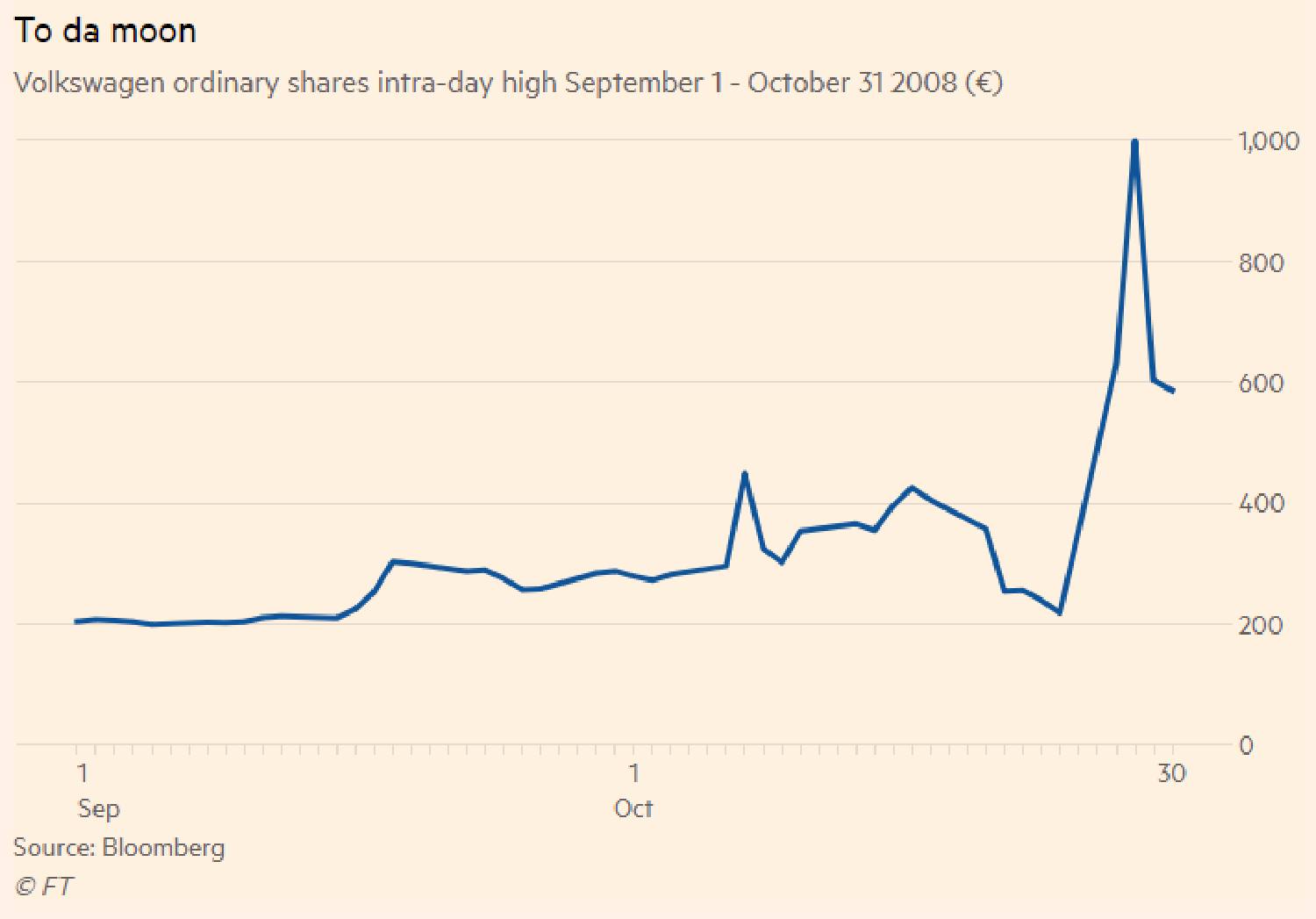
An alternative place to put investments will trigger it. When your options are savings accounts paying 0.25% interest, and treasury notes paying nothing, and CD's being garbage, what are your alternatives for investing? If interest rates were 5%+ on savings/CDS's/Treasury notes then you would see a bunch of money move from stocks to these other safer more stable investments. But the safety/stability doesn't mean shit if the return is near 0.