I wonder how low "cars per person" we will achieve through self-driving Uber/lyft services? Those type of services, if cheap enough, could replace the need for cars for little trips here and there.
But things like commutes are harder to replace. You have everyone trying to drive all at the same time during high traffic. Traffic will only increase as people can nap during commutes because people will commute from further and further away.
You'd have to have a lot of extra cars that only make 2-4 trips a day due to demand.
Plus a large amount of car lifetime is determined by mileage. Fleet maintenance will help, but after 150k miles on average, they'll need to be replaced. If these self driving car services are so cheap, we might increase the car mileage per person. Which means we'll burn through cars at a faster pace than person.
I'm not convinced that the end of personal ownership will be all that bad for car companies. I bet it hurts midmarket luxury the hardest since nobody will buy them.
>Fleet maintenance will help, but after 150k miles on average, they'll need to be replaced.
What most people don't appreciate is that fleet use completely changes the economically optimal strategy for car manufacturing.
If you're selling cars, the dominant strategy is planned obsolescence. The fewer miles the car lasts, the more frequently the car needs to be replaced and the more revenue you make.
If you're selling mobility, the dominant strategy is durability and reliability. The more lifetime miles you can deliver from each car that comes off the line, the more revenue you make.
Tesla's stated goal is a "million mile powertrain."[1] I think their leadership has already anticipated this shift in the economic calculus.
This is really hard for people to understand. Things like long term cost per seat mile etc.
If electrical really is that efficient and maintenance free and cost effective, albeit a heavy investment, they should be employed in buses and taxis first. And long after that, in consumer cars that sit in the parking lot modt of the time.
> electrical really is that efficient [...] albeit a heavy investment, they should be employed in buses and taxis first
Most cities, and whole countries!, already have this! And they had this for a long time. It is just mostly overlooked by "car people" because these are driving on rails or streets with rails, instead of plain steets.
Maybe it is also overlooked because it is named "train", "metro" or "tram" instead of "bus". But a tram is really just like bus: It drives a predefined route multiple time per hour (or per day, or per week). You just need better streets for it (namely: streets with rails). But that's, again, mostly a one-time investment. It means building the energy infrastructure directly into the street.
Rails do have some disadvantages, and not all countries have a good rails infrastructure, especially not within their cities.
But: The one huge advantage is the energy supply - no huge batteries and no charging times. This is why this technology is so old and has alredy worked perfectly decades ago, before modern battery technologies were developed.
In almost every city I've lived in, buses are much more "fine-grained" than trains. It's just too expensive to build rails to the same density as roads.
I wonder if there are any public numbers for maintenance of existing electric busses (e.g. San Francisco's trolley busses) vs traditional busses.
Wikipedia just has an unsourced "Electric motors typically last longer than internal combustion motors, and cause less secondary damage from vibration, so electric buses tend to be very long-lived as compared to motorbuses"
Proterra Catalyst Electric Bus Completes Reliability Test By King County Metro[0] (2016) shows estimated maintenance costs of $0.20/mile, compared to national averages of $0.90/mile for diesel, $1.10/mile for diesel hybrid, and 1.00/mile for CNG.
King County Metro Transit Hybrid Articulated Buses: Interim Evaluation Results[1] (2006) page #24 (PDF page 35/58) shows a table of several individual buses of different types, with mileage, parts cost, and labor hours, summed into cost-per-mile. Diesel had an average cost per mile of $0.48/mile. Hybrid buses kept at one bus base had a cost per mile of $0.47, while Hybrid buses stored at another base had a cost per mile of $0.46.
I'm unsure about the national averages - they seem to be twice the Seattle rate. And KC Metro's electric buses are estimated to have less than half of the maintenance costs of other buses. And the national average for hybrid is higher than diesel, while KC Metro's hybrid buses have slightly lower maintenance costs than their diesel. Unfortunately, I couldn't find numbers on KC Metro's electric trolleys or CNG buses.
By comparison, the 2016 IRS rate for Business Mileage is $0.54/mile. [2]
  Operator Type Average Maintenance Costs Per Mile ($)
  KC Metro Electric 0.20 (2016) (estimated)
  National Diesel   0.90 (2016)
  KC Metro Diesel   0.48 (2006)
  National Hybrid   1.10 (2016)
  KC Metro Hybrid   0.47 (2006)
  National CNG      1.00 (2016)
  IRS Mileage Rate  0.54 (2016) (car)
Self driving cars make existing mass transit more useful. Many offices have a shuttle bus to the subway for free, but they don't run late and cabs are slow to arrive and pricey. Cheep and fast self driving cars in such areas make the occasional cab ride far easier.
>Plus a large amount of car lifetime is determined by mileage.
It depends somewhat on location. Corrosion from salt (put on roads in winter or from ocean air) is probably more proportional to age than mileage.
But I fully agree with this basic point and it often seems to be ignored. To the degree that car lifetime is primarily based on mileage, increased utilization doesn't really buy you an awful lot.
In addition, as you and other suggest, basic economics pretty much dictates that, to the degree going somewhere in a car gets easier/cheaper, you'll get more of it. Many people are willing to trade a longer commute in terms of time for taking a train versus driving themselves today. I don't see why having a "driver" would change this equation.
Mileage is not a major factor with young cars. People have regularly hit 1,000,000 miles and while many components need to be replaced much of the original car can make it that long. Further replacing a full engine costs less than you might think, it's the piecemeal replacement of individual parts that drives up costs.
In any case, something makes cars depreciate over time. Lots of people don't dump their cars just because they're tired of them. And, if you're just driving somewhere like the US Southwest, age probably isn't the issue.
Some of these cabs are lasting 30+ years, though they often use old cop cars which also have high mileage. The limitation is offen accidents not direct mileage.
Cars are definitely more than a commuting device, they are cultural.
Also I think articles like this often forget that while it would be great to not need a car for the morning commute, people in suburbia still need to do many other things like shopping and fetching children etc.
Many of those tasks are just easier or more preferred to be done in personal transport. Sometimes you need to leave some shopping in the car while you go in to sit with the kids at an after school thing, before heading past a friends house to drop off their kids then finally heading home. A self driving fleet could probably still achieve that in multiple trips, but how many people want to deal with continuously pre-planning and concerting a half dozen small trips a day?
I strongly dislike suburbia and car culture does grind my gears in various ways, but I can't help but feel the car-in-an-app is solving the very specific problem of short once off trips, and solving that doesn't even come close to solving the nations transport issues.
I suspect that a lot of people who live in cities, don't own a car, don't use a car much, etc. don't really appreciate the degree to which people customize cars for their needs (roof racks for sporting equipment like canoes, car seats for kids, etc.) and use them for mobile storage. As an exurban person who does a lot of outdoors activities, it's hard for me to imagine not having a personal vehicle. The economics would really have to be compelling and it's hard to imagine they will be especially if the number of miles "driven" go up.
You will have carseat cars, cars with sports racks, larger minivans where you don't need the sports rack and so on. Uber today has a car seat option for example in NYC.
I could see cars that let you just move the stroller in and lock it in with standardized connection types in the wheels, no carseat ritual required, no waking up the baby. I can also see cargo delivery cars that you just drop your shit in and it delivers it securely to your house after you have gone shopping. Or even more likely, you just use an app for that and not even go to the store. Malls turn into showrooms.
All of that is for a self driving future.
What you do today is use something like car rentals when you want to go do outdoor activities. A friend of mine uses uber to go kiteboarding and rents a car with friends when he goes skiing.
There is probably a pretty well-defined density threshold where vehicle pooling makes sense, vs. personally owned vehicles.
In cities, pooled vehicles are a no-brainer. It's probably already faster to have an Uber come get you than it is to park a personally-owned car in the core parts of NYC, SF, or some other megacities. This is only going to get better, including specialty vehicles.
But as you get out into the suburbs and exurbs, it's more challenging to provide an acceptable level of service (max. 5 minutes from call to arrival, or some other pain threshold that causes people to just wish they had their own car). The economics also start to get harder: if I take an Uber (self-driving or otherwise) out to my house in the sticks, it's a lot less likely to get a return fare back into the city; that trip is a lot less profitable than circulation within an area. So it's doubly bad for a self-driving car company: you need a lot more cars/customer to provide the same service level, and you're spending a lot more time "deadheading" with empty vehicles, or charging extra to compensate.
That's not to say that self-driving vehicles won't significantly affect driving and commuting patterns, even in rural areas, but the displacement of personally-owned vehicles is going to be more challenging and may lag urban areas by a very long time.
>Cars are definitely more than a commuting device, they are cultural
I am from a generation (in my 40s) were most of my friends do not like the robot car idea because they love cars and driving. To me that is a very weird thing; I hated driving since I got my licence (well over 20 years ago). It is a nuisance and waste of time and I would never do it again if I did not have to. I find the cars I am supposed to like, like sportscars uncomfortable and beauty of a piece of transportation does not come into the equation. I do not know what it is with that obsession. But most my friends have it nonetheless. Which makes me have plenty of volunteer drivers who love to drive 1000km for fun while I read or work.
I'm the same way. The whole time I'm driving I'm wishing I could be doing something more productive with that time. It's a time suck and way too risky. Also, ubers too expensive.
I live in New York, frequently travel to suburbs around the country and world, and have not missed for a second the driver's license I gave up almost 5 years ago. This might be a generational thing.
I don't understand. Do places like the US national parks have train stations? And do you take an Uber all the way into the wilderness? Are Uber drivers really happy do that? Do you carry a SATCOM system so you can get a data connection to request an Uber to get home again? How long do you have to wait for one to turn up if you are doing a climb three hours drive into the wilderness?
For example look at the 'getting here' page for a random national park, like Zion. It only lists directions for private cars. Presumably if there was any other way of getting there then someone like the National Parks would make it extremely clear how to do that. Are there train stations near Zion? Would you literally take an Uber all the way there from a major city? It would be hundreds of dollars wouldn't it?
If you got an invite to join your friends hiking for a few days in Zion next week, how would you get there?
I think you're going to reply 'well obviously you can't quite do everything and I wouldn't be able to do a climb far from a central visitor centre or join those friends' and bingo, I think the bar for what you can do outdoors without a car to get you there is pretty sad and you'll be missing out rather than living some high life of car freedom.
My car's paid for, sits out of the way in my garage and costs me a week or so's wages a year in maintenance, fuel and insurance. It's an effective tool to get out there in the world and do things with basically zero negative impact on my life.
National parks do have buses. I live in NYC, and have backpacked from one bus stop to another (three days and 25 miles away) through state wilderness in the Catskills. How you get from place to place changes, and it does take a little bit more planning, but it's really not a big deal. I agree, if you're in the mountain west, it's really hard not to have a car and go hiking or camping or biking. But if you're in a well connected area of the country, with lots of buses, trains and boats connecting the relatively close together locales, it's really not that hard to get out without a car. And even in the mountain west, if you have a group of friends you always go out with, you really only need one or two cars amongst all of you (and it may be cheaper to rent when you need it).
Car rentals for those times you really need a car for a few days. Especially given the cost of parking in a city like DC or NYC (unless you want to play the "move your car every other day for street cleaning" game), it's possible to rent a car almost every weekend for the same cost.
You don't miss the freedom of not having to return to the spot where you left your personal vehicle because you never enjoyed it. If you are used to taking public transport you might be massively put off by the idea of being limited to round trips from wherever you left your car.
Theoretically, people could take the best of both worlds by substituting public for rental or personal for public when the other has an advantage, but that rarely happens because people tend to stick to the mode of transport they are most used to.
Personally, I am lucky to be just two days of cycling (or one really long day) from the Alps, and when I do that trip on external power it does not matter wether it is by train or by car, it always feels like cheating.
If my worst case is paying a few hundred dollars for a hired car to get to and from places as remote as Zion, places I don't go more than once or twice a year, I say good riddance to the cost and hassle of owning, maintaining and operating a car. All of this only gets easier when cars drive themselves.
What's what I'd said someone would say. 'replace much'. And I think 'much' would turn out to be a pretty poor standard compared to what you can do with a car. The logistical organisation involved in achieving what you could do would be a huge time and money sink - which is what people who give up cars often say was the benefit in the first place!
You wouldn't get to join your friends hiking in Zion is what would happen in reality.
No, you'd rent a car is what would happen in reality. Same way as the vast majority of people who visit Zion. I went to many remote areas in the western US before I moved from the east coast, and it was often in rental cars (and not once in the personal car I owned, which remained on the east coast.)
This just isn't the obstacle you're making it out to be.
I can totally understand doing this with a rental car, but upthread, the idea of not having a driver's license at all was being put forward in a positive light. So that means no renting a car. Without the ability to drive, you'd have to not just rent a car, but rent a driver as well; that's like an order of magnitude difference in price.
Rental cars are already a great alternative to private car ownership in a great many situations, basically any one where you don't need a car where you live most of the time, and just need one for travel/vacation/etc. purposes.
Speaking for myself as somewhat of an outdoors adventurer: my wife and I still need a car for that stuff, but we don't need two cars anymore, and we don't use the one car we still have very much during the week (which means it will last longer). This represents a smaller, but still tangible, difference in car buying needs.
Lots of types of bicyling require a car. Downhill mountain biking is very exciting and the mountains are absolutely beautiful. It's like skiing, but more dangerous because there's no snow.
I live in a city with Car2Go and this use case is covered by the ability to make stops on a trip. You just pay for the time that the car is reserved to you. I see no reason that a self driving vehicle couldn't offer a similar option.
A lot of people do not by cars in areas where there is affordable and useful public transportation or taxis. I would say most people are buying cars in areas where a cab would be significantly more expensive.
There is currently no viable alternative to cars in the vast majority of the US.
Taxis are usually disgusting too. I won't take a cab because I frequently feel like I need to shower after sitting in one. I rate Uber drivers almost exclusively by their cleanliness, which is usualy very good.
All you save is the driver and some fraction of the accidents, and you gain a lot of sensors that need maintenance. Free transportation would be something indeed, but uber will never be more than a cheap taxi, and "cheap" is just a function of income.
Additionally, taxi service doesn't have to be unreliable, that's more about american car ownership being so high there isn't much market for taxis.
I think the typical SDC taxi will be a two seater. Getting rid of the driver not only saves on wages, but also space, weight, fuel etc.
By "unreliable" I mostly meant the primitive "call your local monopoly, and they may or may not send you a car in 1-30 minutes, so just stand there and wait and worry" system as opposed to the quick and visible Uber/Lyft experience.
I agree that taxi could work like that, I've just gotten used to the thoroughly rotten SF taxi system.
That is certainly the silent promise in any gushing text about self driving cars, time will tell how good the robots drive after the few years of neglect most cars suffer.
> You have everyone trying to drive all at the same time during high traffic. Traffic will only increase as people can nap during commutes because people will commute from further and further away
Perhaps the only way to get Americans to start riding buses is by making it sexy with an app and adding a smartphone/credit card barrier to keep the poor people out.
>But things like commutes are harder to replace. You have everyone trying to drive all at the same time during high traffic.
Replacements for commuting with more people per vehicle include self-driving cars taking people to transit stations, as the article discusses, and computerized ride-sharing in self-driving cars or min-vans. In addition, my understanding is that self-driving cars can drive safely with considerably less spacing between cars, so a given road can carry many more people per hour.
>my understanding is that self-driving cars can drive safely with considerably less spacing between cars
SDC's still need to maintain a safe stopping distance. The problem is really the opposite, human drivers drive too close, causing bunching, traffic jams, and collisions.
>> traffic will only increase as people can nap during commutes because people will commute from further and further away.
Napping or not a two hour commute isn't going to go mainstream anytime soon, even if you don't have to drive. That's four hours a day on the road and you can't just 'nap' through it every day.
Guess we'll need to agree to disagree and see how the situation shakes out, as we run the "in vivo" experiment.
In the area where I live (N. VA), there are already an astonishing (to me, anyway) number of people who drive an hour or more each way to work. 2+ hours a day of just piloting a car down the highway, frequently in heavy traffic. This isn't especially uncommon or anything -- it's not the majority (thankfully, due to all the externalities involved), but it's not rare either. People generally do it because it allows them to buy a significantly bigger/nicer/whatever-er house out in the exurbs than in the inner suburbs, for a given amount of money. I think it's an insane tradeoff, but people are already doing it.
If you didn't have to drive the car, and could basically reconfigure the car's interior to some sort of fully-reclining "pod" like the very high-end cabins of transcontinential airliners... it'd seem a lot less insane. I could imagine dragging myself up at oh-dark-thirty much more easily, if all I was doing was staggering from my bed to a vehicle, where I could pass back out until I was five minutes out from the office.
The afternoon commute would still be rough, because I don't really do naps, but a self-driving car would let you legitimately work from the road; it wouldn't be that hard to stack up a few hours of email, coding, or other non-face-to-face work to do on the way home.
All of a sudden, living in West Virginia and commuting to DC doesn't seem entirely impractical -- and that's probably a nasty problem for transportation infrastructure if a bunch of people all decide to try it in the near future.
Almost all cars right now are empty nearly all day every day. Vehicles that go around picking people up (cabs, buses, ubers, etc) are the ones that actually achieve utilisation of any significant amount. If more cars are shared, people per car goes down, not up.
Also, it's not as if those empty unused private cars disappear when not in use. They take up vast amounts of public and private space in urban and suburban areas.
The "slug lines" of the Washington, D.C. area (places where people can congregate to join other commuters, to use the high-occupancy lanes) give us a useful view into this.
Yes, if you're driving alone, you have to use a single car. But having the car take care of finding others going (effectively) the same place, and picking them up seamlessly, for only a short increase in commuter time (and a corresponding drop in fare), will make these cars do a whole lot more than 2-4 trips a day.
In fact, given how much of a difference in arrival time for the people on my project (anywhere from 6:30 am to noon to 1pm) I think the cars will be able to do quite a few trips.
My pet idea is that you could do dynamic "bus lines" with this.
Have a variety of capacity vehicles, including full sized buses. Have bus stops and have people indicate where they are going, and set preferences (like "willing to accept a change for a discount" to allow better vehicle utilisation), and dynamically adjust the routes accordingly and use minibuses or smaller cars to "backfill" capacity to aim to guarantee that you can be picked up within a certain time.
Having fixed routes and scale up size of vehicles based on actual detailed drivership data would be very interesting.
I know from my own bus usage that having the certainty that there'll be a bus "soon enough" makes a big difference in how often I take the bus vs. when I'll order a car. If I know that if I go to the bus stop I'll get one or the other but guaranteed within a short time, it'd remove most of my need for ordering cars.
Rush hour traffic is due to human drivers making bad decisions. They knee-jerk the brakes just in case, they rubber neck by accidents, they take too long to accelerate, they try to cut other people off from merging, etc etc etc...
Computer drivers could make much better use of the existing bandwidth on freeways. I'm guessing 6X better, since my 15 minutes drive takes 1.5 hours during rush hour.
It could be a long time before we ever have enough automated cars to realize this benefit. But when that days comes, we could safely increase speed limits too (computers generally have better reaction times).
Large minivans/buses should and probably will replace work commutes. In Singapore a few startups have started such services. From looking at Singapore government's plans they are trying to bring all places to 15-20 min walk to mrt and then have automated vehicles pick and drop people from designated places to and from the mrt stations. As they are a small country and have made car use and parking expensive they will get a lot of traction for automated services.
This makes sense for big cities, but that vast territory in between, where Trump got the majority of his support, that territory where you see lots of trucks and SUVs, and people drive miles to Walmart or the grocery store or baseball practice - they're going to still want their own vehicle.
Need, not just want. For the residents of most of the surface area of America, you cannot survive without owning your own vehicle. Stores can be 10 to 50 to 100 miles away from your home, there are no buses or taxis or Uber, you can sometimes get a ride from a friend or neighbor but only if they're also planning to go to town, and if you each go to town together you're usually stuck there all day and then have to each wait long times for the other person to do what they need to do, because you're each shopping for the next 2 – 3 weeks before you go to town again.
Agreed, I have the feeling that most people think San Francisco or New York when they think "city"... the problem is that Phoenix exists (all 517 square miles). There are many, many medium sized (1 million ppl +) cities that are conglomerations of suburbs, with very little "urban" interface like Phoenix dotting the western portion of the US.
And there are plenty of people who do not and have no desire to live in a city at all, and that isn't going to change. Many people retire to rural areas, or live in smaller cities/towns. It's a deliberate lifestyle choice for many, and these people are perfectly happy to own a vehicle of their own and use it and it's not a problem that needs solving for them. So when urban technologists come in and say they're going to "solve" the problem of car ownership and turn it into a service, such people respond somewhere between mockery and outrage at the ignorance of such people thinking their ultra-urban environment is the only acceptable way of life.
Do you guys hang out in the makeup department and talk about your disineterest in lipstick? Why is every thread on this subject loaded with peanut gallery comments from people who aren't interested in autonomous cars. If you don't like them don't use them. They still stand to address the needs of 10s of millions of commuters in America, and far more worldwide. It's a huge addressable market.
I think it's not disinterest, but more of a reality check. While we all agree that self-driving cars will be a game changer, some of us think that it can be easily blown out of proportions.
"The needs of 10s of millions of commuters in America" could have been addressed with public transport years ago. The fact that they weren't should tell us that there's more to it than whether someone drives the car or not.
Basically this, combined with the fact that people who dislike public transit for cultural reasons (see also: hate the poor) point to SDC's as a panacea for all our transportation problems.
There was literally a post in one of these threads saying we should "screen" people so undesirables couldn't use public transit so it would be more attractive to yuppy scumbags.
I think this will change. Those small towns don't look so hot right now, and young people are leaving for the closest city because that's where the jobs are. The 'burbs will be fine but things don't look good for "small town America", a lot of towns could decay and disappear. Just because it's a deliberate lifestyle choice doesn't mean it's a sustainable one. Just look at the quality of housing stock, infrastructure, basic services like drinking water and jobs (or lack thereof) in these places, it's not a pretty picture.
Car ownership is a problem for some (many) people. If someone responds with mockery at the idea of self-driving cars only because it's not a problem for him, he's the one being ignorant.
No one is mocking the idea that there is a place for self driving cars, whether privately owned or pooled for collective use, just that this is going to completely replace private ownerships for everyone.
As a rural resident who does most driving on rough, dirt roads and roads without lane markings, I think it would be cool to eventually have a car that could self-drive, but I don't expect them to work for me anytime soon. Electric cars, similarly, aren't practical for rural usage—there is nothing comparable to the ease of throwing a few more cans of gas into the back to extend your range when driving long distance in a remote area with no fuel/power. As batteries and range keep getting better, they become more useful for some rural users, but still not so much for long distance backcountry travel.
Furthermore, people who choose to live in rural areas end up needing to be more self-sufficient mechanically as well, able to repair vehicles themselves. Electric and self-driving vehicles are and will continue to become decreasingly user-serviceable. That alone is a big reason for me to hesitate in ever wanting one. The world is moving away from repairability, and for people who need to be able to fix things ourselves, or who believe that it's the right thing to do, that forces us to avoid adoption of certain newer technologies. But now I'm getting into a whole new subject.
The best case I see, is the modern day equivalent of the horse that could get you home when you were otherwise too drunk to do so yourself. The worst case I see, is that this technology could be imposed on all of us, whether is works, is useful, is needed/wanted or not.
I couldn't begin to answer that, but I do and just about everyone I know does. Outside of the few major cities in the southwest, many people do. There are occasional small general stores scattered around, but if you want to actually go grocery shopping or hardware shopping, etc., you take a 50 to several hundred mile trip to various larger cities.
Couldn't you argue that self-driving cars are more appropriate to more sprawling areas versus other types of public transportation? Buses, trains, subways, light rail etc all seem inefficient for urban sprawl, but self-driving cars require no complicated infrastructure and let you get point-to-point just as fast as today.
There are two issues that I think get talked about together, whenever the idea of self-driving cars comes up: self-driving cars themselves, and then self-driving cars as part of an Uber-like pooled vehicle business model.
I think that self driving cars as a technology are definitely on the horizon, and if they don't hit any major roadblocks (literally or figuratively...), some level of self-driving capabilities might become mandatory in the next couple of decades. It makes driving on freeways much safer, and also allows for types of interchanges that aren't possible with human drivers.
But the argument you sometimes hear tossed around, that self-driving cars will lead to Uber-like services displacing all or nearly all private car ownership... that strikes me as much more speculative. There are cultural-psychological aspects to car ownership, and I'm not convinced that the value proposition could be made sufficiently strong to cause people to not want to own their own car, while still creating a viable business for the pooling company, in a suburban or exurban (to say nothing of truly rural) area.
Owning a car in a dense city is a pain in the ass and a huge expense; owning a car in a rural area is basically a necessity to live as an independent adult. It'll be a lot harder to get people in that second group to switch to vehicle pooling than the people who probably detest having a car in the first place for all the expense and inconvenience it causes.
Owning your own self-driving car would make sense there.
But in rural areas, you'd have to wait too long for a centralized service's car to show up because of lack of economy of scale, and the larger distances it'd have to service. In theory, you could schedule them well ahead of time to arrive when needed, but that's far less convenient and the scale & distance will still significantly affect the price.
Yeah, owning personal transportation isn't going anywhere for a LONG time except, largely, in certain growing circles in less than a handful of US Urban centers.
For everyone else self-driving will just another trickle-down feature their cars get; like electronic stability control. When the Ford Fiesta has had self-driving features for 3 years(so I can pick it up used) that's when I'll have it. And that's probably about when it will start seeing widespread adoption; when it's available standard in lower-end cars and used lower-end cars.
Carmakers have to adjust and prepare for a reality in which mobility is treated as a service and cars are losing their traditional function as a (middle class) status symbol.
I think that self-driving cars may actually increase traffic and our dependency on cars. Just think about it:
- If you don't have to drive yourself but can instead use the time to sleep, watch a movie, study or shitpost on the Internet, a 1.5 hour commute to work isn't that bad anymore.
- Since the labor cost for operating a self-driving car is probably really low (we'll still need mechanics for maintenance and such) and streets are heavily subsidized by the government, self-driving cars are cheap and could be a competitor to traditional public transport services.
- There isn't a reason why kids, who now have to use a bike, a scooter or the bus until they are allowed to drive a car shouldn't be able to order a self-driving taxi; thus, they get used to being shuttled around all the time from a young age.
Many people have hour+ long commutes during which they can shitpost on the internet. It's still really fucking boring and a massive waste of your day.
Also, congestion still affects people in a self driving future. A complete abandonment of public transit in major cities would lead to much larger increases in commute times than you seem to think.
> I think that self-driving cars may actually increase traffic and our dependency on cars.
Exactly. Remember how computers were supposed to give us paperless offices? They're automated paper-wasters and likely increased paper consumption in offices incredibly during the 90s and 00s. I've not been in corporatastic environments for a while, so I can't comment on the 10s.
>I think that self-driving cars may actually increase traffic
Your assumption is that cars will stay the same form and shape after they become self-driving, which is myopic. Without needing all of the safety protection cars or three spare seats, cars can be far smaller and you can easily envision a sitution when we get a x4 increase in traffic density, meaning traffic won't be an issue.
This headline really overstates it. Anywhere outside of a major metropolitan center you are gonna be hard pressed to deal with day to day things like getting groceries without a car. The nearest grocery store to my house is about 5 miles. I can bike it but that really limits how much stuff I can get.
Similarly if you're a family with pets, particularly big dogs like mine, I can't take them anywhere without a car.
There is no public transportation of any kind that comes to my neighborhood.
So while yes, more and more people in cities may be abandoning cars because they have gotten more and more expensive over the last decade, there is no near future where America as a whole is able to live day to day without a car.
Exactly. I lived outside of the US for fours years and never needed a car. Even though I moved back to a city with public transport, and a single regularly rail line, it pales in comparison to the type of transport available is much of the developed world.
Self-driving cars are a terrible solution. They will ONLY solve the last-mile problem, but not the missing American infrastructure. Russia is larger, less dense and has better public rail infrastructure in terms of both commuter rail within cities and inter-city rail including high speed expansion. The US only has the California high speed system currently being constructed. Nothing else.
I've written about the self-driving car problem before:
I disagree, I think self-driving cars will help motivate American cities to improve public transportation. The easier it is to get to from home to the transit station and from the transit station to work, the more people will use public transportation. Ditto for cross-country rail.
Our entire system is kinda broken with how roads/parking are relative to size. So it's not an easy problem to fix overnight. With an our established and spread out infrastructure. But self driving cars will eventually lead to smaller pods or smaller vehicles. Potentially fewer lanes or even allowing non standard road shapes and straightaway and fewer parking lots. I think autonomous vehicles is a stepping stone to a better infrastructure and community
The problem is definitely political, but I don't think it's a corporate conspiracy. Americans just don't like paying taxes, and aren't willing to pay taxes at the rates that would make Euro-style public transportation (with a mix of buses, trams, commuter rail, intercity trains, etc.) viable. Even in the cities that have marginally-decent public transportation systems, they're chronically underfunded.
You could probably build a hell of a public transportation network if people were willing to pay what they currently spend on average on automobile-related expenses (or even a substantial fraction of it) towards a shared network, but people have been making that argument to the American public for the better part of a century now and it's not gained a lot of traction.
I'm not sure that self driving vehicles really change the underlying political calculus that makes Americans unwilling to pay for that sort of public infrastructure. But they could still be an improvement, in safety and resource consumption, vs the current status quo.
I agree and I don't think it's a conspiracy any more than I would any other powerful lobbying group. Autonomous vehicles, in my opinion, have the potential, if not high probability to make things worse. Instead of increasing population density in areas like the Great Lakes region, it'll make it easier to commute and build expensive, no poor people allowed, suburban enclaves filled with chain restaurants and a replica of an uptown or downtown where people can pretend they live in a city.
Even when State or local governments have funds available, they opt not to build out other options. I think the USDOT offered many billions to states like Ohio to build out rail connections, but they didn't want the funds. To add to that, the states and local governments know about things like induced demand, but they just keep building out these giant highways any way. They could have taken the funds and poured it into public transportation. There isn't much politics cost to it. Traffic is always bad, and people are going to be angry before, during and even after construction because it never solves the traffic problem.
It makes me so sad and drives me crazy that we're doing this to ourselves.
Airlines solve the intercity transportation problem just fine. The only advantages rail could have are lower cost and the absence of the TSA. We're one train bombing away from the same screening system, and the cost is not lower (and if you value your time, it's much higher).
Compare the places you have lived to Texas, Arizona, Utah, and all of California in terms of population density and square miles/kilometers. The rest of the world are generally "fucking tiny" in comparison.
I don't mean to side-track a very valid point that you are making, but stepping back a little, isn't it amusing that humanity has reached such an advanced state where a strong argument for owning cars is to ship dogs around?
Also, only slightly related, but as someone not owning pets I always find it amusing (again, for lack of better word) to see people in the act of picking up dog-poop (I'm well-aware of the worse immediate alternative of leaving it on the ground). Still, isn't there some irony hidden in these small gestures, given mankind's (otherwise) complete domination of nature? etc. etc. etc.
I don't mean to side-track a very valid point that you are making, but stepping back a little, isn't it amusing that humanity has reached such an advanced state where a strong argument for owning cars is to ship dogs around?
And double basses, my situation. I commute to work, and could do most of my shopping, by bike. But playing music requires a car, for myself, and to schlep the kids to their music activities.
Still, I could see moving to a situation where I make much less use of a car. Maybe there's a way to request an Uber that's big enough for my instrument, and to pay a little extra for that. There are double bassists in NYC who get around by subway. And since most of my playing is local, I could get away with having an electric car with relatively low speed and range.
> Maybe there's a way to request an Uber that's big enough for my instrument, and to pay a little extra for that.
There is. UberXL in most cities with Uber.
This has generally also been true with taxis. There are usually van taxis you can request, but there are fewer so they take even longer to come than the cars.
The article isn't discussing abandoning of cars because they've gotten more expensive, it's discussing it in the context of public transportation and "last mile logistics" being on everyone's mind now not just the local governments.
In fact, the article explicitly mentions people who do have the luxury of being able to take public transport using cars on the weekends for grocery shopping, just like you mention. And it mentions that in many many parts of America solving the last mile problem isn't anything since people are driving a lot more than a mile.
In Germany this is picking up really quickly, you pay 4€ more and have everything delivered to your home in a time window that can be as narrow as two hours (when the service is well frequented). The app doubles as your grocery list, and at some point you just send it off. Great customer retention too ;-)
I'm in the UK. One of the companies here (Ocado) will automatically populate your shopping list for you based on your shopping history the day after each delivery, so you have about a week to adjust it. We often don't even bother checking the weekly shopping list any more, as it's generally "close enough" that if we're busy we'll just accept whatever they deliver. Just need the fridge to tell them what we still have enough of :)
Plenty of families don't actually need N cars. They can probably get by with N-1 and summon another when needed.
Also, one car can do multiple errands without a driver, eg drop someone off at work, drop the kids off at school, and then go stage somewhere until needed.
In Europe entire families usually share just one car. Some cities like Jena, Germany (<100k) have 4 tram lines and three inter-city rail stations (1 that serves a high speed ICE train). That famous city from the song, Chattanooga, no longer has a (functional) passenger rail station at all.
>In Europe entire families usually share just one car.
Yet, in the case of France, the number of cars per household keeps rising; the share of households owning 2 cars, owning 3 cars, keep rising as well; in spite of the decrease of the size of households (the number of people per household).
To add insult to injury, car owners have become so lazy that don't bother parking their cars in their garage or their yard. Nope, that's out of fashion, now they park them on the public space: streets, roadsides, side-walks, etc. It's like witnessing an invasion, it spreads everywhere.
For now. Where I live, and in some other cities I've visited in the Great Lakes Region (like Pittsburgh or Cleveland), people are increasingly moving back to the downtown areas. For now it's primarily young people, but the difference is that it's a lot of young people, and the jobs and shops are following. Now this is not a dramatic change, but it is a change. I think it has the potential to turn into an increasing amount of people moving into the urban cores of cities that were previously car-only.
>This headline really overstates it. Anywhere outside of a major metropolitan center you are gonna be hard pressed to deal with day to day things like getting groceries without a car. The nearest grocery store to my house is about 5 miles. I can bike it but that really limits how much stuff I can get.
Self driving cars don't limit "how much stuff you can get", and you only need a few for a neighborhood of say 10 houses...
At least for grocery-shopping I find that a children's bike trailer can pack a surprisingly large amount of stuff -- of course it is not quite as convenient as a car.
I take my dog in Ubers. I call in advance to ask if it's okay; I also give a cash tip for it. Only one driver seemed ambivalent when I asked and seemed thankful when I said I would cancel and rebook.
I know it is a pipe-dream, but it'd be nice if all the data these cars gathered got loaded into a central database. That way they all could improve faster and it would increase the ability for competition. I feel right now how we're doing it you'll get a certain brand that is definitely safer than another, which could easily cause a feedback loop.
If that's implemented by way of some sort of public agency which obtains, analyzes, and releases sanitized versions of the data collected by self-driving cars for the benefit of the public... then sure, that sounds like something we ought to do.
But I would probably not phrase that as asking for a "central database" as though it's being fed by the cars themselves. That sort of centralization is... architecturally suspect, for a lot of reasons.
I am not shure. As a european I see the cost of public transport only rising and at the same time I am giving up lots of flexibility. I see the option to buy a cheap self driving for arround 10'000$ as very appealing. Public transport is a tradeoff between cost, flexibility, time losing/saving and freedom. A self driving car can give lots of flexibility which public transport never can and will give. It's where I see the future of owning a self driving car. Also I do not see lots of chances for makers of self driving cars to differentiate between each other except the interour. About what else should I care?
Did you read the article? Americans are over owning a car, not mobility in general (the simple problem of when cars drive themselves you probably don't need one full time).
Decades ago when I was in Indiana, which liked and still likes cars, I knew some people from NYC, and they hated cars, any and all cars. Ever since then, NYC has had a lot hatred for cars. NYC just doesn't like cars. And, no surprise, now the NYT from NYC doesn't like cars.
I've lived in Tennessee, Indiana, Maryland, and upstate NYS, and all those places like cars, and those places have liked cars for all the decades NYC hated cars.
So, the OP is from the NYT in NYC and is about hating cars. So, from the decades of history, I'm not surprised or impressed.
E.g., I have a car in my garage. I own it 100%. It costs me $500 or so a year in auto insurance. Since I drive it about 5000 miles a year, there is nearly no cost for maintenance and the insurance costs me, what, about 10 cents a mile. The gasoline costs me about 17 cents a mile. So, all things considered, we're looking at ballpark 30 cents a mile.
And the NYT wants me to replace my car with what? No thanks.
Yes, it's easy for NYC and its NYT to believe that they have the right answers for everything for everyone on the two coasts and everywhere between. Alas, mostly NYC and the NYT are in an echo chamber and at odds with nearly everyone else in the US except for parts of a few of the largest cities and some of the West Coast.
Long ago I concluded that quite broadly NYC and the NYT are out of step with nearly all the rest of the US. So, the NYT doesn't like cars -- I didn't expect anything else and am not influenced at all.
Of course, there is the old screaming that humans are evil, sinners, that humans are doing terrible transgressions against kittens, puppies, flowers, the grass, the air, the water, the land, the oceans, the great natural order, etc. and that these transgressions are leading quickly to terrible retributions. Then, the claim goes that if we act quickly, we can achieve redemption. Of course, the redemption will require sacrifice. It's a trilogy -- transgression, retribution, redemption. And we can add on sacrifice. I'm not nearly the first person to think of such things! So, we hear from the NYT that cars show that humans are evil, sinful transgressors .... Gee, not nearly new.
I'm having a tough time finding what the NYT is good for. Apparently so are many others since, IIRC, now the NYT is planning to shrink its staff, vacate several floors of its main building, and lease the space to others. The NYT used to have some utility: It was printed on paper which was good for starting fires, wrapping dead fish heads, and in the outhouse out back.
Whatever side one was on in the election, everyone can see that the NYT was strongly on the side that lost. Since I put new batteries in my loser detector, it has been making loud noises in response to any mention of the NYT!
To me, the NYT fills a much needed gap in journalism and would be illuminating if ignited and still printed on paper. I continue to pay attention to the NYT occasionally, first, to remind myself of how much I miss good journalism and, second, to have details to argue that the NYT should just go out of business.
>"So, the OP is from the NYT in NYC and is about hating cars. So, from the decades of history, I'm not surprised or impressed."
Except the article is using Los Angeles as an example and the train picture and two of the women they spoke to in the article were Angelinos. This is is significant because Los Angeles has traditionally been an epicenter of "car culture."
Also since you seem to be implying an editorial bias against cars I will add that NYTimes has a regular automotive section of their paper, where they cover the industry and do new car reviews and quite decently at that. This article is from that automotive section.
Again, the OP NYT article saying that people will be buying fewer cars is because the NYT hates cars, cars not just in NYC but also cars in, in this case, LA. The NYT and much of NYC believe that cars and gasoline are sinful and evil.
Did you read the article? I say that because it wasn't about New Yorkers hating cars, it was about auto manufacturers deciding that Americans are going to be buying a lot fewer cars in the future, and then gave Los Angeles as an example of why.
If you are so much smarter than the auto manufacturers are on this matter, perhaps you should become a consultant to them and earn big bucks explaining how they are going wrong.
> Did you read the article? I say that because it wasn't about New Yorkers hating cars, it was about auto manufacturers deciding that Americans are going to be buying a lot fewer cars in the future, and then gave Los Angeles as an example of why.
I saw the part about buying fewer cars, etc. But flying over NYC and the NYT at 20,000 feet and also from decades of history I concluded that the NYT was eager to draw their conclusion about "fewer cars," in LA, Boston, NYC, because -- right -- the NYT hates cars and likes to fabricate silly stories to grab eyeballs.
I did not address the idea that people will be buying fewer cars because that seems to me to be beyond absurd, in NYC, Boston, and especially LA, although for different reasons especially between NYC and LA.
Indeed, IMHO, a significant fraction of the cars being sold now will get dumped relatively soon -- causing people to buy more cars instead of fewer -- because of the long list of electronic this and that that will fail and need maintenance -- before the shocks, suspension bushings, engine, transmission, brakes, and corrosion problems -- but where owners will discover that in the car industry good maintenance on such electronics is difficult to find and expensive. Heck, one car repair guy thought that connecting my radio antenna might give him an electric shock! E.g., one bright guy I know with experience just flatly states "Never own a BMW out of warranty."
For car manufacturers looking into self driving cars, all electric cars, super small cars (pregnant roller skates), cars with solar panels on the roof, hydrogen powered cars, cars that burn corn stalks, cars with pedals for driving up hill, etc., sure, they have to stay informed. Maybe, maybe, maybe, against nearly all common sense, the NYT, etc. will talk enough people with enough money into buying goofy, far out cars, and in that case the car manufacturers want to be in position to sell such cars. No way can I believe that the big collection of goofy cars will become significant.
Uh, I'm a car nut, e.g., once was made a Full Member of the SAE. To me, finding anything at all realistic about cars in the NYT is like looking for Levi's 501 blue jeans on the runway of a NYC fashion show!
Or, the NYT is having fun saying that the
cars they hate are on the way out. Wrong. The NYT is on the way out.
Cars also still rust out in those midwestern states, that will be a huge driver. It's unlikely the installed base will shrink, or people will not replace the cars they have.
I don't however think the NYT is on the way out, but like any news source, it can be a bit myopic at times.
Gasoline should be cheap; there are several cheap sources; and over the next four years gasoline stands to become significantly cheaper.
A car needs a quite significant supply of energy, and gasoline works great -- for a car, a 15 gallon tank of gasoline is tough to beat. The piston engines and automatic transmissions powered by gasoline have long since been highly refined and are tough to beat.
But much of NYC and essentially all of the NYT strongly hate cars and gasoline. Tennessee, Indiana, Maryland, Upstate NY, Ohio, ..., Montana, Idaho, the Dakotas, etc. very much like both gasoline and cars that burn gasoline.
If you had said that the general point of view of its editorial board was that the car-using populace should pay more for what they consume, then I'd say, sure. Because there are no cheap sources of gasoline. Or any other petroleum product. You just don't, currently, have to pay full-freight for what you consume. Nor must you consider the externalities of the use of what you consume. And while you'd be partisan about it, that at least would be a complaint reflective of some kind of reality--
--but that wouldn't be nearly the axe you're grinding so desperately here.
> Because there are no cheap sources of gasoline. Or any other petroleum product.
Gee, IIRC a fracking driller in TX recently said that he could get the crude oil out for ballpark $3 a barrel. Sounds "cheap" to me! Maybe we could get the retail price of gasoline down to $1 a gallon!
For the "externalities", I'm not seeing anything very significant there.
I'll make a wild guess: The externality being considered is global warming caused by human sources of CO2, e.g., burning gasoline. Well, three points:
(1) There are claims that the concentration of CO2 over the past two decades or so is relatively high. However, from the more credible measurements, the global temperature has not gone up significantly in those two decades.
Or, is temperature relatively high now? Well, apparently in 2006 the temperature was essentially the same as in year 1000, and the increases in the 100 years before 2006 and the 100 years before 1000 were essentially the same. So, the current temperature and the rate of increase over the previous 100 years happened before back near year 1000 and are not unique now. Details are in
Committee on Surface Temperature Reconstructions for the
Last 2,000 Years, National Research Council,
Surface Temperature Reconstructions for the Last
2,000 Years,
ISBN 0-309-66264-8, 196 pages, National Academies Press,
2006.
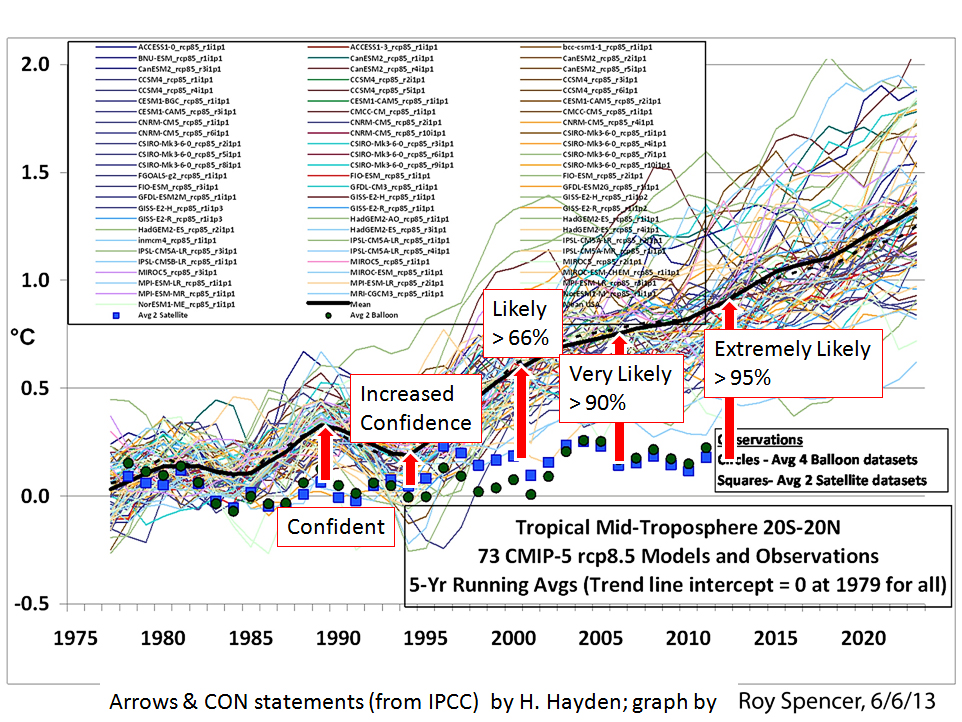
(2) There were some dozens of computer model calculations that took CO2 concentrations and predicted significant global warming by now. The predicted temperatures and the carefully measured real values are summarized in
The measured values showed essentially no change. Nearly all the predicted values showed significantly higher temperatures and were significantly wrong.
(3) We can go back ballpark 800,000 in the history of global temperatures and CO2 concentration and find some really significant changes in temperature but fail to find even one significant example when CO2 concentration went up and then temperature went up or when CO2 concentration went down and temperature went down. The main examples of CO2 concentration changes are when temperature went up (from some cause, not a change in CO2 concentration) and CO2 concentration went up 800 years later where the guess is that the higher temperatures caused more biological activity that caused higher concentrations of CO2.
Is CO2 a greenhouse gas? Sure it is: CO2 absorbs in three narrow bands out in the infrared, one band for each of bending, twisting, and stretching of the molecule. So, more CO2 will warm the planet. So will lighting a match. The issue is how much warming. So far, from both the models (2) and the historical record (1) and (3), it appears that the warming effect of realistic concentrations of CO2 in the atmosphere is from trivial down to too small to measure.
What about clean air? I live 70 miles north of Wall Street, and the air seems fine to me.
As I outlined, NYC quite broadly was hating cars decades ago, well before there was much talk about externalities.
Again, once again, over again, yet again, one more time, the NYT hates cars and, thus, is liked by a lot of people in NYC who hate cars.
Again, ..., one more time, when I see an article from the NYT that is against cars, I have to conclude (my version of artificial intelligence!) that the reason is just that the NYT hates cars, even if the cars are in LA.
No reason to make the OP complicated: Instead the NYT hates cars; has for decades; likely will as long as the NYT continues to exist. That the NYT hates cars is something "a blind man could see in a minute". If add enough other stuff to the argument, then can have a difficult time seeing the obvious -- the NYT hates cars.
> What about clean air? I live 70 miles north of Wall Street, and the air seems fine to me.
Had we not regulated emissions and created one of the west's most extensive public transportation networks to serve the 8.4 million people in NYC you might not be saying that.
I understand your point, that you need a car to live in most of America. But you need to understand how different life in a real, dense city compares. If everyone drove - if we made space for everyone to drive and park - you would radically alter the culture of the city, and you'd significantly reduce its capacity to house so many people and businesses. Density creates opportunities for cultural exchange, cities are efficient human/economy-amplification systems. NYT rightfully hates cars, there is simply no space for cars in NYC and people are so close together they feel the pressure car infrastructure exerts on the city.
My argument is that we'd have more spaces like these if we didn't subsidize the construction of places where you need cars to live. I'm presently teleworking in Northwest Indiana, and thought it would be easy for me to wait for my car to get fixed in the Starbucks kitty-corner from the repair shop. I didn't heed when the shop owner said, "you take your life into your own hands," when I told him my plan. I nearly got hit walking across the street - the only way out of this place - in broad daylight.
We have an obesity epidemic and our communities are dissolving. Just look at what was trending on HN 4 days ago. [1] More suburbs, strip malls and parking lots are certainly not part of the solution.
NWI is hardly rural. It could densify if the incentives were there. We shouldn't keep subsidizing the expansion of suburban infrastructure by keeping gas artificially cheap.
Sure, NWI includes Gary, long important for steel. I got married in Indiana, and our dinner that night was in South Bend on our way to Chicago. South Bend didn't look very big, and near South Bend looked quite rural.
The wedding was 15 miles south of Warsaw; it wasn't very big, and the surrounding area was farm country. The wedding was in Claypool, and her family was from a farm on the east side of County Farm Road a little south of the railroad tracks E-W about the latitude of Claypool.
Her father was a really good guy, had been a Captain in WWII, did well in farming, built the house and the farm buildings, mixed his own animal feed, was on the bank BoD, was active in Lions, was on the school board, eventually ran the local REMC, etc.
She was a fantastic student, high school Valedictorian, PBK, "Highest Distinction", Woodrow Wilson, NSF at IU, Ph.D. at Johns Hopkins.
I also spent five years in Ohio, at OSU, in Columbus. From all I can see, Ohio, Indiana, ..., are heavily rural and very much want and need cars. There the pollution from cars is of little concern.
> he could get the crude oil out for ballpark $3 a barrel
Regarding this point, yes. There are many privately owned wells that could extract oil cheaply - if they wanted to! [Thank goodness] that's not the kind of system we live in though, and these well owners try to time their extraction to take advantage of highs in the price of oil on the global market. This podcast [0] follows oil from ground to gas, and it was enlightening to see the well operators' thought process.
In addition to low taxes, the petroleum industry in the United States is perhaps the most heavily subsidized industry (on both a state and federal level) in the country. (Top three, for sure.) At the same time, neither the petroleum industry nor the people driving gas-burners are asked to account for the pollution caused by said gas-burning. The unpaid-for externalities related to cars and gas-powered transit cannot be blurfed away by insisting that the New York Times "hates" cars.
(And that's not getting into the economic questions about the places that are made livable because of the profusion of cars--he namedrops places like Tennessee and Idaho and blah blah blah, but the overwhelming majority of those places are money sinks rather than money sources. As a happy liberal, I'm not against subsidizing economically inefficient lifestyles to some degree--but when they're built inescapably on farting out greenhouse gases at a high rate, I think there's a reason to have a discussion about the policies that encourage them.)
It is a many-faceted problem, but the facets being most steadily ignored are the ones that make the pro-car argument pretty weak.
Most of those oil companies are huge multi-nationals, wouldn't that (admittedly evil) subsidy benefit the whole world?
Roughly 30-40% (depending on which source of numbers you look at) of greenhouse gas emissions are from base load power generation - which is something we can mitigate far more easily than the transportation sector. I believe strongly in building more walkable cities, but I don't want to hang the whole of the greenhouse gas problem on the car.
How would subsidizing multi-nationals benefit the whole world ? Corporate welfare benefits the corporation and that's it. If you wanted "the world" to benefit then help the world. I've always found the argument that helping corporations ultimately benefits some other nebulous beneficiary somewhat vacuous.
I believe cargo ships followed by airplanes are the biggest net emitters in the transport sector. Office building are the biggest consumers of non-industrial base-load. So pushing fat broadband pipes to the home could potentially reduce the need for both office buildings and daily commutes.
Yes, city density should vastly increase. I would like to see the vast sprawling urban deathscape replaced by massive tower cities surrounded by mostly native parklands, interconnected by underground trains and fat broadband pipes. Should you need to leave your comfy digs you ride the elevator or the train.
Air and water in my neighborhood are more polluted[0][1] thanks to byproducts of the petroleum storage and refining industries finding amenable (read: desperate and politically and economically disempowered) conditions here. This is the cost I pay that you aren't paying.
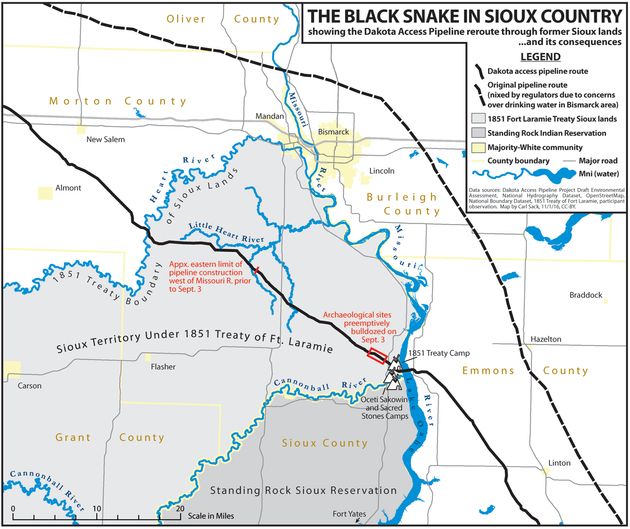
The native people of Standing Rock are fighting to prevent contamination of their water supply, a risk that was unpalatable to the people of Bismarck. The predominantly white city was able to force the rerouting of the Dakota Access Pipeline. [2] They are fighting to not be forced to pay the cost that you aren't paying.
Not only is the oil industry tax-subsidized, they are also granted use of eminent domain-seized lands and have their interests protected by militarized police forces from across the country. [3]
I spent my formative years in the Los Angeles Area - please don't presume I didn't pay for it - I did. I'm very aware of the solution and byproducts of refining - while its much cleaner than it ever was - its still not clean.
I read the story about NW Indiana, South Chicago, and Lake Michigan.
The Great Lakes were long a dumping ground for whatever, and for decades now there have been efforts to quit the dumping and clean up the place.
A lot of progress has been made: E.g., some people I know who live on Lake Erie and do a lot of boating say that the lake used to be just filthy, put scum on boats, etc., but now is much cleaner.
Yes, apparently for some reason it was common to dump PCBs in rivers. Then the mud at the bottoms of the rivers got the PCBs; even when the dumping stopped, the PCBs kept leaching out and causing trouble, say, for wildlife and using the river for drinking water. This was the story in the Hudson River. IIRC, the clean up effort has been extensive and somewhat successful but very expensive and long lasting.
The story about NW Indiana and South Chicago has residential homes in the shadows of oil refineries, electric generating plants, steel mills, etc. Those homes should have been bought out long ago.
Apparently now we know how to make such industrial plants clean enough, and maybe we are.
On the externalities, it appears that mostly the pollution is left over from the past, decades ago, clean up efforts have been going on for decades, and maybe now new industries have to be clean enough. In this case, the pollution externalities are from the past, not the present.
For CO2 and global warming, I responded to that in another post on this OP -- net, I'm not concerned.
For the "subsidies", so far I have yet to see a clear, credible description of those.
But apparently it is common for a plant, essentially anything that can generate employment, to get various subsidies, tax breaks, help with worker training, etc. E.g., it was just announced that Toshiba and SolarCity will be taking over some old factories in Buffalo, NY and building solar panels or whatever. Well, NYS and Cuomo gave them some financial help.
Apparently such financial help is common -- the local communities and the states want the jobs and associated tax revenue from the employees, the increased economic activity, etc. and regard the financial help as worthwhile. I suspect that if the businesses are successful, NYS will get the money back plus a lot more.
IIRC, the regulations now on coal fired electric generating plants are so severe that really can't start a new plant and, for an old one, about have to shut it down. As I explained above in this thread, I'm not at all concerned about the CO2 from burning coal, but other stuff that might come out the smoke stack should be of concern -- radioactivity (right, from coal, really much more than is coming from nuke plants), heavy metals (mercury?), sulfur (causing acid rain?), maybe some concerns over some oxides of nitrogen, black smoke from carbon soot, etc.? But my understanding is that long ago there were good cleanup techniques and efforts for such stuff from burning coal -- stack gas scrubbers or some such.
It looks like now Obama, his EPA, etc. are using CO2 as an excuse to go after coal in an effort just to shut down coal; to me, that is foolish. We need to use coal, if only for making steel. If we can generate cheap electric power from coal safely without harmful pollution, then to me we should. Apparently Buffett believes that the US will continue to burn coal to generate electric power because recently he bought Burlington Northern Railroad which carries a lot of coal to electric power plants.
But, I'd like to see lots more electric power from nuclear fission -- uranium, plutonium, thorium, whatever -- and nuclear fusion when and if we can make that work.
I'm sorry about what happened over the past 100+ years to many of the major US rivers -- Mississippi, Ohio, Hudson, Calumet, Cuyahoga (right, the one that had a spill that actually caught fire) -- along with Chesapeake Bay, Gulf of Mexico, maybe San Francisco bay, maybe Long Island Sound, etc.
Easily, our most dense central cities won't like lots of private cars. Okay.
Easily our rural and suburban areas and smaller cities will like lots of private cars and will buy more of them as soon as they have the money -- one car for Dad to commute to the office; one car for Mom to move the kids, laundry, groceries, take the family to the beach, etc.; one car for Junior as he turns 18 or so; another car for Sis, etc. If Junior has a 10 year old used car, okay, but he'd have a new Corvette if he could afford it. Outside of the dense cities, people need/like cars.
Yes, we need to clean up the messes of the past, and I suspect that in total a lot of money is being spent to do that and significant progress is being made.
But I also suspect that now we can burn gasoline in cars, burn coal and natural gas, etc. safely and cleanly enough.
With the cleanup done from pollution from 50+ years ago, we will be able to can catch and eat fish and shell fish in the Great Lakes, the major rivers, the major bays, offshore in the salt water, etc. and, IMHO, we should.
Net, I'm not seeing why private cars that burn gasoline and provide personal and family transportation outside the dense central cities are a bad idea. And, for the OP, I can't believe that there will be fewer cars; instead, outside of the dense central cities, people will buy more cars as soon as they have the money.
For self-driving cars, I see no hope for a long time.
> Those homes should have been bought out long ago.
Careful, you're talking about my home. Our neighborhood has long been served well by being adjacent to the places that provide employment. In fact - before suburbia was subsidized [0] that's how the majority of America lived. The GI Bill [1], with zero-down payment home loan provisions and redlining that drained away investment in urban neighborhoods of color[2] created the conditions for white flight into places defined by car infrastructure. We long thought we'd be able to keep gas cheap, but those days are over. Now we frack and destroy groundwater in search of sweet crude. Now we build oil pipes from those fracking fields that threaten freshwater.
There's a difference between liking cars and being forced to use one to live. We need to stop creating those places.
As much as I endorse concepts like Minimalism, Tiny Houses and Ride Sharing for reasons of practicality/economy, it should be abundantly obvious we're getting poorer.
It is not even subtle and a good portion of us are pretending it's about lifestyle choices.



But things like commutes are harder to replace. You have everyone trying to drive all at the same time during high traffic. Traffic will only increase as people can nap during commutes because people will commute from further and further away.
You'd have to have a lot of extra cars that only make 2-4 trips a day due to demand.
Plus a large amount of car lifetime is determined by mileage. Fleet maintenance will help, but after 150k miles on average, they'll need to be replaced. If these self driving car services are so cheap, we might increase the car mileage per person. Which means we'll burn through cars at a faster pace than person.
I'm not convinced that the end of personal ownership will be all that bad for car companies. I bet it hurts midmarket luxury the hardest since nobody will buy them.