I'm not even convinced that there will be a "marginal increase in mining required for battery production," nor that there will be an associated increase in localized environmental damage.
Lithium mines produce localized environmental damage, _but so does fossil fuel extraction_. Think about environmental damage from mountaintop removal coal mining, fracking, offshore oil spills, etc.
With fossil fuels, you get localized environmental damage, _plus_ climate change.
With lithium, you get localized environmental damage, but you hopefully support a transition to renewables.
No, not at all. In the past year, they attempted to shut down one of last remaining paper mills that is keeping the beleaguered forestry industry alive by ordering the removal of a dam that alteady had had a fish ladder installed at great cost, because it might possibly still impact the spawning of a miniscule subpopulation of salmon.
There's been enormous conflict about simply building a high voltage transmission line across the boondocks of the western mountains to bring cheap green power down from the Quebec Hydro dams.
> It is unfortunate that in the public mind, hydrogen as a lifting gas is associated with the Hindenburg disaster. Actually, hydrogen filled airships were extremely difficult to set alight. Just ask the Brits in WWI.
> The RAF could easily hit the German airships with gun fire, but couldn’t get them to ignite until they developed special phosphorus filled ammunition. They used sustained machine gun fire to rip a section of the gas bags to get the hydrogen to mix with air at their surfaces. Then, the small number of phosphorus burning bullets could ignite this hydrogen air mix. Even then, the RAF brought down very few of them.
> Because of this knowledge of how difficult it is to get a hydrogen filled airship to burn, there has been much speculation that the Hindenburg was sabotaged, set to burn deliberately, in a very public act of terrorism / economic / public relations warfare against the NAZI regime (and who could blame them?).
I had no idea that there were controversies regarding the cause of the disaster, nor that hydrogen was (arguably, at least) dangerous more in the public eye than in reality. I'd be interested to hear other modern engineering perspectives on the hydrogen issue...
I don't know much about the Hindenburg disaster, but the fact that it is difficult to set something alight with bullets traveling through a thin fabric and then (flammable) air (as opposed to having sparks generated by bullets hitting e.g. metal and even then, there's not a lot of sparks) is not really evidence of hydrogen's safety. It's really really hard to make even normally flammable things catch fire with normal bullets or even tracer bullets. You could shoot at a gas tank all day and it won't explode. Even absolutely riddling a gas tank with tracer rounds often won't set it alight. It is far far far easy to set something alight with a single match than it is even with full magazines of bullets, all the more so if it's a patch of air that the bullet goes straight through.
Hydrogen is still widely acknowledged to be extremely flammable (see all the references here https://en.wikipedia.org/wiki/Hydrogen_safety). We have had many many disasters with hydrogen explosions pre and post-Hindenburg.
> to having sparks generated by bullets hitting e.g. metal and even then, there's not a lot of sparks
Just wanted to chime in on this - it's impossible for most bullets to cause a spark, unlike what TV and movies show. Most projectiles (including the .303 round the British were using back then!) are lead with a copper plating, which are both non-ferrous metals.
Some Soviet era and US military ammunition (specifically m855 rounds) have a steel core, and those can cast sparks, but almost all handguns, and most rifles, aren't using ammunition capable of doing do.
Sparks no, but a spall can be hot. Fabric will not spall but whether by spark or spall, bullets hitting solid objects can generate enough heat to ignite things they touch.
Note that regardless of what you do, a container of fuel (without its own oxidizer) would never successfully light/sustain fire without first having displaced the majority of the fuel with atmospheric air to provide the necessary oxidizer. That’s why you can’t light a full container even with tracer rounds.
Otherwise, you are only be able to light the part of the fuel that leaked into the atmosphere.
I think people have done experiments with gasoline exposed to open air or with a chamber of air and even then it is quite difficult to ignite, especially if the bullet has nothing to impact against, but travels through the vapor.
This is interesting to contrast with my experience as a former tank commander doing range gunnery with wooden targets and dry brush. Range fires due to machine gun fire happened all the time. They were not remotely uncommon or difficult to cause.
I know next to nothing about chemistry or materials science, so offer no explanation of why this would be the case but a gas tank is difficult to ignite. The only layman intuitive answer I can think of is that a high speed projectile traveling through wood generates a lot more friction than one traveling through a liquid or gas, and something has to happen to that energy.
Yeah as soon as you have a solid chunk of something to hit it's a lot easier to start a fire. E.g. it's actually quite easy to start a fire by shooting a lot of bullets into a gas station pump rather than a thin barrel.
I read (I forget where) that the Hindenburg's skin is where it started burning. The skin was fabric, painted with flammable shellac, and the shellac contained a lot of aluminum powder.
This is a major plot line in the kids series "Pendragon". One of the books centers around the blowing up of the hindenburg. I guess the author was onto this as a conspiracy and decided their own explanation! (If your child liked Artemis Fowl, they might like this series)
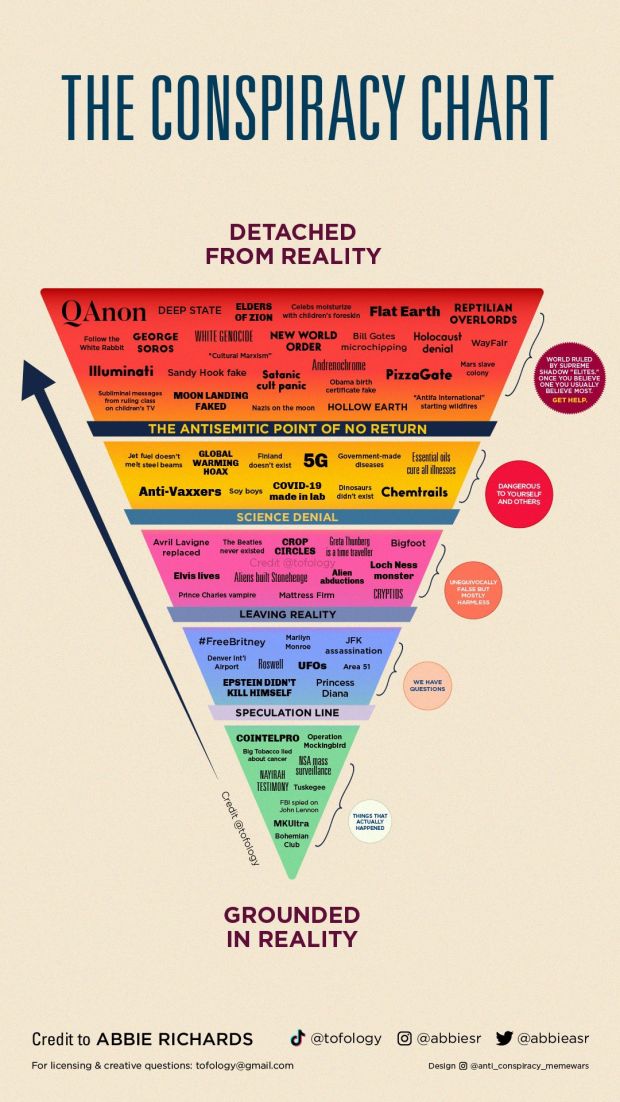
if you go down this rabbit hole on google, just be wary that while the hindenburg sabotoge conspiracy theory actually seems fairly plausible, most of the people you'll find talking about it are right at the top of this chart:
A bit off topic but I'm a little sad to see "Covid-19 made in lab" in the "dangerous to yourself and others" tier, especially with how much public view has evolved. Very few people will ever know for certain, it seems, but it could very well have naturally mutated from an existing virus in captivity and then escaped accidently. We have to be careful how we approach framing conspiracies because you risk to alienate and smother valid discussion.
(Scientist chiming in, albeit not working in a relevant field for this discussion)
In fact, several well-respected scientists are calling for a scientific and unbiased debate on the origin of covid, as it is now almost impossible for scientists to simply mention lab origin as a possible origin to study.
Here is one of the last papers I've seen on this subject:
I'd say right on the speculation line. It's far-fetched to say he can totally see, but he may very well experience some limited optical sensation, albeit one of such limited utility that we can't really call it sight.
The story about him seeing Shaq is an interesting example. If you already know that Shaq lives in your apartment building, how much visual acuity do you need to make an educated guess that the large form waiting for the elevator is probably Shaq? There's also no one to tell us if he ever stood there talking to thin air thinking it might be Shaq ;)
It also seems like the kind of thing that would be difficult to give a satisfactory description of, so being coy about it is probably for the best.
NOVA did an episode recently that demonstrated how the Hindenberg could have burned based on a confluence of the weather and coincidences. No sabotage or conspiracy is necessary.
If your hydrogen-filled airship is flying through heavy anti-aircraft fire, you likely have bigger problems.
This scenario also fails to address the numerous failure modes of airships, including but not limited to the extraordinarily wide range of explosive mixes of hydrogen and air, as well as the rapidity and violence of hydrogen combustion and explosions.
As anyone who has ever switched from an iPhone to an Android device will tell you, iMessage makes the process extremely painful, and in totally unexpected ways. You get your new Android phone set up, and suddenly find that you're not getting messages from any of your friends that have iPhones... because those messages are being routed over iMessage instead of SMS.
So you do a bunch of Googling or contact support for your phone manufacturer or wireless carrier, who directs you to an Apple tool for de-registering your number from iMessage. You go through that process, but it takes days/weeks for your de-registration to finally make it through "the system" to everybody's iPhones so that messaging with your friends on iPhones finally starts working again.
Did Apple do this intentionally? No, probably not. Could they solve this problem? You bet they could. But why solve something that makes switching to Android a nightmare?
True story: One day, Windows wouldn't let me type the letter p.
I was trying to log back in from the Windows lock screen. Typed my password, got it wrong. Typed it again, got it wrong. Eventually got locked out of my account, despite being extremely careful to type my password correctly. Went to IT and had them unlock my account...
Went back to my PC and tried to log in again. Typed my password very carefully, letter by letter, watching each letter come up on screen as I went. When I went to type the letter p, nothing happened. I hit p repeatedly, nothing.
I figured the switch for the p key on my keyboard had died or something, so I went to IT and got a new keyboard. Unplugged the old, plugged in the new. Still no p. OK, this is getting ridiculous. Clicked on accessibility tools and tried to use the on-screen keyboard to type in my password. _Still couldn't type the letter p, even with the on-screen keyboard._
Ended up having to hard reset the machine, and then everything was fine and dandy. Still have no idea what could have happened. It ended up being the last straw that pushed me to Ubuntu, and I've never looked back.
Reminds me of the drinking game called the "Land of Nod", you go in a circle making claims like "you can live in the Land of Nod, but you can't die there" or "you can listen to Nirvana in the Land of Nod, but not Dave Grohl" and hand out penalties of two fingers of your pint every time someone makes a statement that doesn't fit the rule. The only advice you give them is "the clue is in the name".
You can only play this game once with a particular group, but it's a good laugh.
At a job I worked at, we had servers that were given several internal IP addresses to map to external IP addresses.
One day, one machine just ... stopped having a bunch of those IP addresses. They were just gone.
We didn't understand, troubleshot as much as we could, and eventually just gave up and went "forget it, just try restarting the machine."
It worked.
It's amazing what weird states a computer can get into that "did you try turning it off and on again?" is a very real and legitimate and helpful piece of advice.
Well, bit flips happen all the time, and we call that "cosmic rays". It is not obvious that bit flips from cosmic rays in the more usual sense of "cosmic rays" happen all the time.
That's actually testable and determinable from several perspetives.
- Isolate any other sources of ionising radiation.
- Check to see if prevalence increases or decreases with increased or decreased cosmic ray exposure (atitude, shielding, detected cosmic ray storms).
- Are the characteristics those of single-bit flips? (E.g., power-of-two changes to values, or similar.)
- Are the errors nott repeated for the same hardware component. (E.g., under increased cosmic-ray influence, bits flip at an increased rate, as predicted, but which bits flip is random and has no detectable pattern, as predicted.)
You end up with very strong circumstantial evidence of altered bits due to cosmic ray influence.
You can get into a similar state on MacOS by pressing a key multiple times in a row (option I think). It just quietly disables a large number of keys. I figured it out by accident one day because I assigned the key as my "push to talk" on Discord. That was a fun hour trying to figure out what had happened.
On MacOS if you remap your capslock to control there is a race condition on the login screen. If you use the control/capslock key to wake up your laptop and manage to time it right, you can enable capslock but not have a way to disable it (unless you remapped another key to capslock (why?)).
Funny, I just had a version of this happen to me this morning on iPad OS using a folio keyboard.
I had just upgraded to iPadOS 15 and the caps-lock-as-control setting reverted to the default. I went into settings and changed it back, but I did so with caps lock accidentially enabled.
This left the folio keyboard stuck in caps lock. I had to go back into settings, set caps lock back to caps lock, press the caps lock key to disable, then I could make it a control key. But trickily, the setting change didn't seem to take effect until I swiped out of the screen where you change that setting.
Dunno, but in my country we use a QWERTZ layout where you can't write the letters Ě, Š, Č, Ř, Ž, Ý Á, Í, É without caps lock, because with Shift those keys produce 2, 3, 4, ..., 0
It was useful on some old machines that tended to prefer uppercase input. On typewriters, the shift lock key (which is slightly different) tended to be used when people wanted to add emphasis to a word or phrase.
As for modern computers, it is less useful. When one of the keyswitches on my keyboard failed, I replaced it with the keyswitch from the capslock since I figured it was the one key I was guaranteed to never use.
Capslock exists to make typing in allcaps easy. I use it most when I'm in a C project with lots of macros. I use it about as often as I use ten-key -- just enough to justify its existence, not enough to find alternatives in every os/editor/browser/etc that I use.
Sometimes I use caps lock for its intended purpose. Probably not nearly enough to justify its existence as a physical key that takes up space, but at least a little.
This is a rabbit hole that I followed as well. There's some good articles if you search for it.
Auto doesn't make total sense to me, but it seems originally the Romans had only the letters we know as capitals, and none of the extra characters like semicolon.
IIRC sometime in the middle ages lower case letters were added, but it's not clear to me why and how it ended up getting a bunch of different rules (eg German capitalises nouns but in English it's only proper nouns).
There are also theories out there about why our names appear in all-caps on government documents, relating to the concept of treating an individual as a 'corporation'.
Yeah, back when I was using Windows, I had RAlt mapped to Compose with WinCompose, and RAlt would get stuck occasionally when the system was under significant load, so I’d need to manually disable WinCompose, tap RAlt to clear its spurious down state, and then enable WinCompose again.
> (unless you remapped another key to capslock (why?))
When I first started doing caps-lock-to-control, I mapped my physical control key to caps lock. Eventually, I stopped bothering and kept it as control.
I'm using Caps Lock key to switch between input languages, but I can still use the caps lock mode by pressing Shift + Caps Lock. This is macOS built-in functionality.
How would you remap the capslock key without using a hotkeys-like setup, such as Karabiner? I looked for a long time for a way to do that and couldn't figure it out.
Windows 10 has this funny bug where sometimes for some reason your individual windows don't get focus any more. You can click at their title bar, and they'll be drawn as-if they have focus (darker shadow and foreground titlebar), but no window actually accepts or processes any user input (while updating normally in the background, and also redrawing). The only way I know how to fix this is to go into the Ctrl+Alt+Delete screen; just bringing up task manager doesn't change anything.
It sounds like you've installed some sort of app with a low level keyboard hook that's discarding the input. The login screen is in a separate desktop and not subject to such meddling. If it was an accessibility tool it might be able to hook into the login screen, I forget.
Alt+Tab (switch between open programs) - might help change the focus
Windows 10 has an advanced version of ^ as I understand, which uses the key combo: Win + Tab. The cycle of these commands can be reversed by adding "shift" to the mix (in case of many open programs / windows and you dont want to cycle through all of them)
Win+x has different, but equally useful menus for win 8 / win 10 - I was overjoyed when i first discovered this, as it retired many many other shortcuts I used over the years. (to get to device manager / control panel / event viewer)
and if all else fails: Alt+F4 - closes active (focused) program / window. If no programs or windows are in focus, then it will bring up the "shut down" dialog box, which allows for reboot / signout / shutdown / Switch user / sleep and hibernation if its enabled.
MacOS has had a similar issue as far back as 10.7. In 10.6 and before if you see a window with red, green, and yellow buttons in the corner, that window has focus, period. It was an enforced invariant.
In later versions it's pretty common to see such windows that don't actually have focus. Clicking again on the title bar usually fixes the problem but I find it very annoying. There's a race condition in the system somewhere that Apple doesn't recognize as a bug.
Could you have something running with an invisible window, e.g. keylogger? Less scrupulous friends from way back used to talk about writing such things.
The reason why this will fix it is because Ctrl+Alt+Delete has a higher level of system interrupt than alternate ways to get to task manager. Ctrl+Alt+Delete fixes a surprising number of issues by interrupting runaway issues.
My favourite W10 bug is that if I maximise an Office window and then try to close it by mashing the mouse right into the top right corner, it actually clicks past and closes whatever window is underneath.
Button presses are often handled by state machines at a driver level so that a single “press” only registers as a single press. Otherwise, it will register as a lot of presses because the physical switches bounce on contact. They call this debouncing. Probably, a drivers state machine did not transition out
Same generic keyboard debouncing in use in all 3 instances on the windows end? I know windows drivers debounce mouse clicks because I had a really old mouse that would double and triple click by accident on Linux but not in windows. I might be wrong, but changing the device might not affect it if the different devices are handled by shared runtime code
Sounds like a reasonable explanation for physical keyboards—if the new keyboard used by the OP was identical to the keyboard on their machine, I can see how Windows might reuse the same device driver instance since it has already been loaded into memory.
But what about the on-screen keyboard? Do on-screen key presses get routed through the keyboard device driver too?
So fingers bounce when they touch a screen? I wrote a capacitive touch driver once back in uni and we debounced that. I don’t know how windows does it, I’m speculating
It wouldn't be the same debouncer, keyboard input is usually debounced before it reaches the OS, let alone whatever windowing system that an on screen keyboard sends events to.
Pretty sure this would be done at the hardware level, as otherwise this behavior would differ between the BIOS, Windows, Linux & Mac. As far as I know no such debouncing code exists in operating systems for HID keyboards.
I have actually seen this before. It wasn't the P key; it was a different key. X or C, I think. However, the symptoms otherwise seem to match. I don't remember if we tried a second keyboard, but we definitely tried the on-screen keyboard and were confused when it, too, didn't work.
The only things we could guess were something related to the Windows Search, Cortana, or telemetry services. Unfortunately, it's been since the early days of Win10 since that happened so I don't remember any other details. We also had to physically restart the system to fix the problem.
I've been having bizarrely similar issues with my XPS lately, except that none of the keys work except the i key, even with the on-screen keyboard. Only happens once in a blue moon, but as in your case, requires a hard reset.
Wow, I'd nearly forgotten about this. The exact same thing happened to my sister-in-law a few years ago when she visited with her Windows 10 laptop and couldn't connect to our wifi.
Eventually we figured out the 'p' (or maybe it was 'n'? Can't remember for sure.) in the password was getting skipped, but it was hard to tell with the password masking. Tried a USB keyboard, onscreen keyboard, same thing. I think we might have given up and let her use one of our computers at that point. It was (and still is) very confusing.
For those who (like me) didn't get the "toothpaste company" reference - it seems to be a reference to Intel trying to squeeze every last bit of performance out of an old architecture (as one would squeeze every bit of toothpaste out of a tube), rather than innovating with new architectures and technologies.
Starting with the Ivy Bridge (3rd) generation, Intel switched to using thermal paste between the core and heat spreader instead of solder on socketed desktop processors. Presumably this was done as a cost savings measure.
This caused a marked increase in core temperatures and thermal throttling. Enthusiasts discovered that you could remove, or "delid", the heat spreader and replace the "toothpaste" with higher quality paste or liquid metal to drastically improve temperatures (15-20c) and improve overclocking headroom.
Edit: This event is commonly reflected on to showcase Intel's greed at a time where they dominated the market. It wasn't until the i9-9900k that Intel went back to soldering heatspreaders for consumer CPUs, at which point they were forced to because they were being challenged by AMD.
Cost saving would've been to get rid of the IHS entirely. Their mobile chips work fine without them, I don't really understand why they're a thing for desktop processors.
AMD uses them too, so there must be a reason... is it because they're afraid of improper installation breaking them? That's on the user.
The weight of the desktop heatsinks? Small changes to latch design should suffice. Or you can have a metal spacer around the chip with the die exposed, kinda like GPUs do.
I've replaced many laptop chips and even ran some on desktops with no issues.
I remember how they briefly tried those black foam sticker pads in the corners of the substrate before acquiescing and using the IHS.
At some point they realized they could do better than a heatsink mounting system that involved trying to balance a heavy metal object on a small pedestal while trying to hook a tensioned spring to a clip you couldn't see by exerting tremendous downward force with a flathead screwdriver. I guess those motherboard return rates finally got to them.
I always wondered why that mounting mechanism even existed. Would've thought it would get scrapped on the drawing board but maybe no one in the design pipeline ever put a screwdriver through their motherboard.
It was probably all part of Intel's strategy to sell more chips. It's hard to repair a gouged motherboard and not worth the time to recover the chips soldered into it. After the introduction of the IHS and new cooling solutions the motherboard market became unprofitable, that's why Intel had to exit it. /s
I don't know if there's any truth to this, but I heard that there were also issues that could arise more easily with electrically conductive thermal paste and that there was essentially fraud going on where lower end SKUs were being passed off as higher end units. That being said, that seems like something that would only affect the consumer used market.
> Cost saving would've been to get rid of the IHS entirely.
The IHS itself is a cost saving measure.
When Intel and AMD first introduced flip chips, they didn't have the IHS and the heatsink was balanced on top while you tensioned a spring. If you rocked the heatsink in any direction you would (not could) crush an edge or corner of the chip and likely kill the CPU.
The IHS protected the chip and reduced the failure/return rate.
> Cost saving would've been to get rid of the IHS entirely. Their mobile chips work fine without them, I don't really understand why they're a thing for desktop processors.
Because there's a huge difference between running 5watts sustained through something the size of your fingernail, and 100 watts sustained. That heat has to go somewhere and there's 20x more of it on a desktop part, as it requires way more integrated cooling to not immediately thermally throttle.
I think the parent meant an anecdote I've heard many times, in slightly different ways. It goes like this: a major toothpaste company was having a meeting, trying to increase sales. Many solutions were tried: new flavors, advertising, none had much effect.
On a whim, a director asks the guy serving coffee:
  - Jack, what would you do to increase sales?
  - Have you tried increasing the hole on the toothpaste?
There might be some truth to this, toothpaste tubes used to be metal in the 60s and you were supposed to punch a hole on the front of it with the back of the cover cap. That hole got a lot smaller than the ≈1cm wide in the plastic ones of today. It was also much easier to squeeze the very last gram by folding it.
I had also heard a point for toothpaste involving the marketing: toothpaste advertisements, and all marketing imagery of toothpaste on a toothbrush, almost always show absurdly larger amounts of toothpaste than is effective or appropriate to use brushing teeth, trying to increase consumption by increasing waste.
It's amazing how backwards we went from a sustainability perspective when you consider likely no one had this issue front and center as they did in the early industrial days.
We used reusable metals and glasses much more. Now everything is plastic.
On the other side, just take a "Tragerl" of beer (German beer crate with 20x0.5l):
- It weighs much more than a crate of 20x0.5l aluminium cans or plastic bottles
- it is more voluminous: glass bottles have way thicker walls and they need plastic spacers to prevent the bottles from crashing each other, whereas cans and bottles can be shrinkwrapped just fine)
- the return logistics are simpler: glass bottles and the crates have to be returned to the brewery to be refilled, whereas PET bottles and aluminium cans enter the normal, regional recycling stream
The switch to plastics has saved lots of money and environmental pollution in logistics. What was missed though was regulating recycling capabilities of plastics - compound foils are impossible to separate, for example - and mandating that plastics not end up in garbage, e.g. by having a small deposit on each piece of plastic sold.
"Trains move 32% of goods in the United States, but generate only 6% of freight-related greenhouse gas emissions. Meanwhile trucks account for 40% of American freight transport and 60% of freight-related emissions."
From the beginning of the industrial period, we relied on rail and boat for logistics, and buggies for last mile deliveries, until the advent of affordable, mass produced vehicles, and the interstate system, this didn't change much. Our reliance on plastics combined with airplanes and trucks for logistics results in much greater pollution in my view.
Granted, coal was the primary fuel source for steamboats and steam engines, but sail still was common until iron boats became widespread, and still more economical for cross-sea transportation.
All this to say, as an amateur historian, in my view, this all comes to a precipice between the late 1950s and early 1960s, with the completion of the interstate highway system in the US, and DuPoint proliferating plastics in 1960s.
That's an interesting point that without the interstate highway system (which had many benefits) we might be using rail a lot more than we are currently and therefore emitting less CO2.
Another way of looking at it is that we could consider the interstate highways only half-complete, and that the important part that was never built was an electrical delivery system for the cars and trucks that use it, so they can recharge their batteries without even stopping. It's what we would have been forced to build if fossil fuels weren't plentiful and cheap and we still wanted to use cars and trucks for our main transportation. We could have built that in the 70's in response to the oil crisis, and we could've had 50 years of electric vehicles by now, and it could have worked even using awful lead-acid batteries if cars didn't have to go more than twenty miles or so between electrified road sections.
Building the same thing now would be a lot easier. Battery technology is good enough that it would only be needed at regular intervals on the major freeways, and we can pair the electrified road sections with cheap solar power where it makes sense to do so.
> electrical delivery system for the cars and trucks that use it, so they can recharge their batteries without even stopping.
> and we can pair the electrified road sections with cheap solar power
I don't know. More cars on the road in general is just a bad idea IMO. Traffic, noise, accidents, parking lots, Fast and the Furious movies...
Alternatively we can use a system of transport that can carry a whole neighbourhood in one go, is electrified and can be built underground like a billionaire suggested we do for cars. It can be automated and sorta self driving too, can hit 180km/h without too much of a fuss. And we've been building them for almost 200 years.
More trains would be good. In the U.S. that's a hard sell, though. People do road trips in their cars for vacation in part because it's so convenient to be able to bring a whole carload of food, luggage, and camping gear with you. And there's a lot of places trains don't go. How many national parks have rail service?
Replacing trucks for long-haul would be good, but you'd have to accept slower deliveries. (I wonder if Amazon ever ships things by train?) I expect it's less of an uphill battle to just figure out how to make the things people are already doing more energy efficient and emissions-free than it is to tell them to completely change what they're doing. Admittedly, that does come with the risk of getting stuck in a local optimum. I just think of all that diesel being burned to push wheeled boxes around the country and I'm appalled at the unnecessary waste. Those fossil fuels could just as well have stayed in the ground.
> People do road trips in their cars for vacation in part because it's so convenient to be able to bring a whole carload of food, luggage, and camping gear with you.
On a decent rail infrastructure you can run car-carriers like in the Euro Tunnel between UK and Continental Europe (https://en.wikipedia.org/wiki/Eurotunnel_Shuttle). These things are big enough to accomodate cars and even buses, with people being able to walk around outside of their car.
Another big thing is cleaning - maybe someone put paint thinner, bleach or some acid to their used bear bottle before returning it ?
It could be even an accident (eq. someone turning in old beer bottles found somewhere), but you have to still account for that when cleaning all the beer bottles before refill.
Umm, explain to me exactly how it is simpler to recycle a set of PET bottles than to transport a crate of glass bottles? It is infinitely more costly and complex, and involves multiple industries.
As for aluminum cans, it's perhaps less of an ordeal, but still you only recycle between 1/3 and 2/3 of the material:
I believe you are only thinking about the logistics directly experienced by the end consumer... which is part of the problem with disposable consumption goods.
Reminds me of the Alka-Seltzer campaign "plop plop fizz fizz." One tablet was enough, but there wasn't any harm in consuming two. So they just told people to take two tablets. https://www.snopes.com/fact-check/double-bubble/
Also worth mentioning that U-haul trailers are very handy for this. There's at least 3 U-haul dealers that I can think of within a 5-minute drive of me. The one I prefer is probably 2 minutes away, I can rent a trailer for a day for like $15, they're never out of stock, and the owner of the U-haul dealership is the most chill person on the planet. I get all the benefits of a pickup truck, but don't have to pay for one. Win-win.
You're of course welcome to own a pickup truck if you want, nothing wrong with that. And I'm sure plenty of people don't live in suburbia with U-haul dealers everywhere. But if you do, it's stupid simple and you can save a ton of money.
I agree with you and the U-Haul idea makes loads of sense, but dear heavens are those unpleasant places. I wish there was a business that was like.... U-Haul, except nice although I'm sure it would cost 3x as much.
I'm sure the experience varies somewhat by location but it usually involves some combination of:
- very long lines, particularly on weekends. understandable, but adds hours and stress
- the vehicle you "reserved" online last week so you could do that job today? yeah, it's not really reserved. it may or may not be available; they "overbook" because they expect a certain number of cancellations. again this is understandable and something you see in a lot of industries, but yuck.
- lots of bogus-ish fees like "cleaning fees".
That all said, I own a home and have never felt the need for a pickup truck. I do fine with a hatchback and a roof rack.
A friend of mine just owns a trailer that he occasionally hooks to his minivan.
The main disadvantage is that you're driving something larger and more unwieldy, like backing up.
But the advantages are numerous. Still lots of seating in the minivan. Much lower deck to roll/drive/ride things on (I can't recall if the trailer tilts).
It's basically a portable pickup truck bed, maybe it's even bigger.
IMO for people who don't want to own a pickup, the Home Depot rentals may be a more convenient option. Especially since you're as likely as not buying whatever it is you need to haul from there.
It's a pretty painless process, but I save that option for the "big" hauls. If I didn't have the minivan and renting the Home Depot trucks was my only option, I'd probably organize my life around hauling less stuff.
Even for planning for personal travel, it's worth noting the massive difference in the amount of tourism between America's top 5 or 10 National Parks, and the countless other National Parks, Forests, Wilderness Areas, etc.
Yes, Yellowstone, Yosemite, the Grand Canyon, and a few other places are absolutely crawling with tourists. They're victims of their own success as destinations for people to check off a bucket list.
But once you get outside that top tier, America has countless places that are just as beautiful, still legitimately wild if that's your thing, and definitely not as crowded.
In my neck of the woods, the Blue Ridge Parkway and Great Smokey Mountains National Park (which are among the most-visited in the country, by the way) don't have the same sense of overwhelming crowding that, say, Yosemite does, except for maybe during peak leaf season, or at specific times/locations (e.g., Cades Cove in Spring). Most of the year, sure, they're not pristine wilderness, but it's not like they're wall-to-wall people and trash, either.
And, if wilderness IS your thing, you can go right next door to Pisgah National Forest or Nantahala National Forest, backpack for miles at a time without seeing another soul, and see views that are, IMO, equally as impressive as what you get in the official National Parks.
I guess what I'm saying is, if you're looking for a more remote experience, venture away from the big-name National Parks, and hit some of the lesser known areas, and you'll find that America still has a ton to offer.
Also, most of the busiest places can be visited as a pretty quiet experience in their offseason.
I've had the Grand Canyon, Zion, Arches, Yosemite, Sequoia and others as quiet, near-empty experiences in the past couple years...just showed up in mid-winter (and not on a holiday week).
-------------
Of course, doing that means: Spikes are a requirement for most hiking. The desert may not get feet of snow, but a couple inches of ice on your narrow trail is an issue. Scheduling flexibility is needed because snow/ice storms close roads at times, and fog/other weather can limit the views you're there for. Some places require snow tires and may require you to have chains.
Not every trail/trailhead is accessible, although in some cases different winter-only routes exist.
But, if you're looking for visiting the "bucket list" places without their usual crowds, it's worth considering.
Even in Yosemite, at the absolute peak of the tourist season, if you go to one of the trailheads outside the main valley, in the Chilnualna or Hetch Hetchy area, it isn’t overcrowded at all. If you take a multi-day backpacking trip, after the first half day hiking into the interior, you’ll hardly see any people at all. And the vast majority of Yosemite is further than an easy stroll from a parking lot. One tiny, tiny bit of Yosemite is crowded and the rest has very few people and still incredible natural beauty.
Totally agree. Outside DC, Skyline Drive is a crowded mess in leaf season, but the rest of the year, it's not bad. The most popular day hikes are overcrowded on weekends (White Oak Canyon) as described in the article, but there are less popular hikes that are almost as dramatic and far less crowded.
Also, the Mt Rogers Wilderness is only a few hours drive south, on the TN/NC/VA border area. It's absolutely STUNNING how remote it is, despite being spitting distance off I-81. We spent a week visiting late last summer and it rivaled many of the other places we've visited over the years (Outer Hebrides/Scottish Highlands, Iceland, and others).
It’s worth pointing out that Pisgah, Nantahala, and Mt Rogers are all administered by the Forest Service, which is a division of the Department of Agriculture. They are NOT part of the National Park Service and are maintained with far different goals in mind!
Oh yeah, just using it as another example of someplace that's stunningly gorgeous that isn't on many people's radars.
I'd never heard of it until a few years ago when a friend mentioned it as a tangent in another conversation. Piqued my interest and last summer gave us a good opportunity to go. We just day-hiked, and based out of a tiny cabin a bit outside Grayson Highlands (a state park within or adjacent to the broader Mt Rogers zone, IIRC). I'd love to go back and do a week of backpacking or bike-packing.
There's a big difference between church attendance and church membership... Unfortunately, the original linked article glosses over the difference, while the original Gallup study digs into it. According to Gallup, approximately half of the recent reduction in church membership can be attributed to people becoming less religious, while the other half is explained by people who still attend church regularly, but avoid formal "membership" in a congregation.
And, to your point, the historical data is very telling. My understanding is that the idea that basically everybody in the US used to be super religious and go to church all the time is largely a myth. In fact, I believe the high-water mark for US church attendance as a percentage of the population was actually around 1990. (Source: Sociologists of religion Rodney Stark / Roger Finke. Their book "The Churching of America" attempts to get historical stats on this question, and includes this graph: https://madeinamericathebook.files.wordpress.com/2010/03/fin...)
Take from these stats/trends what you will. Just adding some additional context to the discussion.
> while the other half is explained by people who still attend church regularly, but avoid formal "membership" in a congregation.
I wonder if this can be explained by an increase in people moving around compared to a hundred years ago. I am a member of the church I was raised in, but I am not local enough attend. I do visit when I am with my parents but otherwise it doesn't make sense. I wouldn't go join another church though - even though I do attend other services in my city, I am not a member at those churches
Yeah, likely part of it. I think there's also been a rise in non-denominational and "seeker-sensitive" churches that just don't have any concept of membership at all...
Native English speaker here. Never heard nude used that way. Always just as a synonym for naked. The existence of this now removed definition was a surprise to me.
Fair point. My wife does have "nude heels," which are (more or less) the color of a white person's naked skin. Still, I guess I didn't think that the word "nude" in "nude heels" was supposed to actually mean "the color of a white person's naked skin," but rather that nude meant "naked" and the shoe company had (wrongly and unfairly) assumed that the only people they needed to care about were white...
I'm not disagreeing and I don't have an axe to grind here, this is just anecdotal observation about language and usage in my (limited) experience.




Lithium mines produce localized environmental damage, _but so does fossil fuel extraction_. Think about environmental damage from mountaintop removal coal mining, fracking, offshore oil spills, etc.
With fossil fuels, you get localized environmental damage, _plus_ climate change.
With lithium, you get localized environmental damage, but you hopefully support a transition to renewables.