> The US government, for example, spends on “Defense” (including “preemptive” warfare) and Homeland Security, 8 times what it spends on educating the next generation.
You know, whenever I heard numbers like those, it always seemed like it was missing some very subtle point, but I never could quite put my finger on it. I think I just figured it out:
Myself, American citizen, I've gotten, I don't know, maybe 1/10th of my knowledge and education from U.S. government related things? Something like that? Maybe I'm being charitable here, I've learned a heck of a lot more from books, primary and secondary research, my own experiences, and acquaintances with expert domain knowledge than I ever learned in school. I dropped out of two high schools, and I would've left the education system earlier if I was a little more self assured and independent when I was younger.
So maybe 1/10th of my education has come from the U.S. government, maybe. How much of my defense against foreign warfare has? 90%? 99%? The rest being my utterly trivial-in-comparison training in martial arts, marksmanship, and other survival and combat skills? I guess you could count the time time I've traveled as under the protection of the English government, or French government, or whatever else.
But the basic point is - various government-run military has provided almost all of my defense against foreign warfare, and very little of my education. If you cut military spending by 7/8ths without implementing mandatory service, conscription, or a draft, we'd be a hell of a lot less safe. Multiplying educational spending in the current American public education system by 8 times wouldn't make us a lot more educated.
"... US government, for example, spends on “Defense” (including “preemptive” warfare) and Homeland Security, 8 times what it spends on educating the next generation... You know, whenever I heard numbers like those, it always seemed like it was missing some very subtle point, but I never could quite put my finger on it. I think I just figured it out: ..."
"... if you add up the money we spend on public education in this country, at the local, state, and federal levels (most of it is at the local level), it's about what we spend on defense. It may even be more ..."
Defence at 4% (2005) [0] and education at 7% of GDP (2007-006). [1] But there is no mention of costs associated in the intelligence community. You can read more about the breakdown of spending for education in the reference.
> > The US government, for example, spends on “Defense” (including “preemptive” warfare) and Homeland Security, 8 times what it spends on educating the next generation.
> You know, whenever I heard numbers like those, it always seemed like it was missing some point, but I never could quite put my finger on it. I think I just figured it out:
There's the small problem that the bulk of US education spending is by state and local govts, not the federal govt.
The feds may dominate college spending, emphasis 'may'.
Curious about the downvote here - is my reasoning off? I'll elaborate on my position a little bit -
It seems to me like top-down centralized education has historically done a somewhat poor job of teaching, and extra top-down education funding probably wouldn't make us more educated. Whereas top-down military seems to be the best way to defend against aggressive foreign powers.
Considering that there's always been aggressive military powers in known history - the Khanate Mongols, Alexander's Greeks, Shaka's Africa, Imperial Japan, Fascist Germany, Soviet Russia, the Khmer Rouge, North Korea today, etc, etc - defense against these types of places becomes an unfortunate necessity. And it seems like top-down, state-run military/defense works better than individual militias, individual defense and military, or whatever the alternative solution should be.
I think governments have done a relatively poor job as educators and education typically works well in an individual, decentralized way. Military? I don't think you want that as decentralized, but maybe you do. So when you see that the U.S. government has a much larger defense than education budget, that's because there's lots of quality private education happening, but not so much quality private defense happening. Agree? Disagree?
It seems to me like top-down centralized education has historically done a somewhat poor job of teaching, and extra top-down education funding probably wouldn't make us more educated. Whereas top-down military seems to be the best way to defend against aggressive foreign powers.
I'm not entirely certain of my history, so here's as good a place to ask as any: when was the last time the United States was under threat of invasion from aggressive foreign powers?
Not that the general thrust of your argument is incorrect or anything; it just seems a little bit like Russia being worried about unreliable oil imports.
Not to put too fine a point on it, but unreliable oil imports are exactly the kind of thing our military does worry about for us.
There are several ways to strike a serious blow to America besides outright invading it. We have always been blessed by geography and our good relationships with our immediate neighbors to lessen that particular risk. However, since the 1970s we have become increasing dependent on resources found outside our borders (oil isn't the only one, but it is the elephant in the room). In the same period, our allies have become increasingly dependent on us to assist in providing their defense as well.
Aside from all that, this whole discussion is born out of the idea that more money will automatically improve education. I'd argue against that. Sure, there are lots of way money would help in a lot of places, but every extra dollar doesn't translate into an extra well-adjusted knowledge worker. Also, a stable society that doesn't have to concern itself with wars and violence has a lot more time to spend learning, rather than surviving, so military spending indirectly benefits education.
> I'm not entirely certain of my history, so here's as good a place to ask as any: when was the last time the United States was under threat of invasion from aggressive foreign powers?
Threat of even a remote chance of attempted invasion/occupation ending 1989-1991 with the dissolution of the USSR.
That said, massive global conflicts don't start with the superpower getting invaded - they start with the aggressor seizing control of their local economies, conscripting soldiers, and invading for strategic locations and resources near them.
I was just talking about this with a friend of mine - what would the world look like without America as the world police? Any time a medium sized country is thinking of invading a smaller country, they need to consider whether the United States will intervene.
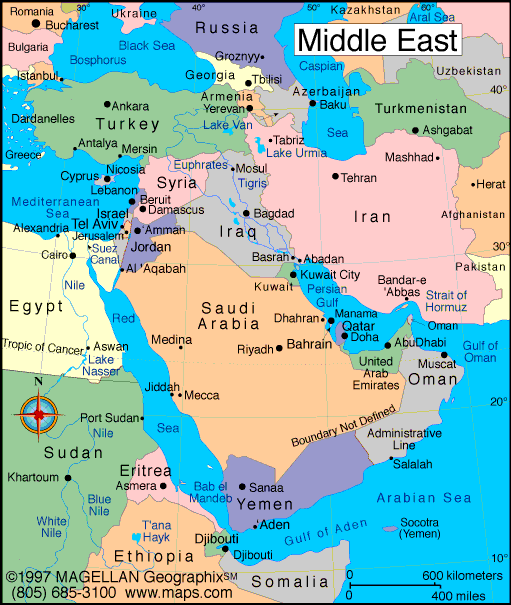
So for instance, think about the first Gulf War. Saddam's Iraq invaded Kuwait. Map here:
Lots of oil in Kuwait, small and weak military compared to Iraq of that time, strategic position in the Persian Gulf, etc.
Let's say America and allies doesn't step up and stop him. He conquers and assimilates Kuwait. What's next? Invade Saudi Arabia for Mecca and trying to install himself or a puppet actor as a new Caliph (supreme Muslim leader, office dissolved under secular Turkey post-WWI)? That'd give him legitimacy under an Islamic war banner. Try to take over Iran? Semi-peaceful assimilation of another neighbor? "Holy" war on Israel?
Certainly - Kuwait wasn't an end-all, be-all goal for Saddam. Who knows what he'd have done if the UN coalition led by America hadn't stopped him?
I mention these things because I'm generally in favor of American non-interventionist policies. American world policing is very expensive. The American people have had the benefit of living in the world's dominant empire recently, the standard global currency, the generally accepted world political system, the most military bases across the world, a fairly high quality passport, but at this point, the cost is probably higher than its worth for its citizens, and the job America does is a mixed bag for the rest of the world.
It's also kind of capricious in where it intervenes - there was no real American interest in the Kosovo campaign, whereas in Burma horrible things are happening similar to what happened in Kosovo. Why Kosovo, which was expensive, no strategic value to the USA, and no threat to the USA, but not Burma, which would also be expensive, have no strategic value to the USA, and is no threat to the USA? Similar sorts of violence/repression/abuses happening in both places.
Alright, that was a bit tangential. So to answer your question, America is absolutely in no danger of being invaded, what with the world's most powerful military and the geography layout of the world. But imagine if America went non-interventionist, or decommissioned its Navy and went to a a much cheaper homeland defense urban skirmishing style of military - how long would it be until North Korea went to "unify" with South Korea, or cooked up a pretense to invade Japan? I'd guess pretty fast. And that's how aggressive powers are built - they don't take on the world's dominant power until they've seized control over home industry, begun conscripting, and started taking over strategic places near them.


You know, whenever I heard numbers like those, it always seemed like it was missing some very subtle point, but I never could quite put my finger on it. I think I just figured it out:
Myself, American citizen, I've gotten, I don't know, maybe 1/10th of my knowledge and education from U.S. government related things? Something like that? Maybe I'm being charitable here, I've learned a heck of a lot more from books, primary and secondary research, my own experiences, and acquaintances with expert domain knowledge than I ever learned in school. I dropped out of two high schools, and I would've left the education system earlier if I was a little more self assured and independent when I was younger.
So maybe 1/10th of my education has come from the U.S. government, maybe. How much of my defense against foreign warfare has? 90%? 99%? The rest being my utterly trivial-in-comparison training in martial arts, marksmanship, and other survival and combat skills? I guess you could count the time time I've traveled as under the protection of the English government, or French government, or whatever else.
But the basic point is - various government-run military has provided almost all of my defense against foreign warfare, and very little of my education. If you cut military spending by 7/8ths without implementing mandatory service, conscription, or a draft, we'd be a hell of a lot less safe. Multiplying educational spending in the current American public education system by 8 times wouldn't make us a lot more educated.