In The Matrix, you could tell which "world" you're in by the general grade of color. When in the Matrix, everything had a greenish overtone, and when in the "real world" it was more blue. I really liked that use of color to be a part of the story telling process.
That's definitely the part of the movie i remember most, 16 years later: that feeling of flatness in the matrix that they emphasized by the green and black. You'll also notice, if you go back and watch it, that everything in the matrix is angular and well defined where as in the Nebuchadnezzar everything is curved and messy with pipes and wires leading to nowhere in every shot.
Steven Soderbergh's Traffic (2000) made heavy use of this, too, to distinguish different locales and parts of the story. The Mexico/Benicio Del Toro partions were heavy on gold/orange, burnt, sepia, while the Washington/Michael Douglas parts were blue, cool.
This. Their use of color grading is one of the things that made The Matrix have a very unique feel. The sound design is also worth paying attention to.
I also find that the lack of money forced the grittiness that was lacking in the second and third movies, and in a lot of high budget movies that attempt "edginess" like that.
In my opinion the pill scene [1] has everything that made The Matrix unique. The color, lightning, costumes, ambience (rain and thunder outside), surgical use of soundtrack and the dialogue itself. All the elements successfully contribute to give it that comicbook/cyberpunk feel.
In contrast, the sequels don't have such simple but striking scenes like that.
The 1984 version of 1984 had an intentional "washed out" appearance to reflect the grimness of the world it was showing - apparently done by a bleach bypass done to each print:
Interesting. Being partially colour blind I would have thought that the original was much greener, while the re-release is a lot bluer and bumped up the brightness contrast.
For example, most of the agent scenes in that comparison the left frame appears "greener" (but also more washed out in terms of brightness contrast) than the right.
I'm in the same boat: it's weird seeing the comments describing the blu-ray as "green-ray" and that things are SO GREEN when I literally can't see it. For those of you with decent color sight, was the original... more orange?
There was a bit of a green hue in places in the original, but not as pronounced as in the "green-ray" version.
When I first saw the blu-ray version I had to check my TV colour settings to make sure no-one had been fiddling with them (colour saturation, temp etc). It was quite jarring on the eyes, and that was even after three or four years of not having watched The Matrix. As a non colour blind viewer my reaction (after checking the TV settings etc) was, "yeesh".
The original looks more green-orange and flat. The blu-ray looks more green-blue and contrasted. The original feels 'warm' and the blu-ray feels 'cool.'
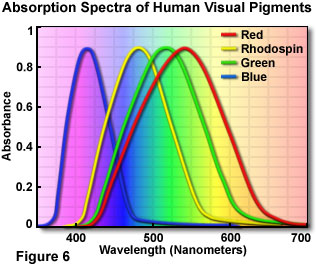
Ah, that explains it. I'm technically green deficient. Because of how colour vision works, green perception partially overlaps with red perception[0], so I tend to think of green as more of an "earth tone" (essentially brown).
Colloquially people with normal vision tend to say "green" when they refer to teal (i.e. green-blue or just generally green with some blue in it). Because I don't actually perceive the green part of the hue, the blue is much stronger for me.
I absolutely agree with the "warm" vs "cool" thing, though.
> Because I don't actually perceive the green part of the hue, the blue is much stronger for me.
Interesting. Yes that's the opposite the effect it has in me. Teal is a washed-out blue...
The original/DVD release of the Matrix did have a visually distinctive green tint in the scenes taking place inside the Matrix. But it felt soft, warm, and flat. It was also subdued in some scenes, such as the training dojo. The scenes in the real world lacked the filter and felt harsh, cold, and rigid by comparison. It was a great artistic choice.
The new blu-ray release (and the sequels) have the entire movie feel like the harsh, cold, rigid reality, and have heightened the contrast to make it worse :(
Ugh. I can see why they wanted to move more in the green/blue direction from the very red/monotone original, but it definitely looks like they went too far. Both sides of that comparison look pretty awful at times.
They also do this in a TV series called "Charlie Jade." In the show there are three known universes and each has its own distinct color and hue. You know which one you're looking at by the color change alone. It really helps keep the universes (and by extension, the timeline and story) straight.
I remember that the book "The Neverending Story" also employed a similar scheme: Red and green ink was used to distinguish between the book's two worlds.
I've always wondered if part of the reason for the blue/green shift beyond storytelling was due to blue/green screens used heavily throughout the movie.
I would imagine it helps smooth some rough edges during the compositing phase when the overall grade matches the color key.
Another example of this is the the show Fringe, which used a tint (blue or red) to indicate information about where a scene took place. (Keeping it a little vague to not include spoilers.)