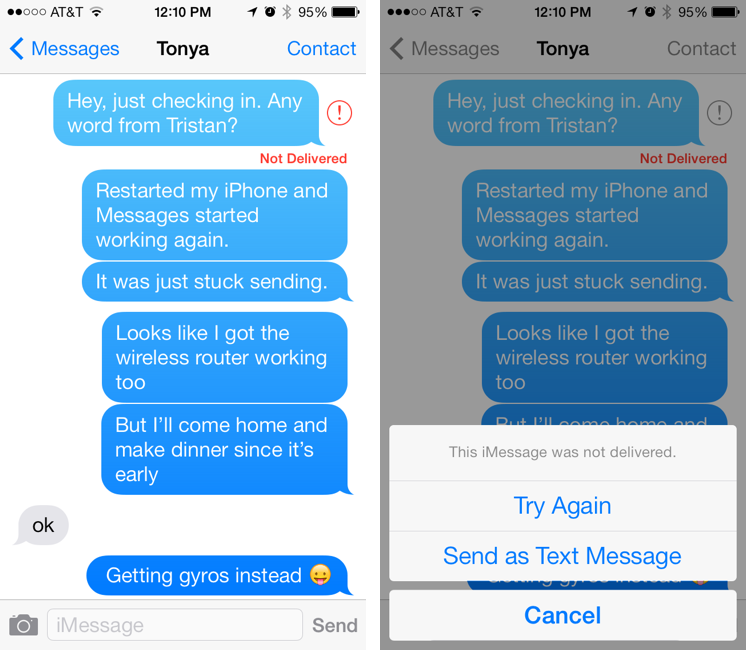
There's a much bigger issue, the default iPhone settings has "Send as SMS" off, this means that if a failed iMessage attempt occurs, it will just give up (rather than sending by SMS).
I've tried disabling iMessage on my iphone several times. I then have nothing connected to my iMessage account, but I still miss out on loads of messages from people who have the "Send by SMS" option disabled. Their devices are not told that I am no longer using iMessage.
I went to the apple store to ask about this, and I was told the only solution was to get all my contacts to ensure "Send by SMS" is turned on. Which is frankly absolutely ridiculous!
I had to show this setting to my fiancée who just got her first iPhone, a 5c, as a free upgrade when her feature phone kicked it, and since she isn't paying for a data plan...
First we figured out how to disable cellular data, since the phone with the minimum data plan gets only 100MB of usage per month, it's definitely too much to ask that one should police their applications and "just not use data" -- I don't have to tell you how easy it would be to accidentally go over this cap if you are actually using apps or any features of the iPhone at all, and the incidental metered usage rates are just absolutely ridiculous.
Then we had to go and find the Send as SMS setting, which was disabled by default, because text messaging to other iPhones only ever worked when she was in a WiFi zone. She would receive a flurry of messages she was missing while out, immediately when she got home, obviously a symptom of this issue with iMessage.
Even now, with the setting enabled, other iPhones won't reach her if they try to send a message when she's not in WiFi zones, because they still have this setting disabled. You have to show all your friends with iPhones how to enable this setting, or to force one message through individually, or just bite the bullet and pay for a real data plan. It does seem to be all by design, some type of collusion with the phone carrier(s) to make more money on data plans.
I agree that iOS and apps could do more to help users stay within the limits of their data plan. Sometimes it seems like they assume data is free.
I once had Spotify eat my entire data for the month in a few hours because wifi was spotty and it just went on to stream (in max quality) over 3G.
Another issue, especially in Europe, is international roaming. When you're near a border, your device may be roaming in the neighboring countries network because their signal is stronger, so you really have to catch the "welcome to foo network" sms and turn off data roaming (or pay for an "EU Day Pack").
This makes sense, I see now that you can disable it. But was this even an option before Apple published the "selfsolve" page referenced here in today's news?
I haven't seen any articles that suggest you should disable iMessage unless you are dropping your iPhone completely. It was totally not obvious to me that you can even do this, and I am professional. ^_^ (I don't have my own iPhone, so I've never had to wrangle with these issues on my own.)
Did they say that with a straight face? I can't believe that would be serious advice! "You literally need to contact everyone in your address book and make sure they have the right settings."
You're wrong, and the comment you replied to is right. According to Apple, it can take up to 45 days to receive text messages from Apple products after you turn iMessage off.
This was the experience of the person who initiated the class action suit:
"21. Apple personnel informed Plaintiff that even though she had turned iMessage off in her old iPhone she may still not be receiving all her text messages because some texters using Apple devices may not be using the latest Apple iOS version. Rather than Apple coming up with a solution to a problem created by Apple, Apple's representative instead suggested to Plaintiff that Plaintiff get her text message senders to update their Apple iOS to the latest version, or have them delete and then re-add Plaintiff as their contact, or have Plaintiff and these unsuccessful Apple texters start a new text conversation with Plaintiff."
> There's a much bigger issue, the default iPhone settings has "Send as SMS" off, this means that if a failed iMessage attempt occurs, it will just give up (rather than sending by SMS).
So by default, it sends a secure end-to-end message, and you'd prefer it to fail back and send an insecure SMS logged by your telco? (Verizon, for example, makes your SMS history available in a web portal.)
I think the bigger issue would be if iMessage burned your SMS plan and sent insecure messages without you explicitly asking to.
Defaulting to losing the security and privacy seems more "frankly absolutely ridiculous".
That's a very generous reading of the situation. How many iPhone users bought their device because it offers secure end-to-end messaging? I'm going to say very few of them. How many of them even know what the blue bubble and the green bubble mean?
I think a lot more users would be surprised that iMessage doesn't burn through your SMS plan than those would be surprised if it did.
What? The correct behavior here is to realize that the target no longer supports iMessage and return to non-iMessage behavior. This should involve swapping the UI from blue back to green so the user is aware.
This is what happens. The setting is only what happens automatically: if the UI is blue and it fails to send. When it fails to send, the message is marked failed (with a red exclamation point), and then the UI switches to green because the recipient is not connected to iMessage.
He implies a nice middle road: don't automatically fall back to SMS, but inform the user that the recipient cannot be reached on iMessage and SMS must be enabled if you want to talk to them.
Availability is part of security, right next to confidentiality and integrity. Systems that silently fail closed aren't secure in a meaningful way, because you can't distinguish a DoS from "working as designed".
Is it just an optical illusion, or does Apple really has a problem with anything related to network programming ? Every single time i hear about any technology they're developing that is vaguely related to network, i have the feeling something is going to break up.
I say "network" because i think it goes from
- web sites : their developper and itunes connect website is a shame, app store discovery simply doesn't work, i've never even tried to open an icloud drive document on the web because of how poorly advertized it is, etc.. ,
- their web related technologies: icloud sync in general feels historically unreliable, even more so when you combine it with coredata, no server-side programming language (swift could be a fantastic opportunity but nothing was even advertized by apple), their network api on iOS was so raw that the most popular iOS lib is AFNetworking that was developped by a single guy (at least the first release) and made a world of difference.
- Even wifi and 3G connectivity is often buggy on iOS and MacOS: see the infamous bluetooth+wifi bug plaguing yosemite today.
And i could go on and on. It seems that network is just beyond Apple. Now of course it may be a bit harsh to them because they do have among the biggest user base for their service, but if you compare them to Google, Dropox, Facebook, Microsoft, Amazon and all the other tech giants of today, you can't ignore that there is definitely something special in that area with Apple.
I have a different problem - I did a T-Mobile tryout and had an iPhone with a different number for a week. And then I returned it. I can't remove that number. I hope the new person that got it doesn't get my messages.
Hopefully you can only associate one number with iMessage.
We'll see if it fixes the big issue I'm having - a friend who ditched his iPhone can exchange SMS messages with me and others individually, but he can't participate in group threads anymore. No error, he just never receives the messages.
Seconded. I still have the old iPhone. I wonder if reregistering and deregistering with the new tool will help or just make things worse.
This is only an issue for me because Apple made the arbitrary decision to make your iPhone functionally useless after a restore unless you insert a SIM. I still use my iPhone for dev. Guess what happened after a restore once I inserted my SIM? My iPhone automatically enrolled my phone number in iMessages. I spent months getting SMS working after switching to Android and I'm back at square one. This is antitrust level BS.
Likewise here - switched from iPhone (on Verizon) to Android (on T-Mobile), and in several group threads I no longer see the replies of some of the participants. Truly frustrating, and makes you feel marginalized from the conversation.
What Android SMS app does he use? Tell him to try another. Group texts over MMS appears to be somewhat of a kludge, and different text apps support or do not support it to differing degrees. For some of the ones that do, 80% of their changelogs appear to be "Improved support for group texts / MMS bug fixes".
I've found that the best way to fix this is to get everyone who participates in the group conversation to delete the conversation from their phones. Then once everyone's done that, one person can send a message to everyone else and it should use SMS.
In my experience, it looks like iMessage stores metadata about the chat medium for a given conversation, and that's determined upon creating the conversation.
When sending individual messages, iMessage doesn't seem to attempt to determine whether conversation partner has gone dark from iMessage and fall back to MMS going forward. So everyone else gets the message, but not the person without an iPhone.
Group threads have been implemented as MMS on all major smartphone operating systems. Unfortunately, Android didn't get it until Android 4.2 or something.
The key is that the recipient list is sent with the message, so the other clients know who else is participating in the group, and can also thread and send outgoing messages accordingly.
I think the problem was that sometimes the iMessage did get delivered, but to an iPad, a Mac, or some other device with iMessage set up using the same Apple ID - so they couldn't just wait to see if the iMessage failed and then just send as a normal SMS.
It will be interesting to see if it actually works this time around; just having a new interface for deregistering from iMessage does not convince me that it will solve the issues.
The most frustrating, for me, is that in a one-on-one conversation, if your iPhone attempts and fails to send an iMessage to someone, it will tell you that it failed and allow you to send it as SMS instead.
However, in a group, if it attempts to send an iMessage to a member of the group that does not actually have a device supporting iMessage, it will silently fail; you will not know that the message was not sent to that person, nor will you be able to force it to send as SMS even if you know they did not receive it.
Why is the list of countries so small? (India seems to be left out). That simply doesn't make sense for a global company. iMessages and iTunes SMSes worked perfectly, so it's not like they don't have capabilities here.
I assume Apple couldn't get the lawsuits dropped, so they were forced into making concessions to their customers. Prediction: this tool will be ungoogleable, and discoverable only from a visit to an Apple store, or the last step of a support call.
There is no technical reason for iMessage to behave as it does, only business reasons. I can come up with a more intuitive UI for this tool right now - make disabling iMessage send "curl -X POST [whatever] http://apple.com/technicallyyoucanturnitoff.now ". Done.
-----
edit:
Is 45 days still in effect?
"If you want to transfer your SIM card or phone number to a device that doesn't support iMessage
"Go to Settings > Messages and turn off iMessage if you plan to transfer your SIM card or phone number from an iPhone to a device that doesn't support iMessage. If you don't, other iOS devices might continue to try to send you messages using iMessage, instead of using SMS or MMS, for up to 45 days."
Apple could have done this at any time, but chose not to.
-----
last edit:
from the lawsuit filing -
"49. Apple's business practice of distributing, marketing, and its iMessage and Messages service and application in the manner described herein is also an unfair business practice because it, inter alia, threatens to harm competition in its incipiency. Class members and others who become aware that switching their Apple iPhone or other wireless devices in favor of non-Apple products will result in these persons not being able to receive text messages sent to them by other Apple users are likely to be disincentivized from switching from Apple to an Apple competitor. [...]"
My problem is sending SMS when you are roaming abroad. iMessage will attempt to send it's thing even though you are offline, then fail few minutes later and it's only then you can tap and hold to send as SMS.


I've tried disabling iMessage on my iphone several times. I then have nothing connected to my iMessage account, but I still miss out on loads of messages from people who have the "Send by SMS" option disabled. Their devices are not told that I am no longer using iMessage.
I went to the apple store to ask about this, and I was told the only solution was to get all my contacts to ensure "Send by SMS" is turned on. Which is frankly absolutely ridiculous!