I don't get it. Buying digital and real books is not exclusive. Personally, I like explicitly deciding which books deserve the honor of "gathers dust and taking up space" status. Just as I keep printed-out copies of interesting online essays or blog posts in a bunch of binders, I keep tangible copies of interesting books around as well.
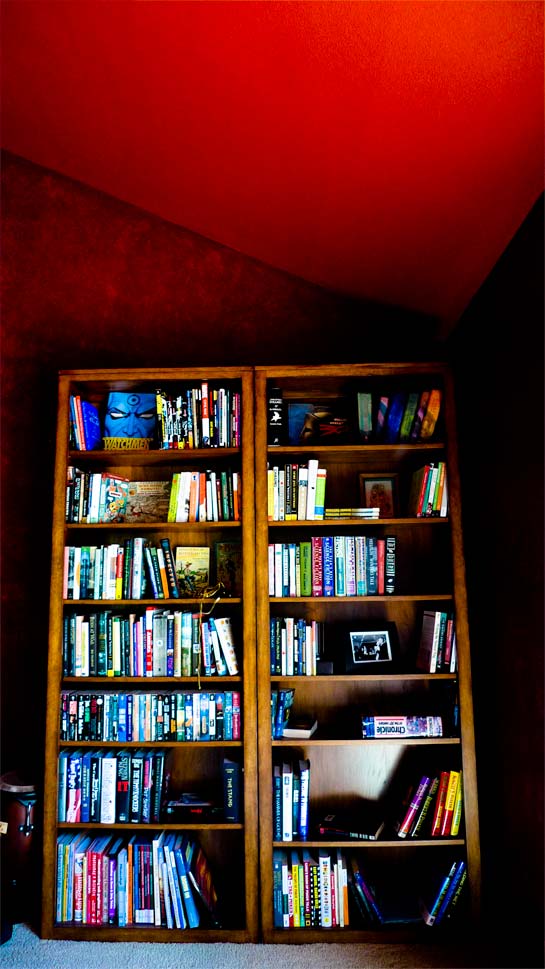
I'd like to zoom in on that bookshelf. I wonder what books are on it. All I can make out easily is Watchmen.
With examination I see "Infected," left self third from the top. I notice IT and The Stand on the left shelf second from the bottom. Must be the Stephen King shelf. Lots of sci-fi on the shelf above that. Textbooks in the shelf on the right...
Top right shelf contains "Jonathan Strange & Mr Norrell" (in black) and the Harry Potter series. Below that "The Rise of The Creative Class" (green). Middle left contains "America (The Book)" (red).
Third shelf, all the way to the right, "The More Than Complete Hitchhiker's Guide" -- which does not include Mostly Harmless, but IS leatherbound and DOES include slick gold-leafing.
Growing up, my parents' apartment (which contained their startup's office) had about 300 feet of shelves, all completely full. On top of that my dad had about 2000 vintage trade paperback scifi novels in grapefruit juice boxes, and at any one time there were ~3000 computer magazines in banker's boxes. Every few years we would fill the building's dumpster with magazines, but the piles would grow again. It's much harder psychologically to get rid of books.
Books are a burden.
When I was in college I would go through periods of using the regional interlibrary loan to its limits -- having 30+ books at a time, going through 10 a week.
Now that I've graduated, I read almost solely from the screen. I already spend almost all my time reading, and there's a massive surplus of material. Why would I want to spend my time and anxiety on acquiring physical books, and paying for the privilege, when I already have too much to read?
Of course they are a burden; things are only burdensome to the extent that they are valued. If they were worthless, who'd care. Besides, if nothing else, you can always donate them to a library; I've ended up doing that with boxes of the books that were less valuable to me every time I have moved.
I think people like books because bookshelves hold them so well. They are decorative. You need something on your wall, but posters are for college kids, so why not some books?
I have a shelfful of books. I maybe read one of them every few months or so. But mostly, it is a list of books that I've read that takes up a significant part of my flat. They take up valuable space and collect dust, and are a pain to move, all so I can flip through a book instead of do a Google search. Not very convenient. You could go so far as to say, "pointless".
e-books are much better -- when you are done reading them, they become a line on a display that you don't have to dust, find storage for, or pack when you move. And of course, just like real books, you can refer to them years after you've read them. (I guess you can't loan them to people, but for $5, who cares?)
And oh yeah, trees. When you buy a book, you kill them.
I can see the perspective that physical books as an inefficient alternative to digital books, and I grew up with books and books will always be a part of my life.
I believe books can be totems of our life and interests. Even if they don't get read and/or don't reflect your current life, books on a shelf are still telling a story aboutyou in a way that DVDs you own can't. I feel that a single book by itself that someone owns is not particularly interesting but the larger hodge podge or holistic collection of books that it belongs to is interesting. For example, my friend Simon and his wife have a collection of travel books in a high-traffic/prominent location (right next to the garage access/front door) (to places they've been and hope to go) - and I feel this is interesting because they have two very young kids and are in no position to travel off.. But perhaps a daily reminder..
Books can be good conversation starters/icebreakers. Seriously, if you want to meet someone with a certain type of interest, try starting conversations with people who are hanging out in that area of the bookstore. You can start to learn more about a person from the books they have on their bookshelf. If they have any biographies, I usually ask why they are interested in that person. Sometimes you can even infer what they are hiding from the books they show.
Before a party in my apartment, I deliberately randomized the books that were all neatly categorized and alpha by author (like in a bookstore! I own one of those UPC barcode scanners too) to make it appear that I wasn't that OCD. I don't think anyone noticed.
I believe physical books are more valuable than digital ones because they are a concrete representation of someone's passion and their investment of time in it. The sentimentality of books as being part of someone's life work is more noticeable if it is decades old and sizable (page-wise) - makes you wonder - who wrote this/why did they write it/who were they.
my bookshelf contains tons of books, hardcore zines and vinyl - I wouldn't have it any other way. The chance of me finishing reading a pdf/ebook of the smalltalk 80 manual from front to back including the appendix is slim to none - however order it for 3 bucks off ebay and keep it around and with in a month or so I've read the entire thing at my leisure. On top of that When people come over and I start ranting about programming I have physical implements to push my point - "look at this book!!" I almost scream as I reach for the sacred yellowed tome, "It's from the 80s and it's more relevant than 90% of everything that's come since!"
Also the chance of lending someone a book or record and having a meaningful discourse follow from that incident (during/post lending) is much greater than just saying "check out w3c" or "listen to minor threat on myspace".
I am in the process of going digital on books- having just moved a couple of thousand books in and out of boxes a few times, it's just not worth it. It just doesn't work for everything. Some kinds of books- cookbooks, API reference guides, things with diagrams and pictures, large books, etc. just don't play well on the current set of devices. The key thing I am missing so far is the ability to lend/give books that I am done with- even though no one seems to want my out of date technical books. There is no resale value on digital goods.
Maybe the solution to Rands' problem is a projector that shines a picture of a bookshelf with simulated spines onto the wall where your real bookshelf used to be, or maybe he could read your Amazon reviews.
People that think they can encapsulate you by looking at X-attribute usually lock in some (comfortable to them) simplification and reject further information that breaks their understanding if it's 'good' or can be much later disappointed if it's 'bad.'
Just look at the API the person offers you at your current user privileges. Digging into internals just results in leaky abstractions and buggy dependencies (e.g. Why are you looking for the books their hiding? Do you have trust issues?).