Everyone who I know that's read Atlas Shrugged (including myself) turned into a selfish jerk for at least a month after reading it. God help us if the "Ayn Rand temporary jerk phenomenon" is unleashed through movie theaters all at once.
It's a good book but like anything else people extrapolate the points beyond recognition and additionally interpret it to re-enforce their own views, regardless of how unreasonable those views might be.
I said something similar on the last Ayn Rand thread, and indeed these threads do start to sound repetitive.
I read literally hundreds of books in school with socialist, feminist, existentialist, collectivist, or fatalist themes. I read exactly one author in all of American literature with the theme that an individual could shape his own destiny and that capitalism (you know, that evil economic system that has sort of created unprecedented global prosperity) is okay. That author is Ayn Rand.
I was an obnoxious Randroid for awhile. But Ayn gave me the ability to stand up for myself intellectually, to question establishment ethics and politics, and to eventually question and reject her. I think that's a valuable experience for a young person to have.
I suppose my parents thought I was a "selfish jerk" when, after reading The Fountainhead, I ginned up the strength to leave the religion that made me depressed and a little suicidal in my youth. I'm not sure that's a bad thing.
In my mind, the inventors of the computer revolution did more good for humanity than all the starry-eyed kids going into the Peace Corps or working soup kitchens. How often is a teenager going to hear that? It's certainly against establishment ethics. It's not something that you can safely assert in mixed company. People will label you a sociopath if you state it. But I think it's true.
Is the worldview of myself and Ayn so dangerous that people should be completely shielded from it? If so, watch out for this movie. If it's done right, it's going to fill lots of heads with dangerous ideas.
Personally, I like dangerous ideas. I think we could use more of them. When people's minds are filled with safe ones, the intellectual climate stagnates.
Lastly, to those who say her characters are not believable, I reply that neither were the characters in the movie "300". This isn't Hemmingway. She has her own style. You hate her politics so you're saying she's a bad author. Admit it and we can discuss the real issues.
I've yet to find one person that says "I think Ayn makes some great points, but I really think she writes like crap". Rather, it is usually "Ayn is a hateful and evil person. And besides, her books are total crap. Nobody should ever read her works for any reason."
I think Ayn makes some great points, but I really think she writes like crap
Actually, i say something on these lines very often, if a discussion related to Ayn Rand is happening around me. I would say Ayn makes some good (and obvious) points, but at least for me, Fountainhead was not a "reading pleasure". It was too long and overstretched at places, when it could have been far more succinct.
Someday, i might actually get the dust off 'Atlas Shrugged' in my bookshelf, and read it.
That latter point is the problem. Atlas Shrugged is a fine novel, and I'd excuse people for being jerks if they were in fact doing the brilliant things that AS says jerks are allowed to do, but people don't do that. They read it and interpret it so that whatever they were already doing, they're allowed to keep doing.
Okay, let me clarify, because I like The Fountainhead much more. But you make a very good point.
The Fountainhead is the better book. It's better edited, the characters are better, and the plot is much more secure. Atlas Shrugged isn't nearly as good if you don't have Roark and Toohey and Dominique fixed in your mind, because Rand doesn't spend time making her characters realistic in Atlas. She just assumes that you can make the leap from her Fountainhead characters.
That said, Atlas is the more epic novel, and it's a conclusion in a lot of ways to the battle started in The Fountainhead. It's poorly-written, but in terms of pure pulp enjoyment there's nothing to beat it. That's why people get addicted to it: it lays out a fairly complex philosophical idea and attaches pirates, Spanish conquistadors, sci-fi weaponry, mad scientists, and - of course - all-American capitalists into the fray, and lets it culminate in lots of really fulfilling scenes that are terrific fun if you're okay with ignoring poorly-written stuff. It's a quagmire of a book, with several awful chapters leading up to two or three incredible moments - the ribbon-cutting of the train, the court scene with Rearden, the Galt's Gulch chapter - and those are the moments that stick in mind, especially the first handful of times you read the book.
So I say "fine" meaning "not terrible", which I know is a horrible corruption of the idea behind "fine". Atlas is worth a read for people who liked The Fountainhead, and it offers stuff that book doesn't have to offer, even if it's not as good a novel.
It's better in terms of encapsulating her philosophy. However, it's a worse story, the characters are more shallow (and the more interesting ones, like Fred Kinnan, get lip service at most), and the writing is atrocious at points. It deserves the satires of it, because it's got a lot of weak points.
When I was 19 I first came across an Ayn Rand quote about subsidies. It so perfectly captured my own views that I went to the campus library and asked for the largest fiction book by Ayn Rand. So I started off reading Atlas Shrugged with nothing more than a single quote on a single topic by her.
The first 25 pages were BRUTAL, but after that I was hooked. I finished the book in less than a week then bought the book for myself and read it again. I didn't need to make the leap from Fountain Head at all.
While that's kind of true (after reading a book which extols rationality and logic above all, seeing constant irrationality in daily life does tend to make someone a little apprehensive), I find another common symptom of the post-Shrug reading is a feeling of helplessness and even to some a sort of depression - you see how society crumbles around the heroes in the book, only to see many parallels in reality. The feeling that society cannot be fixed is an overwhelming one to someone who takes Rand's ideas seriously, and does unquestionably lead to the feelings of anger (this feeling is not just isolated to Rand readers either, but to anyone who looks at the "big pictures"). It usually takes a while for new Objectivists to shake that feeling and start focusing on the good things in life, rather than the bad. But before that, the desire to "Go Galt" and abandon society for your own quasi-utopian refuge becomes very strong.
Personally, though, I find the "selfish jerk" thing more as a result of "The Fountainhead" than "Atlas Shrugged," though at the same time, I think TF is the right book to read before AS. TF prepares you for the "self", while AS applies all that to society.
All that said, while Atlas Shrugged can be an extremely depressing book (the constant feeling of "How can this get worse" coupled with the inevitable "Oh, this is how"), it's also a very uplifting book. After almost every reading session with AS, I found myself with a burning desire to work, to improve my business, to "go get it" and seize life. The heroes resonate very well with those who absolutely love their work.
The only other book that has come close to as uplifting a feeling as Atlas Shrugged (for me) is Founders at Work, because many of the people interviewed in that book share the same passion for their work as the heroes in AS, and pull off monumental achievements.
Will the movie be any good? I'm not holding my breath, but I'd love to see someone like Cate Blanchett play Dagny.
Of course you mean everyone you know who actually liked the book. I didn't much like it, I like style, and there wasn't much of that. And, of course, I read "The Grapes of Wrath" right before - two polemics from opposite points of the political spectrum, but Steinbeck can actually compose a sentence.
How about not flogging the dead borse? Anyone who's read a classic novel or two can see that Rand is a lousy writer. Yes, we do know that. Can we therefore agree that it's what she says that is interesting not how she says it?
I don't know how I feel about this. It's my favorite book, and I've read it many times, but I feel like it's something that either means a lot to you or means nothing. It doesn't translate very well beyond how you personally take it, and I'm afraid of flamewars breaking out over the content, which can have no winner. Or the studios missing the point to make it more mainstream. I also just have a very good internal idea of what it looks like, and I'm somewhat afraid of it being ruined by a movie which misses the mark, but that's remedied easily enough by me not seeing it.
Atlas Shrugged is a powerful book, but the arguments it makes highlight fundamental disagreements between sections of society. We'll do as we will, and others will do likewise. Bringing it to a national stage I don't think would cause many to go "Oh! I get it now!". At worst, it could cause sentiment to turn against entrepreneurs given the current political climate, casting them as arrogant and malicious towards the rest of society. Not that popular opinion should influence the entrepreneurs, though.
Agreed 100%. I love the book, but I can't see how it could possible be turned into a good movie. I almost don't want the movie to be made at all...if it's not done well it'll just convince people the book isn't worth reading.
Some things just don't translate well. I also love the Hitchhiker's Guide to the Galaxy, and the movie was painfully bad.
Well, obviously. People who hate Rand loathe her, and people who love Rand are annoying and misphrase her stuff and say stupid things.
At the core of her philosophy is the belief that you should live for yourself, that you should do things not because other people want you to but because you want to, that you should never feel guilty for the things that you can do that other people can't, and that the worst kind of person is the person who leeches off of other people. Is that none good?
I've got nothing against her philosophy in the abstract, it's how people interpret it that I have a problem with. The "selfishness" in living for yourself is supposed to be open ended, but often people interpret this as taking as much as they can for themselves, without thought of the consequences to others.
Rand positioned the major protaganists in Atlas Shrugged (eg. Dagny, Rearden, Galt, etc) as real producers, who through their selfishness, were actually acting in the public interest (railroads, steel, etc). The same can't be said for a selfish sub-prime mortgage lender. Rand's ideas are more or less amoral, and probably need to be coupled with some other moral framework for it to be described as "good".
Exactly! That's the problem with lots of her fans. I tried joining an Objectivist forum once - big mistake. I think the closest to a real Objectivist scene you get is a scene of entrepreneurs, actually.
Dude the sub prime lender is nothing at all like Rand's ideas...
First, the idea of the virtue of selfishness is that we should question the "virtue of self-sacrifice". Really what she means is "the virtue of self-actualization". The idea is that the idea that we should all somehow do what we don't want (being selfless) is what she attacks, and her argument makes perfect sense.
Second, someone who is part of the home/mortgage industry is not really a capitalist. The industry is full of subsidies, tax breaks, transfers, etc., and is home to Fannie and Freddie, which are government created, Enron-style entities that allow the government to do things "off the books". You're absolutely right that there is nothing the slightest bit similar between the mortgage industry (or most big, entrenched business in the US) and Rand's heroes...
>> First, the idea of the virtue of selfishness is that we should question the "virtue of self-sacrifice". Really what she means is "the virtue of self-actualization".
Good point. Rand called one of her books _The Virtue of Selfishness_, apparently either as a marketing idea or just to get a rise out of people (she seemed to enjoy controversy). "Self-actualization" is more new-agey, and she would probably have disliked it, but it's clear from her writing that that's exactly what she meant.
The values you describe are good ones for the most part (the devil, as ever, is in the details), but I have little interest in Rand's development of them given what I've about the rest of her work, and the fruits thereof. Maybe that's unfair, but life is short.
The philosophy behind the book is good, the politics are stupid from whatever point you look at it. It typifies both stereotypes of capitalism, for the left wing 'capitalism = evil' and for the right wing 'capitalism = glorious'.
From a literary stand point, Rands work is the pulp fiction of politics. It plays the traditional stereotypes and helped make the woman famous (specifically in the USA, I believe the word is infamous elsewhere) without contributing anything truly new or unique to the discourse.
But it takes a much more friendly approach to some pretty heavy philosophical things. I and my friends moved from Rand to Emerson. Reading Emerson (or his contemporary Thoreau) at 16 is a pain unless you have motivation to read his thoughts, and Rand provides that motivation.
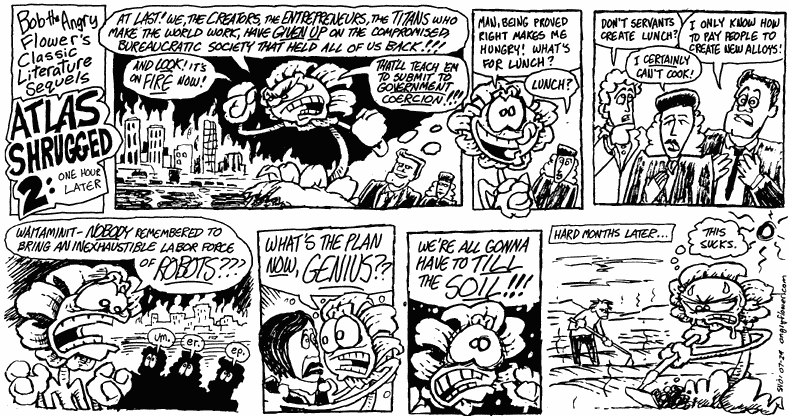
Ugh, such a gross misinterpretation. One of Rand's big points is that it doesn't matter what you're doing as long as you do it well. One of her physicists becomes a janitor, and when the misguided protagonist expresses horror at that, he says that there's nothing wrong in doing menial tasks.
Bob is incredibly stupid because he makes fun of something that Rand expressly says is a good thing. Furthermore, the Rearden parody ("I only know how to pay people to invent alloys") ignores that in the book, Rearden is the scientist who invents the alloy himself. He's portrayed as a very skilled mathematician. So it's a good parody IF you're okay with laughing at something that Rand never actually wrote.
This is a perfect testament to the masses of people who think they understand (and thus have license to lay valid criticism on) Rand because they read the first 30 pages of Atlas Shrugged.
I'm so sick and tired of hearing some pseudo-sophisto unload on Rand at a cocktail party, their insults and blind lambasting only to abate when confronted with questions about Rand's actual philosophy and works as opposed to her reputation.
Apologies for being slightly off topic, but since there are a number of Atlas Shrugged readers here, I have a question:
Is it worth reading? Most discussion about the book seems to be about Objectivism in general, understandably. But aside from the philosophy of the book, is it an entertaining or interesting read? (or is that like the quotation asking "Otherwise, Mrs. Lincoln, how was the show?") I generally like to read books that are getting talked about, but I've heard so many mixed reviews of this it's a tough decision.
I think it's a better idea to read one of the shorter books first (IIRC the Fountainhead is pretty short). Atlas Shrugged could be cut down to about half the size and make the point it's trying to make better (by virtue of being more concise).
Personally I find it fascinating that the characters in the book (and Ayn Rand) constantly reiterate that "decisions should be made on logic and rationality instead of emotions" but the entire book is driven by pathos instead of any logical argument.
All the "good guys and gals" and smart, beautiful and horny. All the bad guys are ugly and stupid. They constantly use tautologies ("A is A") as if it was a way to debate with logic (it's not). And it never provides any attempt to prove that the entire premise is true or even feasible. Say what you want about Karl Marx but he did at least attempt to make a rational argument.
All that said you may still enjoy the book. Personally I've read a lot other books which make the same, or similar, point but better. Animal Farm springs to mind (no, it's not about objectivism, but it is about how power corrupts people, or animals).
I recommend reading Atlas Shrugged first... the Fountainhead is a great book too, but not quite as good.
I suggest you download the unabridged audio version of Atlas Shrugged from audible.com or iTunes. It's read incredibly well and you'll probably enjoy it immensely...
I loved Atlas Shrugged (though it did take me a while to complete the speech), and coincidentally, I'm working on Dune right now, but I'm honestly struggling, and I haven't even reached page 100 yet.
It's just a little slow for me. Though having seen the movie and the miniseries, and knowing a fair bit of the Dune lore may be taking some of the "discovery" out of it.
Except for the speech, I didn't think Atlas Shrugged was slow at all, just LONG
Patents and copyrights are the legal implementation of the base of all property rights: a man’s right to the product of his mind.
...
But what the patent or copyright protects is not the physical object as such, but the idea which it embodies. By forbidding an unauthorized reproduction of the object, the law declares, in effect, that the physical labor of copying is not the source of the object’s value, that that value is created by the originator of the idea and may not be used without his consent; thus the law establishes the property right of a mind to that which it has brought into existence.
...
The government does not _grant_ a patent or copyright, in the sense of a gift, privilege, or favor; the government merely _secures it_ i.e., the government certifies the origination of an idea and protects its owner’s exclusive right of use and disposal.
Piracy constitutes "unauthorized reproduction" and such falls under the above passage. Thus, it is with great irony that one would advocate pirating the works of Ayn Rand.
Suppose a person agrees about property rights in general, but believes certain circumstances are extenuating.
None of the quotes you provide argue that he is wrong. Rand could have agreed with him. It simply doesn't say, either way.
One such extenuating circumstance might be this: no harm is done to the property owner. Then if there is a crime, it is a victimless crime. A libertarian like Rand or myself might think in that case it's really none of the property owner's business, since it has no negative effect on him.
Not all downloads are harmless, but some are. Property rights advocates can disagree about how many. The passages you quote don't say where Rand stands on this.
Of course they don't discuss internet downloading, these essays were published in the 60s, and she died in 82.
What she does mention is "unauthorized reproductions" of which piracy is explicitly. Once something is in the public domain, then it can be freely copied without anyone's permission, but until then, it remains an unauthorized copy.
The movie in question is still protected under copyright.
If you want to talk IP durations, then that's a different discussion altogether. What stands is that your original post advocates the unauthorized copying of a work still under protection of copyright, in this case, of a Warner Bros IP.
The victim is the copyright holder. Just because someone doesn't wish to buy a movie (book, song, whatever), doesn't give them the authority to copy it.
And in some cases the copyright holder is not harmed in any way.
Do you dispute that? Are you saying in absolutely every case of downloading, the person would otherwise have paid?
Even if you think that's true in every case, you have no evidence that Rand did. I know plenty of free-market libertarians who think its sometimes a victimless crime.
(Disclaimer: I am not a libertarian or an Objectivist.)
IMHO one of the characteristics of owning something is that you have the right to control how it's used without having to justify that decision to anyone else. If you camp out in my back yard while I'm on vacation, you are trespassing on my property even if you don't uproot a single blade of grass. I don't have to argue with the police about whether or not my yard was damaged by your presence because the law considers trespass to be damage in and of itself.
Now I think extenting the concept of "property" to intellectual works is fraught with problems, but I don't think Rand would agree with me.
It doesn't matter if they were going to pay or not. One needs to have a right to copy something before one can do it, and only the copyright holder has the right to grant that to another. There are no exceptions. If anyone can copy another's work without permission, why have copyright at all? Do you oppose copyright? Does copyright only hold if you were planning on paying in the first place? What would that even mean?
In the spirit of Atlas Shrugged, I invite you to "check your premises" :)
The primary purpose of copyright is so authors/etc can get paid for their work. If something doesn't harm their ability to get paid in any way, then why should they mind it?
It's true that some piracy harms their ability to get paid. And some doesn't. Why are you unwilling to differentiate?
Of course I'm in favor of copyright. And I would never ask an author to sacrifice himself altruistically for the good of humanity. But why should not an author be happy to see people exposed to his ideas, to their benefit, in the cases where it does him no material harm?
Your position seems to be the author is harmed b/c his rights were violated. But the whole point of rights is to protect him from harm, not to provide a platform for him to tell others what to do. I think it's very un-Randian to get intolerant when someone does no demonstrable material harm. Do you think Roark would rather sue people for copyright infringement or make buildings? The best way of life, in the Randian way of thinking, is if you don't like people or their actions, you ignore them as far as possible, and get on with your own life.
But why should not an author be happy to see people exposed to his ideas, to their benefit, in the cases where it does him no material harm?
It's not my place to tell the IP owner what he should or shouldn't do with his property. The copyright holder has ultimate and absolute ownership of their IP, and while I think there would be great benefit in the works of Rand* going public domain, it's not my property to dispose of.
I respect the owners' terms by which their IP is distributed.
What meaning does copyright have if someone can copy something and say "I wasn't going to pay for it anyway"?
* Less so for The Fountainhead movie, as it's honestly not that good, imo. Gary Cooper had admitted (citation needed) that he didn't even understand the courtroom monologue at the end, which accounts for his delivery lacking the proper emotion. It's worth seeing if you're a fan of Rand, but if you want material to chew on, read the book.
You are not addressing the issue of victimless crimes. Do you think Rand supported victimless crimes? I am not advocating Rand's works be public domain, or be free to all. I'm advocating that harmless copying take place, only. To start with, can you see how there could ever be a case of harmless copying?
a: i was harmed.
c: how?
a: my rights were violated.
c: how?
a: a young child with no money downloaded and read my book without paying
c: and how did that harm you?
a: by violating my rights.
c: were you harmed in any way other than you rights being violated?
a: no
c: what do you think the purpose of rights is?
a: to protect from harm, and to help people live more morally
c: so basically the thing to protect you from harm was violated, but you weren't actually harmed in any way?
a: no, i was harmed. i told you. my rights were violated. that's harm.
c: how did it harm you? what bad thing happened to you?
a: the bad thing is my rights were violated.
c: doesn't it seem circular to say you were harmed b/c your rights were violated, and you object to your rights being violated b/c it harms you?
a: are you saying copyright shouldn't exist?
c: no. are you saying victimless crimes should exist?
a: it's not victimless. I"M A VICTIM.
c: some Randian you are, all eager to be a victim.
a: it's not my fault. i didn't want to be a victim. the young child victimized me. i have no choice but to sue him.
c: did you consider writing another book? that might be more productive than a lawsuit.
a: i already created. i already produced. i deserve money for it.
c: you got some money
a: i want more.
c: well, that child doesn't have any
a: i'll sue his parents!
c: aren't you glad he read your book?
a: oh, yes, that's wonderful. so, his parents are responsible, right? I wonder how much money they have.
c: why do you think of them? think of yourself. ignore them.
a: that's crazy.
c: it's how Roark lives.
a: that's crazy.
c: would you be happy if i loaned the kid my copy of the book?
a: well, sure, you have every right to loan it.
c: he lives pretty far away. mind if i send him a scan of it?
a: but then there'd be two books! you didn't buy two!
c: while he has the scan, i won't read my copy. only one will be in use at a time.
a: oh, then it's ok.
c: so, basically, you're OK with him reading the book without paying, as long as some effort is made to be sure that the number of people currently actively reading the book is less than the total number who bought it?
a: i guess.
c: you realize the total number reading the book is far less than the number that were bought?
a: erm. well, how many participated in a lending plan like this?
c: so if they do a lending ritual, which costs them nothing, then you're ok with them reading your book, but omit the ritual, which has nothing to do with you, and then it's a crime?
a: yes. no ritual, no reading.
c: so you think the world is a mess right now, with all this rampant piracy. but if only there was a website where everyone with a copy of your book registered. and then people currently reading the book made an "in use" tally while reading it, and then number of tallies was kept below the total registrations, you'd be happy?
a: that'd be great.
c: you wouldn't get a dime more. and in fact more people would read electronic copies of your book, without paying, then.
a: but my rights wouldn't be violated. i wouldn't be harmed.
c: how does the existence of that website help you?
a: by protecting my rights, so i'm not victimized
c: i mean, in what way does it materially benefit you, or improve the quality of your life?
a: it makes people pay for reading my book, at least they have to make the effort of visiting the website. they can't have stuff for free. that'd be an awful world to live in. people need to learn that life is hard and expensive.
c: but what if it isn't? or doesn't have to be?
a: what are you, a humanitarian?
c: yeah.
a: it hurts me to imagine a paradise like that where i'd have to change my ideas about rights.
c: don't worry, there will be some books available to advise you.
To the best of my knowledge, when a copyrighted work is made available for free over the Internet, it's available for free to everyone. Nobody has to prove that they are so destitute that they could not possibly afford to pay even one cent for the work before they are allowed to download it. So your hypothetical case of a child with no money downloading the book is a red herring.
The concept of a victimless crime is difficult: let's say we have a kid with no money. Currently, pretty much the default route for that kid to get music is to simply pirate it. In the past, a music-loving kid might have done extra chores, got a paper route, or whatever to earn some extra cash and buy the item. The fact that someone has no money now is no indication that they wouldn't buy something if they had no other route to accessing it.
Now of course, some crimes really are victimless. People pirate stuff that they really wouldn't buy. I certainly don't quarrel with you that in this case no significant harm is done to the property owner. The key problem here is the issue of enforceability. Maybe you and I can be trusted to pay for the things we really think are worth it, but if you think everyone can, you're probably mistaken. How do you enforce copyrights if all an illegitimate copyer has to do is lie and say that they wouldn't have bought the item?
The law needs to be enforceable, and it can't possibly effectively cover every corner case. It is of necessity coarsely grained, and some activities that are victimless are nonetheless criminalised for the greater overall good: so that victimising actions can be punished. Now, you may not agree that intellectual property rights are the greater good, but that's another discussion altogether ;).
I don't see how "the law needs to be enforceable" can be an anti-torrent position. Shutting down torrent sites isn't working out so well. They just provide information, like Google. The actual people doing file transfers are the ones who ought to be in trouble, but that's even less enforceable.
It is enforceable. I agree that it's hard or impossible for rights holders to effectively defend their IP in the current environment, but it wouldn't be all that hard for governments to make torrenting too much like hard work for the average individual. Of course, this rightly entails questions about whether defending the IP is worth it, but that's a different issue.
Well, I'm not sure, but I think too much emphasis got put on TPB in my message. I mean, based on my own understanding I don't think Rand would approve of people getting the full benefit of her work without people paying. But I also think she would have tremendous respect and appreciation for Amazon.
I've read the book a few times. I've always ended up skipping over the last half of the Galt speech, so the idea of skipping the rest of the book just to read that never ending speech seems funny to me.
No, it's not worth it, unless you specifically like reading very dry passages. I slogged through it but only out of a sense of commitment to reading the book in its entirety.
I loved the Galt speech but it has been a few years since I last read it so I don't recall how much lead-in it requires. Sometimes I listen to the audio version of Anthem Chapter 11, another powerful speech.
That's Atlas Shrugged 2, due out a month after the main movie.
(Is it too off-topic/nerdy to make comparisons between that speech and the Spirit Bomb week from Dragonball Z? Something about way-too-long things is extremely hilarious.)
I was scanning and did a double take on this part:
"A high net-worth individual with whom the Baldwins have partnered"
For a moment I thought they were talking about Alec Baldwin and his brothers as producers. My Imp of the Perverse is sadly disappointed that it isn't so.
I thought this was an April fool's joke, but IMDB has a page for it and a quick Google search does turn up articles from 2006 mentioned Jolie being attached at one point.
It's been going for over 35 years, Jolie was cast but in 2008 got pregnant and the project is dead again. I personally hope it stays dead, the last thing we need is something else promoting government inaction, which gave us this problem in the first place.
The main reason the financial crisis happened was pure greed and the reason people got away with being so greedy was because they were allowed to. Umm... what's that thing called where companies are allowed to do absolutely whatever they want even in complete disregard of even their own long-term survival... oh yeah aggressive-free-market capitalism, just what Ayn Rand wanted.
I hope Ayn Rand's work is dead and gone so that at least my generation isn't going to suffer the complete stupidity. I'm 21 and I've already been through two large recessions thanks to the US, coming from the UK I hope to sweet god that America stops following moronic policies and starts towing the line with the rest of the world.
Quite honestly, if there's a 3rd economic recession because of the US, I'm going to start voting for the people trying to ban international trade with the US, at least then the US can kill itself without ruining everyone else's country too.
>I hope Ayn Rand's work is dead and gone so that at least my generation isn't going to suffer the complete stupidity.
I think a work of literature that has had such an impact should never be lost or forgotten no matter how much you disagree with the content. Mein Kampf is a great example of this.
Seconded. Atlas Shrugged has a hell of a lot to teach people, young individuals in particular. Frankly, I liked the Atlas Shrugged dicks more than I liked the emo dicks at 16. The guys that read Atlas Shrugged avoided a lot of the existentialist angst, and some of them went on to do some cool things with their time. That's worth the many people who get obnoxious after reading it.
Honestly, for all I dislike Rand's work, as a writer I'd have to agree.
From a sociological point of view, ignoring your history (either physical history like WW2 or economic and political history) is likely to cause the problems to repeat.
Coming from Europe and suffering two recessions caused by US economics, all which Ayn Rand promoted I hope this crap never gets turned into a film.
The economy grows at a fair rate on average, yet Rand's aggressive-free-market capitalism basically promotes trying to grow the economy at 5000% until pop and everyone who doesn't have $500 million in the bank gets screwed over. I'm sorry, but when someone gets fired and then handed a $150 million check for losing their job, I think capitalism flat out sucks.
All the CEO's who've been fired have lost their jobs for a reason: bad business. Yet they're rewarded with more money than an average person would make in a millennium. Yet if I lost my job, I'd be given nothing.
Well, high-paid CEOs are one of the things laissez-faire capitalism didn't really do well. Not the salary per se, but the very caustic obsession on short/medium term profit over long term. You can't really blame regulations here: the most important one was forcing companies to disclose CEO salaries 20 years ago, and we know how that turned out (they exploded because of competition).
I'm very much in favor of Rand's ideas, but we must admit they do require a rather hard to find mix of idealism and dedication for all parties involved in order to work out. They're a good start, but far from a final solution.
Well you kinda sorta can: the board has a fiduciary reponsibility to the shareholders, which is good, but the regulations and penalties in place to enforce that mean that there is an obsession with quarterly figures - it actively discourages long-term planning. No-one dares make tough choices now that will depress the share price for 2 or more quarters, they'd get class-actioned into oblivion. A vast corporation that has been public for decades can weather it. A newly public company is in a very difficult position.
Enlightened self interest doesn't work on a scale necessary for a civilization to function.
Every nation that has next to no government and every man is free to do with his life as he wishes is a giant shithole that teeters in and out of revolution. Want to see objectivism at work? Go visit Somalia or the Democratic Republic of the Congo. In those countries every man is free to pursue "... his own happiness as the moral purpose of his life, with productive achievement as his noblest activity, and reason as his only absolute." Countries full of people who are "all noble heros free to pursue their dreams". Too bad their dreams all involve mass murder and slavery to pursue personal wealth and power.
Hobbes was smarter than Rand. We have a Government to protect us from each other.
I don't think you'll find Rand objecting to a government that protects its people from physical aggression or coercion. The problem I have with most world governments (including my own), is that they try to (and fail at) protecting people from matters that the people are capable of handling themselves. In doing so, they rob people of their motivation and self satisfaction.
I understand why people would think that Rand says "you should only care about your own life and happiness". But that is bullshit. It isn't considered bad to care about and care for other people (look at Dagny and Hank/John/Francisco). What Rand is railing against is being forced to care about another person (which is what the government does to the producers by threat of coercion).
I'm a firm believer in Rand's theories, but that certainly doesn't stop me from donating my time and money to worthy causes. The important part is that my donations are made of my own FREE WILL and not forced at the barrel of a gun.
All over the Internet (even a few other forums for the highly intelligent), there are people trying to blame the recession the "unfettered capitalism" we've apparently gained over the last decade. At HN, I expect people to know better, or, at least, to only have to be taught once.
Just because you disagree with someone doesn't mean you downvote them. This is exactly the kind of attitude that fosters groupthink and drains the life out of forums.
What gets on my nerves isn't whether people like capitalism, it's whether they go around saying that the system we have now is laissez-faire capitalism, and then huge bonuses to failed executives are testament to that. I have full respect for someone who has a very clear idea of what capitalism is and argues against it nonetheless.
I downvoted electromagnetic because he distorted what Rand's actually saying. I upvoted him everywhere else in the thread, where he argues about the book, but I thought that it was worth downvoting inaccuracy.
I feel that it would be better to point out the inaccuracy, which could very well be a result of misunderstanding on electromagnetic's part. I believe downvoting should be reserved for more egregious errors (trolling, off-topic, rudeness, and so on). I think you raise a separate point than Darmani did, however. He was focusing on economic ideas and topics that are far more open to discussion as a reason for downvoting.
Actually, if you look at the history, you'll see that many in the Canadian government and the banks themselves felt that they were missing out on all the great action that US banks were able to get in on. It was the prudence of the government of the time that saved them. If it was left up to them, the banks up here would be in the same state as American banks.
To suggest however that the government somehow forced American banks to lend to people that didn't deserve it against the bank's better judgment is garbage. That doesn't explain half of the EU's current problem.
No, the one exception between Canada and the rest of the world right now is that we have tighter regulations on our banking sector.
Incidentally Bank of Montreal actually ran a profit on interest from bailing out the US' system.
A considerable amount of money spent in the US bailout of banks actually ended up in Canada, Europe and Japan due to debts the US banks had already accumulated.


It's a good book but like anything else people extrapolate the points beyond recognition and additionally interpret it to re-enforce their own views, regardless of how unreasonable those views might be.