I'm not going to argue on how expensive it is, but consider this: a 24 hour subway means many fewer people would have to drive. If you don't have to drive, you don't have the choice between not drinking that night or leaving before midnight. If drunk driving is reduced by eliminating cars, then 'last call' can be extended to, say, 4am. Less traffic, less drunk driving accidents, more booze, more late-night coffee shops.
I hear ya, but it would require laying a second track along the entirety of the BART system.
This is a woulda/shouda thing going back 60 years to the original construction of the system. Even if we gave BART billions in funding, there are certainly better uses for that money (Build a rail line into OAK, extend service on all the currently-approved-but-unfunded routes, extend to San Mateo, and deal with some expensive, lingering issues with the transbay tunnel.)
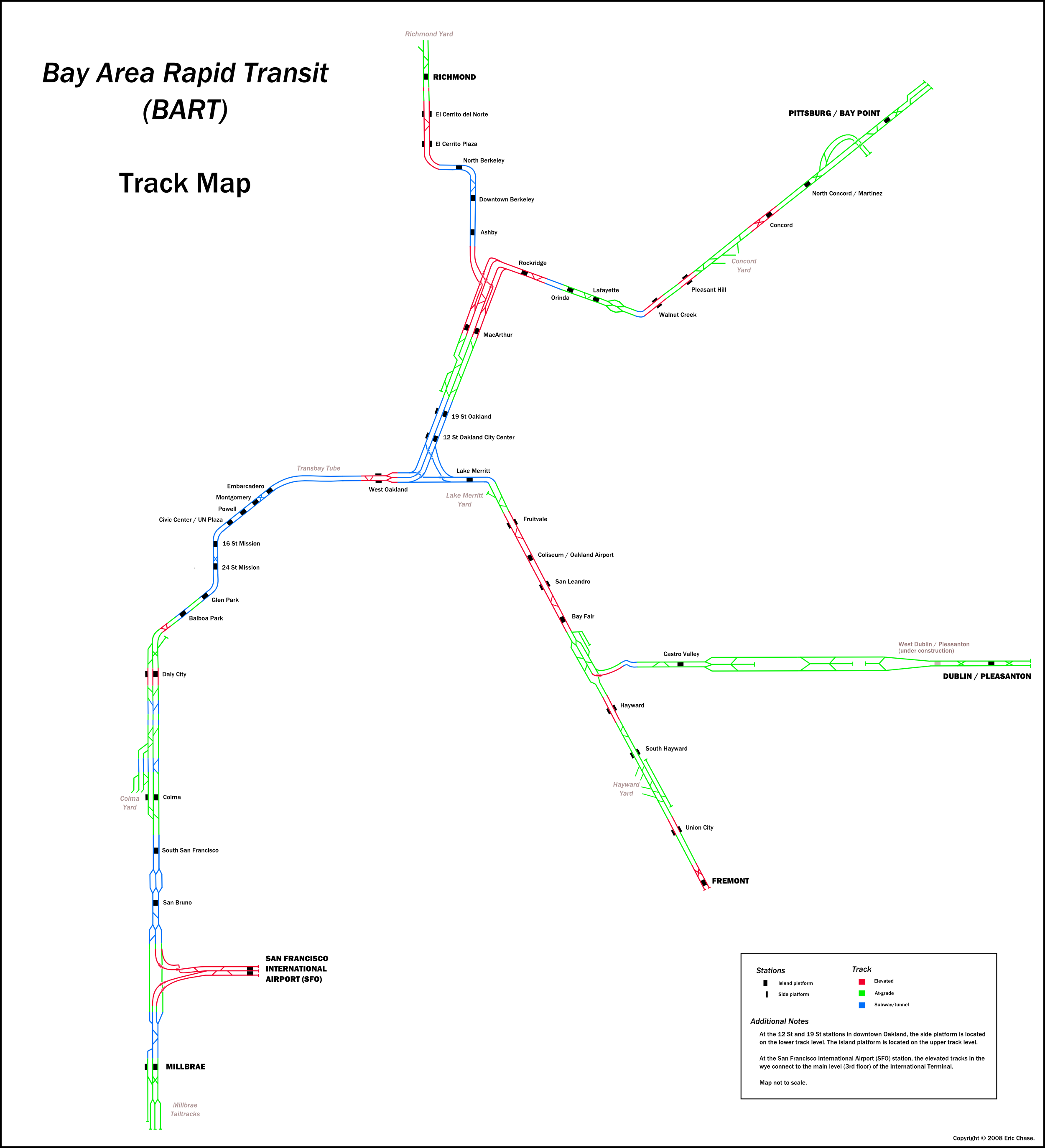
Did you mean a third track? BART is already double-tracked or more along its entire length. The reason they close the system at night is because they can barely keep up with car and track maintenance.
I think late-night CalTrain (or late-night BART on the peninsula) would be more useful than 24-hour BART.
First, the city has buses running at night and there are 8xx buses that run along BART lines after BART is closed. While one's experience on BART is much better than on a bus, current options don't require that much more time.
Second, the last north-bound CalTrain leaves Palo Alto a little before 11 pm making it really difficult for people living in the city/East Bay without a car to do evening activities there. If one wants to get back, the best options are spending two hours on a SamTrans bus into the city or taking an expensive cab.
If the trains were automated, the cost of running some short trains in the middle of the night would be (at least more) reasonable. The Copenhagen Metro runs 24/7, for example. I believe BART trains are actually capable of fully automatic operation, but haven't gotten regulatory permission to run without an operator.
That's consistent with my recollection riding BART. Shutting down one of the two tracks for unexpected daytime maintenance ("single-tracking") is a common source of delays, since in single-track mode the system can't run nearly as many trains per hour due to the need to pass at specific points. But it can still run some trains, probably enough for a night service.
It's definitely true. BART has one track in each direction. Systems that run 24 hours have dual-tracks in each direction or segmentation that allows them to individually power-down segments of track, though that isn't really 24/7 operation anymore.
You can research this but I'm not going to do that for you. I'm comfortable that I'm correct, if you're not, well, meh. It's not personal, I'm sure you can understand.
And to your original point -- the engineer driving the train is a fraction of the cost of keeping the system running. Even if BART was dual-tracked, the salary of the engineer doesn't hardly move the needle on their costs, which include: Salaries of station agents and security, additional maintenance and wear-and-tear, janitorial (including dealing with higher janitorial costs between 2AM and 6AM than other 4-hour periods due to the nature of overnight passenger traffic), baseline power costs to keep the power rail hot at 1000+ volts over 100+ miles of track, etc.
Oh, yes, it has one track in each direction. I thought you were arguing it was actually single-tracked in portions, the way some commuter-rail lines are, and which was the original proposal for the SFO extension. The Copenhagen Metro is also one track in each direction, and runs 24/7. At night it will sometimes (if maintenance is needed) run in single-track mode, with one of the two tracks powered down in a segment, the same way BART operates during emergency daytime single-tracking. Perhaps that's not "really" 24/7 operation, but it does produce the effect of uninterrupted 24/7 service from the passenger's perspective, since it's able to maintain its scheduled nighttime headway of 20 minutes even when single-tracked through a segment, barring exceptional circumstances.
You are misusing the term - in rail systems, double-tracked means that the system (or line) has two tracks, typically one for each direction. Their are systems (MTA/NYCT most notably in the USA) that have more than two tracks, although in NY's case, it's to allow local trains and express trains to run on different tracks.
In a single-track system 24/7 operation is not possible:
In double-tracked systems, there are crossovers (typically located near stations, but they can be anywhere) or switches to storage tracks that allow traffic to be routed along single tracks as necessary to allow track segments to be taken out of service.
The primary argument against 24 hour operation is that it allows for track maintenance, and is required because BART lacks redundancy throughout its system. The system is shut down for 4 hours, from midnight through 4am, nightly (counting end-point departures, service actually runs slightly later from some intermediate stations).
That said, it's double-tracked in many (though possibly not all) sections, which might allow for running periodic service along one set of tracks, assuming switching and train control systems would allow for this. With a full circumnavigation of the Bay, it might also be possible to phase system downtime such that service might run on either eastern (Contra Costa) or western (Penninsula) lines, with service between SF and SJ. By phasing which specific track segments are down for maintenance at any one time, effective coverage of much of the system might be possible (at the cost of greater scheduling and maintenance complexity).
Triple-tracking the system could also provide for this, though at much greater infrastructure and land costs.
As it is, the 4 hour shutdown doesn't affect too many patrons, and service during operating hours is very reliable (much more so than other regional transit sywtems, or driving).
It should be feasible to run it 24hrs during weekends only. Stockholm's subway does this and is closed normally at night weekdays. The headways are long enough (30+ minutes out on the branches) that repairs can be carried out if need be by switching to the other track (not sure if they actually do this regularly).