Photo Voltaic, or PV, of course.
14 GW just in 2023 alone.
Note that Gigawatts is the installed capacity, but GWh is the actual production. Germany produces 2.5 times more energy from wind, rather than solar (quite intuitive, considering that solar is much less productive in Germany compared to, say, Greece or northern Africa).
From Wikipedia [0]:
Germany's installed capacity for electric generation increased from 121 gigawatts (GW) in 2000 to 218 GW in 2019, an 80% increase, while electricity generation increased only 5% in the same period.
The main problem with renewable energies, at least in Germany, is that they're not replacing anything, they're just added on top of existing fossil sources, so in the end we still pollute as much and we're still as far as ever from our end goal.
The fact that we consume so much more just hides the truth behind nice percentages. The reality is that Germany burns as much fossil fuel as they were 20 years ago, and on top of that they offer the most expensive end user kwh price of Europe
You are confusing installed capacity with power used. The consumed power is going down since the early 2000s, but since the generated power by most renewables depends on the weather and season, more reserve capacity needs to be installed.
The reserve capacity , would need to be 100% - to be able to supply the country for at least several days if/when renables are not able to produce , most likely due to weather.
That's why Germany is building a lot of new gas power plants. They're cheap to build and can be turned of and off really quickly, so it's okay if they're only really needed for a few weeks a year. The new power plants are also planned to be able to handle hydrogen which can be produced with electrolysis (during an oversupply of renewables) and then stored underground.
Currently about half of the gas in Germany comes through pipelines from Norway, the other half is mostly from the the Netherlands and Belgium (which I think import a lot of LNG to ship to Germany).
Russia - is now (thanks to Germany) one of the top exporters of LNG.
With some creative accounting (rewriting labels) of where the oil/gas/lng came from (Russia) -> even India is now a Net exporter of oil.
Please note that LNG is even more environmentally damaging than burning coal.
Australia is a big exporter of LNG...they even need to liquify it to use it themselves (where gas is available is often too far away from where people are to use just pipelines).
The contribution of renewables has never dropped below 30% over a full day in Germany in the last year. Good thing is that wind and PV are often complementary.
The capacity doesn't have to be constantly burning fuel 365 days a year in order to solve weather issues, just for however long the combination of startup/shutdown time and adverse weather duration.
Adverse weather conditions can be predicted sufficiently well in advance that this matters.
And yes, they know of the concept of getting electricity from south to north or vice versa - and there are already High Voltage Direct Current transmission lines in place and more on the way (much more efficient, to transport electricity long distances).
Portugal is within a stones throw of 100% renewables due to its pumped hydro storage and Spain interconnector. Extrapolate through Europe accordingly. Don’t stop building renewables, transmission, and storage.
You're looking at consumer prices of electricity two weeks after Gazprom stopped its gas deliveries to Germany indefinitely, which lead to a heavy price shock. The graphic also ignores that some countries like France simply prohibited companies from raising prices in 2022. Lastly, the consumer price comparisons are flawed because they include taxes and levies and Germany adds plenty of these. German electricity production is not nearly as expensive as the consumer prices suggest.
The claim that Germany's electricity is as dirty as ever is also not true, the CO2 per KWh decreased by 350g over the past 30 years.
I just wish this was the price on my bill. But it’s not. It’s 13x more and we are waiting for: the VAT on electricity to go up to 19%, co2 taxes (aka the budget filler money) to go up, and the removal of the price cap for end consumers. 2024 will be wild in Germany. But energy companies will make a killing.
The contract has a two weeks notice period. So I could easily switch to a different provider, but I doubt that would change things long term - most providers also buy from the spot market.
BTW this spot market plan would have been cheaper than my previous, regular plan when the energy price hikes hit last year.
I live in Sweden and my electricity bill would be cheaper in Germany. Why? Because in Germany, base fees are so low. 5ct per kWh doesn't help you when you pay 24€ per month to be connected to the grid.
Hence I always simply chuckle when people say „the electricity is so cheap as never, 0.03€/kWh”. Yeah, to manufacture. No end customer ever sees that price.
Same thing with water. For residential. Most of the cost is the capital costs of the distribution network. You'll always pay way more than the water district pays.
Example. A friend lives in a tiny water district. Used to not be metered. Then they installed meters and usage went down. They had to increase the rates to make up the difference and people were really mad. And usage went down even more. It was kinda brain dead because their water comes from a huge spring so it's free as in beer.
I'm a bit suspicious in the US that rates are higher where per capital consumption is lower. And probably also depends on max vs average usage. In practice capital costs of both generation facilities and distribution are being rolled into the rate part of peoples bills.
Consider California is using probably 25GW today. But has 50GW of capacity which has to be paid for whether it's operating or not. Also uses half as much per capita as other states. Stands to reason capital costs will be a higher proportion of the bill.
A bet I'd make is as people switch to heat pumps and electric cars consumption will go up and maybe rates will drop.
if you pay 13x more, which is 0,42 Euro, you are just too lazy to switch to a new contract, which usually is about 0,27 Euro/kwh.
You can even get significantly below that using dynamic contracts where the current price is based on spot market prices.
Unfortunately you can't just turn on/off coal at will. Gas is easier but still takes some time. This is why renewables solve very few problems. They are not really a replacement for anything.
The main reason why Germany increased coal usage last year was because they exported it to France. Because their (french) nuclear plants were in maintainace or lacking cooling water.
And why is everyone always looking at the momental situation? Look at yearly tendencies if you want to see what happens.
Edit: since people are down voting, here is a fun fact for you.
Power generated from nuclear:
France 2016=415TWh; 2023(ongoing)=312TWh
Germany 2016=80TWh;
So optimistically for France -95TWh/a, Germany -80.
Greens (the world over) aggressively attacking nuclear is quintessentially that meme of the cyclist shoving a stick between his own spokes.
In 25 years, when we still have to keep coal plants turned on because we couldn’t magic enough battery capacity into existence to compensate for base load, those coal plants should have giant billboards next to them with this generation’s green politicians.
All the utility grade battery capacity was added in the last three years.
What's kind annoying about solar, wind and batteries is we could have done a moon shot program in the 70's to develop the industry but we didn't. So we wasted 40 years and trillions on fossil fuels and nuclear. If we had taken the money spent on nukes in the 50's and 60's we would have been switching over in the 70's.
Wasn’t nuclear supposed to be the “moonshot” of the 50s and 60s? I guess another problem is that they would’ve had to solve both solar panel and the battery issue at the same time.
My dad said when he was a young engineer nuclear and space was going to be the future and it didn't pan out. Friends dad was a nuclear engineering professor and said I retired just in time.
I think battery storage costs something like $100/MWh or 10 cents per kwh. (Don't quote me/find a reliable source). Batteries increase demand when there is excess supply and increase supply when there is under supply. The result is lower price swings. The price differentials are higher than the cost of storage which makes them balance sheet profitable. The notable thing is the buy low sell high cycle is 24 hours, not weeks or months. From an arbitrage point of view that's exceptionally attractive. Better than buying wheat futures in the spring and trying to offload them in August and sometimes losing your shirt.
I’ll just copy my comment from elsewhere verbatim:
Projected battery production capacity makes this a a pie in the sky. Every western country + China will be clamoring for batteries, on top of virtually every industry.
The only solution I hear from “green” people is the “future battery technology” MacGuffin.
> Every western country + China will be clamoring for batteries, on top of virtually every industry.
Yes, which by the power of "hey look there's a lot of demand for that, we should invest in some factories to make money servicing that demand" means a lot of people make battery factories. And mines. And processing plants.
Which is why it's clear that if…
> The only solution I hear from “green” people is the “future battery technology” MacGuffin
You're not listening to the sound of money being made.
Imagine we build 3kwh worth of batteries per world capita. Or 8 billion people. And the batteries cost $100/kwh. That's 2.4 Trillion/Year. No ones leaving that kind of money on the table.
Indeed, and despite that being not too dissimilar to annual fossil fuel costs, that figure also assumes the batteries have to be replaced each year, it's probably more like every three to ten years.
> we couldn’t magic enough battery capacity into existence
"My Little Investment: The Invisible Hand Of The Free Market Is Magic"
UK has mostly shut down coal. Has one single plant hanging around just in case. In 2020, Britain went 5,202 hours free from coal electricity generation, up from 3,665 hours in 2019 and 1,856 in 2018.
And that's without significant quantities of batteries, because there's more than one way to store energy and more than one way to fuel backup generators if those storage systems aren't sufficient.
energy is the economy and france hast the most affordable energy in europe which would give a competitive advantage if its leader didnt plan a global european price destroying its own nuclear industry thanks to german and green party influence that hated the competition.
Don't talk such nonsense. The capacity additions in renewables are so enormous that by 2030 most European countries will run so much surplus during summer that we will likely not know what to do with it. TFA talks about tripling in solar in Germany until 2030!
The only chance for needing any more coal in 2030 will be as a contingency if Putin is still fighting in Ukraine at that point.
A surplus is useless without storage, and with projected battery production capacity having enough grid storage is a pie in the sky. Every western country + China will be clamoring for batteries, on top of virtually every industry.
The only solution I hear from “green” people is the “future battery technology” MacGuffin.
The surplus in summer during noon isn't useless bit rather means that during morning and early evening we need less fossils. This is the main point of all of this, remember?
A surplus also leads to reduced prices which enables novel uses such as charging an electric vehicle for very little money. This replaces CO2.
The market will be clever to profit from the available cheap electricity.
You’re also importing tons of renewable energy from scandinavia. Sweden for example exported 39TWh in 2022 alone - which of a majority is renewable energy.
And in addition to this, if you’d build the new energy sources based on coal, things would of course just get worse while implementing renewables doesn’t increase emissions in the same fashion.
If PV prices continue to plummet like this, it'll become feasible to just produce hydrogen. It's not optimal that there isn't a grand plan but there are various ways how even base load can be covered through storage once it's set up
This is a gas industry falsehood that has to stop being spread.
Hydrogen efficiency would have to improve ~350% to be competitive with current battery electric stored power. That’s just never going to happen, particularly as battery electric is dropping ~15% in price / becoming more efficient every year.
Battery electric is to power storage what silicon has been to chip manufacturing.
But the point isn’t that it’s “better” it’s just that gas (really only H2) provides the volume of storage to meaningfully transfer energy between seasons. It’s mostly about capacity not about efficiency
If you need to fill a 20 hour storage system in 4 hours of sunlight, you care about how cheap the electricity is to generate and overproduce accordingly in better seasons. PV is cheap, and also not the only renewable so it may not even be as bad as 20:4.
If you need to fill a 6 month night storage system with the sunlight from the other 6 months, instead of overproducing in summer you care about the storage being relatively stable and dense enough you don't run out of space. There may well be enough space, though at the scales that matter you'd need a lot of pipes or transmission lines depending on where you want the hydrogen powered generators, and a good electricity grid diminishes the need to store it anyway (a sufficiently good grid, 1m^2 aggregate cross section, doesn't even need any storage, because the planet is a sphere).
Given how many people react as badly to hydrogen as to nuclear, just replacing Chernobyl with the Hindenburg and a misunderstanding about hydrogen bombs, I think sufficient storage will be tricky politically even if you solve all the technical issues.
If you see a way to make it happen anyway, go for it. A plurality of solutions makes black swan correlated failures less damaging.
Guess what: we already have the storage capacity for that. We currently have something like 200TWh of gas storage. Once we don’t need that anymore for heating (give it 30 years) it’s free for hydrogen storage. This pretty much selects the locations for the grid-scale electrolyze installations. They must be either next to the storage sites or along the pipes. The latter already covers significant parts of Germany. Yes it’s inefficient, I’d be surprised if you even get 50% roundtrip efficiency, but it’s effectively free (at least compared to build battery capacity or nuclear power plants).
If only chemistry was so forgiving. The existing methane infrastructure isn't nothing, but it's also (from everything I've heard whenever this comes up) not everything either.
OTOH, I have heard hydrogen is a lot friendlier when mixed with methane, so I assume this will still be very useful when transitioning to whatever comes next.
Sure the storage tanks aren’t completely tight, so you will have some amount of leakage. But that’s (afaiu) mostly a problem of the distribution network. The tanks themselves are rather small and even if they leak 20% of their capacity.. who cares? You still get 200+TWh storage (because H2 is more energy dense than LNG) and you shouldn’t burn it either. Just use the reverse process to get electricity back. Yes _those_ plants aren’t there yet. They will have to be build. But that’s much less of a problem (10-20 locations) than upgrading all of the distribution network and all the heaters in every building!
We will have to move away from gas-to-buildings though and that will require an upgrade in like 60% of the buildings. Industry is much less of a problem, because at the end of the day, their consumption is much less seasonally influenced (2x, rather than 10x) and only about 1/3 of total gas consumption anyways. So deal with the 2/3 block first. Then chase the rest
But the whole point is that 1) at peak solar times electricity is free (meaning wholly insufficient storage) and 2) the upfront cost of battery storage is rather prohibitive right now, while a hydrogen system is (I'd naively assume) technologically simple.
Where this comes into play is with the repeated calls for new nuclear plants - nobody in their right mind will bet against solar and battery electric storage on a 30 years timescale, and so nobody is building those.
Sure the “electricity” is free or maybe even “paid for use” a couple of short times a year. That doesn’t justify the massive capex investment needed to build a hydrogen plant that would be underutilised 95%+ of the time.
The economics will never get there. You’re railing against battery electric whilst ignoring the even bigger cost of entirely unproven hydrogen. The gas industry wants you to believe this so that we invest in hydrogen usage that for the foreseeable future will be made using gas.
Where did you get this number from for battery? All research shows that there is no such thing as moors law for batteries. Also the advancement of battery technology is highly challenging.
Anyways, batteries don't scale easily to dozens of TWh while hydrogen storage is mostly possible in gas caverns Germany already has (and provide Germany with energy in the winter)
If you assume a big enough underground salt cavern it's already cheaper to produce 1 GWh of electricity from electrolyzed hydrogen produced from solar power than it is from a nuclear power plant.
It's not a particularly meaningful milestone, just a sign of how expensive nuclear power is. There are cheaper ways to store power.
The dumbest thing we did was to slow down the expansion into renewable. Similar dumb was to make us (Germany and Europe in general) depend on Russian energy (gas, nuclear fuel&technology, ...), which the Russian regime then used as a weapon against us.
Renewables are not a complete solution, you need a backup for when the wind down't blow and the sun don't shine.
That backup was going to be Russian gas. Oops. Even in the best of cases, that's just not good for the climate. And you make yourself dependent on a tyrant. And that tyrant then miscalculates, thinking he can blackmail you into not supporting the country he wants to invade. And thus he invades.
With nuclear you need...nothing else. So what we should have done is build out nuclear energy like crazy, starting the same time we started our push into renewables. Because then we would have been done by now, instead of half-way done with the 2nd dirtiest electricity at the 2nd highest prices in the EU.
That's what we should have done.
But turning off perfectly fine reactors that have already been paid for and are producing tons of CO2 free electricity in a so-called "climate emergency" is incompetence that's indistinguishable from malice.
> Renewables are not a complete solution, you need a backup for when the wind down't blow and the sun don't shine.
You can't just switch off and oon a nuclear plant. It is not good as a backup solution.
> But turning off perfectly fine reactors that have already been paid for and are producing tons of CO2 free electricity in a so-called "climate emergency" is incompetence that's indistinguishable from malice.
Well, while this is by no means scientifically sound, between 2011 (the year Merkel decided to get rid of the nuclear power plants) and 1954 (the year the first such power plant got available for civilian production) there were two worst accidents and one half. Using this data there was a catastrophic accident every 22.8 years, luckily not in our neighbourhood.
> You can't just switch off and oon a nuclear plant. It is not good as a backup solution.
That turns out not to be the case. For example, the French stations are built so they can easily manage a much larger range.
However, this is backwards. Or as I put it elsewhere: if the logical choice in a particular situation is a really stupid choice, you need to examine the decisions that got you in that situation.
Although turning nuclear power plants on and off again is possible, it is stupid. Just keep them running! The illogical choice that gets you in the situation that nuclear is "a bad fit" is making an unreliable, unpredictably intermittent power source your primary. That just makes no sense whatsoever.
> two worst accidents and one half.
1. Even with those accidents, nuclear is still among the safest power sources.
2. The negative effects of the accidents were far less than is generally assumed in the wider public.
3. The Tchernobyl reactor was inherently unstable. We don't have any inherently unstable reactors in the West. And last I checked the RMBK-1000 was retrofitted to no longer have the instability. And Ukraine is not just keeping nuclear power, but is among the states that have pledged to expand it 3-fold.
4. The Fukushima reactor was damaged by an unprecedented Tsunami that killed 15000 people. Whereas the reactor accident itself killed zero. We don't have Tsunmais in Europe, and if we ever get one, the reactors will be our smallest problems. Just like the reactor was the smallest problem with the Tsunami in Japan. Oh, and Japan has also pledged to expand its nuclear generating capacity 3-fold.
5. The deadliest accident of a power-generating technology was a dam that broke in China in 1975. It killed >15000 people, destroyed upwards of 4 million homes and displaced 11 million people. Not only did no country whatsoever get out of hydro-power, the accident is virtually unknown in the West.
6. The Bhopal chemical accident killed upwards of 4000 people and injured half a million. No country disbanded their chemical industry as a result.
> The Fukushima reactor was damaged by an unprecedented Tsunami that killed 15000 people. Whereas the reactor accident itself killed zero. We don't have Tsunmais in Europe, and if we ever get one, the reactors will be our smallest problems. Just like the reactor was the smallest problem with the Tsunami in Japan. Oh, and Japan has also pledged to expand its nuclear generating capacity 3-fold.
A single earthquake took out the ENTIRE Japanese reactor fleet for many years. Even today many of the reactors are not running, have been closed forever or are not save (-> the affected reactors at Fukushima). 12 reactors have resumed operations, out of 54.
If there is a severe earthquake, I bet the surviving people want to have electricity. Zero of the Japanese nuclear power plants produced electricity after the earthquake. Instead they needed electricity&cooling, to not melt. In Fukushima there was not enough cooling, so cores did melt. Now they are needing several decades to keep the melted cores under control. Costs pile up...
The government has a conservative cost estimate of >200 billion USD for the Fukushima accidents.
> Oh, and Japan has also pledged to expand its nuclear generating capacity 3-fold.
The Japanese nuclear generating capacity is very low. Less than 1/4 of their reactors are allowed to run.
"Japan" here means "the Japanese nuclear industry".
"Introducing the current situation in Japan, Uetake (Senior Managing Director of the Japan Atomic Industrial Forum (JAIF)) said, “Due to the Fukushima Daiichi accident, nuclear power—which had previously accounted for about 30% of total electricity generated in the country—fell to zero percent. However, with 12 years having passed since the accident, some 12 reactors have resumed operations, and another five have passed the new regulatory standards and are preparing to resume operations.” He also pointed out that ten reactors are currently under review, and “if all of them were to be restarted, the total number of reactors in Japan would be 27, or three times the number of nine reactors in operation as of 2020.”"
Where your "3-fold" means far below the state of the nuclear industry before Fukushima. 27 reactors are half the number of what they had operating before Fukushima. They have 54 reactors. "3-fold" just means, that they want to restart some of the old reactors.
> single earthquake took out the ENTIRE Japanese reactor fleet for many years.
Comically incorrect.
The Tsunami took out a single reactor.
Human overreaction took out the rest of the reactors. Just like human overreaction took out Germany's accident-free, reliable and cost-effective reactor fleet.
> Japan" here means "the Japanese nuclear industry".
Incorrect. The elected Japanese government.
> "3-fold" also means, that they just want to restart some of the old reactors.
Interesting interpretation of the 3-fold commitment from Japan. I doubt it's actually a correct interpretation.
Let's see:
"Japan adopted a plan on Thursday to extend the lifespan of nuclear reactors, replace the old and even build new ones, ..."
"Build new ones." Guess your interpretation wasn't correct. And that's just one country out of the 22 who signed the pledge. And a bunch didn't sign but are also expanding at a similar rate, for example India and China.
Germany's phase out has been a great advertisement for nuclear power.
> Comically incorrect. The Tsunami took out a single reactor.
If you don't know it, the Fukushima power plant had six reactors. Three reactors had meltdowns. Four of the six reactors were destroyed. The remaining two are in shutdown since then.
The Tsunami was caused by a strong (series of) Earthquake. The Earthquake caused shutdowns of nuclear power plants. throughout the country, not just the Tsunami.
The fact is, and this is not comical, today only 12 of 54 reactors are running. More than a decade later.
> Human overreaction took out the rest of the reactors.
That only shows that you are living in an alternate reality, where you are the expert and you know better than the authorities in a country, where the actual event happened. I doubt that you have any more experience of nuclear technology than the authorities in Japan.
> "Build new ones." Guess your interpretation wasn't correct.
You can't fully read the thing you posted? Look here:
"Under the new policy, Japan will also push for the development and construction of "next-generation innovative reactors" to replace about 20 reactors now set for decommissioning."
So they will lose 20 reactors. They also want to develop a next generation and deploy it. How many? Doesn't say. When? Doesn't say. What technology? Doesn't say. They say "next generation". Clear: 20 reactors will be decommissioned. Unclear: when and how they want to replace them. Many of the reactors to be decommissioned are probably not even running now, since only 12 reactors are online.
My guess: it won't happen. Second guess: if it happens, it'll take >30 years.
The "next generation" (then) EPR in France has cost increase estimations between four and six times. Planning and construction is now ongoing for roughly 25 years. (-> https://de.wikipedia.org/wiki/EPR_(Kernkraftwerk)#Beginn_der... -> "Bereits 1998 wurde das grundsätzliche Design der Anlage festgelegt.")
The only thing which is sure: it will be late and extremely expensive. Plus: the decommissioning of 20 reactors will cost > 100 billion USD.
Japan is a fast aging country. Where do they get the engineers for all this from? Japan expected to lose 20% of its population until around 2050.
> And a bunch didn't sign but are also expanding at a similar rate, for example India and China.
India has 3% of electricity production from nuclear. Tripling that over the next decades won't change much. 72% of electricity is generated from coal.
Nuclear is too late, too expensive, ...
You just need to check the existing capacity for various power plants and the newly built capacity for power plants from the last years. The trend is clear: nuclear stagnates and struggles to replace aging capacity. Renewable energy is massively expanding, world wide.
The reactors were fine. The decision to shut them down was a political one, not a technical one.
>> "Build new ones." Guess your interpretation wasn't correct.
> You can't fully read the thing you posted?
Yes I can. Alas, you don't seem to be able to read or remember what you wrote:
>>> "3-fold" just means, that they want to restart some of the old reactors.
This was false and continues to be false. They are building new ones.
> In reality China brings two coal power plants per week online.
Yes, in addition to building out nuclear and renewables, China is als still building coal plants.
Can you explain how that is related to anything? I mean, they als build cities, bridges, railway lines, ships, ...
> Nuclear is too late, too expensive, ...
Citation needed.
Nuclear is quicker than renewables. France converted their electricity to nuclear in 20 years. Germany has taken 20 years so far to try the same with renewables and we are flailing. We have the 2nd most expensive and 2nd dirtiest electricity in the EU. And we haven't even started on the more difficult part yet.
> ...the last years.
The underinvestment into nuclear in the last 10-20 years is a well-known problem that is just now being corrected. Linearly extrapolating the past is ... not wise. Particularly when there has been a massive policy change.
Germany is alone in the world with its Atomausstieg. The rest of the world is looking at us with pity and bemusement while they build reliable, grid-level electricity generating capacity in the form of nuclear reactors.
They withstood the earthquake. They were not shut down by the earthquake.
The one claims to know better than the Japanese authorities is the one who says they are not building new plants, just reactivating old plants. When the Japanese themselves say they will be building new plants.
> They withstood the earthquake. They were not shut down by the earthquake.
You know nothing about safety of nuclear power plants in Japan?
There is a nuclear power plant. Then there is a strong earthquake.
Technical systems will automatically shutdown the powerplant, if the earthquake is of a certain strengths. If not, it might be shutdown because of other factors (like loss of outside electricity).
Then one does not know the state of the power plant.
Then an inspection will determine the state of the powerplant. It might also be the case that damage was minor. Still the question again: is this powerplant still safe to operate? Will it survive another earthquake? Are the assumptions about the strength of earthquake still correct etc.
It will be determined if powerplants will need technical improvements, for example powerplants on the coast might need better flood protections. It is then seen if technical improvements are possible & economical.
Take for example Fukushima Daini, another nuclear powerplant on the coast:
To make it clear to you: Daini is ANOTHER power plant and not the Daiichi powerplant. It also sits on the coast and it has four reactors. A single powerplant with four reactors, on the coast. Affected by both the Earthquake and the Tsunami (which was caused by the Earthquake).
"All four units were automatically shut down (scram) immediately after the earthquake"
"The tsunami caused the plant's seawater pumps, used to cool reactors, to fail. Of the plant's four reactors, three were in danger of meltdown.[19] One external high-voltage power line still functioned, allowing plant staff in the central control room to monitor data on internal reactor temperatures and water levels. 2,000 employees of the plant worked to stabilize the reactors. Some employees connected over 9 kilometers of cabling using 200-meter sections of cable, each weighing more than a ton, from their Rad Waste Building to other locations onsite."
"The tsunami that followed the earthquake and inundated the plant was initially estimated by TEPCO to be 14 meters high, which would have been more than twice the designed height.[11] Other sources give the tsunami height at Fukushima Daini plant at 9-meter-high"
"In unit 3, one seawater pump remained operational and the residual heat removal system (RHR) was started to cool the suppression pool and later brought the reactor to cold shutdown on March 12."
"The loss of cooling water at reactors 1, 2 and 4 was classified a level 3 on the International Nuclear Event Scale (serious incident) by Japanese authorities as of March 18."
"As of June 2011, 7,000 tons of seawater from the tsunami remained in the plant. The plant planned to release it all back into the ocean, as the tanks and structures holding the water were beginning to corrode. Approximately 3,000 tons of the water was found to contain radioactive substances, and Japan's Fisheries Agency refused permission to release that water back into the ocean."
and so on.
The reactor was early on in a critical state and three more meltdowns were feared.
You did not do any research on what happened with the reactors in Japan.
Sad.
They had a lot of luck that this powerplant did not have the same fate as the one in Fukushima Daiichi.
TEPCO has closed the plant and it will be decommissioned.
The Japanese nuclear industry was prone to corruption, incompetence and criminal behavior. Especially TEPCO the owner of the plants:
"On March 2, 2011, just days before the start of the current earthquake catastrophe, Japan's nuclear regulators lobbed accusations of mass negligence against Tepco. It alleged that Tepco had failed to inspect 33 pieces of equipment at the Fukushima-Daiichi plant, one of the sites of the current catastrophe, including central cooling system elements in the six reactors, and spent fuel pools that hadn't been inspected according to regulations. The company has since admitted to having made the errors."
"At the same time, Tepco also reported to the nuclear regulatory authority that it had not only failed to do the 33 inspections at the Fukushima-Daiichi plant, but also 19 further inspections at the nearby Fukushima-Daini plant."
Just shortly before the Earthquake, the reactors were claimed to be safe by Tepco.
Checking the Wikipedia page, this was a sister plant to the one with the meltdown, located very similarly and inundated by the same 14m Tsunami that was twice the height both plants were designed for.
It got a bit luckier and avoided the same fate.
So same kind of plant, same Tsunami, better results.
What exactly was your point here?
Oh, and there was corruption in the Japanese nuclear industry.
I also remember reading about those problems after Fukushima, and that actually informed my change in opinion about nuclear power:
There was corruption, they were using an old design, they disregarded new directives, the Tsunami was unprecedented.
Yet despite all that crap going on, very few people were harmed by the reactor accident, whereas a LOT were harmed by the Tsunami.
Maybe this nuclear stuff isn't nearly as dangerous as I thought?
I'm helping you with your own question: I gave you an example where a reactor was not shutdown for 'political reasons'. It was shutdown because it was a crap safety design, which almost caused additional meltdowns.
> So same kind of plant, same Tsunami, better results.
But not good results. The results were still shit: the reactors had be decommissioned.
> the Tsunami was unprecedented
Was it? Japan sits for several million years on the "ring of fire" with lots of volcanos, earthquakes, tsunamis, ...
The 2011 earthquake was only the strongest in the short recorded time. There are similar strong ones on the list. -> Earthquake under sea cause Tsunami.
> Yet despite all that crap going on, very few people were harmed by the reactor accident, whereas a LOT were harmed by the Tsunami.
A few 100k people lost their homes. 10k people will work in the reactors with high radiation over the next thirty years. Japan lost >> 100 billions USD worth of electricity production infrastructure.
What's worse: they built the reactors knowing that there was a chance of a meltdown, the molten fuel went through the reactor containment and was going into a concrete bed underneath, where it also was melting into it. With the Earthquake creating cracks. But the kicker: they had no idea what to do then. No plans, no technology, no sensors, nothing. They had decades time to prepare. They did nothing.
6 years after the accident they were finally able to measure radiation inside a reactor: 530 Sievert per hour...
They were completely clueless what actually happened, because all electronics (sensors, computers, cameras, robots, ...) were useless, because they all were dead because the high radiation. It will take decades to develop the technology to deal with the molten cores themselves. 880 tons of molten nuclear fuel. -> https://www.neimagazine.com/news/newsfukushima-decommissioni...
Looks pretty bad, when a single event can take out all their nuclear reactors for years (please don't mention your armchair expert bullshit that it was all politically overreacting on their side).
"Kan's decisions to back away from nuclear power came after an unusual number of public demonstrations. "
And of course, all this is an irrelevant sideshow.
The point is that you claimed nuclear power is on its way out.
Except that turns out not to be the case, we have had 22 countries committing to tripling nuclear power. Tripling is not "on the way out".
And it turns out that Japan is one of those countries. Something you first denied. Then you claimed they were only reactivating their old reactors. Even if that claim were correct: so what? It's an increase compared to now.
But your claim is not correct: they are actually planning to build new plants.
And of course Japan is just one country of the 22 (+China+India+...). So again, how is nuclear on the way out?
You know what is on its way out? The German Energiewende. A lot of countries were going to follow this model, but most have now reconsidered, and the few that remain are hedging, for example Belgium just extended the life of their reactors. In Switzerland, recent initiatives to turn their reactors off earlier than currently planned were rejected by the electorate, and of course they have >50% reliably hydro power.
In fact, the German public also rejects the Energiewende, around 60% say that getting out of nuclear was a mistake. I have a hard time thinking of anything in recent times that got that kind of a majority.
You found another plant that was affected by the Tsunami (not the earthquake directly), as it was a sister plant of the one that melted down and sited about the same, so inundated by the same unprecedented Tsunami.
Now you claim the Tsunami wasn't unprecedented. The Japanese disagree with you, but what do they know? About anything really. You know better than them about their plans for nuclear power, you know better than them about their Tsunamis, you know better than them what the risk/reward of nuclear power is...despite them actually having had to deal with the 2nd worst nuclear accident in history.
Coming back to the Tsunami:
"It was the most powerful earthquake ever recorded in Japan,..."
"Most powerful ever recorded" sounds pretty unprecedented to me.
"The earthquake triggered powerful tsunami waves that may have reached heights of up to 40.5 meters (133 ft) "
"Among the factors in the high death toll was the unexpectedly large water surge. The sea walls in several cities had been built to protect against tsunamis of much lower heights. Also, many people caught in the tsunami thought they were on high enough ground to be safe"
So a lot of non-nuclear infrastructure in Japan built specifically to withstand or even protect from Tsunamis was...washed away by this Tsunami. To point a finger exclusively at the nuclear infrastructure that was also washed away is either ignorant or dishonest.
> And of course Japan is just one country of the 22 (+China+India+...). So again, how is nuclear on the way out?
Japan has only working 12 reactors. Tripling those will create 36. It had 54.
It's just TRYING to catch up. Other countries will have it more difficult, they need to build new ones. That will take decades and will have very little effect on a global scale, while at the same time many reactors are aging.
That's with all these numbers, it's hard to believe that you don't understand that there is not one trend to look at, there are several possible trend curves to look at. What you believe is that the most optimistic outlook proposed by the nuclear industry will actually happen. Good luck with that. There are a lot of other trend predictions possible. One would be to just calculate the current trend a bit further. That would show that nuclear fluctuates around zero expansion. I think even that will be optimistic.
> "Though all of Japan's nuclear reactors successfully withstood shaking from the Tohoku earthquake..."
They still were ALL shutdown. ALL. Not a single one was running for several years. But you know better.
Now you can ask yourself why that was? You might think a bit and find out that the "political" argument is both bullshit and not bullshit:
a) Politics is responsible to govern a country. In the end it makes the decisions, and not technocrats. That's their responsibility. Politics should govern a country, not the nuclear industry.
b) "Withstood" means not that much for nuclear safety. That a reactor "withstood" one event does not mean that it will withstand the next event. To assess damage (and the reactors had damages (just read the story about the Daini reactor), to analyze the event and improve reactor safety. Many reactors had massive safety problems exposed. That's why they were either shutdown or closed.
> "It was the most powerful earthquake ever recorded in Japan,..."
Recording is just done for a few years. It shows that such strong earthquakes are possible in Japan. Better prepare for the next one.
Now it is expanding. Obviously from its current base. They can't expand from some other base than the current one. And once again, Japan is one of 22+ countries expanding, with the goal of tripling by 2050. Maybe in your universe tripling means "getting out of". In the Real World™ it does not.
> Not a single one was running for several years. But you know better.
What on earth are you talking about? The fact that they were all shut down was never in dispute.
However, your claim was that they were all knocked out of operation for years by the earthquake.
That was false.
SOME were knocked out by the Tsunami. Obviously so and also never in any way in dispute, with the most prominent example the Fukushima Daiichi plant. Again, do you really believe that this was in dispute?
However, shutting down ALL of them was a political decision, a simple fact you continue to deny.
It was. Again quoting:
"Prime Minister Naoto Kan this week persuaded the operators of another nuclear plant west of Tokyo to temporarily close it to make safety improvements. And he is canceling a plan to build more nuclear facilities."
"Declining public support for nuclear power appears to be having an impact on Kan's thinking."
In what universe is the prime minister persuading operators to close a plant due to declining public support not a political decision?
"The Imperial Earthquake Investigation Committee was created in 1892"
"In modern times, the catalogues compiled by Tatsuo Usami are considered to provide the most authoritative source of information on historic earthquakes, with the 2003 edition detailing 486 that took place between 416 and 1888"
Note that they even have estimated magnitudes for these older quakes.
So in your universe, 1600+ years is "just a few years". OK.
And obviously you know better than the Japanese about their earthquakes.
> it's hard to believe that you don't understand that there is not one trend to look at,
Sigh. There are obviously multiple trends. Germany is obviously moving in a different direction (or has moved) from the rest of the world. Belgium is also still moving tentatively in the direction of Germany, but even there the momentum has slowed with the decision to postpone the shutdown. Similar in Switzerland. I would not be at all surprised if they also reverse entirely within the next couple of years.
However, it is very obviously possible to compare these trends and to combine them to form an overall trend. Just three years ago you would have been correct, the overall trend was away from nuclear, and Germany was at the forefront of the overall trend.
This has shifted. Dramatically. The overall trend is now towards more nuclear, not less. And not just hypotheticals, but official and enacted government policy. And Germany is now the outlier. Very clearly. Heck, even the German public has figured out that getting out of safe, reliable and inexpensive nuclear, even with all its problems, was a mistake.
It's not about a 'single madman', which surprised us. There were many warnings that the Russian regime was going in this direction and the German government ignored it. Even shortly before the Russian attack on the Ukraine, when the gas storage in Germany was (almost) empty and gas delivery was going down, our German government did not believe the warnings.
There is nothing rational about increasing dependency on an authoritarian Russian regime, which for example invaded Crimea almost ten years ago. The aggressive Russian politics was on display. It is also not rational to, at the same time, sell critical energy infrastructure to Russian companies, like Germany did with its gas network and storage systems. Similar it was not rational to build a gas pipeline together with the Russians to even further increase the Russian potential to blackmail us.
Burning methane is not rational if you value living in a stable climate. The atmosphere doesn't care whether it came from a democratic or autocratic country.
The idea at that time was for electricity production to replace nuclear&coal with renewable & gas (as backup) for some time, until there are other ways to backup renewable.
It could (!) have had the effect of CO2 emissions going down in total.
> And even had it worked, the emissions still would have been significantly higher than just going with nuclear.
We have basically started the renewable energy revolution, which will lead world-wide to much faster replacement of fossil fuels.
Nuclear is at best stagnating in authoritarian surroundings (China, Russia, ...).
In the west it is struggling (US, France, UK, ...).
Get rid of it and invest the money into the much faster and cheaper growing renewable energy.
Why should we invest more money into nuclear? The industry has since decades not being able to demonstrate safe storage of nuclear waste, it has rising costs, there are no cost effective modern reactors, breeders are dead, the technology is still linked to military use, non-state owned companies are not able deal with the cost problems. All we see are rising prices and time delays. That's not the technology to get carbon neutrality.
Years too late, cost overruns, state owned EDF gets all the cost increases (-> French tax payer), Chinese investors not paying, time delays, above market prices, ...
If France would have not made Areva fully state owned, it would have had to close it because of the mounting losses...
> We have basically started the renewable energy revolution
We subsidized China's renewable sector with German taxpayer and electricity consumer money. China says thank you!
Alas, renewables are not viable as a primary energy source, due to their intermittency (at best) und unreliability. They need vast amounts of backup.
The dirty little secret of Germany's "renewable energy revolution" is that it only works with lots and lots of backup...and that backup was Russian gas (because Gas plants can ramp up quickly). Or coal.
Neither option is exactly ideal when the purpose of the exercise is to reduce CO2 emissions, and it turns out that Germany, despite many decades and hundreds of billions of investments, has the second dirtiest electricity in Europe. Not the second cleanest, the second dirtiest. After Poland, who just use coal for everything, and are now starting to invest heavily in nuclear.
And of course, the solution is even less ideal when the Gas is coming from a maniacal dictator, who uses that dependency to blackmail. (And who miscalculated that the blackmail would work, and thus invaded Ukraine).
Germany's solution was to reactivate lots of coal and to essentially buy up all the gas on the international market, at sometimes exorbitant prices. But hey, we're rich, so who cares?
Except of course a lot of that wealth is built on industries that are now struggling...and moving.
Furthermore, one country buying up essentially all the gas on the free market is not a scalable solution for multiple countries.
Which is why, after the Ukraine war and its repercussions, basically the entire world re-evaluated nuclear, and found that the mostly imaginary risks and problems were outweighed, dramatically, by the practical advantages.
> Nuclear is at best stagnating in authoritarian surroundings (China, Russia, ...). In the west it is struggling (US, France, UK, ...).
Incorrect.
It is being dramatically expanded all over the world, and the problems with the EPR are outliers, they are not typical. Average time to build nuclear plant has been remarkably steady at 7.5 years since the 1970s (with some fluctuations above and below that line).
> not able to demonstrate safe storage of nuclear waste,
Incorrect.
Storage of nuclear fuel at interim sites is safe and unproblematic. Which is one of the reasons the purely political problem of a permanent site can be kicked down the road by spineless politicians. Technically, safe final storage is completely solved. Finland's Onkalo site just opened, Sweden is also close to completing theirs and Yucca mountain was also ready.
"The Government Accountability Office stated that the closure was for political, not technical or safety reasons."
One of the reasons nuclear fuel is unproblematic is that there is just very little of it, because the fuel is so energy dense. For example, just the single Herfa-Neurode site in Germany stores an order of magnitude more of both arsenic (enough to poison the entire world several times over) and heavy metals than there is nuclear waste. In containers that are far less safe. And of course arsenic has no half life, it stays poisonous forever.
Last not least, there would be even less nuclear waste (and it would be even less dangerous) if we actually used up the nuclear fuel. Currently, we use less than 5% of the nuclear fuel we feed into the reactor, and throw away the remaining 95+% after it comes out of the reactor. Unsurprisingly, this 95% of the original fuel still contains a lot of energy, and so that is producing the most radiation.
We should be recycling this, but alas fresh Uranium fuel is so cheap that recycling is at best marginally economical at this point.
And since waste disposal is also not an actual problem (just a political one) there is also no real incentive coming from that side either.
> UK:
Yeah, the EPR is apparently a difficult design to build, and these are the first reactors of that type built, so it is at the start of the learning curve and last not least, we let our know-how on how to build reactors slip away, so we are now re-learning how to do that.
The Chinese already finished their copy of the EPR, and the average time to construct a reactor has remained steady at 7,5 years, including and notwithstanding the outliers.
And yes, if it's 7,5 years including the outliers, that means that a lot of reactors get built much quicker, 5 years and less.
> Storage of nuclear fuel at interim sites is safe and unproblematic. Which is one of the reasons the purely political problem of a permanent site can be kicked down the road by spineless politicians. Technically, safe final storage is completely solved. Finland's Onkalo site just opened, Sweden is also close to completing theirs and Yucca mountain was also ready.
Incorrect. Germany is currently spending billions to clean-up experiments to store nuclear waste (-> Asse II) and the general solution of other nuclear waste in Germany is completely unclear.
> It is being dramatically expanded all over the world
> We should be recycling this, but alas fresh Uranium fuel is so cheap that recycling is at best marginally economical at this point.
Definitely not, re-processing nuclear fuel is extremely environmentally damaging and technically challenging.
You are bringing up dead horses, which are dead since decades. Nobody will be able to build a re-processing plant in Germany in the next 50 years.
> The Chinese already finished their copy of the EPR
Still, Europe is not in China. If nuclear friendly countries like France and the UK can't build them cost and time effective, it says something for Germany.
Plus: China finished many many more coal power plants.
> You have seen the statistics? Coal use for electricity is going down?
Yes, I did. Did you? They first went up for 2 years. Now energy consumption dropped because we are in a recession, due at least in part to...drumroll...high energy prices. Because Germany has the 2nd highest electricity prices in the EU. After only Ireland.
And of course we would expect them to drop at least a bit, because renewables do produce some electricity. Just not reliably, and so we still produce the 2nd dirtiest electricity in the EU, after only Poland, at the 2nd highest prices in the EU after Ireland. Some accomplishment!
And who produces clean electricity? France.
> Incorrect ... Asse.
So which part of the text that I wrote was actually "incorrect"? Who cares about the politically motivated shenanigans in Germany? The world has built 2 final storage sites and a third is close to completion. Claiming this is somehow "unsolved" is simply wrong.
> [Expansion] so far without effect.
Well yes, obviously. The invasion of Ukraine that laid bare the vapidness of the Energiewende happened not even 2 years ago. The cutting off of Russian gas was only a little over a year ago. The political decision-making followed and has just now been announced. Are you expecting this policy change to be implemented in a few days? Seriously?
> re-processing nuclear fuel is extremely environmentally damaging and technically challenging.
Only in anti-nukies scare stories. There are also reactors that can burn the stuff directly. For example the Canadian CANDU reactors, and of course a variety of newer designs.
> Nobody will be able to build a re-processing plant in Germany in the next 50 years.
Where did I say that a re-processing plant will be built in Germany of all places??
> If nuclear friendly countries like France and the UK can't build them cost and time effective
They can. And have done so. But both UK and France believed in the renewables fairy tale and both haven't built a new reactor in, what, a decade or more? And even then the production rate even in France was extremely low. Know how has been lost, the EPR is a difficult design and at the beginning of its learning curve. The only thing that would be surprising is if there were no problems.
That says nothing about nuclear power in principle, because, once again, the average construction time is still just 7.5 years, consistently over the last 50 years or so, no matter how much you want to focus on just the most extreme outliers.
And of course, it also doesn't make any logical sense: do you really believe that something about the universe changed in the last 50 years that somehow has made it impossible to build nuclear power plants when we used to do it just fine?
That idea is so preposterous, it doesn't pass the laugh test, yet it is gospel in EE circles.
"Diese wurde jedoch von Indien gebrochen; das Land baute mit CANDU-Know-how und -Technologie sein Kernwaffen-Arsenal auf."
Wonderful.
> no matter how much you want to focus on just the most extreme outliers
France is an outlier? OKAAYYYY...
> do you really believe that something about the universe changed in the last 50 years that somehow has made it impossible to build nuclear power plants when we used to do it just fine?
Well, the reactors developed 50 years ago were designed with completely different technology, which is no longer in use and very very different safety standards.
You can see France struggling with the steel...
Additionally in 2022 up to half of their fleet was down for corrosion inspections...
Once again: the average time to construct a nuclear power plant is around 7.5 years. Now you can focus all your attention on plants that take longer than those, and you can falsely believe that those outliers are the norm.
But that does not change the fact that they are not. The average was, is, and continues to be 7.5 years. The median is actually a bit lower.
> Additionally in 2022 up to half of their fleet was down for corrosion inspections...
Planned and scheduled corrosion inspections. They have regular inspections, seems like a Good Thing™ to me, which they delayed during COVID. So they scheduled them for the summer of 2022. They always schedule them for the summer because that's when electricity demand in France is lowest.
These days, in addition to demand being lowest, supply is large because summer is when all that over-provisioned PV delivers most...just when other demand is lowest. So a good time to schedule such routine maintenance and inspections.
Because nuclear power can be scheduled. Unlike wind and solar. Which just happen whenever Mother Nature feels like it. Big difference.
> the average time to construct a nuclear power plant is around 7.5 years
That's dumb.
"The average time taken to build 441 reactors operational today was 7.5 years."
Most of the reactors operational today are decades old.
Check how long it takes to build an airport. 50 years ago and now. You can build faster in China (guess why, you can also build coal powerplants very fast in China, even though the air quality is already shit), but not in Europe and the US. None of the EPRs in Europe are built in-time and/or budget. Exactly the opposite, even though the constructing company sits in France and is state owned.
They chose not to stick to their typical schedule, prioritizing COVID instead.
> [average construction time of 7.5 years] That's dumb.
Only in the universe of reality-denial. In the Real World™ it is accurate.
> "The average time taken to build 441 reactors operational today was 7.5 years."
Yes. Unlike you, I don't have to look only at the most extreme outliers to make my case. Because my case doesn't need distortion.
> Most of the reactors operational today are decades old.
Yes, they last a long time. Which is good. Alas, since they built so many so quickly and they then didn't expand further and didn't need to replace the existing ones because they last a long time, they didn't keep the expertise of building alive very well. That was bad.
Anyway, if you think that this means construction was only fast in the old days, you would, once a agin, be incorrect.
The reactors finished in 2022 were finished in...drumrolll..around 7.5 years.
And in fact most of the outliers are in the past.
> None of the EPRs ...
And once again, you focus on the currently most problematic design, which also happens to be brand new, so at the beginning of its learning curve...
> ...in Europe ...
...built in the region that has built hardly any plants or reactors in the last two-three decades.
Single examples.
However, hop over to Statistia and you will find, again, that the plants finished in 2022 were finished in around 7.5 years. Just like the ones before.
"Overall, this picture suggests that nuclear plants don’t take a really long time to build (with a few exceptions). Most are built in 8 to 10 years. Many are built much faster."
"The data suggests that the world is not getting slower. Times vary a bit from decade to decade but average times are not slower than in the 1970s or 1980s."
So no, your singular examples notwithstanding we are not getting slower.
It wasn't in Germany, because Germany has a well-established and well-organized anti-science movement that peddles in magic cures and irrational fears.
As an example, a large percentage of the population believes in homeopathy and most of the health insurers even pay for it(!)
Similarly, what the German public "knows" about nuclear power is mostly patently and even ridiculously false.
Says the one who did not know that Fukushima had six nuclear reactors, with four of them being destroyed.
Nuclear power is a lot "magically thinking". People obsessed with technical solutions are unable to see the other aspects around it: economics, safety, security, public reaction, environment, political, ...
Use a spreadsheet and calculate energy needs, built times, costs, etc. and then try to get a feeling for the impact nuclear will have in the next decades compared to other energy production (coal, renewables, ...). It's not much. I've showed you in another answer the nuclear built-up over the last decades, world-wide. It stagnates mostly.
Above are real numbers. We are far away from getting 3 times as much electricity from nuclear. Especially given that many of the reactors currently running are several decades old. In the past 35 years nuclear has not expanded at all in west¢ral europe. Just holding that seems to be a challenge.
For a long time the German engineers lobbied for new nuclear technology. One of the ideas was the brilliant pebble-bed reactor. We build one. It later died a silent death, because it did not work in the real world (maintenance was too costly) and the industry was closing it. We were involved in the EPR (-> Siemens). Which is mostly a failure.
> Similarly, what the German public "knows" about nuclear power is mostly patently and even ridiculously false.
Others will say that about your opinions. I have yet failed to see a convincing argument from you, just the old stuff like that nuclear fuel has not been used to its potential. We heard that argument ten years ago. Twenty years ago. Nothing has happened. How many re-processing plants have been built in Western/Middle Europe in the last twenty years? None. The UK can't even clean up the one it has.
What happened to the Thorium reactors? HN was full of news about them.
What happened to the Small Modular Reactors? Where are they, beyond the ones used in the military? Too expensive.
The technical solutions to make renewable large scale viable are an order of magnitude simpler than the "next nuclear technology" to be developed. Plus they will be easier to deploy.
What is Japan doing with its Plutonium from reprocessing nuclear fuel?
A bunch of countries would be happy to get nuclear technology under the idea that it is to "save the earth", while at the same time they'll want the option for nuclear weapons. In the middle east we have Israel with nuclear weapons. Iran is working for a long time on that, while claiming to develop nuclear power.
I've been in primary resources for decades (geophysical exploration) and I am pragmatic about our need for energy being balanced against the consequences of fossil fuels.
We need to pivot away from anything that increases greenhouse gases in the atmosphere and toward means by which to reduce what we've added - changing behaviour, reducing consumption, using more electric, adding nuclear to the mix where practical are all strategies to use.
Everybody is susceptible to "magically thinking".
As much as I like solar, wind, and batteries these technologies at industrial scale have as many issues as does nuclear.
The processing of spodumene for lithium for batteries creates vast amounts of waste acids and radioactive waste, you can look at processing waste in Malaysia from Mount Weld in Australia if you're interested.
This is just something we have to deal with, just as we have to deal with waste from nuclear power.
A great fuss has been made about deaths from an accident at Fukishima, as it should - industrial accidents need to have reduced death tolls.
Very little fuss gets made about, say,
Explosion at a nickel plant in Indonesia leaves at least 13 dead and 46 injured
> did not know that Fukushima had six nuclear reactors,
In common use "reactor" and "power plant" sometimes get equated. Whoop de doo. My apologies for being slightly sloppy.
> Nuclear power is a lot "magically thinking".
No. Hard science. Now the Energiewende. That is a LOT of magical thinking. We'll use intermittent sources and when they are not producing <a miracle occurs> and everything will be just fine!
It turned out that the proper name for the miracle was "Russian Gas". Some "Wende" and not a good idea.
> We are far away from getting 3 times as much electricity from nuclear.
Sadly, yes. 17 years. According to 22 countries.
> For a long time the German engineers lobbied for new nuclear technology.
Yeah, for good reasons. Eventually they gave up, because it is really difficult to counter base emotions stoked by raw propaganda with reason and facts. It's not even a competition.
> Others will say that about your opinions.
I am sure some will say just that. Except I can back up my "opinions" with facts, because they are factual. As can be seen from this exchange.
Anti-nukies know that nuclear reactors take forever to build. Because they only look at the most extreme examples, the outliers. The fact is that nuclear plants take around 7.5 years to build. With a little variation up and down, but consistent over the last 50 years.
(note: the article also does the common thing and not distinguish between nuclear power plant and nuclear reactor)
And of course France managed to transition their electricity generation to nuclear in 20 years. Germany has been at it 20 years as well, but we're at best half way done. With dubious results so far and the most difficult parts ahead of us.
Speaking of France, anti-nukies know that nuclear is uniquely expensive. Except "cheap" green Germany electricity is almost twice expensive as "expensive" French nuclear electricity. With the former being the 2nd most expensive in the EU and the latter below the EU average. Strange.
Anti-nukies know that nuclear is uniquely dangerous, unlike any other technology. When in fact it is either one of the safest or the overall safest energy technology out there, depending on which figures you look at.
You know what is uniquely unsafe? Hydro power. The largest energy production accident ever was that dam in China. 150000 people dead at minimum, 4.6 million homes destroyed, 11 million people displaced. Nobody knows about it. No anti-hydro activists in Germany demand we dismantle all our dams. No country got out of hydro. The problem with nuclear is psychological, not factual.
Anti-nukies know that nuclear waste is uniquely dangerous and an unsolved problem. In fact, nuclear waste is uniquely manageable and, in fact, managed. There is very little of it, temporary storage is fine, and permanent storage a solved problem, with two sites in existence and a third being built. The problems of nuclear waste are (1) political, with politicians being able to kick the can down the road because it is so technically non-problematic and (2) economic, because fresh Uranium ore is so cheap that recycling is not economical. Fuel cost is only around 10% of the cost of running a plant.
> just the old stuff like that nuclear fuel has not been used to its potential.
That is not an "argument". That is pure fact. We throw away 95% of the fuel.
> How many re-processing plants have been built in Western/Middle Europe in the last twenty years?
Why would you build reprocessing plants if your potential customer is getting out of nuclear energy? You are not making any sense. UK and France have reprocessing plants.
And of course it's even better to build reactors that can use all the fuel. But you would have to invest money into developing those reactors, which wasn't done the last 20 years because people are irrationally scared of nuclear technology and governments pander to fears.
German engineers. Had to leave Germany and move to Canada to continue.
A great example of just how deep and institutional the irrational hatred for anything nuclear is in Germany:
"The reactor design won the public vote for the Galileo Knowledge Prize in the German GreenTec Awards of 2013, although the award committee presiding over the awards changed the rules to exclude nuclear designs before announcing the winner. Dual Fluid participants successfully sued to remedy this."
Something nuclear won. Gotta change the rules retroactively (and illegally), because that just can't be.
And yes, the public is actually ahead of the institutions on this one: almost two thirds now think the "Atomausstieg" is a mistake.
Was originally scheduled to be completed in 2024. They accelerated and finished in 2021, because it is impossible to build nuclear reactors in time, as we all know. Operating license was just granted.
In the West, interest in investing in nuclear was very low. After the disaster of the German Energiewende became more apparent, interest in nuclear energy has gone up markedly. So we're seeing a lot more activity:
The Chinese also recently turned on their pebble-bed reactor, it is now feeding electricity into the grid. We'll see if they can do a better job of it than Germany did. I am somewhat dubious about that one myself, but again, we'll see.
> That's another reason why a world with lots of countries with nuclear technology is not desirable.
> In common use "reactor" and "power plant" sometimes get equated. Whoop de doo. My apologies for being slightly sloppy.
It makes no sense here and has nothing to do with being "sloppy". It's a huge difference if one reactor exists or six. It's a huge difference if there are three molten cores or if there is only one. It's much more difficult to deal with four catastrophes on a small site, than with one. It's much more difficult to get emergency backup electricity and emergency cooling for six reactors than just for one. It's much more difficult to deal with six full spent fuel pools on top of these reactors, than with just one. All six need cooling. Several of the reactor buildings were largely damaged from hydrogen explosions. With lots of debry. Lots of space is needed for contaminated water coming from the reactors. Ground water had to be controlled for all reactors. A lot more people are needed. They have only very little time to do work, due to the radiation.
This is the systematic downplaying of risks, effects, and problems on your side.
> No. Hard science.
Energy is not just "hard science". That's the typically technocratic blindness. Energy production has many more dimensions: it costs money, it needs to be insured, there is waste to deal with, there is nuclear proliferation, it is embedded in politics, it creates corruption, it is embedded in a natural environment (for example reactors need cooling), safety, security, and so on.
You are ignoring most of that. That't the typical technocratic magic thinking that the best/most complex technology will solve everything.
The "hard science" thinking, is actually arrogant low-complexity thinking of technocrats.
> The fact is that nuclear plants take around 7.5 years to build.
I thought we debunked that, given that this argument is manufactured. The last 50 years of worldwide reactor are of zero interest, when the data is unevenly distributed. Reactors 50 years ago were built totally different, with different technology (which reactor from 50 years ago is safe against a passenger airplane accident?), in a different environment, ...
We have data for the last twenty years in Europe and that looks much worse.
Good grief. I don't build nuclear power plants, and even I absolutely know the difference even if I am sometimes sloppy with my terminology Certainly the people building plants know the difference, so just stop it.
> You are ignoring most of that.
No I am not. In fact, I have dealt with that in what I wrote here. You have just chosen to ignore all these facts.
Prime example:
> > The fact is that nuclear plants take around 7.5 years to build.
> I thought we debunked that
No "we" didn't "debunk" that. Because it happens to be true, so there is nothing to debunk. It is just as true if you look at the last 50 years as it is if you look at the reactors just completed in 2022.
You just refuse to look at the actual data, and instead focus on your gut feelings and then cherry pick a few outliers that confirm your gut feelings. Not entirely coincidentally, this is the same "methodology" that's used by other science-deniers to "prove" that homeopathy works.
It doesn't. And nuclear power plants take an average of 7.5 years to construct.
It was a "rational" decision in the context of the previous decision, the renewables push.
Pro Tip: if doing something really dumb has becomes the most rational choice in some situation, examine the decisions leading to that situation. They may not have been optimal.
Nuclear is a reliable source. >90% capacity factor. Downtime almost always planned and scheduled.
Wind/Solar are not reliable. They are intermittent and not schedulable. The provide power when the weather permits.
For example right now we have a storm in Germany, but it is holiday seasons, with electricity demand low. All that wind energy and nowhere to go.
In order to make intermittent sources viable, you need backup. So in addition to having to vastly overprovision the EEs themselves (due to the 15% capacity factor), you need to additionally provision non-EE backup power generation. Which then sits around idly until needed.
How many times are we supposed to overprovision to make intermittent source viable?!?
It's a pretty non-sensical plan, but at least it's a plan.
Except for one minor detail: the backup power generators are fossil fuel based. Preferably gas. So in addition to the idiocy of having to double up your energy generating infrastructure (intermittent primary, schedulable backup), that backup is not CO2 free. Oh, and there's a little bit of a geopolitical problem as well.
Wouldn't it be better if the backup were not fossil fuel based?
Well, I'm glad you asked: yes it absolutely would!
Except we don't have many of those, except nuclear. Except nuclear doesn't really make sense as a "backup". Because it already produces carbon free electricity, and like PV/Wind, its operating costs are low, it just makes sense to keep it on all the time. And since it is actually reliable, not intermittent like PV/Wind, you actually can keep it on all the time.
And then you just don't need the "primary", because the "backup" is superior in all respects. Well apart from ideology.
Currently it drives much of the electricity in Northern Europe.
> Wind/Solar are not reliable.
The arguments you list are all the old arguments. Years ago it was unthinkable that we (Germany) would have >50% electricity renewable (the typical arguments from 25 years ago: not reliable, grid unstable, blackouts, Dunkelflaute, ...) in total over a full year. Now we are there. It's still expanding, even without nuclear. Since April 2023 all reactors are closed. Gone.
And no, nuclear is not a good backup solution in an energy landscape, which will be driven mostly by renewable energy. That's the future, world-wide.
Nice try, but no cigar. Note the word "almost". Even two times are perfectly consistent with almost always. In fact there were a lot more unplanned downtimes than that. Because unplanned downtimes do happen. They're just not a big deal, because overall, the capacity factor of nuclear is >90%.
You really have to stop cherry picking individual data items that suit your ideology and start looking at the overall data. Nuclear: >90% capacity factor. EE: <15% capacity factor. So it is about as abnormal for EEs to be available as it is for nuclear plants to be unavailable.
That's the actual facts.
And of course, 2022 in France was scheduled downtime. It then took a little longer than scheduled, because they found something during the inspection. As I wrote elsewhere, you can't plan for what you find during an inspection. Because if you could, there'd be no point in doing the inspection in the first place. It's why you do inspections, to find out if there's something you are not expecting.
> [Wind and solar not reliable] ...old arguments.
The fact that they are old does not make them any less true. I don't care what other people said was impossible. This crap only "works" with massive fossil backup, which isn't really an option.
> no, nuclear is not a good backup solution
Totally agreed. Because once you have nuclear as a "backup" you simply don't need the unreliable "primary", as the "backup" is already CO2 free and also cheap and reliable.
And since fossil is not a viable alternative backup either, there is no viable backup. So the whole Energiewende is built on a lie.
Which is why so many countries are now turning around in order not to repeat Germany's mistake.
And no, your curves are not meaningful. In fact, as I and others have pointed out before, multiple times, they are utterly meaningless.
That countries were getting out of nuclear 2 years ago is well known und undisputed.
Even FRANCE was getting out of nuclear 2 years ago, betting on renewables.
They no longer are. Between then and now something happed. Something you refuse to acknowledge or even recognize, because it doesn't fit your ideology, and you don't care to look at actual data.
> How about your ideology?
What ideology? I was against nuclear and in favor of the Energiewende. Until I started look at the actual data. In detail. Something you absolutely, categorically refuse to do.
> All the people not of your opinion are following an ideology,
Nope, people who ignore the data are following an ideology.
To quote the Forbes article again:
"Much of its problem is self-inflicted and demonstrates the perils of populist but irrational energy policy."
Populist but irrational energy policy. Ideologically driven.
True, but also coal. Coal use declined substantially in Germany. Lignite from 171 TWh production in 1990 to 92 TWh in 2020 and coal from 141 TWh to 43 TWh.
Lets hope not. Everone whith basic math skills will understand that economics for nuclear make absolutely no sense... just do your research on the topic...
Reasonable adults can disagree on the economics of building new reactors, but to destroy a fully functional already paid for reactor in a country that burns so much lignite is brain dead to the point that it defies comprehension.
Is this even possible? Would be great if so. First google result seems to say it’s do able [0]. Turning them all off was the dumbest knee jerk reaction I’ve ever seen.
We don't pay? We paid like 40 cents per kwh im late 2022, vs 26 cents in Sweden. Feel free to blame whoever, but German end consumers are probably not to blame.
> but German end consumers are probably not to blame.
If they overlap with the German voters who voted for Merkel and especially Schroder (who literally became an agent working for the Russian government after he left office) before that then we can certainly blame them.
Certainly mistakes were made, but please recall that it is primarily market forces which led us to the German gas dependence. Russian gas was just cheaper than American and Qatari gas.
No, of course not. The whole problem is because they just with the cheapest option (also outright unambiguous corruption in Schroder’s case) and ignored any issues that might have longterm
We pay that and more because both Germany and Sweden decided that nuclear power is a bad idea. You would pay even more if we weren't selling, which in a sense would be more fair because then you would bear the consequences of your own actions.
Nuclear is a bad idea, period. There are less than 20 new reactors in planning in the entire western world and their cost and timeline overruns show that nuclear is a losing ticket.
The quicker we transition to renewable + battery, the better. I am sorry that Germans (or should we say Putin's war?) caused higher prices for Swedes, but all studies I have seen show great benefits of the European unified grid for consumer prices.
Nuclear is the least bad idea and electricity prices have nothing to do with Putin's war. But sure, you are right that nuclear is very expensive but it doesn't have to be that way; plus: there are a lot of countries changing their minds here at this point.
I am not against renewables, I am for keeping our senses.
An example of something that just isn't sensible: Fueling my electric car with energy derived from coal, stored in batteries basically built by satan. (Read about the mines.) For decades, we stopped developing nuclear power because of confused environmental groups. (And against: I am not a coal thumper and definitely a green person!)
Electricity prices have basically increased five-fold at least, here. And it gets worse every years. When the wind stops, we run coal, oil and gas plants here that are extremely expensive and also destroy the environment. Instead of nuclear that we use to have.
Nuclear economics doesn't work. China just pulled out from Hinkley Point C. EDF made record losses and sits on an ancient fleet and is being renationalized. Westinghouse went bankrupt over two projects. NuScales project just got canceled because - surprise - cost was too high. Really, nuclear looks good on paper but simply is as a technology far too complex and costly.
It is very hard, yes. A lot of things in the regulations probably have to change because the technology works in reality, as opposed to wind and solar, which only works intermittently. We see news like these when there's a lot of wind power, but nothing when we use coal, oil and gas in its stead. Why is that? Ask yourself that question.
Opting for even more wind implies the need for backup coal power. Also: a lot of wind economics is pure bs in the sense that they calculate lifetimes that are completely bogus as well as the fact that they, themselves, are not recyclable in the slightest. This is a bubbly/ boomy economy.
I do not have to ask myself the question: I follow energy policy closely and also look at actual data. Of course, we need a solution for time when there is no wind or solar. But this - very obviously - will not be nuclear. Nuclear is far too expensive and everybody who only blames this on regularization only is delusional. The solution will be demand shaping, storage, and gas peakers and this will be driven and optimized by market forces.
Also: What is bullshit are estimates for nuclear cost: Projects are started with clearly "optimistic" ideas about cost and end up being completely over budget and it never works without the tax or rate payer footing the bill. Wind, on the other hand is now a huge industry which would not have the growth rates it has even the economics wouldn't work.
That isn't why in the slightest. It isn't about the number of alternatives, it's entirely to do with the cost of producing electricity for the different alternatives.
When there's plenty of wind, then wind power is obviously cheap. Sometimes running into the negative, as in: we get paid to use it.
This causes _everyone_ to lose money.
When there's no wind in large areas, industry power draw (which is most of it by a wide margin), means that something else has to produce the missing energy. If too little electrical energy is produced, the entire grid breaks down, so there's a scuttle to either disconnect sub-nets or add more production.
The production that is added is more expensive. This sets the market price.
We, where I live, regularly pay over 26 Cents. Just last week, every day cost us north of 15 EUR a day on the electric bill, and it's not even _that_ cold yet. Because of a lack of nuclear power that used to be there.
Germany's location means that it's a logistics hub. Gas, electricity, goods - large percentages of each are going into Germany on one end and leave it on another.
The Germans certainly don't want to export dirty coal power but my understanding was that they were essentially aiding France to overcome a summer of draughts which crippled the mono-culture in France.
When your energy mix is biased towards wind and solar, the market price for energy fluctuates with the weather, basically. So when there's a lot of wind in an area, then energy is cheap (and the wind farms lose money.) When there's no wind, energy becomes expensive and the wind farms lose money.
This means that base power generation from nuclear also loses money when there's a lot of wind, and that coal power is needed when there isn't any [wind.] So we all pay more _and_ destroy the environment more.
When there's no wind in Germany, they buy from the energy market, driving up prices all the way up to what Coal and Oil power generation costs (which is expensive and terrible), since that is the competition. And since everyone pays market prices, we all suffer from Germany's lack of nuclear. (And ours.)
In a sense: Germany has socialised their energy production.
If I was conspiratorical, I would say that Russia played Germany like a fiddle in this regard. Cancel your nuclear so that you have to buy gas for energy production. And here we are.
> When there's no wind in Germany, they buy from the energy market, driving up prices all the way up to what Coal and Oil power generation costs (which is expensive and terrible)
Neat! Can you show me graphs where that happens? Who makes that power from coal and oil?
> And since everyone pays market prices, we all suffer from Germany's lack of nuclear.
We? We who?
I don't think I pay market prices for it, since I don't live in Europe.
I think you might be right in the short term or considering the past, but it doesn't explain why a lot of money is pouring into renewables nevertheless and that there just isn't any other path forward than building another magnitude more in renewables (as TFA says: Germany is aiming to triple(!) solar by 2030). This will change massively change the markets.
It won't work. What needs to happen for that to work is extreme progress in accumulation technology. It's a pipe dream.
You cannot run any industry that requires power or energy on: oh, I wonder what the weather is like tomorrow. And if we want to replace coal and other really bad parts of reality, we have to come up with alternatives that work and actually exist.
Solar and wind now is not that. Doing more of this will lead to even greater non-linear effects on prices, which will bankrupt normal citizen. And industry won't want to be here. They need stability and _lots_ of energy.
Industry can definitely adapt to electricity prices. This is the power of free markets, they can optimize production and demand. Fluctuating prices cause by renewables will cause investments in storage and demand-side flexibility.
In contrast nuclear, storage gets cheaper and better. Nuclear does not remain in Germany and is largely irrelevant almost everywhere else. My prediction is that it will increasingly become completely irrelevant, because it does not really help: We need storage, demand shaping, and peaker plants. Nuclear does not have any useful role in this world because it need to run all the time to be able to be profitable, so it can not be used to cover the missing gaps where there is no wind. So it does not make economic sense to today, and this will get even worse.
Actually it has been revealed that Gazprom supported financially anti-nuclear and pro-renewable NGOs in Germany for many, many years. That's not conspirational, just a fact.
If Germany can do this much solar, than New England is going to have a much much easier go of it.
And why isn't there far more solar in Florida, when solar is such a cheap source of electricity for running all that AC? Because of regulatory capture by utilities and fossil fuel interests.
One reason might be that Florida likely experiences much more destructive storms on a regular basis. Germany doesn't. Texas and California (the US leaders) also have more protected land area.
The economic calculations look different if you have to factor in the relatively common risk of a hurricane wiping out your entire capital investment every few years.
Texas and Florida are actually great canaries to judge whether wind and solar are actually becoming economically viable. You know that they don't have the politics that would artificially subsidize and try to force them to happen. Like you suggest, if anything, they try to resist. Texas is the renewable energy leader in the US purely because it makes $en$e.
In Florida any home system over 10KW requires you to purchase $1m in liability insurance if you intend to connect to the grid and participate in net metering. This is not insurance against destruction, it’s liability insurance in case your solar plant hurts someone. Needless to say this requirement does not exist in other states with successful net metering programs, it was invented to discourage rooftop solar. And this is just the highly-visible stuff. You can only imagine what other disincentives the powerful energy company lobbiests have used to discourage other solar installations in the past.
PS I’ve now seen multiple commenters explaining that solar in Florida is rare because of hurricane risk. This makes me wonder if some PR firm is circulating this as a talking point.
The argument about risky Florida actually doesn't make any sense. There are so many structures that look like solar panels that continue to be built: gas stations, billboards, pergolas, covered walkways, etc... What exactly is different about solar panels that makes their construction riskier than everything else that we do build?
Liability insurance seems fine -- if the systems and installers are safe, underwriting it will be cheap. What seems to be harder is finding an insurer that will cover you.
You can even tie this back to hurricane season if you wish (since you brought it up)-- given the high winds can cause downed power lines, even when a storm has been downgraded below hurricane, you really don't want energized lines from solar while repairs are ongoing. And given Florida's hurricane frequency outlier status in the US, they may want more rather than less of it. One way to keep people honest about this is liablity insurance. Now it's your job to keep it repaired and the insurer's job to inspect it, since they're on the hook. And if someone is injured as a result of your culpability, neither they nor you are screwed.
But sure, the energy company probably isn't happy about solar subsidies either.
FWIW, the US is only slightly behind Germany in PV solar generating capacity per capita, and IIRC is building out both solar and wind faster per capita than pretty much anywhere else.
There's lots more to do. There are certainly things to complain about (c.f. Florida regulatory capture, something I would believe but know nothing about). But the US isn't really "behind".
Why dont Floridians install panels themselves? Airco use correlates strongly with sunshine, so I imagine they pay themselves back within a year or three.
Good question! First, will the utility let you do it, second will they charge you excessively for the privilege, third, will your local municipality allow it, fourth is there a base of skilled labor to make it happen?
Germany got around all these obstacles, but if the state and utilities are in the way, it's hard for individuals to make the move to solar.
PV is a bit counterintuitive in that it loses efficiency when it gets hot. Best efficiency is when circuitry is a bit colder and not in full sunshine and 30+ degrees C. Full sunshine around 15-20C works well.
So coupling AC with PV seems like a no brainer it doesn’t work that well when you really want to blast that AC full power because panels get too hot from the outside temperature.
Efficiency isn't the uptimate goal, that is: do you get enough power per currency spent? Efficiency may drop, power output won't. It might plateau, but that's OK.
I really dislike these baseless claims. At least provide some backing evidence.
Y’all always like to spout regulator capture but when I go look at the data it does not seem to back it up.
2021 stats
Florida is the second largest generator. And third largest in solar.
Natty gas dominates their generation mix but I wonder if it’s more than just the blanket complaint regulatory capture. Florida is pretty unique as a state, lots of wetlands, is this suitable for solar? Perhaps for the electric companies there on a cost per acre basis it’s easier to build out natty plants? It would make some sense because I don’t think Florida has as much accessible land as other states do.
And without wind it’s 53 MW from coal. Even more with increased demand for heat pumps and electric vehicles in not far future. Here in Munich I constantly get warning about wind gusts from my warning apps. This windy period imho is not usual.
Extremely impressed at Iowa for seizing its opportunity to be a major wind energy producer. I visited the Iowa State Fair a few years back and they had a big turbine smack-dab in the middle of the fairgrounds, along with a building with educational exhibits on wind energy. Kudos to them.
The average monthly electricity bill in Iowa is $142 [1], or $1,704 annually. As of 2022, Iowa's population was roughly 3.2 million [2], giving an estimated electricity consumption of ~$532 per capita annually. What has to happen for near energy independence to translate to near zero cost? Granted the amortization of installed wind generation is not zero, but I am certain it is not $532 per capita.
Interesting side note. Previously, Iowa had one operating base load nuclear plant - the Duane Arnold Energy Center in Palo, which ran for over 40 years before permanently shutting down in August 2020 due to economic reasons and damage from a derecho storm.
It is the most expensive power source. Cost is prohibitive without the state footing part of the bill. And depending on the type of power station, it is not as reliable too: remember past year France shut down few of their nuclear plants due to the draught causing water levels in rivers to drop? They needed that water for circuit cooling.
the best thing with people preaching renewable its that it became a religion where facts do not mater. french nuclear energy got destroyed by recent governments and political mowement backed by germany and green party that wanted france nuclear industry to disappear. if not for the war in ukraine france would not have done a 180. plants shut down because under investment, government asking operators to reduce workforce with negative growth for over a decade. all because of the renewable religion. meanwhile germany destroy its cities to dig coal and power its country when there is no wind.
oh and wind is renewable but not the device producing the energy, it lasts barely 20 years with regular maintenance and hen you heed to burry the turbines. its a ponzi.
More clarity: 500 TWh/yr is ~57 GW on average. From a quick google, it seems that peak electricity usage is 60-80 GW, which makes the 80 GW milestone much more interesting.


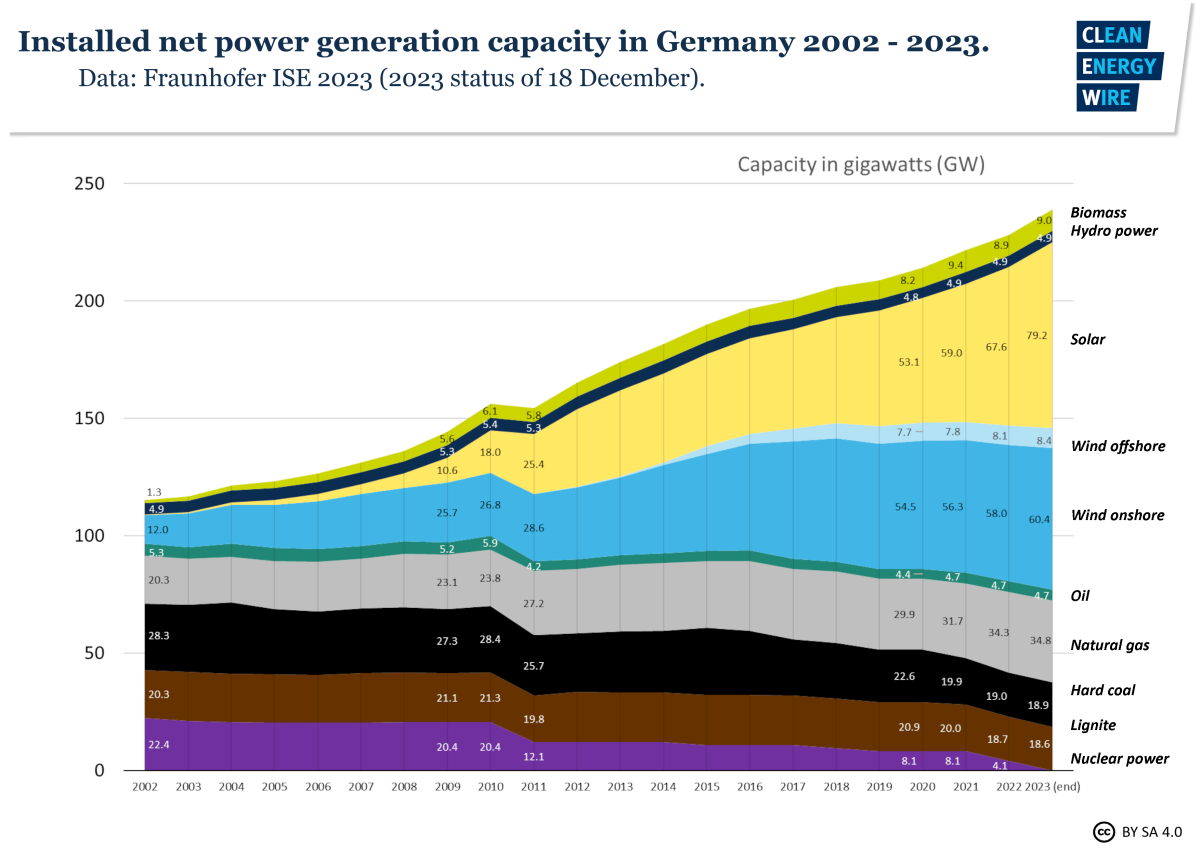
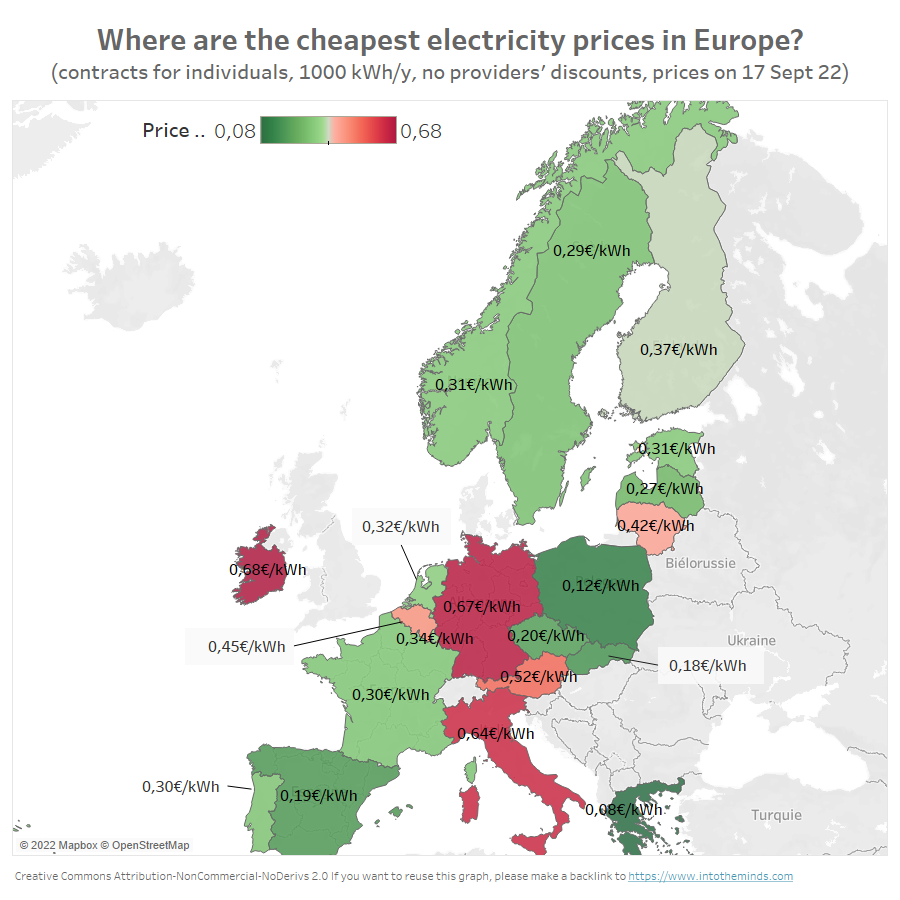

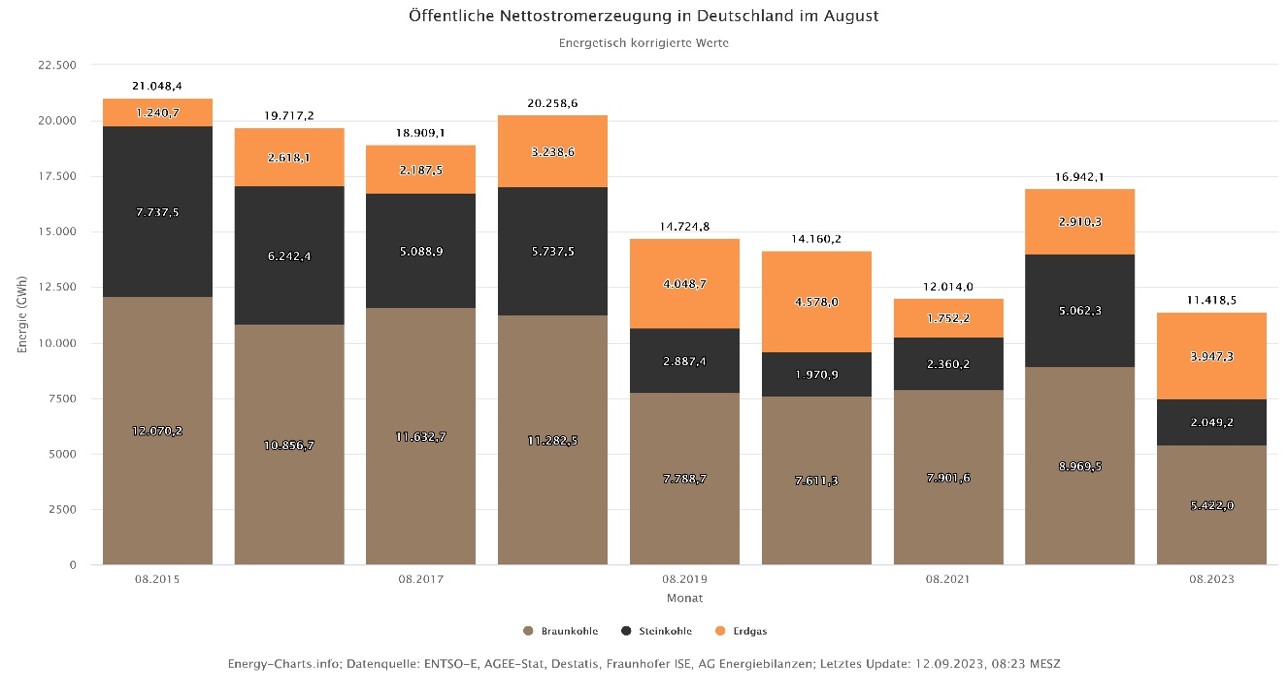


Note that Gigawatts is the installed capacity, but GWh is the actual production. Germany produces 2.5 times more energy from wind, rather than solar (quite intuitive, considering that solar is much less productive in Germany compared to, say, Greece or northern Africa).
From Wikipedia [0]:
Germany's installed capacity for electric generation increased from 121 gigawatts (GW) in 2000 to 218 GW in 2019, an 80% increase, while electricity generation increased only 5% in the same period.
[0]: https://en.wikipedia.org/wiki/Electricity_sector_in_Germany