I like the idea of walking 15 minutes to get all the things.
But man when I think of the costs involved in making sure there is a High School (in the US they tend to be large and draw from a distance) within 15 minutes of everywhere (no small cost to drop in a high school somewhere), or plop down a grocery store in a neighborhood ... that sounds both super expensive and politically difficult, and for some good reasons.
Heck I'd be annoyed if someone decides "Sorry we're rezoning / creating an incentive to build a restaurant in the plot next to you, not enough restaurants nearby. Good luck..."
My hope is that if not Gen Z then the following generation will push for American cities to get their act together and become better for people to live in. It is going to take a lot of political will to make it work as the entrenched older generations want things to stay the same as always and/or cannot envision a different way of living. A walkable city with car free zones seems like a fantasy and that is a real shame.
It is truly shocking how much damage the car has done to our cities and lives. Here in the Twin Cities, we have three enormous concrete canyons completely dividing up the city[1], destroying any chance at walkability or density for miles. All for the sake of people who don't even live in the cities to drive 30 minutes in their personal luxury steel cages from their suburban mansions to spend 30 hours a week here and then buzz off again. We lose so much to cater to the surburbanites and gain so little.
We have a real opportunity to fix this by removing one of them[2], but we're too terrified of change to improve our own lives. So the concrete canyon called I-94 will remain, poisoning the heart of our cities, for at least another four generations. Sigh.
Not to mention the opposition of public transportation here. People are already up in arms about the light rail expansion cost, plus the people angry about losing parking on Hennepin Ave for the proposed 24 hr bus lane.
I grew up there. The public transit was always worthless for anyone who wanted to do something more than go to work downtown. It is no wonder most people oppose anything: so many years of bad service makes even good ideas look like throwing more good money after bad (and like most cities they have plenty of bad ideas they are funding as well)
It’s difficult on a few levels I suspect, because genz will be fighting the previous generation and maybe the one before it too, all the homeowners that will fight tooth and nail for their investments to remain (plus any genz that benefits from the status quo, the inheritors of landlords)
A lot of what we consider "elite" US cities were losing population well into the 1990s. While I don't think the WFH trend is as widespread as people in some bubbles think it is, it's probably an open question whether the latest young college-educated cohort will move into cities for a while like some of their predecessors did.
Young people want things to do. I'm right on the divide between Millenials and Gen Z (the MillenialZ generation, if you'll forgive my poor portmanteau skills) and many college students I knew during covid have done one of the following:
- secured a remote job and settled down in their college city
- as a remote worker, followed a significant other or close friend to a city where they have to work in person
- found a hybrid role that allows some in-person work in a city
I think the "work remotely, from
your college city" trend is a positive one. I attended college in a small city with a serious brain drain problem (aside from medical folks) and it's nice to see more and more classmates move back to that city as the brain drain reverses.
Certainly the fact that I would have needed to commute to a job that was an hour outside the nearest major city (where I went undergrad) influenced the fact that I just went to live near my office when I graduated grad school. It was mostly the same with my classmates who also worked way out in the burbs/exurbs.
If the commute weren't a factor, I'd probably have at least considered living in the city--at least while I was still renting. (Of course, urban prices weren't nearly as relatively high as they are today.)
>Still, I'd guess you'd be right that it would be enormously expensive and difficult to bring this back.
I've moved into and out of downtown Boston over the past 20+ years, and it's been interesting to see this trend actually happen. In the neighborhoods I've lived in, there are usually 1-2 smaller markets that offer convenience at a price, and then a more "traditional" grocery store within 5-10 minutes of walking.
Over the years, a few new grocery stores have been built in the urban core, and they've actually been of the "larger traditional" variety. In most cases, they're part and parcel of new development, so the space, loading, and (reduced) parking requirements can be accommodated as part of the build.
The key is that the stores are being built concurrently with more housing being developed as well, so the stores are effectively meeting new demand. In my most recent "city phase", I actually had 3 "large format" grocery stores, 2-3 smaller markets, plus the assortment of convenience stores within a 15 minute walk.
Politically difficult, yes. Enormously expensive, I'd imagine not. Retrofitting a house to be a cafe/shop isn't that difficult or expensive. And it needn't be done all at once, it could be done gradually over time.
I think it is plausible to work towards, much of it. Some of it is fairly low hanging fruit. If you get several of the check boxes but not a coffee shop, high school, restaurant .... that's pretty good, you got a lot of bases covered.
I suppose it's all a personal preference thing to some extent -- at least if you have a car to get you further away for whatever it is.
But true, different people at different points in their lives, income levels, social positions, and preferences will prioritize different things.
The OP list seems pretty good for improving quality of life for a big round population of people at different stages of their lives and social positions. (After all, generational and income diversity in a neighborhood is probably also a plus?)
I wish I could make a personal preference to have all of those things in a 15 minute walk from me! It would require moving to a different city probably, and paying much much much more than I do now for living expenses.
I think 15 minute walkability actually has would have a much larger impact on quality of life than many people realize. I think if most people could get it without having to trade off between different personal preferences (like being able to afford the rent!), we'd be doing a lot better.
Like... nobody needs a coffee shop or everyday restaurant within a 15 minute walk. And if it requires trade-offs, including to affordability, not everyone is going to choose it. But when everyone has one (or ideally several), I think it's going to make neighborhood relationships and connections stronger in general, the people that run into each other at such establishments, or while one (and not necessarily the other) of them are walking to such establishments, the relationships between workers and customers, etc.
While you don't need those things, the more that is within a 15 minute walk, the more likely you are to walk there.
I've seen people who have drove to a neighbors house even though the walk from where they parked on the street was longer than just from their door to door (cutting across the lawn). They did it because that is their habit: they have so few places where they can reasonably walk that it never in occurs to them to walk the few times they could. (the above case was an extreme that they laughed about when they realized it, most people wouldn't drive that trip, but the thinking makes perverse sense)
Grocery, pharmacy, schools, and a public transit stop, only after those would I rate restaurants or coffee shops. This isn't some moral statement about making your own food, outsourifood preparation to a professional makes sense from a specialization standpoint if you can afford it, but if you can't and for daily life, being able to get food and medicine seems a bit higher.
I include public transit time in my 15 minute city. However you have to always include the worst case: just as your arrive at the stop the vehicle closes its doors and leaves.
Imho it was pre-war when it peaked. You look at rust-belt cities that were designed to be suburban but transit-oriented and you see a good balance; 3-bedroom houses where everybody has a back-yard but not necessarily a driveway, and the cities were irrigated with street-cars. Minor arteries would have corner stores and there were local shopping districts.
While many modern suburbs have embraced townhomes and other denser form-factors, they have other strategies that result in taking up a lot of space - parking lots, massive wide right-of-way, Euclidean zoning blocking local shops, and heavily redundant road-ways, like arteries that have no development around them at all, just a sidewalk then a fence then some trees and a ditch and then the local road. Every person trying to walk to the artery to catch transit has to cross that.
In an old streetcar suburb, the only road wider than 3 cars were the arteries, and those arteries would still be lined with homes if not shops.
I live within 30 seconds walk of 2 cafes, 2 grocery shops, and a pub (I can see them down the street from my window as I type this). And you literally can't hear them from my house. There's also a primary school nearby which occasionally gets noisy, but there's no noise from the shops.
It takes a lot longer to walk across a street when you have to wait for a walk signal. City streets can be 1.5-2 lane residential streets which you can cross basically on demand, making them equivalent in time to walking on the sidewalk. Based on an average walking pace of 1.33 m/s (3.0 mph), you can cover 40m in 30 seconds.
The blocks in this section of Seattle are ~80m long, so one block takes 60s to walk. The "Mercer on Summit" apartments on this map are within 1/2 block (30s) from 3 restaurants, 2 bars, and 1 small grocery.
I also have to walk along the street a little, and cross a small road that intersects my road. It's still probably less than 30 seconds, but it's close enough. It's 30 seconds if you include walking down the stairs inside my house, slipping my shoes on, etc.
Most of the noise I hear from my apartment in a medium-density neighborhood, like 95% of it, is just car traffic. Big noisy trucks and people on Harleys, people honking at each other as they try to leave a parking lot, all that. Building spread out unwalkable areas creates way more noise than the opposite. What is true, however, is that this design was mostly created for the benefit of suburbanites who live in isolated communities with no readily accessible amenities besides a road into the city. Their peace and quiet comes at the expense of mine, and especially at the expense of lower income communities which often exist in the noisiest, most car-heavy parts of the city.
Good point in that European high schools (generally) do not have large sports facilities and therefore are suited to typical urban multi-story buildings. Kids do sports at private/public sports clubs that are usually located outside town or in suburbs.
So high schools within 15 min walk/bike in Europe is much more doable than in the U.S.
Caveat: this is how it was when I was growing up in France; it may have changed since then, though I looked up my old high school and it's the same.
Seattle doesn't have nearly enough density to have that many high schools. Given the ever falling birth rate, it likely never will. The density would need to be obscenely high.
Figure high schools have 4x the number of students that elementary schools do, and we'd need 2x the elementary schools to make them all walkable, that means Seattle would have to have 8x the number of students in high school than it currently does to justify building enough high schools to make them all walkable.
Not to mention Seattle couldn't really afford to build that many schools, as the city can't even maintain the current schools to basic levels of safety (ongoing lead water pipe issues...)
I would love smaller more local schools, but It's worth noting that unfortunately a bunch of the schools have reduced enrollment and the funding is per kid. I don't know how to fix it but I hope it doesn't lead to closing even more schools.
> Given the ever falling birth rate, it likely never will.
But Seattle and Washington are attracting people from the world and the rest of the nation. Both Seattle and Washington have been experience positive population growth for decades now.
I believe the relevant factor is the ratio of school aged children to adults. This determines the relative demand for schools over other amenities such as housing. That ratio is largely dependent on the birthrate regardless of the population or density of the city. While people are moving in, it's not clear that new residents have a higher average birthrate than existing residents.
(This is going to sound like we're playing Sim City 2000) but don't forget to add a hospital (a proper one, with an emergency room), a fire station, a police station...
> a grocery store
Are there many neighbourhoods which don't already have some kind of grocery store?
It probably depends on what you mean by "grocery store." In dense urban areas, bodegas, chain convenience stores, and pharmacies with a small grocery section are pretty plentiful. Supermarkets a lot less so.
That's probably part of a shift over time. In general, we probably have more relatively large but spread out businesses than little mom and pop places on every corner.
(This is sort of a US comment. There seem to be more serviceable smallish grocery stores in Europe that are in between a supermarket and a convenience store. That's less common in the US other than one-off markets and sometimes downsized chain grocery stores.)
> It probably depends on what you mean by "grocery store." In dense urban areas, bodegas, chain convenience stores, and pharmacies with a small grocery section are pretty plentiful. Supermarkets a lot less so. That's probably part of a shift over time. In general, we probably have more relatively large but spread out businesses than little mom and pop places on every corner. (This is sort of a US comment. There seem to be more serviceable smallish grocery stores in Europe that are in between a supermarket and a convenience sore. That's less common in the US other than one-off markets.)
While on a business trip I stopped at a petrol (gas) station in the UK a couple of weeks ago, the sort on the side of a major road outside a city, and with a mini-supermarket attached, and was literally speechless when I realised they had a whole shelf rack containing gluten-free products.
I have coeliac disease, and had been assuming I'd have to travel specially to some large supermarket to get the stuff I can eat, but thanks to this place I grabbed loaf of gluten-free bread and a pack of gluten-free cornflakes, and I was good to go.
I'm discovering that coeliac and mid-range hotels don't always mix :/
In europe, you often have mid to normal-sized supermarkets near public transit since a lot want to grab a few groceries after work.
I wonder what "chain convenience stores" are...are they more geared towards snacks? Mid-sized supermarkets are all over the cities in europe I would say. You usually visit a bigger supermarket once a week, but you can get everything in the smaller ones, from fruits and vegetables to pasta. They are really there to fulfil your everyday needs and you don't strictly need to visit a bigger one. Many don't because it's so convenient, but they tend to be a bit more expensive.
Mid-sized supermarkets are part of my everyday life and I wonder why they are not more common in the US.
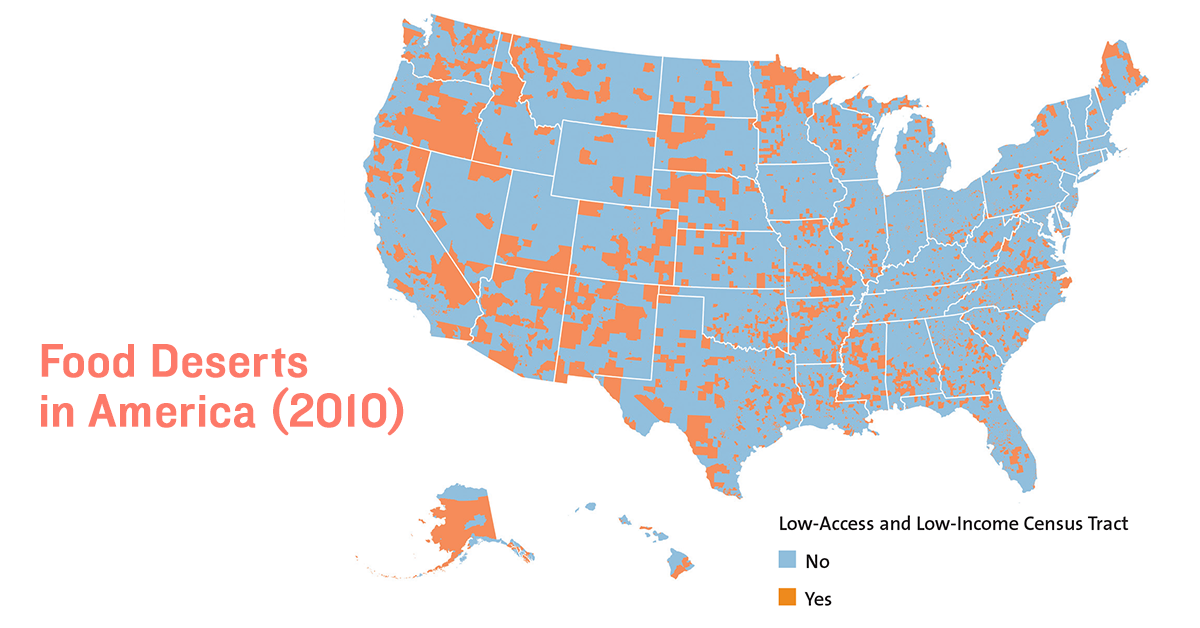
Yes, there's a term called "food desert" that exists for a reason. Think inner city areas. Parts of the town that are attempting to be "gentrified" (in whatever discriminating tone that word implies) where there were places to live, but stores were more than 15 mins by car. it was just yet another reminder of how city planning is anything but good.
It's pretty clever - they use SNAP benefits as a proxy (you can buy what they call staples; fruits/veggies, bread, meat & fish, milk, etc but no hot or prepared food: https://fns-prod.azureedge.us/sites/default/files/snap/SNAP-...) but they map to all of the stores who accept SNAP and combine that with a map of supermarkets from a Nielson directory. They then map the number of census tracts and compare against that map -- the 6.2% figure is the "1 and 10" method which counts households >1 mile from a store in an urban area and >10 miles in a rural one.
Being more than 10 miles from a real market of some sort in an actual rural area seems a pretty low bar. Population density is certainly lower but 10 miles isn't very far if you need to drive to the next town over.
It's not just 10 miles, it's 10 miles and being a low income tract which they define as average household income below 80% of state median or >20% households in the tract being below the poverty line. So trying to measure where the poorest areas have the most limited access.
How are you defining rural? The people who live in small towns in farm country, or the farmers living on their farm. In general farmers are not poor, but the people who live in the towns around them often are. It takes a lot of money to run a farm, you have to be great at business as you will have several years in a row where you lose $100,000 - over the long term though things work out to making a lot of money on farms.
It's as misleading in that way as the big silly maps they show around election time -- since we care about the number of people, not the number of acres.
There are 19 million people in the shaded areas. If we bump up the criteria to 1 mile urban / 20 miles rural, it's still over 17 million people, so clearly a lot of the people at discussion are in urban areas. Even so, it looks like another half million people are over 20 miles from a store who don't have access to a vehicle. Not great!
The "limited access to affordable and nutritious food" criteria is primarily to distinguish between having a Safeway-type grocery store nearby versus only having a Plaid Pantry/7-11/Circle K where you can buy a gallon of milk and maybe a loaf of bread but it's nothing like a proper grocery store.
I was thinking the same thing. This doesn't seem like it's a realistic goal, as much as I do really like the idea. 15 minutes of walking isn't really much in terms of feet or meters or however you want to measure it. 15 minutes of biking time, that's better. I guess I live in a "15 Minute Area" if you only count the bike time. Maybe more like 20 if you count the time I end up sitting at intersections?
Better bike infrastructure really unlocks a lot of potential. With good bike infrastructure, rides of ~30 minutes are quite comfortable, which is a distance of about 4 miles.
IMO a well-designed city could easily keep all necessary amenities in that range.
or with a well designed bike infrastructure a 15 minute walk would become a 5 minute bike ride :) I wouldn't want to bike 30 minutes just to buy a few groceries.
> he costs involved in making sure there is a High School (in the US they tend to be large and draw from a distance) within 15 minutes of everywhere (no small cost to drop in a high school somewhere), or plop down a grocery store in a neighborhood ... that sounds both super expensive and politically difficult, and for some good reasons.
A high school I understand (where I live in the UK it's common for high school kids to catch the bus to school if they don't live close - as long as you live within a 15 minute walk of the bus stop that seems fine). But a grocery store? What's difficult about that? Just convert a house.
> But a grocery store? What's difficult about that? Just convert a house.
I feel that the American view of a grocery store is one of those mega-Walmartesque stores with infinite aisles of stuff, rather than the more common small-scale grocery stores we are used to here in Europe.
At least on my trips to the US I don't recall seeing many small-scale grocers in neighbourhoods, it was either stores like CVS or going to a mega-grocer.
Those large stores are where most people buy food. The margins for food in them are very low, but they make it up by volume. Smaller stores cannot compete on price or selection, and so even if there is a small store close Americans will make regular trips to the large store that has everything at a low price for most food. There isn't much room for the small stores anymore.
There are pros and cons to the above. Do not claim what you are used to is better: it is different, not better or worse. Odds are you have not spent enough time using both to make a real claim. even if you have, odds are your stage of life is different enough that you cannot compare.
Many urban areas in the US all have lots of local, smaller, specialty, and neighborhood grocery stores. It's not a novelty for those who live in those areas. And they're not 7-11s.
In the US you don't really have the urban Tescos and Sainsbury's and so forth. You have some equivalent local markets but it's mostly fairly spread out supermarkets or 7-11/CVS/etc. which really don't count as grocery stores.
In many places there is a miserable quantity of political and legal infrastructure to prevent that from happening. Undoing that is a necessary part of 15-minute cities, but it may be weirdly unpopular.
(also, people expect a wider range of things than will fit in an old style corner shop, and you need to have HGV parking..)
Not weird at all. People don't like change. There's a reason NIMBY attitudes are nearly universal.
I don't agree that it's how it should be, but even in an already urban area (Somerville) getting things built is like pulling teeth. There's a literal hole in the ground from a fire a decade ago that people have been fighting development on for years, because they argue it will bring more people to the area and make it harder to street park. As if there's a guaranteed right to have public space dedicated to your private vehicle.
In the densest parts of European cities, the delivery lorry stops outside the supermarket just before or just after the shop opens and they unload quickly. Often, that pretty pedestrian street full of shops has road access to the rear, but not always.
Parking regulations are written to accommodate this. The pedestrian streets in the centre of Copenhagen allow deliveries from 4am to 11am, but I think there may be additional restrictions on large trucks as they seem to be out before 8am. Rubbish collection is also at these times.
Yeah, I would add: for a small shop the delivery van doesn't necessarily need to be that big either. I know a lot of shops that get supplied primarily by vans that are not much bigger than a transit van.
> But a grocery store? What's difficult about that? Just convert a house.
The difficultly is making the typical residential dwelling compliant comply with existing regulations like the Americans with Disabilities act and complying with things like commercial insurance policy requirements.
That’s the inevitable consequence of the local decisions that have made it dangerous or impossible to walk to school. Many school districts then see an opportunity to save money by charging families to ride the bus.
Ergo, massive traffic jams of parents individually driving kids to school.
Bussing in the USA was a civil rights innovation to integrate schools. At the time neighborhoods were still racially segregated, so neighborhood schools were overwhelmingly the race of whatever the local neighborhood was. The only way to have integrated schools was to send many kids to a school in a different neighborhood, hence bussing.
You are correct. But Seattle's history with desegregation bussing had a major impact on the nature of the schools in Seattle today. It was very common for students to spend a total of 90 minutes each day being bussed across town rather than walking 15 minutes to their closest school. It gave birth to a thriving ecosystem of private schools that still dominates the social fabric of the city today. Over 25% of all students in Seattle are in private schools, with that figure being much higher in the wealthier North Seattle neighborhoods.
I think every neighborhood should have an elementary school within walking distance (my local elementary school is not and it annoys me to no end) but I agree that for high schools this might be unrealistic, and anyway a good transit system should be able to make it easy for kids to get to high school whether they attend their local school or not.
> or plop down a grocery store in a neighborhood ... that sounds both super expensive and politically difficult, and for some good reasons.
Heck I'd be annoyed if someone decides "Sorry we're rezoning / creating an incentive to build a restaurant in the plot next to you, not enough restaurants nearby. Good luck..."
> Heck I'd be annoyed if someone decides "Sorry we're rezoning / creating an incentive to build a restaurant in the plot next to you, not enough restaurants nearby. Good luck..."
I don't get this. Isn't a restaurant at the corner great? Why would you be annoyed? I like living next to a restaurants. It increases your quality of live I think, you can literally just swing by if you feel like it and after a while you get to know the owner and develop a personal relationship. It really makes this place more my home I think, I always greet them and have a quick chat, and brings some life to the street. Of course, there's a question of the size but that can be dealt with. A grocery store is another thing because often they tend to be really big, but I think often suitable places can be found. But I think the supermarkets in mind are small, not a giant supermarket. Something where you can get most of your stuff but don't really have a variety to choose from, something where you swing by because you forgot your eggs.
I don't live in the US so I am really unsure why that's so bad. I don't think living 15 minutes to a Walmart (I picture them to be massive) is meant.
I assume, of course, that you're living somewhere somewhat suitable. But we're talking about living in seattle, so I assume it's ok.
You make a good point. Living in walkable neighborhoods means evacuating most of the country and concentrating ourselves in fewer, denser cities. It'll be a great thing to the extent we can accomplish it, but people have a strong attachment to place and to suburban lifestyles, and the shift will fuel the nasty culture war we already have.
> But man when I think of the costs involved in making sure there is a High School (in the US they tend to be large and draw from a distance) within 15 minutes of everywhere
Not absolutely everything needs to be walkable in 15 minutes. Once kids are teenagers having go to school on transit or bicycle would be fine.
Perhaps focus on elementary schools being walkable.
Elementary schools having the added advantage of being a smaller footprint. In my area, elementary schools tend to be 200-400 students. Middle schools are around 800 students and high schools about 1500. I (car dependent suburb) live within walking distance of one elementary and a second one would be walkable if you didn't have to wind through a series of cul-de-sacs to get there.
The closest high school is 2.5 miles away and the high school my child attended was 6.5 miles away due to a quirk in the boundaries and which schools feed into which higher level school.
> I like the idea of walking 15 minutes to get all the things.
But
>Heck I'd be annoyed if someone decides "Sorry we're rezoning / creating an incentive to build a restaurant in the plot next to you, not enough restaurants nearby. Good luck..."
>But man when I think of the costs involved in making sure there is a High School (in the US they tend to be large and draw from a distance) within 15 minutes of everywhere (no small cost to drop in a high school somewhere), or plop down a grocery store in a neighborhood ... that sounds both super expensive and politically difficult, and for some good reasons.
Even has the weak "what about the costs" argument.
I agree generally about zoning laws. But I also think they do a good job of keeping joe schmo from trying to turn a random plot into a car repair business that is just not suited to the job. Rando business guy doesn't care if the area is suited for it and neither do their customers.
I speak from experience as I lived in a house near a guy who decided to do just that... broken down cars parked everywhere (leaking all sorts of stuff), noise at all hours.
Yeah. Some things need to be kept out. Funnily enough, it's nearly always car related. Repair shops, gas stations, parking lots, ... Nothing trashes up a city more than cars.
I think this is why people tend to like the Japanese zoning model where things are divided up into different "nuisance" levels. Something like an auto shop would be more of a nuisance than say a coffee shop. You're allowed to build anything in a zone as long as it's below the zone's nuisance level. This will help keep real industrial style work away from where people are living and eating, but allows for so much more retail opportunity in those zones.
When you kick out all those businesses that the upper middle class finds unsightly there ceases to be enough latent economic activity for the businesses you do like to exist in an economically sustainable manner.
Banning automotive repair might be ok by itself but there's another idiot who wants to ban X, and Y and Z and their complaints are just as valid as yours and the status quo is what you get when you try and accommodate all of them.
>A far cry from buying some milk and cereal in the morning.
Depends on the store. I've lived next to grocery stores with the loudest compressors for refrigeration that I've ever heard. Going to take some nuance there.
Zoning laws are a great way to implement social segregation without explicitely saying it too loudly, I guess that's the reason they are so popular in "free" and "open" societies.


But man when I think of the costs involved in making sure there is a High School (in the US they tend to be large and draw from a distance) within 15 minutes of everywhere (no small cost to drop in a high school somewhere), or plop down a grocery store in a neighborhood ... that sounds both super expensive and politically difficult, and for some good reasons.
Heck I'd be annoyed if someone decides "Sorry we're rezoning / creating an incentive to build a restaurant in the plot next to you, not enough restaurants nearby. Good luck..."