This is only true if you just count recent history. It's the largest to survive the megafauna extinctions after humans arrived, and was out-competed by the non-marsupial dingo after that was introduced much later.
The "marsupial lion" thylacoleo carnifex (extinct ~35k years ago) was much bigger and more powerful, and "had the strongest bite of any known mammal, living or extinct". https://en.wikipedia.org/wiki/Thylacoleo_carnifex
It seems like the only “leap” is partnering with some other group. Which, yes, organizing is critical on large scale projects… but for those of us looking for a breakthrough, I guess we’ve been clickbaited.
Oh hey! I joined Colossal Biosciences 6 months ago from a post on the Who's Hiring thread and can say it's an incredible place to work, with some of the sharpest people I've ever met in both the biology and computer science space. This is just one of several awesome projects we're working on.
We're actively hiring frontend and backend engineers (React, Golang, GCP/multicloud). Drop a line: darren @ colossal.com
There are a number of other candidates, though. I would guess either the thylacine, the woolly mammoth, or the passenger pigeon would be first to sustain an actual population, but I don't really follow the projects: https://en.wikipedia.org/wiki/De-extinction#Current_candidat...
It's not plausible that such a large animal can have a self-sustaining population in the wild, and not be properly detected by the scientific community for 100 years.
Except that in general the "rediscovery" isn't something dramatic -- it's just a systematist in a lab looking at an animal known by many and realizing that it is the same species as fossilized/preserved specimens thought to be extinct rather than a common related species. That's quite different from finding a thylacine, an animal that couldn't be confused with anything else.
Bermuda Petrel -- there are many nearly identical petrels, exactly the same to non-experts.
Chacoan Peccary -- There are many wild pigs.
Coelacanth -- Maybe the only real example of a "rediscovered species". But that's only because we know the oceans far less than we know the land.
Lord Howe Island Stick Insect -- You've probably seen a stick insect like this yourself even if it is genetically different.
La Palma Giant Lizard -- Same genus as Gallotia, a very common lizard on the Canary islands.
Takahe -- It's the same genus as the swamp hen. To an non-expert, they are the same.
Cuban Solenodon -- it looks like a common shrew to non-experts.
New Caledonian Crested Gecko -- It's a geko.
New Holland Mouse -- it's a mouse (not a marsupial, despite being native to Australia).
Giant Palouse Earthworm -- It's an earthworm, although larger than normal.
Large-Billed Reed-Warbler -- same genus as many other warblers, exactly the same to non-experts who don't measure the bill.
Laotian Rock Rat -- It actually is of a unique genus, so more interesting than most of these examples, but still, it's a rodent not that different to the average person than other rodents.
In 1910 someone tried to introduce moose into a remote corner of New Zealand [1]. They haven't been seen since 1952, but seem to still be out there, as hair was found in 2002. If things as big as moose can hide a self-sustaining population in a small corner of New Zealand, thylacines could plausibly hide in Australia or Tasmania.
If they are successful, how do they navigate challenges related to inbreeding given what is likely to be a very small population of adult animals to work with?
Since the thylacine has been extinct for less than a century, they appear to be hoping that there's enough genetic diversity in modern preserved samples to eventually produce a diverse population. Even with a highly limited population, if you strictly control which pairs breed and aggressively pair the ones that are least related, you only need an initial population of like 16 or something to eventually reach a state where you have a large breeding population where most individuals don't share grandparents, at which point you can let nature take over.
The claim from the researchers is that there has been a lot of success in reintroducing human-raised animals into the wild, and that for mammals, most hunting/etc behavior is indeed instinctive.
My guess: if non-genetic heritable elements -- epigenetics (such as modifications to DNA) -- are necessary for proper development, then the DNA sequence alone will not be enough to develop thylacines. (There are caveats, notably that some modifications can be inferred). However, the scientists will also be experimenting with gestation and creating embryos from modified cells, so whether epigenetics specifically is a limiting factor will be hard to tell.
Yes, that was basically my point. There has also been some fairly fevered speculation about epigenetics being responsible for some types of instinct - even "cross-generational memories" and the like.
This is a really great point. I want very much their effort to succeed, but I suspect epigenetic is so important for higher organisms that the chances of this working are rather low.
My family dog growing up was taught to hunt song birds by their mother. I don't think I've seen something so cute as a mother retriever crouch walking through the brush with 8 little pups in tow.
I worked with the CEO at 2 of his other start ups... Ben Lamm is a joke. Maybe some of the other talent working there knows what's up but I do not have high hopes for this working out.
De-extinction doesn't necessarily mean they will release animals back into the wild. Presumably a portion of animal behaviour is learned and passed down from the previous generation. Animals produced by de-extinction will be lacking these behaviours and perhaps best off in captivity.
If they raise them in an environment where they have to hunt/forage for food, I don't see it being a big problem. You'd want to establish a population in a sanctuary for several generations before attempting it of course. Dogs and cats both can become feral pretty easily, and these occupied a similar niche despite being so distantly related.
It's too bad it would be highly unethical to run experiments with humans in tabula rasa environments. It would be really neat to see what different social behaviors emerge.
This is different since they were exterminated by humans, not by natural processes. It could be argued we have the moral obligation to bring them back if able.
The photos are from different angles, it’s hard to say whether they look that much different. Of course the muzzle is going to appear shorter in a front view and it’s hard to tell what the mouth line would be from the first photo.
It’s amazing what an incredibly prescient work of science fiction Jurassic Park (the novel) really was. Before CRISPR, before Dolly, before the Human Genome, Crichton called it.
Your comment supposes that (1) not a lot of people were talking about the idea back then and (2) that we have made significant progress in cloning extinct animals
I think a lot of people were talking about the idea back then and also we've had very little progress since then (despite flowery "news" articles like OP)
"He was watching one of Lev’s two thylacine analogs through the kitchen window.…Now it turned, in its uncanine fashion, its vertically striped flank quite heraldic, and seemed to stare at him.
The regard of a mammalian predator neither canid nor felid was a peculiar thing."
“We can now take the giant leaps..." says Professor Pask of the Thylacine Integrated Genetic Restoration Research (TIGRR) Lab.
Which is a lot more accurate than the article headline, which says that they _have already_ taken a 'giant leap'. I expect such exaggeration and overstatement from mainstream news sources; I suppose I should not be surprised to see it coming from a university website.


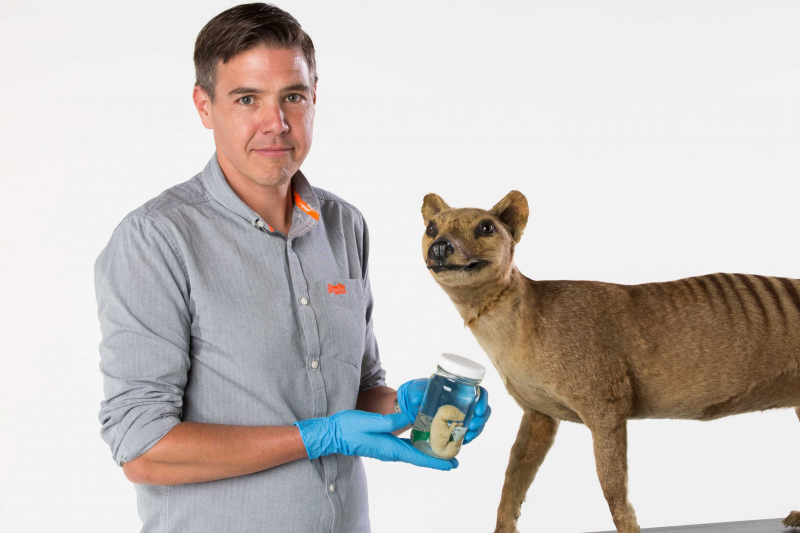

This is only true if you just count recent history. It's the largest to survive the megafauna extinctions after humans arrived, and was out-competed by the non-marsupial dingo after that was introduced much later.
The "marsupial lion" thylacoleo carnifex (extinct ~35k years ago) was much bigger and more powerful, and "had the strongest bite of any known mammal, living or extinct". https://en.wikipedia.org/wiki/Thylacoleo_carnifex
Australia had tons of much larger herbivores too: https://en.wikipedia.org/wiki/Australian_megafauna#Extinct_A...