Far to often I’ve interviewed at places and been grilled by the interviewer only to find out when you start the quality isn’t great, what you where grilled on you won’t be working on “as that’s to hard” or “we don’t do that” despite being grilled on it and the level of skill not to great they just want senior people. It’s the bait and switch.
At least being taken through existing code you know what you are getting yourself in to. Also looking at the current open pull requests and closed pull requests to see the standard and speed of delivery. Bonus points for no PR’s and trunk driven development as that shows a very mature team.
My simpler interviews have often been with companies that have held a higher bar than the ones with tougher interviews. Those companies have often been sink or swim though and if you don’t make the grade you’ll be kicked out pretty quick. My last company had a reputation for new starts disappearing and not great that way, but the team was probably the strongest bunch of people I’ve ever worked with as only do good survived.
> Bonus points for no PR’s and trunk driven development as that shows a very mature team.
Ugh, pass. Trunk development is fine. Skipping PRs just brings back nightmares of SVN. Even if 90% of PRs are approved without comment, it's extremely helpful for everyone to have a second set of eyes on work before it is merged in.
I agree, the PR is invaluable to preserve context: the trunk history remains simple and linear thanks to squash merges, and you can still see the fine grained commits (and matching discussions/reviews) in the closed PR.
It's also a way to give insight when onboarding new developers: if something is surprising, they can see why things came to be this way, not just accept the result at face value.
I'm personally a fan of small, clean commits, rebasing without squashing before merge, always making a merge commit, and writing a clear, through merge commit explaining what the branch does.
That way, I can treat the series of merge commits to trunk as the simple, linear overview of history, but when I'm bug-hunting I get small, clear commits to search through with git bisect.
It also means I get more useful blame output, as instead of huge hunks of a file being all from one giant bomb commit, I can see the process and evolution that the whole change went through as the original author pieced it together. That can be really helpful when dealing with obscure bugs or understanding systems with little documentation, by helping you get back more of the original author's thought process and seeing how their mental model evolved as they built the feature.
I'm with Nate here. Commits are a form of documentation and can be useful for grouping together related changes. All of this context is lost when squash merging. That said, I do aggressively rebase and amend commits on the feature branch to consolidate commits into one for each change, including any minor fixes discovered later.
For example:
When I want to see tests or documentation or config related to a change, I'll find the commit and look for other lines changed at the same time.
When I make automated changes to the code, like reformats, auto-corrections by a linter, or IDE refactors, I create a separate commit to separate mechanical changes from those that require more human scrutiny.
Commits are a form of documentation and can be useful for grouping together related changes. All of this context is lost when squash merging.
In some ways it is unfortunate that services like GitHub and GitLab have become so dominant in the industry. If you're just working with plain git there is no assumption that squashing is some kind of binary decision the way the UIs of the online VCS services tend to present it. It's normal to do an interactive rebase and squash some commits to clean things up before sharing your code, yet keep logically separate changes in their own distinct commits, and you can have a much nicer commit history if you do than with either the no-squash or squash-everything extremes. Of course you can still do that with something like GitHub or GitLab as well but I think perhaps a lot of less experienced developers have never learned how or even why they might want to.
I use the same workflow as NateEag and
mdavidn. My preference is:
• All commits SHOULD pass all CI tests
• Merge commits MUST pass all CI tests
The reason I don't require every commit to pass all tests is to maximize reviewability and logical consistency of commits.
For example, if a file needs to move, and then be modified slightly to function in its new location, I prefer to break that into two commits:
1. A verbatim move operation. This commit will fail CI but can be effortlessly reviewed.
2. Small modifications. This commit will pass CI, and its reviewability is proportional to its size.
In contrast, if you smush those two commits together, it can be hard to see where the meaningful changes occur in one giant diff. (Some tools may be smarter about showing a minimal diff for a move-and-modify commit under limited circumstances, but that doesn't always work.)
My places test suite nukes my local development environment for the full integration tests. If I am working on a hairy piece of code I open up a PR and let the CI system farm out the suite to multiple instances so I can get an answer in less than an hour.
The "right" answer is probably to refactor the test suite to be more performant, but that's never going to get approved given the amount of work that would take, and it would take me longer than I plan on being at the company to get it fixed in my spare time.
I do have it passing all tests before I try to merge if that counts?
Skipping pr’s is not equal to skipping code review.
If you pair, there’s two sets of eyes, to commit both pairs have to sign a commit. You can also organise a demo/quick mob session before commit. Then there’s a level of trust in your teammates.
PR’s are great for open source projects as act as gatekeeper so not everyone can commit freely. If you need to gate keep your team members then I’d question the strength of your team.
The best teams I worked on who delivered working code fast, efficiently even when they are some of the most complex projects I worked on committed straight to trunk, had a very good build pipeline (super import) and worked closely together for review. The standards where extremely high yet the general feeling was it was less dogmatic, micromanaged or kept behind a gatekeeper.
The projects I’ve worked on with dogmatic pr’s generally failed to deliver anything in any amount of reasonable time. The prs where dogmatic as more junior teams get caught up in superficial things such as names, package structure, syntax preferences rather than what the pr actually does.
I'm sorry, no, there's plenty of code that requires much more than two sets of eyes, and outside discussion, for any project above a certain size. I trust your experience that the teams and projects worked out like that, but they must have been suitable to that approach, which is definitely not universal.
As one example, do you think cross-functional changes to the Linux kernel from even trusted contributors can just be merged without review and feedback from people across all affected subparts of the kernel, as long as they have been written through pair programming? That's a big open source example, but plenty of companies have plenty of projects for which that already applies as well.
> The prs where dogmatic as more junior teams get caught up in superficial things such as names, package structure, syntax preferences rather than what the pr actually does.
That is an easy trap to fall into (and wildly annoying), but it does not mean that PRs have no use outside of that.
Sure there are a 1% of megaprojects that require additional process, but for the rest PRs are a method to control code quality socially. They introduce delays and foster ego antagonisms, so less methodical ways to control quality are optimal if the requirements are met (buy-in + skill) and complexity isn't too great.
No, every project I have worked on has review gated commits. It is a /basic/ step in ensuring that a project maintains a high quality codebase. Review does cause delays, because reviewing takes time, but we've generally found that the speed "gained" through poor change control is more than made up for through bad code.
Review also shouldn't be causing ego antagonisms. You're coworkers. You have to be able to work together. That's called having a job.
Every project I have worked on in a professional setting has had mandatory code review, with review acting as a gate. That's been required in order to maintain software quality despite the quality of engineers I've worked with.
Agreed. I'd like to add that PRs are not only a means to review code to improve that code. They're also way for new hires and jr devs to learn new things, how the hive mind thinks, etc. This is, ideally, today's PRs help improve tomorrow's code as well.
You can have perfectly fine, high quality, peer reviewed code without PRs.
Only if some regulation requires sign offs from e.g.other depts. PRs are inevitable. In all other situations they are at best an inneficient workflow and at worst a Kafkaesque circus.
Peer programming, daily checkups, a rock solid CI, and, above all, trust in the professionalism of your team are some ingredients for high quality, high throughput software development.
This is not an opinion. It's a scientifically proven fact. As laid out in the book Accellarate.
> Peer programming, daily checkups, a rock solid CI, and, above all, trust in the professionalism of your team are some ingredients for high quality, high throughput software development.
Absolutely agree, the collaboration should happen sooner in the process, and I would add that the team should probably also have made at least a high level proposed solution together before the work even started.
It's alright, when I started there I turned those 21 regular expressions into a single enormous regular expression that could only be understood at the time of writing, and never understood by mere humans again.
> Review also shouldn't be causing ego antagonisms.
Yeah but the tool itself is antagonistic, because it imposes a workflow of open source, a workflow that also is antagonistic with clear and absolute power. So using that tool suddenly brings that antagonism and power into a team which is supposed to be 100% collaborative, and it also only does it periodically and with random and different people in power. It's not hard to see how that becomes somewhat complicated.
Anyone who can't handle having their code reviewed before it goes into production is not welcome on my team. You can call that antagonistic or not, but I have always found that the best engineers are the ones who are able to separate criticism of their code from criticism of themselves. Get that type of people on your team, and code review is no longer antagonistic: it's just an egoless feedback process that improves the end product, which is what all members of an engineering team should be working toward.
I'm not criticising the review itself as much as rather the PR workflow and the tools of github, especially the blocking mechanism. It's my opinion that collaboration should happen much sooner rather than being pushed to the end with the review of a PR, and that you should have designated people who have the power to sign something off as production ready.
If a team inside a company want to gather inspiration from the open source world, they should look at how the owner teams of open source projects work internally, not how they work together with outside contributors.
And, it's a very common "solution" in tech to just simply not have any feelings, but people have feeling and that you can't turn off, and that's a very important contributor to work satisfaction.
There is nothing about github hat prevents you from working that way. I don't see what your issue is. But, I will say that I don't want people who can't separate criticism of their code from criticism of themselves on my team. You can certainly have whatever feelings you want, as long as it doesn't get in the way of producing the best possible product, all things considered.
Yeah there's nothing that prevents you from using a tool in exactly the opposite way that it's designed to be used, but it's also pretty unlikely that it's going to happen or that it's going to be successful.
Just make a PR early and discuss the code as you build and make changes, not sure in what way the tool wasn't made to do that. Then you also get the discussion interleaved with changes, resulting in basically perfect documentation of how the code was made and why.
The only thing PR's lack in that regard is that if the reviewer accepts it then it gets added automatically, while ideally you should re review things after the reviewer has accepted it. That way they wont accidentally accept prototype changes.
I'm beginning to think you've never actually used github. Are you trolling?
The tool does not stop you from working in the way you suggest. Maybe it's not what the engineers who wrote it originally envisioned, but it's both simple and easy to work in the way you suggest.
If I want early feedback on something I create a draft PR and ask for comments. I can then let people consider my approach asynchronously, in their own time.
> I don't want people who can't separate criticism of their code from criticism of themselves
Yeah good luck with that, nobody can completely separate criticism of their work from criticism of themselves. You are making your job as the team leader way to easy for yourself, "I only hire robots, that's how I solve all these pesky people issues".
In over a decade of enforced code review experience, I've had one developer who was too immature to take feedback. Some folks take it personally and they shouldn't as long as the feedback is about the code. This requires some work on both reviewer and reviewee.
The guy who couldn't take feedback (person A) had code merged in that wasn't properly tested. Person B said, "hey A. I could use some help. We wrote some tests around $feature that were missing and the tests show the feature doesn't work. We see $unexpected results. Wanna make sure we agree on how this should work."
Person A: no, it works, I tested it.
B: could you help us identify the flaw in the tests then - they seem rock solid.
A: no, my code works.
B: ... ok, can you join us and talk through it?
A: no, it works.
A was removed from the team after management came in and A continued to not acknowledge his code could be wrong.
This was aberrational. We, as an org and as a team, constantly strove to keep the focus on the quality of the code. And, yes, his code was borked.
In this example, of course person A is completely in the wrong, but this is a bigger problem of being so immature that you can't admit any fault.
My suggestion is more along the lines of: use a pairing session for review so that you can bring your empathy as well as your technical expertise, and make it a step in the process just like any other steps (testing, PO approval) etc, and just trust people to do it.
I don't think there's any reason to use a tool from open source, to make code review enforced and with passive aggressive online communication and "blocking". Just seems to make work more painful, and less efficient as well actually.
Oh wow, kudos to you, not just for having to deal with that, and getting A removed, but for being so diplomatic about approaching him on the issue.
And yes, someone that lost is pretty rare, but I'd say lower-grade versions of non-transparency and making their work hard to follow is pretty typical (and frustrating).
and yet many people on this subthread alone have worked in review-required jobs, and have not had a problem with it. They've also provided reviews for other people's patches, and presumably were also able to do it without personal attacks.
It's the bare minimum of professionalism.
If you are unable to separate feedback on your work, from attacks on your person, you are lacking some fairly fundamental skills needed for professional engineering.
>So using that tool suddenly brings that antagonism and power into a team which is supposed to be 100% collaborative, and it also only does it periodically and with random and different people in power.
Is code review not collaborative in your experience? In every team I've been on/run we've split code review comments between suggestions/questions and actual "I will not let this go into prod if my name is attached to it" blockers. Code review has been 99% the first set of comments and only rarely do I see anyone actually block reviews over things like style and what not that have been mentioned here.
I can't even imagine those topics getting into code review as a blocker as if we have actually strongly held opinions on mechanical issues like that, they are integrated into the various linters used so you don't even need human eyes to catch the issue.
I've had patch review as back and forth comments in email, in bugzilla, in myriad other bug databases.
If you can't send out an email with your patch as an attachment, and get feedback, then we have a problem, and the problem is not the adversarial nature of review.
But why would you use such a remote asynchronous late stage feedback loop, if you are literally sitting in the same room as your collaborators, during the whole development process?
> if you are literally sitting in the same room as your collaborators
Your very premise is wrong. At any sufficiently large company, you are unlikely to be sitting in the same room as every collaborator and stakeholder, or even proxies for them.
As a simple example, the team I currently work on (on one project of several) is 10 people across 8 US cities in all four US mainland timezones, and the stakeholders and collaborators are across Australia, Asia, Europe and the Americas. A good majority of what I do is pair programmed, yet the pull request workflow is essential to letting _others_ know what is happening and why, and to allow them to have asynchronous input into the process.
You might argue it would be better for the team to be in a room somewhere. Maybe so, but the people this project demands live where they live and could not even agree a common location for that room to be if they wanted to. And it still wouldn’t help the other projects…
I was more offended by the assumption that you can simply interrupt whatever work your coworkers are doing, just because you're already in a much less pleasant open plan office.
The goal in review is to try to catch any oversights or errors in the code you wrote. The code you wrote may have been the result of of discussions with your coworkers, but the code still gets reviewed, even if by people you discussed the implementation with. That review will occasionally find things you missed, and then you can cycle, and re-review.
By definition, the review can only happen at the end of change development.
The prs where dogmatic as more junior teams get caught up in superficial things such as names, package structure, syntax preferences rather than what the pr actually does.
All this means is that you and your team failed to learn anything from the PR process. If simple things like naming or syntax repeatedly come up then you have a style convention but the devs are ignoring it. The very obvious solution to that is to enforce the rules with a linter, and run the linter on a commit or push hook. If the linter fails then the dev can't open the PR until they fix the issues.
If you have process that's only for box checking and not something that's actually providing useful data the you're not using your time well enough. Removing the process is one solution, but it's not a very good one. Making the process useful is significantly better.
> superficial things such as names, package structure
These two are not superficial, though. Naming things is one of the Hardest Things, and that and structure tell you if you're in the right spot trying to track down a bug or add a feature.
Every debugging session should not be an adventure.
Well certainly I agree that naming is important. It’s up there with cache consistency and off-by-one errors as one of the two most difficult problems in computer science.
It's the opposite. Few companies know that you can do without PR. Even fewer know why they are doing PR or where it comes from. But everybody starts with PR, it's the default in their VCS UI.
I described my experience and what I saw, well I did not do any scientific research on 1000s of companies. But I still think my experience has the same validity as your statement. So it can be both at the same time, there is so many companies small and big.
Ok, let's say a lot, or most, companies use processes without knowing why.
Some might just push commits without knowing or caring about reviewing code, beyond fixing what fails in production. But others might just do "git flow" or whatever, doing thorough PRs, without knowing that the changes could be requested after being merged and without realizing the amount of time that is wasted on integrating code and re-testing.
In particular, I think that PRs come from an open source model, where you really have to gatekeep. But in a company, there is no problem in following up: the devs are salaried and you just need to put them to work on whatever is necessary.
> If you need to gate keep your team members then I’d question the strength of your team.
I'm sorry, what?
Review is a gate for everyone, and is a sign of basic project maturity. WebKit, Mozilla, Chrome, LLVM, Linux, etc are all review gated projects. No change is landed - can be landed - without review. If you're questioning the strength of those teams I cannot imagine what your team would need to have on it??
Though the size and risk of a project do materially matter. If chrome ships a bug, that'll cause an impact on billions of people potentially, where as the typical software bug will impact a few hundred or dozens of people?
The way the code quality of webkit built up was by introducing a review gate. Chrome inherited its review gate from webkit, because it had established a much better track record for code quality.
The way you get any project to be "actually good" is by adopting methods to ratchet quality. Early WebKit did not have the same strict rules it has today, and we suffered because of that. Introducing review + test for every change rule was introduced, and the frequency of regressions dropped dramatically.
Code reviews are incredibly valuable, and are a crucial part of software development at all of tech companies. I would argue that if you aren't doing code review, then you're saying that you believe you and all your company's engineers are better than the engineers at Google, Apple, Mozilla, Microsoft, Oracle, ....
Having engineers better than the average employee at those companies is a lower bar than you'd imagine.
Smaller companies can pay much more (in expectation), and can simply poach the cream of the crop (who are invariably frustrated by useless process and corporate politics) from the big ones.
On top of that, most development processes are designed to minimize the blast radius of underperforming engineers, so your actual bar is "hire stronger engineers than the dregs from the giant shops".
No, it isn't. I know the standard of engineers at FAANGs.
Having engineers better than the competent engineers that are responsible for the dreaded process at the FAANGs, MS, etc is hard. The review policies of big projects tend to have been hard learned, and dismissing them because "they're useless process" is a poor choice.
I'm speaking based on the experience of dozens of engineers, including ones from all of MFAANG, and a half dozen almost-FAANGs.
I think you're conflating whether a process is useful for the organization with whether it is useful for the engineers implementing it. Since processes have to be uniform, you need to either figure out how to retain someone that's been at the company for a decade to continue to work maintenance jobs, or you need to figure out how to keep the fresh grads that will replace them from breaking the world.
The right choice for the organization is to keep production stable, and the bus factor high.
The right choice for the engineer is to demand massive comp increases (comparable to startup acquisition windfalls), and also the abilty to stop working maintenance.
A lot of the best engineers I've worked with used to be in a FAANG. Almost none of them would consider going back. They universally cite broken processes as the reason they left.
I'm confused by this discussion about development speed: are you talking latency or throughput?
Because in my experience, reviews and PRs certainly Ven damage latency, but overall throughput remains the same as it would be with subsequent follow-up fixes of these issues to the trunk.
> PR’s are great for open source projects as act as gatekeeper so not everyone can commit freely
Yeah exactly, PR's are based on the fact that you have some person who is the owner that have complete power, and many other contributors who have zero power and whose contributions will mostly be rejected. You simply don't have that situation in a company, where everyone is an owner on equal terms, and all contributions are accepted, only some with slight modifications.
So you get these really weird situations where more junior, or less skilled, people can block PR's and demand changes from other more skilled and/or senior people. And if there's disagreement in a review: the resolution of that is completely unknown, and can often blow up to a really nasty conflicts.
I have so many terrible experiences with PR's where you get hostile nonconstructive comments on your work, on github, from a person that literally sits next to you. It's the creepiest thing ever.
> Yeah exactly, PR's are based on the fact that you have some person who is the owner that have complete power, and many other contributors who have zero power and whose contributions will mostly be rejected
PRs can be approved based on two people's opinion. There doesn't need to be a central gatekeeper.
> So you get these really weird situations where more junior, or less skilled, people can block PR's and demand changes from other more skilled and/or senior people.
Sometimes junior, or less skilled people, have something valuable to say. Especially if the code could be simpler.
In a stalemate, the PR could be sent to a third party. I've suggested this many times to avoid unnecessary conflict.
I don't think it is PRs that are the issue, rather your working environment.
> Sometimes junior, or less skilled people, have something valuable to say. Especially if the code could be simpler.
Yeah and sometimes they are naive, dogmatic and overconfident, and on a crusade to change all the things! because they have read some blog post by uncle bob, and this tool is putting them in absolute power every time they do a review.
> In a stalemate, the PR could be sent to a third party. I've suggested this many times to avoid unnecessary conflict.
Ok and who might this lucky scapegoat be? I have a feeling it's not the manager for some reason..
> I don't think it is PRs that are the issue, rather your working environment.
The issue, which I'm trying to illustrate, is that the tool makes the working environment worse by introducing (hostile) dynamics between people that don't exist, which leads you into situations that you don't have resolutions for, situations that should not occur.
Using a tool that allows you to block other people's work causes unnecessary conflict in a team where people are supposed to be working together.
Edit: blocking contributions is a normal and natural thing in an open source workflow, and it is not normal and natural in a team inside a company.
I've never thought of a PR as causing conflict. For sure, you're right now that you've explained it, but as an engineer I've never felt that way.
But I'm okay with the conflict! There should be conflict at work! Ideas should be freely expressed and those ideas are going to meet contrary ones!
What wouldn't be healthy is a place where that conflict isn't resolved or doesn't lead to a better idea winning. Or where only the Lead "wins" because of their position.
There shouldn't be arguments, no one should yell or be hurt. For sure that's a bad place to work. But conflict about where to place a piece of code? Sure! Conflict about if we name it Foo or Bar? Why not?! That conflict is like the sharpening of Iron! It hurts _today_ but can strengthen and make _you_ better let alone the organization as a whole.
>But conflict about where to place a piece of code? Sure! Conflict about if we name it Foo or Bar? Why not?! That conflict is like the sharpening of Iron!
I dearly hope this is sarcasm. This is about the same level of absurdity as developers taking ages to pick project/file names. I'm not railing against a review's abilities to find bugs and make sure someone else understands. GP is right in pointing out how many fruitless review discussions exist over personal differences in what to call a function name because "I think X sounds better than Y", despite every party involved understanding the code and what it does.
I’m sorry you had such bad experience but you were working with the wrong people (feels like toxic even). PR reviews work best in environment where trust is key, and deciding together (emphasis on together) best approach to reach a goal is the main drive. In the end PRs should make you and the team stronger, as the knowledge is shared collectively.
IMO every developer should be an admin of the repo, but more importantly it’s not a gate, it’s a process that benefits communication. All the team can read and learn from small addings to the code base.
PR reviews should not equate to 100 comments either, complex discussions can (should imo) be worked out in a call discussing (dialog) best approach. Think of white boarding a problem with a fellow engineer friend.
Ofc, teams differ and some teams work better with other processes and other tools.
> I’m sorry you had such bad experience but you were working with the wrong people (feels like toxic even).
It's the tool itself and it's imposed workflow of blocking work and gaining absolute power in demanding changes, that causes the working environment to become toxic. Nobody would ever do that in a meeting "I'm blocking this work now until my demands have been met". That would be incredibly hostile, but with this tool it becomes normal.
It doesn’t have to be like this. Even when I was CTO, I’d submit my code in a PR and my team would pull me up on mistakes and inconsistencies. It was really annoying! And also great.
PRs are a great way for the whole team to learn about how the organisation cuts code, and can reduce the number of errors, but of course with poor leadership they can be used for evil.
Same here! I would have one of the more senior people review my code, and I would review his. It was a small organization and we didn't have time to do the most thorough reviews, but it was good that someone else knew something about what was going on.
"Code reviews", in general, are a good thing for knowledge transfer. If they are done for nit picking and stylistic complaints, they are not terribly valuable.
> It doesn’t have to be like this. Even when I was CTO, I’d submit my code in a PR and my team would pull me up on mistakes and inconsistencies. It was really annoying! And also great.
I can imagine that you had fun mingling with the commoners for a day, now try it on all of your actual work, and with the whole C-level team gang up on you for each review.
> about how the organisation cuts code
You don't have any guidelines for how the organisation cuts code, and that's why you like the review process, because it covers up for that.
Why the hate? You’ve obviously had some shitty experiences but I’ve never done anything to deserve your attitude.
> I can imagine that you had fun mingling with the commoners for a day, now try it on all of your actual work, and with the whole C-level team gang up on you for each review.
You literally know nothing about me, my experiences or how I conduct my life, and rather than listen to people with a different experience to yours, you choose borderline abuse.
This is the comments section of HN. Take a break and get some perspective.
I agree with the others commenting here and can't relate to your experience at all. Review is a huge positive and while it does "slow things down" it usually is preventing people from slamming into walls at high speed, so that's a positive too.
Maybe your work experience is mostly in a high stress, prototype-heavy environment where it's more important to launch something than it is to have a maintainable, incrementally improving codebase? I worked at a consultancy like that and it was very different from "big product" long term work.
As for the social dynamics, it sounds like your workplace culture just blows.
He's getting downvotes because he's persistently overgeneralizing from his unfortunate, legitimate lived experience to a bunch of dogmatic claims about the fundamental nature of the pull requests that contradict many other people's own lived experience.
I'm simply pointing out that the workflow of the pull request is made for a different workflow than what you normally have inside a team in a company, and it therefor quite a bad fit. And illustrating this with a few examples.
I'm getting downvoted because I'm criticising developers favorite tools that lets them pretend to be Linus Thorvalds for a moment.
No it isn't, though. It's not like there's a "right way" to run a team. The teams I've been on that didn't review code always ended up imploding because because people rationalize their innocent corner-cutting when they don't have to deal with the embarrassment of sending it off to anyone.
Where I work, development is trunk based and without pull requests, and all code is reviewed. When I want to submit code, I push it to a staging area that tracks master. This causes the commits to appear in Gerrit where (conflict-free) rebasing can be performed with a single button and the code can be reviewed. During the staging I can change anything about the commits to my hearts content. Once everyone is satisfied, someone with the authority to approve the change approves it and I submit it, upon which the patches are applied as-is on the branch I staged it for.
Creating a separate branch, pushing this to your public copy of the repository and then asking someone to pull from that branch into their master branch seems absurd to me, especially if it's just 1-2 commits, and the idea of reviewing code (which I think is extremely important at team scale) should not be conflated with the concept of pull requests.
What you are describing, is pretty much exactly how it works at every company I've worked at that used PRs. You create a new branch from master, make your changes, push the branch to github/bitbucket/gitlab, make a PR. While the PR is open, you can make any changes you want to the commits in that branch (since it's just a branch).
People look at the PR (which shows the diff) and approve it if they are happy, or request changes. If there are no conflicts, you can merge with a single button. Otherwise you need to resolve conflicts somehow. I normally just rebase the branch off updated master and force push.
> Creating a separate branch, pushing this to your public copy of the repository and then asking someone to pull from that branch into their master branch seems absurd to me.
That's how it works for open source projects because people do not have permissions to make branches in the main repo, so they must fork and have the changes in a different repo. I've never seen this done at a company, I presume everyone here is talking about creating branches in the main repo and requesting review before merging the branch to master.
> I presume everyone here is talking about creating branches in the main repo and requesting review before merging the branch to master.
Regardless of whether someone is pushing to a branch in the upstream repo or pushing to a branch in a fork, the workflow is the same either way. At worst, it just means adding a remote if you want to check out someone's code locally.
I've used that workflow before, but it was called "merge requests", presumably because you're not actually requesting anyone to pull from a remote, but requesting someone to merge one branch into another.
Yeah, it's one of those things where the term everyone uses strayed from the etymology. Probably because in the GitHub UI it still calls this a pull request despite not pulling from a different remote.
Either way, if you read the thread, the folks are arguing that giving someone the power to block code getting into the mainline is bad. Judging by what you described, where someone has to approve before it can be merged, we both agree to disagree with them. We are just arguing the semantics of how that is implemented.
I don't understand at all what you're saying. Sounds like you push your code to a branch called master that tracks master but sits on a separate repo and then you apply your commits after approval via patches? Seems like you're recreating the concept of branches using repos and then using patches instead of merging.
Either way, just so you know, this kind of attitude and that you think it's a-ok to use such a convoluted process for what is effectively the same thing would 100% mean me not hiring you. That may not mean much on some random forum on the net, but you will encounter it a lot as the industry is definitely not aligned to this odd flow you described.
I'm not sure how you read what you're suggesting into my description. I make a commit.
    git commit
    # ...
    git commit # or two
I push them to the staging area for a given branch, in this case master
git push HEAD:refs/for/master
This isn't a branch in the traditional sense but git conveniently sees it that way.
Now they're immediately available for review. That looks something like this (this is not from my workplace, but the Go team's Gerrit instance): https://go-review.googlesource.com/c/go/+/361916
> Either way, just so you know, this kind of attitude and that you think it's a-ok to use such a convoluted process for what is effectively the same thing would 100% mean me not hiring you.
That's fine. There are plenty of companies that manage to hire based on competence, experience and references so I'm not exactly aching to get hired at a place that would deny me for having used Gerrit.
It really seems like this "no PR" idea is having a moment on HN. I can't tell if it's just engagement bait contrarianism or genuine. That any developer would trust themselves even to just not make simple typo's is baffling to me.
Maybe the kernel of a good idea in the comment: A team that prioritizes reviews, such that PR's are not a significant hurdle, is indeed a sign of a mature team.
I took a job once because they were honest about the fact that the code was a complete shit show, and that’d I’d have to clean it up. I’m sure this is naive on some level, but I’d say you don’t have to lie to people. Just help them imagine doing the job and let them decide if that’s how they want to spend their time.
Bad code + time allowed to clean it up = perfectly well-defined business requirements + a license to think about code craftsmanship. That's a lot of people's dream job.
> Bad code + time allowed to clean it up = perfectly well-defined business requirements + a license to think about code craftsmanship. That's a lot of people's dream job.
I agree, also sounds like an unusually well defined role with a clear way of having impact. I would also take this job any day over another job that would bait and switch me into some rewrite death march.
But yeah, when you think about -- a sufficiently fecal-encrusted, lost-cause codebase is almost indistinguishable from an actual greenfield opportunity.
I’m sure this is naive on some level, but I’d say you don’t have to lie to people.
Sounds perfectly sensible, and not naive at all.
I'd much rather come into a situation where they were both already aware of, and entirely honest about the current shit-show status of the project -- than a situation where everyone thinks what they're doing is great and bleeding edge but when you actually take a good look at their assets, as it were... not only are they manifestly and visibly unwashed -- but no one seems to notice the stink.
This is precicely why only few companies will do this kind of interview.
Good candidate would instantly notice the team is being labeled as seniors but instead are a bunch of crappy devs with years of experience.
Code does not lie. If you are crap you gonna produce crap code.
Ive recently hit such a mine. Lies during interview. Gonna sit here through vacations and jump the ship. Was sold on working with experienced ppl with over 10y of experience. Turns out those ppl IMHO have less skill than me few years ago with only 2y experience. Legacy bugers that did not improve over the years.
Trunk driven development has worked well everywhere I've used it.
That being said, pull requests / code reviews / merge commits are totally compatible with that. Gerrit, for example, does every commit as a mini-pull-request on top of a branchless HEAD, and when the review finishes, you merge to main/trunk and off to CD it goes.
I’ve never understood this. I’ve had Teams grill me on questions I know most of them wouldn’t pass and they themselves said they’re struggling with delivering things. Some weird dick measuring thing
If you're on a team that isn't currently having staffing issues, I don't think it's weird to want your next hire to be better than the median person on the team. "Raise the bar," etc. Asking harder leetcode questions seems like a bad way to achieve it, but I get the impulse. If the bar for member nine of the team is approximately "better than the bottom 4" then that 9th person in is likely to have at least one moment of "wait, how did you pass that interview?" at some point after they come on.
Or they don't have the time or manpower to fix/learn things and
are trying their best to hire someone to help right the ship before bringing you onboard. Such a negative take.
One who needs a good, steady paycheck at a stable company? Just because hiring team doesn't have time to learn/apply a specific piece tech on the job doesn't mean they're low performers or less competent than the interviewee. They can be sufficiently busy with their current jobs and need someone experienced to lay the groundwork for others to run with. People that go and implement stuff when they're already busy usually half arse it. Those people are just creating issues that'll be fully realized months, years later.
If you say you know tech X, manager wants to hire for tech X to solve a business need, and I'm asked to help interview, I may ask you questions about things I don't know or do myself because it's my professional responsibility to my employer and manager to help them hire a quality candidate. Maybe some people use the interview as a place to be jerks or show off but that's not always true. Personally I'd rather not be involved in the process at all.
Yea a lot of people in this thread missed that point. It's still contrived problems, just testing comprehension rather than creation.
But you can contrive much larger problems than you could ever ask a candidate to code, so you escape the ability for a candidate to practice your exact questions to some degree.
i kind of like the idea of taking them through your codebase, though. allowing the interviewer to concoct problems leads to something i'm very passionate about, and that's attempting to stifle the ego involved in the interview process. for whatever reason, intellectual prowess, and displaying it, exposes itself in interviews. the interviewer will ultimately end up trying to dominate you intellectually to satisfy their own ego. it's pretty pathetic, and rampant in whiteboarding.
> despite being grilled on it and the level of skill not to great they just want senior people
Happens to me too, I get tough interviews, and a good salary, but the work is exactly the same as the juniors "a guy on the scrum team". I don't even understand why they hire seniors, or have that title when it means nothing. I guess they expect them to be just faster versions of juniors.
yes and no. the last company I worked at is a feature factory. They have senior, and staff engineers, on various product teams that have 0 technical influence. What they expected is you to somehow increase quality of the product via code review and writing design documents... but the quality of the product was being destroyed by a handful of people making all of the technical and architectural decisions and forcing their platform on the rest of the org. Upper management doesn't have the technical expertise to see this and thinks this approach will lead to some sort of unified performance and scalability. Maybe it will down the road, but if I can't change out the underlying database, ORM, or web framework for something that is just _better_, I'm ultimately just working on the assembly line at the feature factory as a Sr/Staff engineer.
I think we must've worked at the same place. I took a job at a jira feature factory working on an aging, ossified code base. Literally, it was using the same tech I was using 10 years ago, almost exactly, except it was new back then.
I spent most of my time writing design documents, doing code reviews, and shepherding my relatively small changes through review. Something I could've banged out in a week would take months due to all the review and processes.
Last person I hired to work with me in my previous job I walked them through the entire code base, architecture and CI setup. This gave the hire a chance to best understand day to day work and me a chance to know which parts they understood immediately and which they would need to learn. Works perfectly for me.
> Those companies have often been sink or swim though and if you don’t make the grade you’ll be kicked out pretty quick. My last company had a reputation for new starts disappearing and not great that way, but the team was probably the strongest bunch of people I’ve ever worked with as only do good survived.
This is not what I would call a "strong" team. This is what I would call a developmentally stunted team. By that I mean they've reached competency as individuals, but they have limited ability to level up fellow developers. As such, they are not a producer of talent and rely on actual strong teams for their hiring pool. In my experience, these teams are best avoided if you actually care about growth.
It would be quite absurd to dismiss a candidate based on the editor and yet I find it more important that a particular cloud provider, which quite often is a requirement.
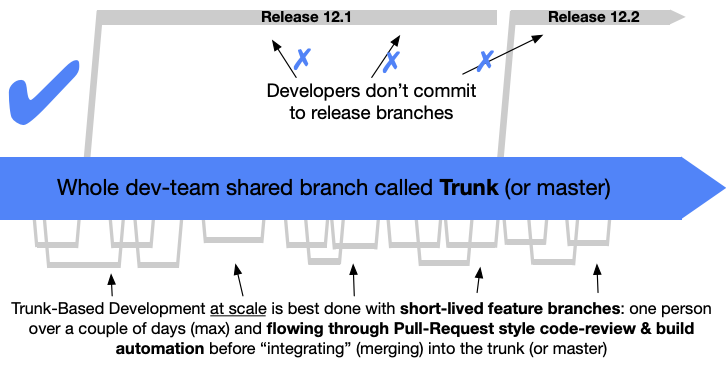
Gitflow, and its various flavours, has been a popular alternative. Though it seems trunk-based is considered the preferred standard due to emphasis on achieving a stable main branch, simplified pipelines and faster cycle times. This requires a bit more maturity to get right if I'm not mistaken as you need good automation, test coverage and code review practices.
I've never heard of Gitflow or anything. I've been doing this stuff for almost a decade and trunk based with short lived development branches is all I've ever seen.
It's good that people experiment with new ideas I guess, but in my 27 years as a software developer all the progress I've seen is towards continuous integration and testing. The more branches and configurations there are, the slower development is and the lower overall quality is. Sometimes there are advantages to counterbalance that, and if you've got a huge team and a huge user base it may be worth the cost. But a strong default bias towards less branches, less options, test more often, merge sooner, deploy sooner has always worked better than fancy alternatives.
Yeah, it was pretty popular for a while but I doubt many people really do it because of it’s shortcomings. I guess if you spent most of your time in feature freezes trying to stabilise the upcoming release of your product, but I’ve often felt it’s better to either just have a few feature branches queued ready to merge once the master branch is tagged and released, or to branch master into a release branch once you have a feature freeze and only commit bug fixes to that. But then you have the annoyance of having to cherry-pick features between the branches.
Alternative is having long lived “devel” branches or even dedicated release branches. Used to be quite popular especially with waterfall style processes
Trunk-based development, as I've seen it explained in the past, isn't what that site describes. The way I understood it is, no branches at all, everything committed straight to trunk, and extensive use of feature flags to keep incomplete features hidden.
Short-lived branches like that site's describing just sounds like a team that's adopted git pretty well, but not formalized usage into gitflow or similar...
Virtually all game companies use Trunk Based Development, in my experience, including many very large studios. (Outside of game engine development, which isn't really done by game studios anymore with a few exceptions)
I suspect you'll find that two of those numbers are decided by committee, one by a human, and the other by the build system.
There's good odds that it's the 26836th build, the 4045th snapshot, and the second time they've broken the file format. (or the 2nd expansion, or both)


Far to often I’ve interviewed at places and been grilled by the interviewer only to find out when you start the quality isn’t great, what you where grilled on you won’t be working on “as that’s to hard” or “we don’t do that” despite being grilled on it and the level of skill not to great they just want senior people. It’s the bait and switch.
At least being taken through existing code you know what you are getting yourself in to. Also looking at the current open pull requests and closed pull requests to see the standard and speed of delivery. Bonus points for no PR’s and trunk driven development as that shows a very mature team.
My simpler interviews have often been with companies that have held a higher bar than the ones with tougher interviews. Those companies have often been sink or swim though and if you don’t make the grade you’ll be kicked out pretty quick. My last company had a reputation for new starts disappearing and not great that way, but the team was probably the strongest bunch of people I’ve ever worked with as only do good survived.