Just curious, is there any progression for relatively high bitrate audio codec? Not that I'm not satisfied with the current state of AAC, but I found most of these new development often about some super low bitrate (this case is even more extreme, 3kbps!?).
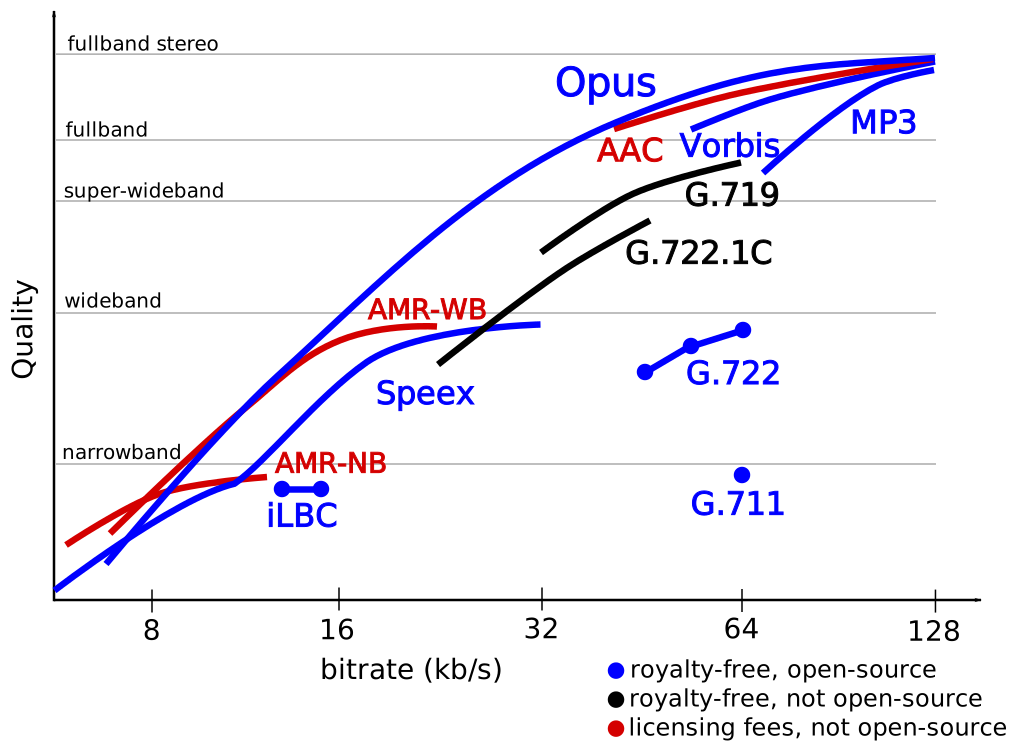
Opus is a remarkable codec because it’s excellent at almost everything. The only areas where it’s being beaten are extreme narrowband, which it can’t do, and narrowband, where it’s still not shabby (though some of this new stuff is redefining what’s possible).
Opus tackled a broad field of competitors that were each somewhat specialised for their part of the field, and pretty much beat all of them at their own game. And in most cases the incumbents were high-latency, while Opus not only achieves quality superiority but also supports low-latency operation.
Past about 16kb/s, Opus is pretty much just the format to use, except for extreme niches like if you want to represent over 20kHz (above which Opus cuts).
Opus is so good there’s pretty much nothing left to improve for now (for now), and even if you improved things it probably wouldn’t be worth it. That’s why all the development is happening in narrowband, because that’s the only interesting space left. Perhaps eventually some of those techniques will be scaled up past narrowband. I don’t know.
Yeah. In reality the main reason new audio codecs are developed post-Opus isn't technical, it's so that companies can get their patents into new standards and rake in the licensing royalties. There are better codecs for really low bitrates but that's quite niche these days; even telephony is going wideband and higher bitrate.
Let's assume for a moment that you're not stupid enough to confuse 200kBps (1.6Mbps) for 200kbps.
Opus is fine down to 8kbps. It fits over a cheap, shitty mid-20th century analogue telephone line with room to spare.
The ultra-narrow band stuff is very niche, and is consequently unlikely to have the broad impact you're imagining.
In contrast there is continue enthusiasm for these pointless midband codecs that are similar in performance to Opus but have the "advantage" that somebody gets $$$.
8kbps is enough - when you don't spare anything anything to bit correction. Maybe in those cases, somewhat okay analogue audio is enough (for example, in long-distance raditelephony). But having a very impressive digital codec raises the bar significantly, especially the last time someone bothered with this is someone in Nokia trying to fit 6kbps using what was now rudimentary phone chips.
Additionally, there are people in the world (including US) who are stuck using unreliable 28kbps lines. Having an option to do excellent audio and video is something that no-one seemed bothered to do.
I just compared 730 kb/s Flac with 160kb/s Opus, I can see no difference even on spectrogram using 'mother of mp3' track: Tom's Diner (Live At The Royal Albert Hall, London, UK, November 18, 1986).
Very surprising, will be migrating all my music to opus to save space.
Beware of phase differences, they won't show up on a spectrogram but could seriously upset your stereo impression. Before you compress all your Flac content and only figure this one out afterwards. That could be quite annoying.
Yeah - definitely keep your backups in FLAC. Having a lossless source gives you infinite future flexibility, and that cannot be underestimated. Otherwise you're kinda doomed to hit https://www.youtube.com/watch?v=fZCRYo-0K0c eventually.
For on-listening-device though, oh heck yes - Opus is great.
As I said, spectrograms are not indicative of compression quality. Codecs should be judged by ears only. What you see in a spectrogram will vastly differ between codecs and will not reflect their compression efficiency.
For 99.9% of use cases, that's a solved problem. You'll never use anything other than FLAC and Opus for lossless and lossy compression respectively.
I'm sure there are unusual cases such as live streaming over satellite internet where getting an extra 1% compression on high quality audio is a big deal, but even that's likely a temporary problem. Starlink users already get >50mpbs
After AAC, researchers realized that AAC produced perceptually transparent audio with excellent compression and that growing bandwidth and disk space meant there wasn't much point to further improvement in that direction.
And remember that, unlike MP3, AAC is more like an entire toolbox of compression technologies that applications/encoders can use for a huge variety of purposes and bitrates -- so if you need better performance, there's a good change you can just tune the AAC settings rather than need a whole new codec.
So research shifted in two other directions -- super low-bandwidth (like this post) for telephony etc., and then spatial audio (like with AirPods).
Oh I wrote something about that [1] on HN and HydrogenAudio But basically there are zero incentive to do so. We are no longer limited by Storage or Bandwidth. Bandwidth or Cost Per transfer decline at a much greater rate than any Audio or Video Codec Advancement.
So if you want higher quality at a relatively high bitrate? Use Higher Bitrate. Just use 256Kbps AAC-LC instead of 128Kbps, all of its patents has expired so it is truly patent free. The only not so good thing is that all the Open Source AAC Encoder are't anywhere near as good as the one iTunes is provided. Or you could use Opus, at a slightly better quality / bitrate if it fit your usage scenario. Even high bitrate MP3 for quite literally 100% backward compatibility. If you want something at 256Kbps+ but doesn't want to go Lossless, Musepack continues to be best in its class but you get very little decoding support.
The article mentions that it can scale bitrate directly by adding or removing layers. But I sure wish they had included some hi-fi quality sample audio.