If you want a bit more of an in-depth, audio depiction of this incident then check out the Well There's Your Problem episode on it: https://www.youtube.com/watch?v=dgKU0zu6KB8
It's a podcast about engineering disasters (with slides) that I enjoy and share whenever I can :D
This is my go-to podcast for background noise at work. I recommend their episode on Gulf State vanity projects, it's my favorite one (it is also quite long).
The Mine Safety and Health Administration produced a report [1] with an inconclusive "Possible Causes" section. One thing I noticed there is that "the plotted location of the drill hole fell just within a mined-out section." I wonder if the drillers were using a map showing only the active galleries, though I would imagine that would have been mentioned if it came to light.
There are detailed maps and drawings of the mine works in this report. Also, there is a diagram [2] to be found in several places, apparently from Keller & Blodgett "Natural Hazards" (Prentice Hall.)
If you watch the video linked in another comment, one of the folks interviewed says they used a form of triangulation that displaced them 400 meters, but all that evidence is gone.
>So much water drained into the caverns that the flow of the Delcambre Canal that usually empties the lake into Vermilion Bay was reversed, causing salt water from the Gulf of Mexico to flow into what was now a dry lakebed. This backflow created for a few days the tallest waterfall ever in the state of Louisiana, at 164 ft (50 m), as the lake refilled with salty water from the Delcambre Canal and Vermilion Bay.
Author of the original Damn Interesting article here. This Today I Found Out (TIFO) video is problematic, because the host of TIFO (Simon Whistler) used to be part of Damn Interesting, he was the narrator for our audiobook and some of our early podcast episodes. Our Lake Peigneur article, the one this HN thread is based upon, was one that he recorded for us.
Simon joined TIFO without informing us, while still working as our narrator. And TIFO had long been poaching our articles, lazily rewriting our work and calling it their own. So you can imagine my dismay when I found out that our paid narrator was also being paid by a competing website to read our slightly reworked content.
This Lake Peigneur video is a particularly egregious example. Their script is extremely similar to our original article in structure and phrasing. That alone would be bad enough, but for the video's host to be a former member of Damn Interesting makes it feel really awful.
This isn't the first of our articles they have reworked into a video without our permission, and I doubt it will be the last. I'm not claiming they are breaking any laws, but what they are doing is gross and parasitic.
Diamond Crystal sued the state because Louisiana owns and leases land on which the drilling took place. The company claimed the state was responsible for keeping the mining and drilling operations safely separated, Guste said.
Since 1994, AGL Resources has used Lake Peigneur's underlying salt dome as a storage and hub facility for pressurized natural gas. There was concern from local residents in 2009 over the safety of storing the gas under the lake and nearby drilling operations.
Well, as the incident here was caused by nearby drilling, an attitude of "once bitten, twice shy" is understandable.
I am also curious about what happens to the water in the mine. Did the hole, big enough to swallow the drilling rig and several barges, seal up, and were the workings then pumped dry? If the water is still there, presumably it would become a saturated solution, but I am wondering if that could still erode the salt, on account of continual exchange of ions between the solution and crystals of salt? Or would the water be entirely absorbed into the salt crysyals, given that NaCl and other salts are hygroscopic? If I were a local resident, I would have more than a mild curiosity in these questions.
Well the same mine, on the same 1300 ft level, had a water intrusion related collapse about 10 years prior that killed 4 miners. Without any oil drilling going on in the area.
Part of the engineering involved in the design of these mines is based on leaving enough salt, such that X" of salt on the surfaces will be dissolved by the mine eventually being flooded, either intentionally or not. After that surface-salt is dissolved (and the water approaches being supersaturated brine), enough solid structural salt needs to be left to support all of the overburden, with some additional factor of safety.
Worst case would be some sort of underground fresh water river flowing through indefinitely.
But mine design incorporates ways to naturally seal off flooded areas, such that even if they are left "open" to some connection of water, the supersaturated brine will effectively plug that hole. Usually as simple as changing elevations so that a brine-water interface forms that blocks any natural flow.
And once water is supersaturated with salt, salt is no longer "hygroscopic", in the sense that it's no longer water, but brine.
I said that I can understand the local residents' concerns, and I don't see how the fact of the prior event would do anything to alleviate those concerns.
On the other hand, I see that the storage cavities were created independently of, and some distance (horizontally and vertically) away from the flooded mine, which should answer their concerns that the flooding had made the proposal risky.
It is a weird industry man, ceos of the big companies often talk about God and morals a lot but their actual behavior is reckless and greedy. See the decades of knowingly lying about climate change as well. Source: I worked for a big oil company
1. What you want doesn't really matter, since you and I don't get to vote on company directorships.
2. You would want God on your side[1], if you're going to operate a controversial[2] business in his country.
[1] Or at least claim loudly and frequently that he's on your side.
[2] Resource extraction, even in resource-economy regions is always controversial, because of its impact on neighbouring properties. And when your business is controversial, having the clergy on your side can't hurt.


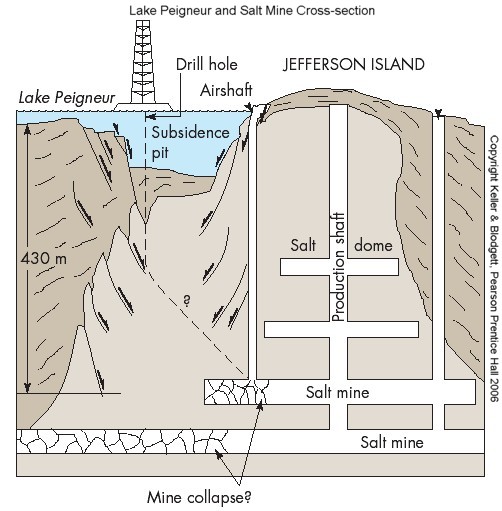
which shows visually what actually happened with the drill.
--
[1] http://1.bp.blogspot.com/--Q5XY2Gkwns/VVK8dT2pPSI/AAAAAAAACG...