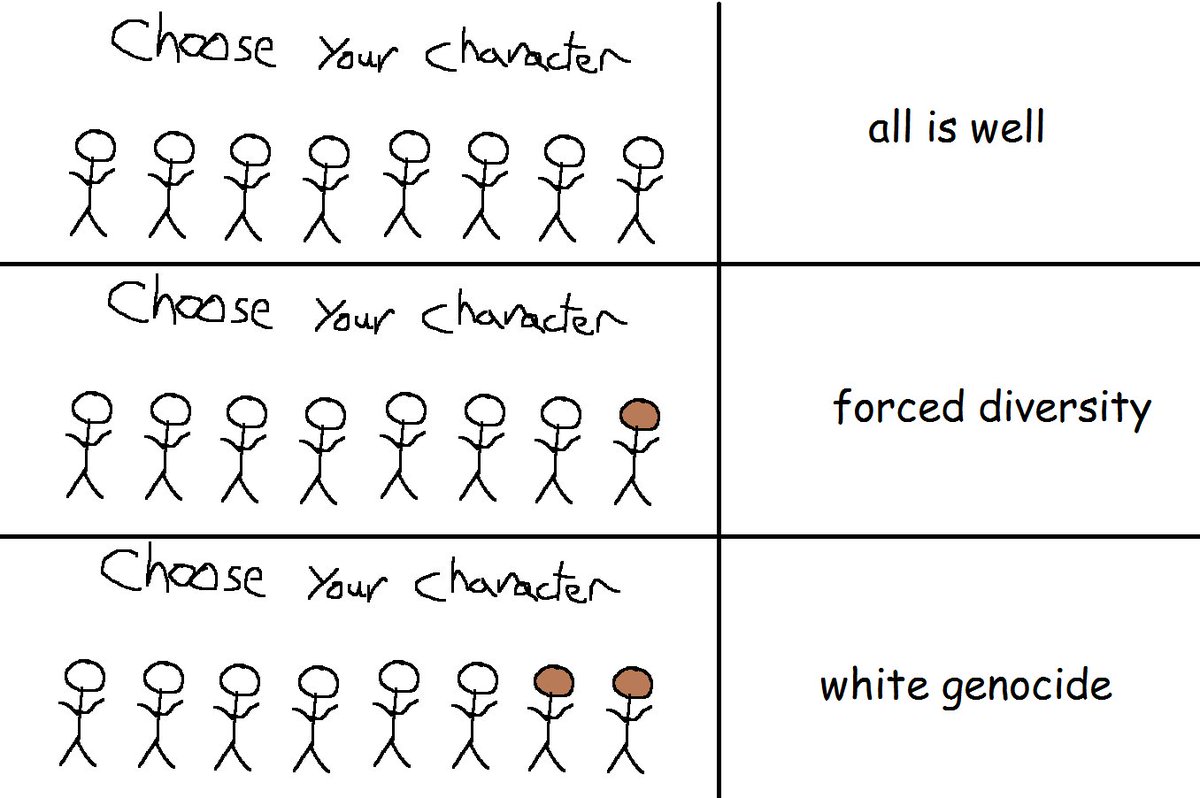
It's US's current cultural trend, which is now enforced on the rest of the world, and also on our descendants who may have different sensibilities.
Maybe the Unicode Consortium should spend their energy on the real problem of third world languages underrepresented in the Unicode standard and spend less energy on the racial and sexual identity of pictograms.
> also on our descendants who may have different sensibilities
Unicode describes flags of nations that no longer exist, dead languages, etc - I don’t see why having a few pictograms that may or may not be relevant in 1000 years time is the place to draw the line. If skin tones play a role in pictographic communication today, then that’s good enough for inclusion.
Put another way: Unicode seeks to describe all human written language. Emojii is unusual in that TUC is actively playing a role in the evolution of the language, but they’re still trying to describe a written language the way people want to use it. This feature sees a lot of use, which to me says that TUC has correctly described how people want to use pictographic communication.
The problem is that it's not about human language. If it was about human language, the consortium would give a shit about Bengali speakers. It's about the sensibilities of a small, particular group of privileged people, in a particular time at a particular place, who consider their weird priorities to be universal.
Let's not forget that adding all this complexity to Unicode has a real burden for people who implement Unicode. In practice, the consortium has to prioritize what symbols to support. So, in practice, it's less "embracing all variants of human expression", and more "the ability to communicate in your native language doesn't matter as much as the gender identity of this police emoji".
What’s wrong with the Bengali character set? A Google search doesn’t show any discussion on limitations here. And while power and privilege do inevitably play an unintended role in prioritization, Unicode successfully encodes several entirely dead languages - so it’s not like everything not relevant to English speakers has fallen by the wayside.
And while you’re correct that emojii do require some amount of UTC resources, it’s worth noting that most of that work is done by a special subcommittee to not distract from the mainline work of other languages, and that emojii have brought new attention and new volunteers to TUC - so I’m not sure how significant the impact of adding emojii to their workload really is.
You appear to be confusing the submitted article with the article linked from a comment, with was put in context (and I'm being extremely charitable to the Bengali article OP with this language) here: https://news.ycombinator.com/item?id=9219162
I apologize, I missed your link. But please don’t assume hostility for me missing a URL - I was clearly interested enough in the issue to do a Google search.
In any case, please see the comments on the HN post (linked by a sibling comment) for that. The issue is in fact wickedly complex, and it’s not clear (even among Bengali speakers) that this is a deficiency in Unicode (vs a deficiency in text entry and rendering software).
Technically, flag emojis are just two codepoints that encode two Latin letters. They are the “regional indicator symbols”[0]. This solves the problem of countries coming and going, and leaves the job of implementing them all to the font designer (through ligatures), not Unicode.
For example, the US flag is composed(?) as U+1F1FA U+1F1F8 (REGIONAL INDICATOR SYMBOL LETTER U) and U+1F1F8 (REGIONAL INDICATOR SYMBOL LETTER S).
It can get even crazier with “emoji tags”[1]. Say you want to encode the flag for California, US. You’d think it’d be done using those regional indicators as “CA”, but that’s actually Canada. The way to do it is: U+1F3F4 U+E0075 U+E0073 U+E0063 U+E0061 U+E007F. This encodes a black emoji flag, “USCa” in tag characters, and a “tag cancel” code point.
Basically, if your font has symbols for countries that don’t exist yet, or are missing some, that’s on the font designer, not Unicode.
True, but Unicode does say that all alpha-2 codes are valid. So while Unicode isn’t saying “this is a list of countries you need flags for”, they do say “go here to find the list of countries you need flags for” - which is mostly a (reasonable) decision to punt political pressure onto somebody else :)
So all that to say: Unicode is still representing language and/or written culture as it is at a point in time (which may be less relevant in the future) - and that’s OK, and absolutely compatible with their aims.
I'm just happy we have three ancient Egyptian hieroglyphic penises in Unicode. Mobile keyboard developers need to step up and make them more easily accessible, though.
The Unicode Consortium is a consortium, big enough to work on multiple issues at once. If you think the consortium should work on third world languages, then you should join the consortium and work on third world languages.
This doesn't at all track as an argument. The US government is far larger than the Unicode Consortium, and I do feel that the government should work on fixing some of our crumbling infrastructure. That does not at all mean I should join the government to do so. Moreover, any number of people in this thread believe they should work on skin tone variants; should they all join to advance that work?
Actually, participating in your local government is a pretty effective way to ensure that your viewpoint is represented.
It's true that "any number of people" in this tread believe that the consortium's efforts towards skin tone variants are a good thing. Is anybody here calling for more work to be done in this area? Those are the people who I'd make a similar recommendation to.
Why do these require much energy? Unicode is big, why not just add everything? I still am pissed of by the fact they rejected Tengwar - how much energy would it take to add (id nobody opposed)?
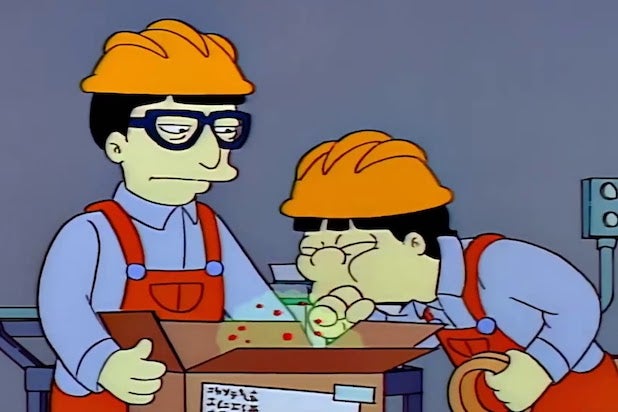
Although yellow seems like it's good for everyone (since no one is actually yellow), it ends up still representing the majority. Just look at the Simpsons - all the characters are yellow, but not Apu.
Also skin tone options are extremely popular with people of colour - probably because they feel the default yellow doesn't represent them.
This is a great example. All the yellow characters in The Simpsons are coded white (from my recollection).
Nobody is actually yellow, but bright yellow skin is very clearly obviously not black or dark brown; it's much more functionally similar to light skin tones.
Maybe the "true" solution would be to use a color that's completely different from all skin tones, such as a very deep blue color. But my immediate reaction to the thought of deep blue emoji is that I wouldn't identify with them - which, again, kind of proves the point that bright yellow is much easier to identify with for light-skinned people
PBS Kids did a good job with this, in my opinion, with their green characters. [0] I think replacing the default yellow skin with green would be a good thing.
That said, the on-going work into representing all humans in emojis is wonderful, and I really admire the clever technical solutions like this handshake proposal.
I'd wager that the popularity of dark emojis has more to do with their contrast and less with politics. Most dark people in the world aren't minorities where they live.
I haven't watched the Simpsons, but it's really unfortunate that they did that. I suppose the problem with fictional skin colors is people will always assume it represents the racial majority. Similar to how icons are usually coded male in the absence of female signifiers.
I wonder if it's possible to avoid that. What if at the outset, we'd used a different color for every emoji? Smile could be green, frown could be blue, wink could be yellow, etc.
I think that Simpsons never intended their characters to be race neutral. They are social/cultural parodie where it is always pretty clear who exactly they make jokes about.
There are also some episodes that are very clearly explicitly about race. If nothing else, the use of n-word makes it super clear who is white.
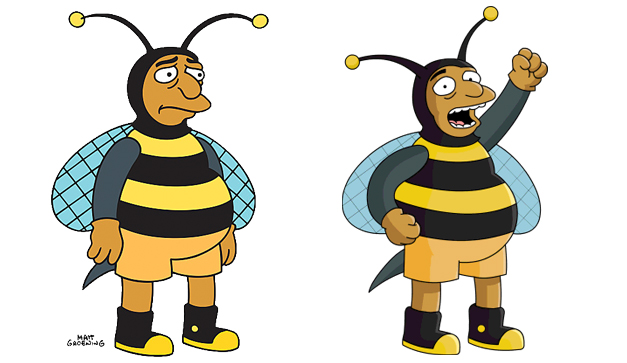
So, Carl Carlson, Dr. Hibbert and Bleeding Gums Murphy are pretty clearly Black, Apu is pretty clearly Indian, Bumble Bee man is pretty clearly Mexican, but all the yellow characters are... "a null race?"
Despite all clearly having signifiers of white people, and several of them clearly ethnically Italian or German, and most of the rest being Waspy?
Does this not simply speak of what you perceive as the "null race" or, perhaps, default race?
And when the Simpson's producers said a few years ago that they were going to stop voicing non-white characters with non-white actors, who did they find to voice all the "null-race" characters?
So the majority of people are yellow, and yet we still have black/brown characters (Bleeding Gums Murphy, Apu, Carl, Dr. Hibbert, etc) and most East Asian characters were given almond shaped eyes.
It's almost like there's a correspondence with the "average" yellow Simpson's character and some real world US ethnic majority...
This is actually further to the point, all the examples you’ve given are explicitly racially diverse characters, meaning that yellow does in fact represent the majority, and implies whiteness.
What does that mean though? I see Fat Tony as Italian-American, Rainier Wolfcastle as Austrian, and Akira as Japanese. The majority of the population of Springfield, which is supposed to be somewhere in North America, is probably "white".
So the context of the show itself, and how characters are portrayed imply their race/nationality. This is not true of an emoji.
I wonder why I see the take "I don't use this thing/see the value, therefore it is bad and shouldn't exist." so much more on HN than anywhere else? It's such a weird view.
In my opinion it’s part of the famous hackernews shallow/middlebrow dismissal that PG described almost a decade ago. “This isn’t my use case, and is therefore worthless” is also very similar to the famous “This is silly, anybody could build this” top comment on the Dropbox launch post. It’s not limited to HN either - see the Reddit comments on any movie not targeted at the 20-30 male demographic, or hackaday comments on anything looking to improve usability.
I didn't read his statement like that at all. Sounds like just your biased take about opinions you don't like, and that you don't find opinions you don't like much outside HN.
The statement "Introducing skin tone provided no advantage" is pretty ignorant and unaware, especially when skin tone variants are widely used so they objectively hold some utility. At best it's an uninformed and lazy take, at worst it's someone showing their lack of empathy and distain for people who don't look like them.
Huh? What if they just don’t think it’s something worth having in unicode? This does just seem like disdain for opinions you don’t hold.
I think it would also be unnecessary to add modifiers to unicode that let me, say, represent a glyph of a man in a dress, or a modifier that lets you use those family emojis while clarifying that one of the parents is an amputee. Just because you can find someone who can write a twitter thread on why those additions are absolutely necessary doesn’t mean I’m lazy or disdainful or, let’s say, transphobic/ableist.
What is it to you what is put in Unicode? Seriously, how does it affect you in anyway what is put into Unicode? We should be making things _more_ accessible and if that means adding all of the necessary variations of emoji to represent humanity, as it is, than I'm all for that and so should everyone else because it costs us literally zero to do.
Any argument to the contrary really needs to examine from what angle they're making their argument because they are not based on empathy but something of the opposite.
I don’t like encumbering our communications with the crowd madness of the age.
You could make your same argument for “latinx”. Who cares if people on NPR say it? It’s harmless and inclusive! Well, that’s where we disagree.
Once again, attacking arguments that you disagree with by asserting they come from a place of bad character isn’t a discussion. It also seems like you risk giving yourself too much credit by seeing your views as some sort of paragon of virtues like empathy, thus anyone who disagrees must be against your self-appointed virtues.
People making argument against their inclusion (futilitously) are doing so in bad faith under various reductionist arguments like not wanting to make a complex language more complex when there are aspects to our language that _should_ be changed.
The arguments against are not based on any logical or rational footing (because adding them is trivial and people want them to be added) so the assumption is that they are making arguments on emotion. Why would someone argue against inclusion based emotion? Because they don't want to be inclusive. You don't have to arrive at this conclusion because you believe you have some moral superiority, you can arrive on it based on common sense.
The arguments against are not based on any logical or rational footing
How convenient it must be to believe oneself to be in exclusive possession of logic and reason. This is not the way to charitably interpret an argument.
The biggest reason these features should never have been added in the first place: the more opportunities everyone has to notice and be reminded of everyone's differences, the longer those differences will remain divisive.
The saying used to be, "On the Internet nobody knows you are a dog." We were all brought together by the common language of text. I became friends with people of many nations, colors, and sexual backgrounds. Now, every single interaction has to be labeled with your "identity," as if a single color code point could remotely capture that, and it drives us all apart.
This is amplifying exclusivity in the name of inclusivity.
The biggest reason these features should never have been added in the first place: the more opportunities everyone has to notice and be reminded of everyone's differences, the longer those differences will remain divisive.
So because people are discriminatory, we shouldn't be more inclusive at the risk of enabling those who...discriminate? The only reason these issues are divisive is because those who are insecure with their personal identity make them divisive. We shouldn't appease discriminators at the cost of letting people express their true identities.
Also, you cannot "remotely capture" ethnicity and culture in a single color code, even yellow. Yellow is light and implies a lighter skin. It's inherently (no matter how you want to argue it) promoting or portraying human skin as light.
I'm not sure where you get to your conclusion but it seems like, based on the adoption of skin tone variants, the only ones amplifying exclusivity are those that want things to stay exclusive.
Unlike latinx, people actually use the skin-tone emojis. I see them used quite a lot, actually. You can disagree if you want, but usage states otherwise, and I'm glad that we're adding emoji that actually get used.
Last fall, I found the plist files which control OS X's character picker, and spent an evening backporting seven years worth of new emojis to OS X 10.9 Mavericks[1]. The one thing I couldn't get working was skin tone variants, because Mavericks has no concept of them. All emojis in the picker are yellow.
Anyway, a couple of weeks ago I got a really nasty email accusing me of being all sorts of racial things, because I hadn't included skin tones. I don't know if this person was just trolling or crazy or what, but they were really mad! I'd never received an email like this before, so I was pretty upset.
It was because of a demonstrated demand for emojis with different skin tones to the default yellow. Before the Unicode Consortium had even considered this, there was a popular app called iDiversicons, which had similar emoji-like characters customisable with five different skin colour options, as images that could be copied by the user into their messages.
After trying and failing to convince Apple to allow their app to modify the iOS keyboard to make these easier to enter, the authors of the app took a broader approach, and wrote a proposal to the Consortium to include their emojis as standard:
From what I’ve seen, the skin tone feature sees lots of use (particularly in some minority communities), which to me is a good indication that this is something that people wanted.
Not at all. Major apps and OSes put a "choose your race" message on their UI (and very strongly direct people to make that choice). This does not mean there was pre-existing latent demand for this.
What this shows is if you inject the concept of racial self-identity onto cartoon symbols, and afford people a way to navigate that selection, people can do that. Not that anyone wanted this, or that this feature is beneficial.
Users follow prompts, so "people choose a race when presented with a racialized emoji picker" doesn't mean "people want their emojis racialized". It means, people understand what they are being asked to do, and want to get back to their business.
You would need to have a theory of benefit, and then design a survey which tests users to understand if that benefit was achieved. You, frankly, are confused about causation -- we put a dialog in front of people and they made a selection, therefore people wanted this dialog?
"we put a dialog in front of people and they made a selection, therefore people wanted this dialog"
You're suggesting that it's impossible for people to have wanted a feature, because UXs have a popup showing people that it's possible to use that feature now. I disagree. You're projecting your personal opinion as everyone's personal opinion.
And that emoji picker still allows you to pick the default yellow color. So if people -really- didn't want to use them, they wouldn't.
I'm not suggesting it's impossible. I'm saying you don't know what you claim to know, and to my knowledge nobody has tried to know it. People, such as yourself, assume that because this feature is used, it's desired. This is not at all warranted, given what we know about how people use computers.
No, it's more like, we put up this dialog, and people didn't overwhelmingly pick jaundice. And therefore the available variety is preferred over less variety.
People choose to pay their taxes, therefore people want taxes. People choose to accept EULAs before they use software, therefore people want EULAs. People choose to stay with spouses with whom they occasionally fight, therefore people want fighting in their lives. People choose to navigate complex civil bureaucracies in order to get things done, therefore they want bureaucracy.
Or, people can suffer through a certain amount of bullshit in order to get to their goals. The word you're looking for is "instrumental" -- there's your missing interpretation.
At some point in the past ten or so years, the cultural discourse has devolved to such an extent that people cannot think even one move ahead. Zero tolerance manicheanism rules everything now.
None of those are analagous to the question at hand.
People are clearly using the emoji they want because they want to in and of itself, end of story.
They're not doing it to satisfy the government or access software or whatever. And no, I'm not looking for the word "instrumental", because emoji are about expression, which is literally the polar opposite of something being instrumental.
Sometimes it's not about looking twenty moves ahead. Some things are just valuable in and of themselves. Some things are about the moment. Perhaps that's the perspective you're missing here?
Just because some things are instrumental doesn't mean everything is. And thank goodness for that!
In my experience, "because I said so" is not a great argument.
Just one look at the way these color pickers are presented on first use, and how that selection becomes the default thereafter, tells you everything you need to know about the flimsy basis of your claims. The picker pops up and interrupts you while you're in the middle of writing a message, and then persists your choice. It's a speed bump on the way to your actual goal -- gosh, does anyone have a word for that sort of thing?
A person would have to be mighty well motivated to believe that this would be evidence of a latent demand for self-expression via skin tone.
Please don't post flamewar comments to HN. It's not what this site is for. Crossing into personal attack is particularly not ok. No more of this, please.
Whoa whoa whoa, please don't post like this. Obviously we have to ban accounts that do, regardless of how provocative or wrong the other person was or you feel they were.
It's not clear to me that anyone went out of their way to select it. I mean, maybe they did. Maybe they didn't. I don't know all the UIs of all the devices that are capable of producing emoji characters.
It's not non-default. When I used macOS every time I tried to send a new emoji for the first time it popped up a modal asking what colour I wanted. So the yellow was no more "default" than the skin-tone ones are.
No, I'm shooting from the hip and exaggerating (slightly). When you're sending an emoji for the first time, an app typically presents you with a selection of skin colors for the hand or face icon you're choosing. My point is that this is a design decision to impart significance into racial self-identity.
So the entire exercise is tautological -- of course people pick a skin color, when you frame the choice as "pick your skin color before you send this (or don't and we'll just keep using the inhuman color, which might communicate its own signal, or just look weird when everyone else has a skin tone)". And of course it's meant to be informed by race.
We decided to present skin tone (race) as something important, and people responded as though it's important, is not a surprising finding.
> Major apps and OSes put a "choose your race" message on their UI (and very strongly direct people to make that choice).
Eh? Never having set it, I went looking for the setting in Slack. It's so discreet that I had to Google it. I still have no idea where it might be in MacOS.
The idea that this is being forced on people is kind of absurd.
We can’t eternally keep the status quo just to avoid opening cans of worms. If we don’t intend to throw it away, we might as well open it and face the worms.
This all reaction reminds me of the “new” skin tone palette of band aids: some people were happy with the change, and it seems to me the impact for everyone else who liked the standard ones was null.
But there was sooooo many reactions against the very idea that more than one color was now available.
I think skin tone color band aids are different, people have different skin tones and the old default only blended well on people with light skin so the new ones are nice for people.
With emoji people took a neutral non-racial thing and inserted race into it. In addition to the complexity of doing that well it just puts race and all the identity issues tied to it into a place it didn’t need to be. I think this generally makes things worse.
Serious question: Do you think that if the majority of people in the US, and particularly the majority of middle and upper classes and tech folk, were Black that they would have defaulted to a yellow color for emoji?
That's not even getting into how all the "man" "woman" "child" etc emoji had stereotypical white-people hair etc.
To expand on this: The original emoji were created in Japan and had light skin tone to match Japanese users[0] (with a few exceptions of other racial stereotypes - like "person wearing turban"[1]). After they gained international popularity, their rendering was changed to yellow in an attempt to be more neutral.
I'm guessing yellow was chosen to match the yellow "smiley face" which few had objected to historically
Make the color blue then if yellow isn’t neutral enough (like iMessage tapbacks, or Facebook thumbs up). Make the people more abstract.
I’d argue the direction should be towards generality not identity specificity.
I’m not dogmatic and obviously my point of view on this is a lost cause, but I generally think the universalist ideal is better and should be the goal.
I do think yellow was intentionally chosen to be universal and not to be read as “white”.
Yeah - even then it’s not perfect because people in real life may have a cosmetic interest in skin tone matching bandages. It’s not about inserting race, it’s about blending the bandage so it looks nice.
With emoji, it’s different - it’s explicitly about inserting race into a place it didn’t need to be. I think this type of thing is generally worse for society. It leads to people thinking about our differences more than our similarities.
One could argue the original band-aid was just rubber colored and non-racial in some way, but keeping ignoring it matched light color skins better was becoming a choice in itself.
Emojis are the same to me, in that they were introduced with very limited scope (original ones were simple outlines, with bright pink, blue or green faces). Then expanded and got more detailed, less caricatural, and stopped fitting a single byte.
IMO the can of worm got opened the moment we got detailed drawings with artistic choices that best match one category of people. We have shown we weren't limited in number, and accepted a ton of complexity to deal with flags or gender representations for instance, it would be tone-deaf to just go on saying it's too complex to also care about racial representations where they might apply.
If you're arguing for getting back to simple outlines of random colors, I'm with you. But I think we're not in a stable place right now to say "we made enough diversification, let's just stop here".
If that's not good enough, then commission your own emoji font. Or, don't use emojis/don't use Unicode. And let other people communicate in the way that they want.
Generality is not, in general, better - we all communicate with different symbols (including different letters and words, different languages and dialects and subtexts and slang) to evoke different aspects of language and communication.
Identity is extremely important to communication - I, personally, am communicating my opinion to you, personally.
If you want to stick to [what you consider] neutral or impersonal language in whatever aspect, you can. That option hasn't been removed from you.
If you want to impose your preference on others, that is to prevent other people from communicating effectively. I don't respect that.
I'm not dogmatic about it and obviously my position is a lost cause, but I don't think inserting race into everything is better.
Race is socially constructed, lines between 'races' dissolve and change over time. Reinforcing our differences in software and communication unnecessarily over arbitrary categorizations and physical characteristics is worse for society (imo).
I think people should generally have the freedom to do what they want, but defaults and incentives matter - it's better to choose ones that lead to a better outcome when possible. That's all I'm getting at.
Race is socially constructed, but skin colour is not - it's a physical attribute.
Emojis literally offer people the choice to use "Light Skin Tone", "Medium-Light Skin Tone",
"Medium Skin Tone", "Medium-Dark Skin Tone" and "Dark Skin Tone".
Yeah you're right of course - and that's the strongest argument in favor of them, but given how modern society operates today where people use skin tone as a (the main?) racial differentiator, the emoji's imply more than that.
If it was just hair color or something it would be different. It shouldn't be different (imo) and hopefully we eventually get to a world where they're just physical attributes. I just don't see this kind of thing helping in the mean time.
> This all reaction reminds me of the “new” skin tone palette of band aids: some people were happy with the change, and it seems to me the impact for everyone else who liked the standard ones was null. But there was sooooo many reactions against the very idea that more than one color was now available.
And now we have superheroes band aids, Elsa band aids, transformers band aids, teddy bear band aids.
You'd be fired for this comment in any big american corp today. The big players in the US have been pushing a new version of the divide&conquer agenda to the poor so they wouldn't accidentally develop class conscience. Basically, most Americans are being divided along the gender and race lines: men vs women vs trans, and white vs black vs asian vs latino. The goal must be dividing the society into a few tens of alienated camps that don't talk to each other. This policy is being pushed hard at every level: from schools and offices, to DoD and WH. It's pretty much an awkward religion or rather a cult, with church, heresy, bishops and inquisition.
Because Unicode emoji started out with a bunch of crap they couldn’t ever say no to new proposals because someone will say “why do we need a man levitating emoji and not skin tone modifiers?” And while we are at it, we need a woman levitating and gender neutral person levitating.
If they simply stuck with supporting those for legacy reasons, then things would have been fine. But no line in the sand was drawn.
IMHO there should be a moratorium for (say) five years to let things settle, and see new ones are actually needed, or if it's just inertia driving recent additions.
I can't think of one. There are already far too many of them to view at once on a phone, so adding more doesn't make things much more disorganized. Storage capabilities also grow faster than the standard adds new symbols.
Frankly I think it's a bad look when people suddenly become very passionate about opposing updates once they are reminded of the existence of dark skinned emojis. They're just silly little drawings, people. If someone is so upset by others being able to send silly little drawings that vaguely resemble themselves, they should do some introspecting.
Time used to implement all of these things is time not spent working on more 'useful' things. Like, from a comment up-thread, languages and scripts that people use in their daily lives:
The Simpsons is not the authority on the meaning of yellow skin for generically representing human body parts. It’s a tv show. The iconic happy face symbol is not intended to specifically be a white person. Pac man is not a white person.
I agree that they're not an -authority-, but the Simpsons is a huge cultural institution. They definitely made an impact on how the yellow tone is coded (as white).
So yes it seems silly, but I think a default of blue or green would be better.
Exactly, yellow was neutral and in line with emojis in general. Now do I have to decide on my skin tone? Will people get offended if I choose a darker tone?
And what would someone use a handshake emoji for exactly?
Agreed. The fallback emoji in particular is very confusing, doesn't look like a handshake, and is only necessary because of this particular solution to a problem that no one had.
I don't have an issue with this-- if people find value in it, fine. I don't think I will use this though. There are too many combinations that I am too likely to get wrong.
Why shouldn’t people have a way to express themselves that they want? Are there words or spellings that computers should refuse to display?
I am not a fan of how Unicode has treated emojis, but there is no question they are completely within scope in principle (they were part of extant keitai character sets) though the way they are being extended by the UCS makes me uncomfortable.
But so what? People like to use them which seems like enough justification.
If using a white-skinned emoji gets you special treatment the yellow, brown, or black-skinned emoji does not, I think that's worth being concerned about.
Until that happens, there are probably bigger fish to fry.
unicode itself is a terrible can of worms. There are so many edge cases that adding black emojis is hardly a big deal. Black emojis is not complicated compared to some of the languages out there.
The appearance of skin tone emojis are bad enough but the thought that someone consciously took their time to choose the skin tone of the emoji that best matched their own in their mobile phone UI makes it that much more bad.
Emojis communicate. Race of the speaker can add important context to the thing being communicated. Adding skin tone to emojis allows them to communicate this.
With emoji you can, in one glyph, raise your hand in a conversation to say, eg, "me too". With skin tone support, you can still raise your hand but can also say, "and I'm a person of colour" which may be a crucial piece of context for the conversation.
TLDR People need to talk about race. People talk using emojis. Skin tone allows them to talk about race while using emojis.
I'm slightly amazed that nobody sees any value in being able to talk about race using a full range of expression.
The wave-hand emoji with a black colour allows you to compactly say "+1 as a black person", for example. That means emojis now support conversations about race. I've seen it used exactly like this in the wild in multiple fora.
Yes, exactly. My point is why it is important what colour your skin is. Are there arguments that are only valid because someone is white? Isn't that racist?
Why is it important to be able to talk about what colour your skin is? Have you lived through the past year?
There is more to language than debate-club argumentation, too. Consider - why is it important what gender someone is? Or age? Should emoji only have had unisex and age-less figures instead of its current set? Is it sexist to use a female-presenting emoji?
These things all have obvious utility for communication, and you're ending up making some deeply strange arguments to try and dismiss that utility.
> Consider - why is it important what gender someone is? Or age?
It really isn't when it comes to arguments. An argument should not be attached to whoever brought it up. If it is it's hardly an argument and most likely something personal or morally loaded which is not suited for objective discussion.
> Should emoji only have had unisex and age-less figures instead of its current set?
Yes!
> Is it sexist to use a female-presenting emoji?
Obviously not and I don't know why you would get the impression it is. It is however mostly irrelevant: So now people assume you are an XX chromosome female or are trying to present as one. What now? Do you expect special treatment now?
> These things all have obvious utility for communication,
No they don't? And I don't know what would be "obvious" about it? You can't just present this as "obvious" fact when it's really not clear at all.
> and you're ending up making some deeply strange arguments to try and dismiss that utility.
You did not explain to me why my arguments are "deeply strange" and you also failed to explain why it should be useful to convey your own skintone in the context of discussion. My argument is that all you do with skintones and a nursing male is to bring political discrimination into electronic discussion, without providing any benefit whatsoever or even doing harm.
> It really isn't when it comes to arguments ... not suited for objective discussion
Emoji is used for more than arguing or "objective discussion"!
Emojis are used for friendship, for flirting, for jokes, for sexting, for gossiping, for nattering. "I'm a woman who likes to dance", "I am white", "oh but I'm an old man" — these are all valid statements people say to one another; adding this capability allows emoji to be used to convey these meanings.
If your argument is "people shouldn't conduct electronic discussion in these sorts of ways, when using emoji they should only have arguments over objective facts" that's ... well, it's a stance, but you're at odds with how billions of people communicate electronically. This is why I use terms like "obvious" and "strange".
Yes, Americans invented the Cotton Gin and Racism around the same time, and no other culture ever has cared at all about representation or inclusion./s
I doubt this was solely Americans or that Americans are the only group of people that care about race/ethnicity. Maybe your findings are different. Please let me know where to find your publishings.
There are way more ethnicities and races than skin colors. E.g. there are hundreds of distinct ethnicities in Europe that Americans would merrily categorize as "white" based on their obsession with melanin.
I don't understand your thesis. Only Americans care about race? Only Americans homogenize outside cultures? I mean you just rolled a country large enough to encompass 30 different European countries, where over 300 different languages are spoken into a single cultural belief system, but go off sis...
Your point: There are more races/ethnicities than skin colors would show exactly why it should be relatively simple to undertake this project: a black person from the US, Congo, or the Dominican Republic could all use the same emoji.
I get that you seem to be here exclusively to dunk on ugly American, but I don't think caring about race is something exclusive to the US. If you're from Europe, remember: we learned it from watching you dad.
Because it "erases Blackness and centers whiteness as a default", that's the standard answer.
Yellow codes for the default, which is whiteness. Or said another way, white skin is the only unracialized skin color. Thus the supposedly neutral yellow stands for it.
Proof? Besides, we've got to have some sort of skin tone to stand for skin tones that are absent or not given for some reason. It's got to be _some_ colour, and it might as well be yellow.
Why couldn’t they do HANDSHAKE + ZWJ + SKIN TONE + ZWJ + SKIN TONE? I don’t understand why a new emoji is necessary — the author alluded to “making sense without an OS update” but without an OS update the new emojis won’t render at all, whereas this solution would at least kinda make sense (it would be a yellow handshake followed by two skin color blocks, I believe, just like on devices that don’t support skin tone modifiers for other emojis)
I thought so too first, but I think that would be a quite difficult solution. Skin tone is supposed to only come after some specific code points. We don't want all the grapheme splitting algorithms to break, and it would really change the meaning of zwj fundamentally.
I’m a bit confused; the article alludes to the fact that the handshake emoji doesn’t include skin tones at all, then solves for adding two different tones. Is there a reason we don’t just have [handshake]+[single skin tone]?
Like 'mft_ said, two tones are because there are two hands shaking, possibly differently-colored ones. And per 'Tistron, Handshake doesn't support skin tones and retrofitting them could break things. So the best solution seems to be to reuse two characters that support skin tones - hands. And with directionality, they pretty much already express the concept on their own (the mentioned "fallback").
Ah, I didn't realize skin tone was specified to only appear after certain emojis -- that seems rather limiting to forwards compatibility to me, but I'm sure there's a good reason for it.
Good question. Maybe this handshake work paves the way to make other emoji more representative too! I bet you could reach out to the author and get involved with making that change.
Yeah, the family emoji are a mistake of sorts. Fortunately, individual emoji strung together convey the idea of a "mixed family" with three kids and require no effort on Unicode's part to add new emoji. Ex:
As an English speaker I don't gender my speech about myself.
But to use some emoji (e.g. facepalming) I must gender that speech, and therefore myself. I'd prefer not to have to do this, especially to relative strangers on the Internet, so I appreciate that "person-facepalming" is becoming available on more platforms.
It'd be nice if the gendered variants were collapsed a bit (like the skin color variants) to reduce clutter.
I don’t use emojis much but if you use Discord they have male, female and “person”! I always use person because I feel weird specifically selecting what gender I am. Feels like I’m making a “big” deal out of nothing I guess
If your goal is anonymity, it's worth nothing that you are revealing more bits of information about yourself by using the person-facepalming variant than one of the gendered ones.
What makes you think this is about anonymity? I would guess it's more about the author's identity and being represented in technological evolutions since we absolutely have the technology these days.
I’m sure the next step for the handshake emoji is people complaining about hands with five fingers being “ableist”, and subsequently a number-of-fingers modifier will be added.
It used to be that "plain text" was pretty much impossible to make malicious. Security conscious people have the option of only interpreting plain text emails, for example. This seems to be another example of the human imperative to increase the complexity of everything until it become problematic and then unusable.
I suppose in the future there will be people that refuse to interpret emojis...
Why? Why so much effort is put in something so meaningless as emojis? There's nothing more confusing than messages with emojis. When I read the text I know what information writer wanted to send me because it was all coded inside the text. When I see emoji I have to stop and think, what the writer wanted. Is it part of the information or just the background noise? Should I 'read' this emoji as a part of the sentence or as a separate phrase? Clear text is just so much less confusing.
I hate to say this but you might be old and out of touch
emoji's are part of text communication in the same way facial expressions and body language are part of oral communication. Yes, sometimes they'll be misinterpreted, but the same is true of text alone anyway (were they being sarcastic? Are they angry?)
> The problem is that some use them as hieroglyphs.
Well, that's those people's problem. They won't be able to communicate with anybody outside of their group, so they must eventually give the style away or learn to tone it down when talking to strangers.
Not differently from any other kind of group idiom people created at any time in history.
Why is that a problem? I quite enjoy conversations that spell out words using emoji. I admit it may take me a few milliseconds longer to make sense of a hieroglyphic emoji then a spelled out word, but there is some satisfaction involved and I hear a different—more joyful—tone in the sentence.
> I hate to say this but you might be old and out of touch
I think you're jumping to conclusions too quickly. It is true, emojis can be an important part of communication but until the same graphics start being used on all platforms, devices and services, emojis are a quite bad medium for communication. My phone, my browser, whatsapp, slack, I think twitter too and so on use their own graphics™ which have subtle differences.
They are widely used, which is actually more important than them being used well. Because it's much easier to fix the problem you described than it is to adopt a new communication style as a species. Unicode may be silly, but it's clearly a step we are taking together in communication style.
This honestly reminds me how on skype (for business) or Lync, where people would type strange messages to me that I didn't understand, but in skype/lync apparently it was transformed into a thumbs up emote; I was using pidgin/sipe which didn't do this.
I'd say for the most part, at least Emojis generally work everywhere I need them and I even get the hatching representations in most VT100-like emulators. the worst case I've seen is some of my environments cannot handle the modifiers, which honestly doesn't matter. I can see the symbols and reconstruct what they mean myself.
Why not? Why do you care about the effort other people put into things that they care about? To such an extent that you’ll put effort into criticising things which are of literally no relevance to you?
> Clear text is just so much less confusing.
Yeah nah.
Just because you’re not hip to it doesn’t mean it’s meaningless. I don’t understand most slangs, whether in my own mother tongue or in foreign langages I more or less understand.
That doesn’t mean I’m going to assert cockney rhyming slang or verlan is “meaningless”.
You've missed the point completely and have created a strawman-based rant.
The problem with emoji is that there is no dictionary, no standardised meaning or interpretation guidelines; no unified, context-dependent cues that everyone subconsciously agrees to. When you try to communicate non-verbal cues using them, it works well because there is a general understanding of what is meant though even there, cultural differences sometimes get in the way. Something like a smile cuts across cultures pretty universally.
When emoji start getting overused to the point where you have to draw meaning from the skin tones involved in a handshake, that's a step too far IMHO. This is precisely why we struggle with deciphering hieroglyphics and precisely why emoji must remain a supplement to language, not a replacement for it as many use.
Your objection on the grounds of lack of standardization applies to language as a whole. Dictionaries describe, not prescribe. It is our job to evolve a mutual understanding of what symbols mean and sort out any misunderstandings; it is Unicode's job to provide us with those symbols, whatever symbols we want. And to evolve that mutual understanding, we have to use the symbols. You might ask why bother, why not stick with the language we have? Well, you hear the same objection every time language evolves, and the answer is always the same - some people find the new way expressive and useful, is all.
By the way, we don't struggle with deciphering hieroglyphics - it's a phonetic alphabet, not a pictorial language.
Your characterisation of what a dictionary does is misleading. Dictionaries in languages like English are a combination of prescriptive and descriptive. Change happens because humans are complex and evolving and language must evolve alongside. There remains a core of the language that is prescriptive.
That does not mean that people are free to redefine words as they choose and change their meanings entirely. That is how you get a dialect and then a different language.
With emoji, there is no shared understanding precisely because there are simply too many, often with no meaning and when meaning does exist, it is either vague or dependent on culture. This is absolutely not the case with written language.
>That does not mean that people are free to redefine words as they choose and change their meanings entirely. That is how you get a dialect and then a different language.
There's nothing wrong with new dialects and new languages.
>With emoji, there is no shared understanding precisely because there are simply too many
A lot of people are already using emojis where everybody in the stream of communication shares understanding. Using an obscure emoji is possible just like using an obscure word is possible.
>often with no meaning and when meaning does exist, it is either vague or dependent on culture.
Using text for communication has the exact same feature. Words can be vague or can dependent on culture. Words can have two meanings. Words can be sarcastic or patronizing just like a thumbs up or smiling emoji can be.
By your reasoning, we should ask British people to stop using X's and O's at the end of their texts to indicate the tone of the message. And Japanese people should stop using ASCII emojis that border on artwork to indicate emotion.
> You've missed the point completely and have created a strawman-based rant.
No. And two phrases don’t a rant make. You’ve written about 3 times as much in response.
> The problem with emoji is that there is no dictionary, no standardised meaning or interpretation guidelines; no unified, context-dependent cues that everyone subconsciously agrees to.
Have you never encountered slangs once in your life? Because not being understood by everyone is quite literally the point.
> When emoji start getting overused to the point where you have to draw meaning from the skin tones involved in a handshake, that's a step too far IMHO.
“Emoji are used a lot therefore emoji are bad” is certainly a take.
> This is precisely why we struggle with deciphering hieroglyphics and precisely why emoji must remain a supplement to language, not a replacement for it as many use.
You seem to understand hieroglyphics about as well as you understand emoji, or slang, or langage in general.
And we actually understand hieroglyphs really really well. Unlike, say, Linear A, or Etruscan (that one is rather interesting because the script is a known alphabet, but since we know nothing of the langage that’s not at all helpful, in the same way English and Romanian both using the Latin script… is not actually helpful to deciphering Romanian knowing only English).
You make it sound like interpreting emoji is nuclear physics. Most emoji have clear meanings, who is replacing language for emoji and what does that look like?
In many ways, it is. Take the family emoji. What is that supposed to mean in a sentence? A floating businessman? How would you use that in a conversation? A single eye? A UK royal guard? A mermaid?
Are you able to define what exactly these mean and why we should devote time and effort to ensuring that each one has the correct skin tone and gender representation?
I am able to define what those mean, yes. A family means “family” and a mermaid means “mermaid”. Same answer for the rest, none of your emoji examples are complicated to interpret unless you add text to accompany them, and even then, at most you are going to misinterpret their tone, not the specific emoji.
Wether we should devote time making sure they are the correct skin tone is orthogonal to my original comment.
Maybe they all mean different things in different context and the language is evolving to incorporate such items.
Eggplant and the one hundred emoji have well known meanings now that I'm sure the creators were not thinking of when they were designed. I'm sure someone somewhere complained about having vegetables and numbers in the standard at the time though.
Because the complexity these things introduce affect all of us. They make software harder to build and maintain, and they introduce bugs and security vulnerabilities.
We should strive for less people overall in software with a better sense for quality, than getting everybody to pile more junk on this dumbster fire that is computer science.
Developing and writing up emoji variants provides employment for people who specialize in particular branch of culture. It is a complement to buying advertising with the activist press - both ensure positive coverage on the social media and in the more formal publications.
This is untrue... Like all the stuff have not to be abused, but when used properly they're great also in technical communication (including code comments or git commits).
Another story is when you write with them and instead of a formatting tool become your words.
So, the subject has proven toxic once again. I submitted my option, got +16 positive vote and a rather civilized (and reasonably big) discussion tree but got flagged.
There was a resent discussion about the implicit downranking of topics around diversity and inclusion[1]. It is in fact listed among the undocumented features of Hacker News[2]. Although I consider this a bug not a feature. Some of the comments here are indeed interesting and I have learned stuff reading through it.
Actually, I find this comment extremely uninteresting, not because of the blatant ad hominem sophism it primarily builds on, but because it's completely leaving out the discussion about why people would be defecting from their side to the other which I believe is happening in significant proportions. Yes, I believe D&I had the majority in tech but lost it along the way, and the polls I remember seeing confirm it.
Their "option" prompting the "rather civilized" discussion was that skin tone modifiers are the real racism.
Dang flagged it as flamebait, which it was. The HN audience has a certain political bias which results in discussions around diversity, inclusion and racism always going downhill fast. But this is separate from and only tangentially related to the implicit downranking you're mentioning (tho I'm sure this decision is motivated by a desire not to have front-page comments be this blatantly tilted towards this particular political "slant").
What I meant under "rather civilized" was it didn't seem "going downhill" - I didn't notice any hate speech or pointless arguments in the discussion followed, only people reasonably expressing what they think in a calm manner.
I myself didn't intend any bait but expressed my genuine thoughts on the subject.
I am not sure if you cared to understand the point rather than stick to the first sentence yet I'm hesitant to explain it as I have little doubt at least somebody will flag it again.
I don't believe sustainable organic progress is possible in the areas where discussion and opinion diversity is not allowed though. Even if there is in fact only one opinion which really is right (e.g. like in the flat Earth discussion) people sharing it have to listen to the opponents and explain it to them with patience and care if they want to make change (despite the fact most of the opponents won't listen - some will, among lurkers especially).
Flame bait doesn't have to mean intentional baiting. It may be that your comments will surely lead to flame wars so the moderator would rather not deal with it.
Having a calm and well-mannered conversation doesn't mean much. It's possible to state the most outrageous and appalling opinions calmly and politely and then dismiss any passionate and emotional response as "uncivil". Most long-time HN readers will remember A Modest Proposal from one of the many previous times it has been referenced, which demonstrates this principle quite neatly by presenting a truly monstrous proposition in the calmest and most soft-spoken way possible to make a point about the cruelty inherent in the issue it addresses.
It's not necessarily always the form of conversation that's undesirable. Far more important is the content. HN has a bias towards form over content sometimes but it seems that in this case Dang clearly flagged it for content, not form.
Your argument looks like it can be summarized as:
1. Acknowledging racial categories is racist.
2. Acknowledging racial categories is harmful.
3. Skin tone modifiers acknowledge racial categories.
Therefore skin tone modifiers are bad.
But the first premise is already blatantly malformed: when most people say something is "racist" they either refer to prejudice and discrimination, or they refer to systemic injustices and power imbalances within society as a whole. Acknowledging that racial categories exist in our society is a requirement to acknowledge that racism in this sense exists at all and that it is harming people.
What you're doing instead is inverting the semantics of "racist" (1) so that it frames the entire basis for being able to talk about these injustices as bad and harmful. This only works because you know that "racist" has this established meaning of being something that is harmful, which is something you don't even bother establishing for your new meaning (2).
You also don't demonstrate the third premise.
People in other comments on this article have already pointed out that prior to skin tone modifiers these emojis were defined as being often presented as yellow but also often as light skinned by default and in fact if you look at the original Japanese characters they were often presented as yellow outlines on a white background, suggestive of light skin. Others have also pointed out that while yellow is often considered a cartoonish skin color because of The Simpsons, the show clearly used yellow as a substitute for light skin as it portrayed Apu, Carl and other darker skinned characters with shades of brown instead. So while a solid yellow rendering might not be as clearly "white" as a light skinned rendering, it was still suggestive of light skin.
But you don't make the argument that defaulting to implicit light skin is better than providing a range of options for specific skin colors in addition to the less specific default. You omit the argument completely and thus suggest the yellow would have been entirely neutral, which is demonstrably not the case.
And in fact you mostly avoid stating any of these premises explicitly at all even if your claim depends on all of them. This means any criticism levelled at face value will likely read as incoherent (because it attacks a conclusion based on premises that were never stated) or irrelevant (because it attacks the premises themselves despite your comment not including them).
But given how you use language in this comment and others, and the phrases you chose to sprinkle throughout, I'm fairly certain you know this. You're not interested in discussing whether providing skin tone modifiers was the right solution because you don't want people to even acknowledge the problem. You want to win based on appearances by provoking the other side into emotional reactions so you can claim to be rational without having to provide an actual argument or addressing any criticism.
Thank you for putting it into words. I've noticed this trend as well on HN. I guess it's the result of any system that gets large enough. Also systems that reward those who spend the most time on them.
People with the most time to spare often have very good reasons why they have a lot of time to spare.
Cute conclusion. The phenomenon of people inventing entire personalities and motives of others in their minds given some [insufficient] observations always fascinated me (used to do that myself, sure). Somebody should explore this scientifically (no sarcasm).
Honestly, all I'm interested in (in this context) is to share my opinion and see if people might write something interesting in response (thank you for your response, BTW, it's delightfully well-written and thought-helping), possibly help them understand what meant if they get me wrong.
Neither provoking emotions (let alone negative ones), nor arguing (I don't feel smart or interested enough for these) and winning (in fact, changing my own mind feels way more satisfying than changing that of someone else) are what I care about. Just sharing thoughts.
As for the emojis I never felt like they had to be colored in the first place.
We used colons with parentheses first, then we got black&white (like in letters) smileys in WinDings (and I think we should have stopped here) - expressing an emotion and nothing else,
then somebody colored them yellow, then somebody decided we need all the tones from pale pink to dark brown, now we discuss necessity of introducing combinations, and it will seem logical to automate picking the correct one by exposing your skin tone via an API next.
Do I care (let alone want) you or anybody to know my actual skin tone or any other physical parameters? No. Would I vote to add whatever tones or anything if I believed this could actually help ease racial issues? Sure!
Should we just replace yellow faces with green, magenta or something even less realistic perhaps?
PS: I in fact believe all the most outrageous and appalling opinions should better be expressed (as they exist) as long as they are expressed calmly, politely and are not implemented. E.g. I wouldn't mind if somebody politely told me their actual opinion is I should have been killed at birth as long as they don't go on killing me or anybody. I feel like that's a pity people take everything serious and can't bear what they dislike being said. Some times, depending on my mood (chemical balance) I indeed express my thoughts in intentionally grotesquely rude, sarcastic way (like calling people for whom the operation of insult is defined pussies).
PPS: I have grown up in a [rather imperfect otherwise] society where there was no racism (besides occasional antisemitic jokes) and having different skin or face features didn't mean anything more than having particular hair colour. The first time I've consciously observed racism was near my 20s - I couldn't believe people take race seriously, even today this still boggles my mind.
PPPS: I dunno why do I write this much to explain myself. Too much coffee, apparently. Excuse me.
The article is quite unclear as to why a new collection of code points is needed to represent a handshake.
It is in fact so unclear that I halfway through ended up confused as to if the author was trying to add handshake into Unicode or to add color to an already existing handshake emoji.
Reading through comments here, it seems that
A) there does indeed already exist a handshake code point.
B) Unicode does not allow adding two colors to a single code point, so author needs to invent a collection of code points that can represent an already existing emoji, in order to allow for different colored hands shaking.
Something that I don't see mentioned is that this emoji opens the door to accidental racism because you are assuming the other person's race when you use it, since presumably one of the hands belongs to the person you are speaking to. This contrasts with something like the thumbs up emoji, where it is meant to represent your own hand, and so you can make it any color you want. It is also not clear if you use it, which hand is supposed to be yours- I am the hand on the left or the hand on the right?
The intricacies of emojis show that they are indeed a whole new language. If you liked the ZWJ mentioned, look into the family or group of people emojis. They are especially complex.
Given that skin colors + genders + emojis representing (pieces of) multiple people already show the early stages of combinatorial explosion, I wonder about several things:
- How long before fonts will start encoding complex parametric curve generators, to generate complex emojis on the fly, instead of whatever they're currently doing (which I imagine is a bunch of precoded vector graphics + code to recolor and glue them)?
- How long before such fonts become some complicated that they become exploitable? I mean, we can already do DOS attacks with Unicode text, but I wonder when it'll cross the threshold to arbitrary code execution?
- How long before encoded emojis themselves become Turing-complete? 10 years from now, someone will want to write: Person Facepalming + Bald + Male Sign + Light Skin Tone + Military Uniform + Red + Pin + Gold, [several similar entries describing the rest of the bridge crew of Enterprise-D], Each, Person, Standing In Circle, Each, Robot, Dancing - and we'll have a loop and a conditional branch, pretty much an embedded Forth.
On the one hand, that last thing would have disastrous implications - on the other hand, we can only cram so much complexity into emojis before someone will start asking for tools to manage it better...
Does the large number of sequences cause any problems? It is only a few codepoints, most (all?) of which already exist, so it isn't exhausting the code space. They are being combined in manners that are already used in unicode. And of course characters can already be combined in a much larger number of combinations.
But combining codepoints into graphemes is different than combining graphemes into text. I'm not as clear on the implications of that. Is it really necessary to list out each possible grapheme? Certainly for software to render it, it will need to be able to map them to glyphs in the font, and enumerating them all is one way of doing that, but I can't imagine that being a common approach. I would think that software that cares would add a small special case to handle placement of the individual composed glyphs, and software that doesn't would fallback to showing each glyph adjacent, rather than organized in a block with children in front. There might also be software that assumes an upper limit on how many codepoints can form a grapheme.
The amusing bit about the controversy on this thread is that almost no one would agree to automatically add a footer to their messages that specifies their race, but that's sort of what this does and some people are actively advocating for it.
The handshake emoji bothers me for the same reason as the fist-bump emoji on slack - it ignores consent. What if the receiver doesn't want to shake your hand? Or what if they don't identify with the skin tone that you chose for them?
These types of emojis would be more powerful if all parties had to engage to make them happen. Senders would have to run the risk of being left hanging, which would make a successful shake/bump mean a lot more, and everyone could choose their own skin tones.
My beef is likely with the chat apps that implement this functionality rather than the emoji spec itself, but the implication of letting one person choose the color of both hands in an interaction like this seems to further complicate the consent issue.
I agree. It’s frustrating when I want to send a thumbs up but when I type :thumbs it shows me thumbs down in 5 colours. I’m not sure what the point was when the yellow ones already covered everyone.
Although I have to say, the gender neutral emoji are the most puzzling and seem to enforce weird stereotypes. According to the Unicode spec. Men are people with short hair and blue shirts, woman are people with long hair and red shirts. And gender neutral people are people who have medium hair and grey shirts.
You just made me think... I'd like the option to, not set a default color, but to automatically select a random color (and gender) every time an emoji is used.
This comment and the subject of the article remind me of a very unrelated article I just read about obscenities.
"...[societal] concern [about obscenety] has been transferred from the sexual and scatological to the sociological"
The middle finger emoji doesn't raise an eyebrow today but would've been unthinkable in the not-so-distant past. Today we've got the best and the brightest invested in cracking the hard cases around skin tone instead.
What about hands with gloves? Almost two years in a pandemic it should be standard by now. And what about consent? If I send you a handshake you don't have the chance to let me hanging. Same for the fist bump. My grandpa lost 3 fingers in a milling machine and he doesn't feel comfortable using 5 fingers hand emojis. Heck he can't even feel his left hand is represented because all emojis have perfectly straight fingers and he has artritis. Also, both hands in the handshake emoji are the same complexion. What about fat people with fat fingers? Or people with Marfan syndrome and disproportionately long fingers? It looks to me that the emoji industry is ripe for disruption. /s
I find it a bit sad that skin tone emojis exist. When I was young I was taught that skin colour doesn't matter. I actually believed it. Then emojis happened. I leave mine set to yellow.
Thanks to white supremacy, what should not matter actually does matter quite a bit, and white people paying lip service to the idea that "skin color does not matter" without acknowledging the history of how it has been made to matter and taking the actions required to make it not matter again just perpetuates white supremacy.
I grew up in a very mixed environment (~50% white). I can assure you it wasn't just white people paying lip service saying that skin colour doesn't matter.
You've touched on something when you say history made it matter. I guess that's what I don't like. Skin tone emojis make skin colour matter.
Emoji do not make skin color matter. That is ridiculous.
People can say one thing and still participate (often unknowingly) in systems of oppression in a way that is separate from their personal feelings. Look at how many white people think voter ID is a sensible practice and not racist at all.
Because "racist" is almost meaningless now, as people who are part of the machinery of white supremacy view "racists" as cartoon villains that do not resemble them.
People are often complicit in white supremacy without realizing or indeed without even feeling personal hatred towards non-whites.
I’d like for you to reflect on why you feel the need to try to make this distinction and do some reading on white supremacy and how we define racism, particularly systemic racism.
It sounds like you’re saying the problem with racism isn’t racists, it’s white people.
I assume you don’t actually think that, since that would be racist, but your inability to accept the fact that this is a pervasive world-wide problem is disconcerting.
The truth is important and if you can’t stay grounded by the truth there is no limit to how crazy your thinking can get.
It shouldn't matter. But it turns out being "color blind" (a term which I, a person with deuteranomaly, loathe) actually means you also lose the language to talk about racism that still exists for now.
It also encourages you to think of yourself as enlightened and rational and not subject to racist biases that are woven throughout the culture you exist in. It creates a false dichotomy between "those racists" who do racist things because they have racist thoughts and "color blind me" who is not a racist because I can't possibly have racist thoughts and thus am actually incapable of doing a racism. This is a thought-terminating cliché that prevents changing "racists" (by essentializing their racism as an inherent trait of who they are) or reflecting on how your own behavior might feed into racist systems you exist within (because if I'm not "a racist", accusing me of doing anything racist is clearly an insult to the integrity of my character).
There's a reason MLK said he had a dream. A world where skin color doesn't matter is the goal. But you don't get there by just deciding skin color doesn't matter to you and declaring the mission accomplished.
To a colorblind person (me included), this discussion is absolutely irrelevant. Why not to focus on edges instead?
A black and white picture would solve all such nonsense.
> Think of it this way; if emoji are letters, emoji variants are sort of like diacritics.
Lovely clarifying metaphor.
On the machine I’m using right now I can’t display an emoji combined with an alphabetic diacritic. In fact there is no UI to construct it; I had to write a tiny program to output the sequence. Clearly this is something that should be the Unicode standard.
Can someone comment with relevant experience about the fact that maybe emojis should not be part of unicode? And that we should literally just send tiny images as part of text?
This way, you know the host system is 100% going to represent what you want to say correctly, that the emoji will look right, and you don't need to worry the system will replace it, that it supports it etc..
And you can literally use 'any emoji' you want.
There is an infinite number of things we can put in emojis, why are we trying to standardize such things?
I wonder if someone has some insight as to the history around this?
Emoji was supported for a long time on Japanese phones. Apple wanted to sell iPhones in Japan, so they implemented emojis using Unicode's Private Use Area which initially was a feature only available in Japan, but people quickly figured out how to use them outside of Japan.
Emojis became a rather popular feature of iPhones, and Android wanted to have emojis as well, however using Private Use Area just like iPhones did wasn't ideal, so they made a proposal to Unicode Consortium to encode emojis in Unicode.
Later, there was a lot of demand to add new emojis, so more and more emojis got encoded into the standard.
But how it works is that big players send them an advance notice ultimatum which comes down to “Standardize it accordingly, or we'll do it in a nonstandard, hackey fashion ourselves.”, which would cause undesirable chaos.
I'm brown and refuse to use any other emoji then the default one on principle. It pisses of some of my friends which pisses me off in turn because it is such a BS issue to devote any mental space to. Oh shit I just wasted 10 minutes of my day on this crap again.
Bah! Could've had both hands with just one new emoji by also introducing a mirror-code, so my trains could finally choo-choo the other way. But nooooo.
(Maybe it's not possible technically just like two skin tones after one handshake? Dunno.)
I wonder if all the gender variants / skin tones etc gets put into much use in real world? I mean yeah, having them is a good idea but they don't seem to be easy to use on emoji keyboards.
Do people care enough to choose the correct skin tone and stuff? It is mostly "set it and forget" though for the singular person emojis, so it makes sense. Would you spend time to choose the right tones, genders etc on a handshake emoji?
> but they don't seem to be easy to use on emoji keyboards
On iOS, at least, it's a simple 'press-and-hold' to get the variants which then persist.
> Do people care enough to choose the correct skin tone and stuff?
I have, yeah, at least on the ones I use regularly. It would be great if the OS could notice that I've changed N of them and offer to set the default for the rest rather than me having to do it each time, mind.
Yeah but it only remembers for each emoji - when there's hundreds* of the little buggers, it's annoying to have to change them individually. I'd like it to remember that I've changed, say, 5 of them to $COLOUR and offer to set the rest to the same as a default.
I think if it more as of a way to be more individualistic in your expressions. The use cases are most likely as you say, set it and forget it. But as there are a lot of people in the world who have different skin color, there is a need for multiple different skin colored emojis.
With handshake being one of the few without a way to customize the skin color it makes sens that it is worked on.
There are people of different hair colors and styles as well; do we also need to represent that in fonts? Heights, weights, eye colors (possibly heterochromic), and many others are all possible variations among humans. I’ve never felt the need to give someone a “<skin color> <gender> with <color1, color2> eyes and <length, style, [colors]> hair thumbs-up” to indicate agreement or mild praise.
Of course it’s fine to represent these concepts in graphics/picture form; I’m not trying to squelch that we have differences that might be relevant to marketing contact lenses, reproductive healthcare, fitness, or hair services. It’s just not obvious that we need to express the full spectrum of humans with high-fidelity across many dimensions in fonts.
I truly hope that my unborn great-grandchildren look with confused derision on the level of importance we currently assign to skin color.
> But as there are a lot of people in the world who have different skin color, there is a need for multiple different skin colored emojis.
Why? The way I look at this graphic: they are schematic cartoon repræsentation of nail-less, hairless hands that are quite minimal, and originally were in a shade of amber that no human skin would ever have.
These are clearly abstractions; human hands have a variety of variations to them:
- finger length
- finger thickness
- nail length
- amount of hair
- visibility of tendons
- missing fingers
- extra fingers
- perhaps partially missing fingers
I do not see why such would need to be reflected in a schematic abstraction.
Personally, I have long, thin fingers, relatively long nails that are painted black, relative hairlnessness, very visible tendons, and a copper-ish skin color that is not well reflected in all the skin color options.
I cannot say I see a particular reason to select something that can approximate the look of my own hands for this, nor can such feasibly be done with the sheer amount of individual variance.
> With handshake being one of the few without a way to customize the skin color it makes sens that it is worked on.
I agree that excluding handshakes is inconsistent. I simply find it odd to say there is a need whatsoever to allow or skin color customization, and only limit it to what seems to be a linear progression from latte to chestnut, which does not even capture all common tones of human skin, and why would one stop there? If one is going to allow color customization, it seems better to have a mechanism to actually select r.g.b.a. color values.
The linear gradient between two polar extremes seems to suggest if anything that it was motivated by a U.S.A. “race” based incentive, that is known to often reason as though what they call “black” and “white” are the only two “races” on the planet.
It seems an odd priority with an odd implementation.
Because some people are really really big on personalization, aesthetics and customization. Some people spend hours tweaking how their characters in games look like. Some people are willing to pay just so they can customize character details.
And while I almost never use emoji, some people use them a lot.
That in no way answers why options of skin tone on a linear scale between latte and chestnut were chosen as the only particular option, which do not even cover all common human skin tones.
As I said, if skin tones should be customization, then simply allow for an a.r.g.b value of some sorts.
The skin tones were based on the Fitzpatrick scale, a recognized standard for determining skin color.
ARGB Skin tones are technically difficult to implement in unicode and would explode the amount of work needed by emoji font designers. It's always a trade-off between enabling expression and keeping it practical.
That's really interesting! It's nice to know that the tones were chosen from an established dermatological scale that was created to help people keep their skin healthy. That's about as wholesome and rigorous as you could hope for, I think.
On top of this if you were to examine the palms of the people around you, you’d see that they’re all lightly colored, so this whole thing is not even representing skin color correctly for the 2nd hand.
That's a great point. This seems like something to handle at the font design level though. Once the Unicode Consortium defines the code points and their interpretation, each platform / font designer gets to choose what that symbol will actually look like on their platform. I'm sure we'll see a lot of variety on the new hand and handshake emoji.
I think if I was black/person of colour, I'd maybe set the skin tone to closer to my real one.
As a white person, if I ever did a "handshake" emoji with a person of colour (and that's assuming if I even knew they were - you can't always tell over chat) I think I would default to just double-yellow [1]. I think to do anything else would be a minefield - did I get the shade wrong? Am I being patronising?
[1] and I rather that was just double-blue or something, due to the way yellow could be misconstrued.
Honestly I've never seen a single person in real life use a skin tone, across imessage / slack / snapchat for years, despite my social group using emojis heavily and being fairly diverse. Everyone sticks to the yellow. The skin tones thing seems to be mostly for twitter-activists and the like, as far as I can tell.
When I see people using them it's usually someone who thinks it's funny to use another skin tone than their own.
If they use the correct one I can't help but think they're racist.
Can anyone help me? I remember reading an article most probably on arstechnica back in 2008 or the like when Apple was said to bring "picture languagee aka emojis" to iPhone os. I remember thinking "something pictographic like Japanese or Chinese? Good luck with that. I aint learning a new language that I have to remember each expression or something ".
It turned out pretty good but I still havent gotten used to emojis. I dont use them like the millennials these days making me feel "old"
This is just a needlessly complicated question.
Why not just make it:
[handshake] + [Skin Tone] + [ZWJ] + [handshake] + [Skin Tone] = [handshake with first and then second Skin Tone]
IMHO adding different skin tones to emojis is racism, just like if we added multiple skin tones to letters and everybody was only allowed to use their own. And this also introduces unnecessary complexity and clutters the screen space. Is a field to set your skin color in the app/browser/OS settings so the proper handshake emoji would be chosen automatically according to that and that of the counterpart the next thing to come?
I don't understand whats flamebaity about the OP. This is an article literally about skin colors; thus it is somewhat natural that the word "racism" will appear in a harmless way, as here.
It wasn't in a harmless way; it was making an inflammatory accusation of racism; not only that, but in a form which is repeated so often as to be a flamewar trope ("that's racist"), and in a way that clearly signalled ideological battle. That is exactly the sort of thing the HN guidelines ask commenters to avoid.
I don't think it's racist, but I do find it a little odd when someone takes the time to purposefully select a non-default skin tone. As a white person, it feels weird to go out of my way to send a white emoji and feels even weirder to use a black or brown emoji.
I'm all for inclusion, but it's not like anyone's skin is the yellow color of the default faces.
I'm all for inclusion, but it's not like anyone's skin is the yellow color of the default faces.
Instinctively I agree with you, but: does that yellow color remind you of the Simpsons? On that show, the white people are yellow but the brown people are brown. The yellow isn’t really neutral.
Exactly why I want Cyan, but it's not available, I feel excluded, apparently the community needs to be more inclusive to people who want to identify with Cyan colored emojis.
Jokes aside, the programmer in me wonders why there are individual skin tone code points in the first place, instead of generic (colorless) "skin tone modifier", which would then be followed by a color codepoint from a palette of named colors, say 256 of those. So I'd write: Rightward Hand + Generic Skin Tone + Green, ZJW, Leftward Hand + Generic Skin Tone + Blue, to express a handshake between an Orion and an Andorian. Or, if 256 colors are not enough, you could write a combination of RGBA Color Modifier + eight characters in [0-9A-Fa-F] range...
This would also help with hair colors and bunch of other stuff that has separate code points at the moment. I have a feeling we'll end up with an approximation of this at some point, maybe a decade from now.
It's even weirder with some apps that seem to default on the black or brown emojis instead of the yellow ones.
I guess they try to be extra-inclusive, BLM and all that?
Dunno, but as a white person I sent the "wrong" skin color by accident multiple times and kept wondering what this actually means. Am I appropriating a skin color? Am I being extra inclusive?
I just wish we would have kept real skin colors out of the emojis.
> I'm all for inclusion, but it's not like anyone's skin is the yellow color of the default faces.
Have you ever noticed how in The Simpsons all the “white” characters have an unrealistic skin tone in a primary color as well as often unrealistic hair textures and colors but all the other races have realistic skin tones and hair textures and colors for their races?
There's also a rather interesting cultural difference in this. U.S.A. viewers often wonder why Japanese cartoon characters look what they consider “white”, whereas Japanese viewers consider them what they consider “yellow”.
The lesson to be learned from this is that a not insignificant number, perhaps majority, of viewers replaces “nonrealism” with what it considers to be the default, unmarked expectation of the world. For U.S.A.-men, that is “white”, for Japanmen, that is “yellow”. It doesn't so much seem to be one's own “race” but the “race” one most frequently encounters in life, as U.S.A.-men of all “races” seem to do so.
The end result is that for many, the amber skin tone is not true neutral territory, even though objectively speaking it is, for they perceive it as replaceable with whatever race is the most frequent in their milieu.
This image is most interesting and ironic to me. The auctor of said image seems to strongly imply that the stick figures that has the same color as the background are “white”, but it is not even clear whether they are transparent or simply the same, unnatural color as the background, whereas the other characters have a realistic, plausible human skin tone rather than a primary color such as perfect black. The “white” characters are not a realistic hue of beige, for instance. — I find such to have an interesting influence on the discussion, in that I often see that some people seem to perceive fictional characters that are raceless, due to for instance being of alien origin, to essentially have the “race” they consider the unmarked default of their milieu.
In particular, I had a discussion once where there was complaint about “changing the race” of the character of Tyrael. This character is a angel, who like all angels in that universe is faceless, nothing of his body but a vague humanoid shape clad in full body armor was ever shown, but when he was given human form, he had to be given such human features as a gender and a race, so they choose a “black adult male”, and some complaint that his “race was changed”; it seems to me that the character that had no race, age, or gender was consider a “white adult male” by them, which is the unmarked default in their milieu, that which they most frequently see and interact with.
Possible, but this seems the simplest explanation to explain the discrepancy.
Regardless of what the explanation is; I'm merely remarking upon the asymmetry and the fact that many persons seem to not perceive the unnatural, amber-colored emoji as neutral territory, but I don't believe this ia a universal human trait either.
I often encounter that various cognitive defects are suggested to be universal in the literature and research that investigates them, and notes it exists, but the research's methodology can often not discriminate between that, because there is no possible negative effect. — it's entirely possible that only half of persons has the asymmetric perception, but that's enough to create an average positive measurable effect.
I do agree with that, adding skin colors was at best of very poor taste, additional unnecessary information nobody needed, emojis already being the most universal concept you can get. If you really want to look them different, add a system-wide setting to change all of them, I personally would like to remove them all.
This is an interesting way to look at it. Indeed, as innocuous as it is, it forces a person to somehow identify with a skin color or at least make a choice.
Fundamentally, racism is the belief in race. It's bad because the whole concept of race is flawed and therefore applying it to anything else is flawed.
However, skin tone is real and skin tone does not equal race. So I don't think skin tone emojis are racist.
Rather, I think your argument should be that skin tone emojis will be "triggering" for racists.
The real issue is threefold in nature: definitions of racism have and are changing rapidly, secondly its not any personal (or dictionary) definition that counts but a kind of collective acceptance of a definition which carries the most weight, and thirdly, if someone says they are offended or says that it is actually racism, then they should be listened to.
Inclusivity, people wanted emojis that looked liked them. If that makes them happy, then why not?
Of course it can be abused, but then you could just as easily send racist words.
Your theory here is that all the white guys in this comment thread have incredibly extreme jaundice and a big interest in normalizing bright yellow skin tones?
In addition, I'd like to add this quote from the original draft introducing skin tones in unicode:
> The Unicode emoji characters for people and body parts are meant to be generic, yet following the precedents set by the original Japanese carrier images, they are often shown with a light skin tone instead of a more generic (nonhuman) appearance, such as a yellow/orange color or a silhouette.
By "pretty thoroughly" you mean "they mention the Simpsons and extrapolate"? Because Springfield is pretty explicitly set in North America, with a strong indication the characters are white - no such context exists in emojis.
> The Unicode emoji characters for people and body parts are meant to be generic, yet following the precedents set by the original Japanese carrier images, they are often shown with a light skin tone instead of a more generic (nonhuman) appearance, such as a yellow/orange color or a silhouette.
It would be less arbitrary than the visual differences between the male, female, and gender neutral emoji which are pretty much differentiated by hair length.
I’d say there are more men with long hair than nail varnish.
Ah yes, the mark of any "pretty progressive" person: whinging about things that help people different from themselves feel included, because they don't explicitly pander to you. You sure about that label?
It doesn't sit right with me that a comment here was flagged for saying that there are a bunch of white guys in here complaining about this.
It is worth sitting down and thinking about why some people feel attacked when reading an article about adding non-yellow skin tones to emojis. Why they feel the need to post that, "I can't choose a cyan skin tone so I am offended", or that "non-yellow emojis are a waste of human effort", or worse that "yellow is a universal skin tone".