I remember seeing this video some years ago and, as a Dutchman, was astounded how much I learned about the Dutch way of treating cyclists. It just seems so obvious and normal when you grow up in it.
I started biking to school at age 6. No helmet, no parent accompanying. So did all my friends.
Later, I had shitty jobs in far flung industrial areas. All had proper bike lanes.
The list goes on. Remember though, as the video mentions somewhere, this is the result of hardcore decision making since the 60ties. Not an overnight succes.
I had the exact same a couple of years ago. However, another interesting that happened is that since then, I've also been aware of how far we've come in just that time. Like, yes, our bicycle infrastructure was good, but it's still continually improving with renewed insights and refined legislation.
For example, the city I live in has really doubled down on the bicycle (and walking) being the primary method of transportation. So not only are all road maintenance jobs required to comply with updated requirements, but roads are being actively transformed to make them more bicycle-friendly as part of a multi-year infrastructure plan.
Which just goes to show: you can make great strides by improving the situation iteratively.
May I recommend "Het recht van de snelste" to you? I read it a few weeks ago and it was mind blowing to learn the things we take for granted, and how they came to be, when it comes to public space and transport. Unexpected gem of a book and a delight to read.
In the Netherlands you learn the traffic rules (at school) when you're 10/11 years old. There is a little exam even. It's normal children start cycling unattended from that point.
However, children have been cycling attended since... when they are big enough to operate a bike that goes fast enough to do so (so say, from 5 years old.) Ergo they probably already know, in practice, how to operate safely in traffic.
When my parents caught me cycling home unattended during the longer school lunch breaks, and I confessed I've been doing that for most of the school year, they were like: "oh. Guess you know how to do that safely then. Carry on." I think I was 9 at that point. (It was a very safe route, which is common for Dutch home-primary school situations.)
At least there is a debate here. I was left alone to play unsupervised at ages around four or five to no ill effect.
What exactly do they believe could happen? Assume I somehow be hurt: I would cry; bystanders would be drawn near over the noise; they would ask me what was wrong; and I would receive medical attention if need be, and even if I would be driven to a hospital, I would easily be able to tell them my name and address and thus my parent would easily be contacted as to what had transpired — this all in the most unlikely event that I would hurt myself from playing on a playground designed for children.
When I was a kid in Ireland in the 80s, we'd walk to the village school unaccompanied. A five or ten minute walk at most, kids from the age of 6 at least, though the fact that all the kids are going means the roads weren't exactly empty of kids going to the same school.
UK 80s kid here - I walked to school with the 2 girls across the road from me. From Junior 1 (7 turning 8yo) we'd walk to and from school alone, 20 min walk each way.
It's fairly normal in Japan to let five year olds travel alone by train, apparently.
I have to say I noticed before that the Anglo-Saxon often considers the minor to be seemingly mentally deficient and incapable of making the most basic choices and having the most basic responsibilities.
It's too much of a culture of “Children are incapable; adults always know better, and must make every decision for them.”.
Ah yes, that. That is most definitely also a problem here.
I was very much warned by my parent not to go with strangers in a manner I later realized was completely counter effective as it implied that there was an easy way to tell which strangers were dangerous and which weren't.
I since learned that my parent would be wiser to warn me for relatives and teachers and strangers, if he were truly so concerned for my safety rather than assuaging his moral panics.
It is still however nonsensical and the chance of ill happening is considerably smaller than letting a relative babysit me.
In fact, one could argue that children are safer when they be left alone, than when they be properly babysat, because the babysitter is one of the ones who would be most likely to hurt them.
My daughter cycled or walked to school since she was around 7, but a lot of children are driven to school by their parents. So many actually that the school had to construct a drop-off zone. I'm not entirely sure when it started or why, but when I went to the same school 20+ years ago it was not a thing. Everyone walked or cycled to school (or used a kick sled the few days of winter when that was possible) from their first day. I know they have the same problem at most schools in the country, which is Norway BTW.
In Ireland during the 1980s, 50% of kids cycled to school. Now it's 2%. I'm sure there's a qualifier there about urban/suburban/rural; I'll try to dig up the report.
I was one of those 1980s kids; the bicycle sheds contained several hundred bikes, all year round. I never heard of any kid being killed on a bike, out of 1,200 students over six years.
It was normal in the US in the 70s and 80s for young children to walk (and maybe bike) to school. Definitely not normal now unless they are being escorted by a parent or babysitter. A lot depends on where the school is sited relative to the students' homes and the trend in the US is for schools to be on very large lots and surrounded by parking lots.
Sometimes on fora I encounter pretty hostile attitudes towards bikes/bikers in the US, things like: They claim the road! They are dangerous! They claim the pavement! And I'm looking at the movies and pictures thinking, but where else can they be?
In the Netherlands everybody is a biker at least some of the time and a driver at other times. A hostile attitude towards a biker is just simply very weird to see and read about. It's like people being hostile to someone for breathing your air or something.
This attitude towards cyclists is somewhat universal outside a few cycling-friendly countries, it is not US specific by any means.
Cyclists are always seen as a nuisance, since they block the road for the "real" traffic. Cycling lanes are also somewhat rare outside the Netherlands and Denmark, so bikes and cars almost always share the road.
I have a particular pet peeve, which is the term "cycling city". I see it everywhere because it is sexy to proclaim that bikes are on your priority list as mayor/government. As an example, in Manchester (UK) the mayor has proclaimed that Manchester will be a cycling city, yet bike lanes are rarely included in new projects. There was a redevelopment for one of the larger streets in Manchester, obviously without _any_ consideration for bikes.
If you want cycling cities, there are a few scattered around Europe, but nothing compared to the Netherlands and Denmark. The rest is just bs.
I once read something similar about France. Most young people will start by cycling to see friends and get about, change to a moped when they have the money, and then one day maybe have a car. So when you see a cyclist they are very much 'you' and not 'other' - there is also great support of the French cycling team and local teams, so there is a feeling of pride when you see cyclist out.
I can only speak for the UK, people certainly see you (on a bike) as something that is impeding their journey, rather than a fellow human getting to work/out to enjoy the location.
I've been told so many times that I don't pay for the roads (I do) and that I'm slowing them down - in London while you might overtake a cyclist they will certainly catch you up at the next light.
Wow, great insight indeed! I do feel really afraid to ever ride my bike with my Dutch attitude outside the Netherlands now, especially without a helmet as everybody normally does here... Wow, "punishment passes", how inhuman!
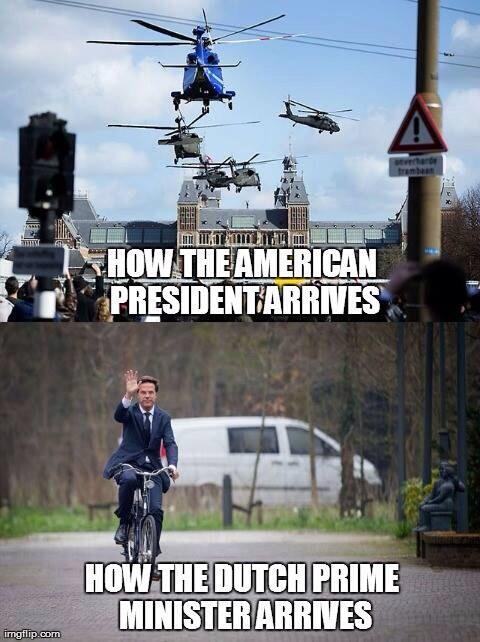
Edit: I looked into it a bit more, apparently videos of our prime-minster on his bike went viral! [0], how funny for such a normal thing. The dutch comments are pretty telling indeed:
> apparently videos of our prime-minster on his bike went viral!, how funny for such a normal thing.
This is a very intentional and knowing part of Mark Rutte's brand. You often see him being filmed jumping on his bicycle - I mean, here, in the Dutch news. He is doing that deliberately to invoke national pride.
Compare image searches: "Mark Rutte fiets" (the prime-minister, apparently thousands of results), "Hugo de Jonge fiets" (the most media-friendly deputy prime-minister, no relevant results)
Also, there are frequent news stories within the Netherlands that are just "look, the Royal Family cycles".
It's something the Dutch are very proud of. Strange to claim otherwise.
Yeah I can imagine it's part of Rutte's brand indeed. And, true, I do feel some pride. Well, I guess it's nice that in incites pride and not a "Damn Cyclists" reaction. It is indeed part of our national identity.
Great to see Groningen represented so much in this video. I think about 50% of all traffic movements are by bike in this city. This includes walking, so IMO it's pretty special.
The urban planning in this town has been the product of decades of bike and pedestrian friendly planning. Making the city really nice to live in.
It probably takes decades to convert a car centric city like Seattle into something like Groningen. That doesn't mean that you shouldn't strive for it. It makes a city much more friendly to live in, makes the population healthier and is more sustainable on the environment.
I havn't watched the entire video so I don't know if it is mentioned, but one important factor imho is our traffic law protecting pedestrians and cyclist from motorised traffic[0].
Which basically boils down to that any non motorized traffic participant will get benefit of the doubt when determining blame in collisions or other traffic accidents over a motorized participant.
Due to this, right of way laws work for cyclist/pedestrians, instead of them just being coerced by cars into giving up their right of way or place on the road.
Driving on this road before the redesign was very strange -- it was essentially two-lane but without stripes and no explicit bike lane. Since the redesign, the turn lanes, bus stops, and bike lanes are clearly marked and it has lead to a significant decrease in accidents.
Not Just Bikes is a great YouTube channel about cycling infrastructure in (mostly) Amsterdam. Being Dutch I never realised how much attention there is for safe and smooth traffic in The Netherlands. Being abroad right now I see that its not obvious.
I wanted to argue against the 'Europeans are supercilious' comment, but this comment doesn't help. Dutch people do know that the extent of their bike lanes and infrastructure is incredible.
I've only seen the new 'megafietsenstalling' at Den Haag Centraal train station complained about because 8000 bike parking spaces was not ambitious enough and is not expected to be enough space. And yet, it's the second largest in the world after Utrecht (also in the Netherlands).
At a comparable train station in London, you would be lucky to find 10 bike parking spaces.
> I wanted to argue against the 'Europeans are supercilious' comment, but this comment doesn't help. Dutch people do know that the extent of their bike lanes and infrastructure is incredible.
Yet you will find many Dutchmen in this thread, including the comment you're replying to, that express that this is the first time in their lives they've given it thought.
> I've only seen the new 'megafietsenstalling' at Den Haag Centraal train station complained about because 8000 bike parking spaces was not ambitious enough and is not expected to be enough space. And yet, it's the second largest in the world after Utrecht (also in the Netherlands).
One of the many reasons I favor the skateboard over the bicycle — it joins me in the train.
> At a comparable train station in London, you would be lucky to find 10 bike parking spaces.
Well I have never been at a London train station. I've been at Belgian, German, and French ones, and I did not notice any particular difference that stood out.
Of course! In London, it can just be expected that there is not anywhere appropriate to park. And, nobody cares to do anything about this, so it seems futile to complain.
Do take into account that there are places where infrastructure is designed primarily around cars. This means a.o. that wherever you want to go, there'll be pretty good parking really close by.
Combine that with a lack of proper bike infrastructure. No bike racks anywhere in sight, so you have to dump your bike on the pavement, hoping nobody will give it a shove because it's in their way. No bike lanes, or if there are, they have angles and corners that are not realistic to take on a bike. Corners that have you swerving into the opposite lane if you take them at anything above 15 km/h.
In those situations taking the car for short distances becomes the convenient, fast and safe thing to do.
P.S. from your name I suspect you're Dutch. In that case you don't even have to go far to find that sort of situation. I live in Belgium, which is generally considered to be a rather bike friendly country. I beg to differ. Everything I describe above applies, at least in a region of a few kilometers around my house. I can only assume it also applies elsewhere in Belgium.
> What other means of transportation would one use for short distances
Uber (half-joking)
In large parts of the USA, cities are cut into small parts by wide 50-mile per hour streets, it’s illegal (and dangerous to try, if not made impossible by barriers in the middle of the street) to cross streets between road crossings, road crossings are a quarter of a mile or so apart, and there aren’t any cycling facilities. Those wide roads often don’t have sidewalks.
Personally I'd escooter everywhere if my own city hadn't hobbled them thoroughly (both dockless and personal). I respect the cycling community but it's just too much work for me and I imagine many similarly unambitious people.
For me, the form factor of a battery powered lazy person's vehicle is not yet perfected, and they should be more akin to a sit-down vespa scooter than the current scooters.
The centre of mass is just too high, the wheels too small.
They should also be restricted to roads - as a cyclist I've never seen one ridden safely in a bike path, and I don't think standing allows for quick enough braking for the average user.
Not to mention that in my country, outside of a few city specific rental deals, all scooters are illegal for use in public - so literally everyone on one is a dangerous criminal.
As a Dutch person who lived in the UK for a year, yes. Bicycle lanes are nearly non-existent outside of London and the boroughs seem to be hostile to the idea in general. The few bicycle lanes you do find often end as abruptly as they start, there's nothing connecting them and there are no bicycle crossings when you meet a road.
However if you get a mountain bike and stick to the dirt roads along the rivers and hills, it is a great place to enjoy cycling through the countryside. One of the best bike trips I've done is cycling for 30 miles along the Thames river.
So the UK is great for scenic cycling, terrible for a cycling commute. And yes, any Dutch expat you meet is silently judging your country on the safety of its cycling infrastructure.
> Yes, any Dutch expat you meet is silently judging your country on the safety of its cycling infrastructure.
And so you should. The UK's cycling infrastructure is embarrassingly bad.
An example. Local to me, recently, the government spent over £100m on a new road junction, to replace an old one. One of the main reasons that they had to build a new junction was that they claimed they could not remove traffic lights from the roundabout to improve traffic because pedestrians and cyclists both crossed the junction at 'street level'. A local cycle organization submitted a proposal with modelling (I can't find the link atm.), that showed that the desired increase in capacity could be achieved by adding bridges for pedestrians and cyclists, removing traffic lights, and altering the road layout.
And save about £90m.
Needlessly to say, the junction was built. I have no idea whether their proposal was considered, or not, unless I submit a freedom of information request to the UK government.
Regardless, the bridges should have been built anyway, because the junction is between two suburbs.
The new junction did get a new cyclist/pedestrian bridge to replace the old one. Except it's about 1km further away from the suburbs that the previous junction, so adding 2km to bike journeys.
Actually, bicycle tunnels - with a limited slope of course, like all other bicycle infrastructure - are recommended over bicycle bridges. These are more comfortable for cyclists. Gravity helps one cycle down, and the kinetic energy gained helps cyclists on the way up in the second half of the tunnel.
Also they can be smaller and cheaper to build. Because they only carry bicycles and pedestrians, a height clearance of about 2.5 meters is enough, while a bridge needs around 5 meters to let cargo trucks pass underneath. This also results in much shorter ramps.
A problem in the UK is that in general we are hostile to build roads and certainly wide roads.
So roads are as narrow as possible and congested, which in itself is not great for bikes but also makes bike lanes near impossible. And when a bike lane is built (i.e. painted on the road or pavement) it is usually also very narrow and interferes with traffic.
Obviously this is difficult to change for existing roads, but we could at least make sure that new roads are wide enough, but this is not the case.
One thing that is not often done, is to have bikes on a smaller parallel road. Often there is an attempt to cram everything on one big road, when there are perfectly fine residential roads next to the big road that just need connecting.
That's great but I fail to see the relation with my comment.
I'm not talking about very central roads that can be mostly restricted to pedestrians, or city areas with narrow streets but also little to no traffic. I'm talking about roads in general. Amsterdam has many roads that look hugely wide for British standards.
This is one of the main roads into Oxford. Note the "cycle lane"... Still, that road is not too bad because it has an exceptionally wide pavement on one side.
> So roads are as narrow as possible and congested, which in itself is not great for bikes but also makes bike lanes near impossible.
They replied:
> Do you think the centre of Amsterdam has wide roads? It does not.
That is the relationship with your comment. The centre of Amsterdam does not tend to have wide roads (with a handful of exceptions) and yet has bikes. Indeed, it is possible to drive down most of those roads, however the city has put a lot of effort into discouraging it which reduces the congestion and makes biking nicer.
Now, newly built areas tend to have wider streets, but there are plenty of old city centres in the Netherlands that are bike friendly, despite their being as narrow as possible. Congestion can be dealt with much more easily.
1. Botley Road - there is plenty of space for a two-way cycle path in the photo you show. Just a couple of photos down, you can see the road fits three vehicles abreast: in other words, it would comfortably fit two road lanes and a double cycle lane, if only that had been or was constructed. There are much trickier problems solved in the Netherlands.
2. Henley Bridge - Overall, Henley could be ideal for cycling around. OK, one of the main routes into the town crosses a river. Yet, if this was in the Netherlands, they would simply have built a parallel cycle bridge at some point in the last 20 years. Or, if there still wasn't one, they'd build one now.
Amsterdam's narrow roads have little to no traffic only because of political decisions that cars are not the only form of transport that need to be considered. You can see in archive footage that this wasn't always the case.
Not sure what you're trying to argue about at this point.
I'm stating facts here: UK roads tend to be very narrow to the point that it is difficult/impossible to just add cycle lanes, and even new roads or development do not include space for cycle lanes (when they should).
You show me examples in the Netherlands where they have built or are building new infrastructures where cycle lanes are accounted for. Well, yes exactly what I'm saying is not the case in the UK and often it is not even doable (it's not only a matter of building a new bridge if the access roads don't have the space, either...)
> You show me examples in the Netherlands where they have built or are building new infrastructures where cycle lanes are accounted for.
No, I'm showing you extremely old infrastructure (Delft: founded 1246, Rijswijk: pre-historic) that have invested in modern solutions for cycling.
The towns I have picked that are almost exact equivalents for Henley here, except that Henley has not bothered.
[For what it's worth, I agree there is no point in starting out by constructing a cycle lane from the middle of nowhere into a town with no cycle provision - but the UK is 5 decades behind in this aspect, and continuing to fall further behind]
> I picked towns that are almost exact equivalents for Henley, except that Henley has not bothered.
Well, that's my point, isn't it? Glad we agree... The thing is that it is difficult to resolve when that has been the case for decades, if not centuries because it's like that everywhere and you cannot decide to re-do half the country's road network and to raze everything that's in the way, especially in the UK.
19th century Paris: They did raze a large part of the city to make way for new avenues. 17th century London: After the Great Fire they rebuilt following exactly the previous narrow roads because no-one wanted to lose an inch or pay for an inch, and it's still the way any new projects are welcomed...
>The thing is that it is difficult to resolve when that has been the case for decades, if not centuries because it's like that everywhere and you cannot decide to re-do half the country's road network and to raze everything that's in the way, especially in the UK.
My point is only that this is exactly what the Netherlands has already done, which shows that it is perfectly possible to resolve (and, in general, without any razing - the Dutch are at least as proud of their history as the British)
The fact that the Netherlands looks good now is because these exact same problems have been solved over time. The UK could even benefit from an easier time, since it gets to just copy the best-working solutions.
Depends where you are. London is starting to get some good cycling lanes and some junctions are having traffic rerouted to make it safer for cyclists.
Sadly in many other places cycling only really works for confident riders. Lots of drivers are either unaware of cyclists or downright aggressive. I would have near misses on a weekly basis. Things are getting better but very slowly.
And in our other cities it's still way cheaper (and socially acceptable) to drive in from the suburbs and park.
There are car parks literally 200m from the centre of Birmingham where you can park all day for less than 10 pounds, and cheaper still nearby.
Things are starting to change (oddly during COVID) by addition of bus gates, but they're making very slow progress. We've already delayed and diluted our congestion charge multiple times.
It depends, but yes. There are a lot of deaths each year, and the law is not in favour of the cyclist either. In fact, it gets worse: https://www.bbc.co.uk/news/uk-45154708
Stay away from the cities, and it's generally safer, but at the same time you'll find cars doing 60 mph on single carriageway roads (the national speed limit), which can also be marked as a national cycle route. If you cycle somewhere where cars don't normally encounter cyclists, it can be "fun" as the motorists don't know how to behave.
The trouble with the UK is that even so-called cycle paths are shared with footpaths, so pedestrians are all over the place, and cycle paths that are getting built as 'joint' footpaths, mean as a cyclist you also stop at every road junction. Compare that to Europe, where the cycle path is an additional lane next to the road/main carriageway and is usually physically separated in some way for safety. In the UK this has the unfortunate effect of making a large percentage of cyclist just us the road (which they are legally entitled to do), because the cycle path next to the road "stops" every 100 yards because there's a road joining the main carriageway that you have to cross.
The side road can be restructured to give bikes priority. And put some good speedbumps on the side road to give cars a hint that they need to pay attention.
Agreed. They can, but they never are. For car drivers, the expectation is that they have right of way on a road, and they that come to a halt at the road junction, and not a few yards before it because there's a bike path crossing.
Town planners/local planning departments are under so much pressure that they literally just end up ticking boxes, and rarely push back on house builders to change their site plans. The 'desire path' is a straight line, for both pedestrians and cyclists, yet new housing estates are allowed to put in bendy cyclepath/footpaths next to otherwise straight roads. It is ridiculous.
Anything 'new' to car drivers in the UK is a problem. We definitely should try and change UK roads to be more bike friendly, but that's the reality. The new bike roundabout in Cambridge, unique in the UK, but common in Europe, and.... accidents: https://www.cambridge-news.co.uk/news/cambridge-news/cambrid...
One thing to consider is that it takes a very long time for the 'cars first' mentality to change. Both in drivers and in planning. Ideally, people who drive a car should also cycle, to know what to expect from bikes. Same for people who plan new roads.
With respect to roundabouts, I'm not sure there is a way to do it right.
In theory probably something but combine the fact that Europeans are incredibly supercilious about this stuff and Americans are incredibly defensive about this and I don't think Seattle is going to change that much.
What would an average American care if we are proud of our infrastructure or not? I think it has a lot more to do with Americans not paying enough taxes to make this worth considering.
Inexplicably it matters a lot because people behave to only buy those things. It's why you get CA HSR (a project that's already pie in the sky) reporting that they'll use a signaling system like nothing else in the world. How about just doing something that's like everything else in the world? Doesn't sell. NIH syndrome is America. But that's okay, that's why startups happen here more often.
America's misplaced pride might get in the way of some things, sure. But that's just dancing around the root cause: most Americans value low taxes above good infrastructure


I started biking to school at age 6. No helmet, no parent accompanying. So did all my friends.
Later, I had shitty jobs in far flung industrial areas. All had proper bike lanes.
The list goes on. Remember though, as the video mentions somewhere, this is the result of hardcore decision making since the 60ties. Not an overnight succes.