While a valid topic for a lecture or handful of folks, missing gravity or matter at distances greater than we’ll ever travel are like missing white kids’ pictures being put on milk cartons in the 80s:
No, like the quest of understanding cosmology is one of the pillars of scientific knowledge that enables our civilization from an engineering perspective. Ignoring it stops real progress.
Also, feynman's Nobel was about blending cosmological concepts into quantum theories. If he didn't obsess over that stuff we'd be without a lot of tools we used for nuclear engineering, and I'd argue distributed computing considering how inspired by feynman's work Lamport is.
> Today, scientists at the Institut d'Astrophysique Spatiale (CNRS/Université Paris-Saclay) may have detected, for the first time, this hidden matter through an innovative statistical analysis of 20-year-old data. Their findings are published on November 6, 2020 in Astronomy & Astrophysics.
Any links to the findings? Any search from me points of copies of the article rather than the source.
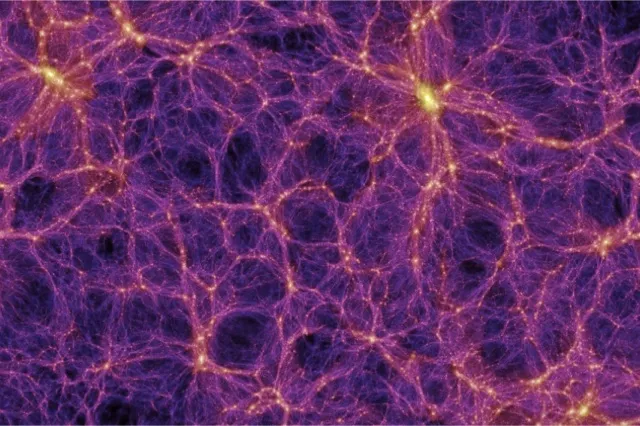
Yes, this is different from dark matter. This is baryonic "matter" that is predicted by our theories but that had not been previously detected.
However the title is misleading, this is not the discovery of this matter even if the press release makes it look so. Previous detections of this matter had been discussed on HN before https://news.ycombinator.com/item?id=17953600
What this is is an advance on our understanding of this previously undetected matter. You can read more about it here https://www.aanda.org/articles/aa/full_html/2020/11/aa38521-..., this work has advanced our knowledge of the temperature and density of the cosmic filaments where this previously undetected matter is.
I'm not an astrophysicist but I did my PhD about the stacking technique used in this paper (but applied to other problem). It was a long time ago though, I could be forgetting something important.
Could you say more about what this stacking technique is? I got the impression that it's about combining different images by aligning and averaging them to get a better signal-to-noise-ratio, is this correct?
Imagine that you get one pixel for each hole in a chain link fence — the average color of light coming through that hole.
If you take a second fence, that’s out of alignment with the first — you get better resolution because each hole in the original fence overlaps with several in the second fence, and you can examine their overlaps. The “size” of pixel of the two fences together is smaller than the size of the fence grating.
A bunch of different overlaps, and some fancy statistics, lets you actually do that with space pictures.
In essence, you reduce from the normal pixel size to the area of overlap between pixels. But if you only have the snapshot averages, you have to guess at what the original was — so statistical result.
In accounting, when there are large discrepancies in their maths, they either hide the problem from their boss or re-do their work. In astrophysics they postulate about "hidden matter". However one must admit that, while astrophysicists have brought us memory foam, GPS, and satellite television, accountants have brought us only pain.


Since 40 to 50 percent of matter has been accounted for, does it mean that we no longer need dark matter to explain the missing matter?