Grass appeared 35 million years ago? At the same time as the first primates? And flowers 120 million years ago? After dinosaurs appeared (220 million years ago)? My mind is blown. What did landscapes look like?
From Wells and Huxley’s The Science of Life (1929):
It is difficult to imagine this world with
all its land surfaces lifeless; yet for more
than a half of its history Life played out its
drama under water, and the continents were practically barren. They were stark and bare, starker and barer than the utmost desert of today. Over the bare cliffs and desolate plains the sole breath of movement came from the wind and rain. A certain margin there may have been of faintly vitalized soil. From comparatively early times, a few simple algae may have trailed their filaments over the seashore or the moist borders of rock pools, or a few bacteria invaded the crumbling earth surface...
The face of the land was like nothing we
know today. There could have been no
real soil, for soil is largely a product of plant action. There was no carpet of plants and felt-work of roots to hold water like a sponge, preventing rapid run-off, and to blanket the ground from excessive gain and loss of heat; and so the work of frost and wind, rain and sun, was much more active. The heights of the land were worn down quicker and sediments more actively deposited, and the scenery was more angular and forbidding. Even long after the first appearance of land-plants vast regions of the land which would now be covered with vegetation remained desert or semi-desert, since all the earliest plants demanded a good deal of moisture.
Plants like grasses, which can thrive on dry steppes and prairies, are comparatively modern things. The Paleozoic Era knew nothing of them and the Mesozoic comparatively little. There was a desert flora and fauna in the Triassic; but possibly at least, the regions it inhabited would today be steppes or savannahs.
It is a good exercise of the scientific
imagination to picture this desolate and
desert earth, its continents cyclically rising out of the waters and submerging themselves again, occasionally undergoing a spasm of mountain-building or an ice age, but remaining essentially lifeless for well over five hundred of our million-year periods, in spite of the abundant presence and notable progress of life in the waters. Through all these ages, the lands remained unconquered and must have seemed unconquerable.
> “Science knows that the disappearance of dinosaurs and the appearance of flowers occurred simultaneously, yet, strangely, it has never drawn much of a connection between the two events. It is up to perfumers to correct the oversight.
> “Vegetarian dinosaurs dined on ferns, floating water plants, and the palmlike cycad. They were not very intelligent, and certainly not very French, having developed a limited, strictly specialized diet. When the great mountain building took place during the Cretaceous Period, seaways drained and swamps dried up. First the aquatic plants, then the ferns and cycads succumbed. Insufficient surface water. Some new plants had been gradually moving in, however. These plants were inconspicuous at first, and neither the dinosaurs nor the swamp plants paid them much attention. Ah, but they had plans for the future. They began to grow their roots longer and longer, sink them deeper and deeper, until they could reach the moisture trapped beneath the surface, and when their stringy little exploratory organs hit the water table-POW!” (Bunny smacked the podium; if V’lu and Priscilla hadn’t been awake before, they were now.)
> “POW! They exploded in a scandalous display of sexual invitation.
> “The old claw-and-fang world of drab, predatory, reptilian repression had never seen anything like this. Lasciviously colored, scandalously scented blossom after blossom flaunted its genitalia openly, enticing with visual and heretofore unknown olfactory charms any who might be inclined to sample its pleasures.
> “With their appalling genius for adaptability, insects responded enthusiastically to the outbreak of sensuality. So did the smaller birds. Dinosaurs, however, were repulsed. Although their reproductive equipment must have been monumental-the penis of a Brontosaurus would have been only a couple of yards shorter than the thirty-foot organ of the great blue whale-it was kept out of sight and infrequently used. The dim-witted, thin-blooded dinosaur was not a hot lover, another way in which it differed from the French.” There was a soft ripple of laughter. Very soft. “It mated once a year, barring headaches. So put off was the prudish dinosaur by the sexy smell of flowering plants that it starved to death and went extinct rather than eat them.”
What's really amazing is to think that it was only after grasses started taking over that very large land mammals could evolve on the vast marshy plains of North America and over 5 million years or so as sea levels rose due climate change become whales and other cetaceans. I wonder if humans will do the same, albeit in much less nutritious oceans that we are busily acidifying.
We don’t need to evolve much in the way of new adaptations anymore, we have technology. That’s how come we can colonise environments from the frozen tundra, to tropical jungles, to the harshest deserts, and now even the vacuum of space.
Humans didn't need much technology to live in deserts and tundras. But what if they run out of earth metals to cycle? What if they can't build sustainable energy sources? Our top modern "tech" lasts a couple of hundreds of years before totally collapsing. Humans will eventually go back to simpler tools, be it 10 million years or 100. I give it a couple of hundred thousand.
We’ve essentially built the entire modern world in a bit over a century. The only way we’ll run out of metals to recycle is if we shoot it all out into space. Otherwise it’ll still be here in one form or another. I am concerned about the long term sustainability of our current phase of civilisation. I think our current way of life is largely doomed, but we will develop new ways of life.
Tens of millions of years is a long time. Who knows?
That's an interesting thought. I was running last week along the beach and was thinking about how early primates/hominids might have decided what plants could be eaten and what plants should be avoided when I saw a stalk of grass with its seeds/flowers. It seemed clear to me just looking at it that the seeds might be extremely edible, and I wouldn't be surprised if many other hungry hominids(and other herbivores) came to same conclusion. What I didn't know was how recent the first grass was nor did I realize how important it might have been for the evolution of land mammals. Here's an interesting fact about grass I just learned (from Wikipedia[1][2]):
> They provide, through direct human consumption, just over one-half (51%) of all dietary energy;
Sort of off-topic: I love looking at images of how the Earth's continents have shifted and moved over time. They provide a lot of inspiration for me when making homemade maps for my D&D games. Whatever nature has done makes for much more compelling and believable maps than what I can make on my own!
My latest map is based on a rotated view of what Pangaea Proxima will (probably) look like in a few million years. Looks pretty neat and provides a lot of inspiration.
Super cool stuff. If the author has time, it would be even possible to derive the major climate zones at that time using large scale features like latitude, mountains, etc.
I can strongly recommend Earth: An Intimate History by Richard Fortey.
Also
Land of Mountain and Flood: The Geology and Landforms of Scotland - mind you that is obviously just about Scotland but it is a gorgeous and fascinating book!
This is so awesome, I just wish it could go back even further to 1 billion, 2 billion, ... years ago! If we know enough about the Earth's history and tectonics to depict it...
I don't understand how land masses the size of africa detaches. The map shows africa attached to the US, but this doesn't make sense. I can understand water levels changing, exposing new areas that might have been underwater, drying up and turning into land masses, as well as areas that were previously land, becoming filled with water.
Consider this model: the Earth is like a puzzle. Its crust is made up of a bunch of pieces that all fit together. But those pieces aren’t unchanging. They all sit on top of a huge soft sludgey core called the mantle. And they want to slowly (slooooooowly) slide around.
At each boundary between pieces one of three things can happen:
- they slide against each other
- they diverge from each other
- they press into each other, often one going under the other, sometimes one pushing the other.
A continent can move, oh so slowly, over millions of years through a combination of shifting along with other plates, or having one side of its plate grow (move away and have the new gap filled with the molten plasticy goo underneath), while the other side pushes away a plate or disappears underneath the other plate.
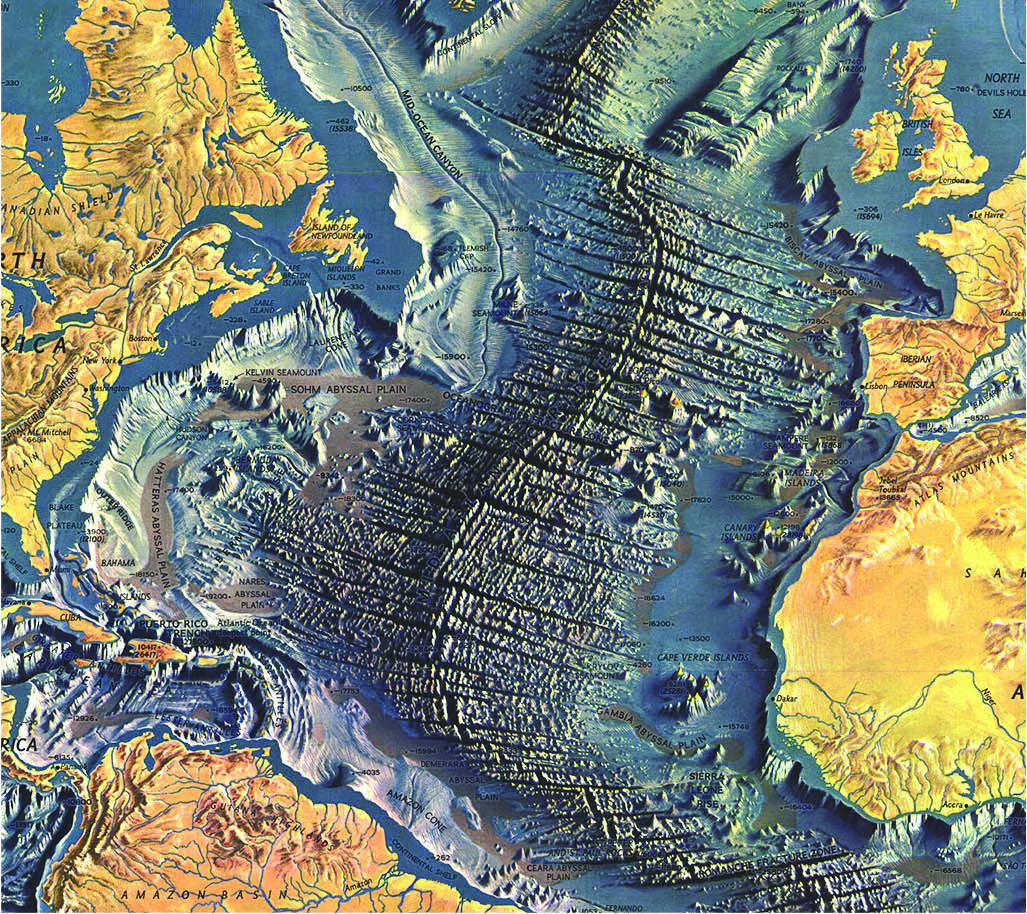
The map I linked shows a massive stretch mark of the Earth in the Atlantic Ocean. This is one striking piece of evidence that the above effects have been happening over a long long time. It’s basically the boundary between a few plates. And it shows all this brand new ocean floor that came flowing up from under the crust (then cooled and got hard) when a gap was created because they separated apart.
Another thing to keep in mind: these tectonic plates are heavy. Like unimaginably heavy. They can be thousands of miles wide and tens of miles thick and are as dense as rock. They exert huge pressure on that soft sludgey core, which is incidentally being heated by a low-level nuclear furnace in the center of the Earth. So the plates are more like a lid on a boiling pot that is foaming over. They're all getting jostled by insanely powerful pressure from underneath. Every once in a while a pimple appears and goes kaboom.
Looking at New Zealand 35 million and 20 million years ago on that globe (search for one of our cities like Auckland or Christchurch) is really illuminating when compared to its current shape, most of the South Island is to the west of the North Island, as the plate boundary between the Indian and Pacific plate runs through the South Island, and the eastern side has been moving south-west for millennia to form the current shape of the land, and our Southern Alps.
There's a BBC documentary on this that's now around 25 years old, called Earth Story (https://en.wikipedia.org/wiki/Earth_Story). It describes not only what we know, but how we know it. As documentaries go, it's rather in-depth but easily digestible.
Thanks for the suggestion, it sounds really interesting based on some YouTube comments. Just ordered it used from the UK, first time I'll be watching an actual DVD since... years. I think I do have a DVD drive somewhere in storage.
All continents rest on tectonic plates, which kind of rest on the liquid core and are moving around on it. Let enough time pass, and the plates will move around, and the continents with them.
Now how that large land mass came to be is an interesting question to me. The globe shown here in the title/link is clearly not homogeneous. The land mass on one side must be less dense than the rest of the earth for it to protrude above sea level that way.
The continents are indeed less dense than the oceans!
On average, the continental crust has a composition that is also seen in magmas that are produced at subduction zones (where denser oceanic crust is forced under continental crust) by the melting of the mantle. At the mid-ocean ridges, water is circulated through the newly produced oceanic crust, and the fresh basalt is metamorphosed, causing new minerals to grow which contain water as a part of their structure. Up to a few hundred million years later, this oceanic crust reaches a subduction zone, where it is pulled into the mantle. As it sinks, it is exposed to higher pressures and the water-bearing minerals become unstable. The water within them is driven off the crust and rises into the overlying mantle. At these pressures and temperatures, water is to rock what salt is to ice, and part of the mantle melts - think of it as a kind of 'slush'. As the magma (the liquid part of this slush) rises to the surface, it begins to crystallise, and the denser crystals (which form first) sink. Overall, this makes the magma less dense, continuing to drive it to the surface, where it may either eventually stall in the crust (in a pluton) or be erupted in a volcano. Now there is less dense material sitting on top of and within the oceanic crust and an island arc is born - an example today is the Aleutian Islands.
The magmas formed at subduction zones have a distinctive geochemical signature called the 'calc-alkaline' trend. Whereas magmas at mid-ocean ridges become enriched in iron because of the crystallisation of plagioclase feldspar, at subduction zones the presence of water suppresses feldspar crystallisation, instead producing 'wet' minerals like amphibole. As a result, these magmas do not become enriched in iron as they rise through the crust, and instead become rich in sodium and potassium. These magmas also have distinctive radiogenic isotope ratios and trace element contents. The continental crust (while highly compositionally varied) on average has similar signatures, suggesting that it was formed by this kind of activity.
The fun happens when two of these island arcs collide. They are both less dense than the underlying mantle, so neither will subduct easily. Instead, they coalesce into a single mass, and a continent is born. More common today is the collision of an island arc with a pre-existing continent. This happened before India collided with Asia to form the Himalayas, and the calc-alkaline plutonic rocks are visible at the surface in Tibet today. This is how the continents grow.
The continents are thought to have started to form during the Archaen Eon, starting at four billion years ago. The rate at which they formed is still very much up for debate, but it is thought that crustal growth was more rapid back then as compared to today, and was mostly complete by around 2.5 billion years ago. Today's tectonic plates are cored by ancient cratons, the oldest and most tectonically stable pieces of crust. Around these cratons are progressively younger strips of crust stuck on by colliding island arcs. Much of North America is made up of island arcs stuck to the Laurentian craton.
Brilliant to see where some land masses stay relatively intact and how little they've changed. Newfoundland and Labrador in today's Eastern Canada stand out to me. I really want to those weathered ancient mountains some day.
What amazed me most is the relative short (recent) period in which the Himalayas formed. India split from Madagascar relavively recently, the speed with which it collided with asia must have been huge.
I could instantly recognize the map as work of Christopher R. Scotese. Has there been other work to create paleo maps or was this work from 2000 and prior so definitive nobody has felt the need?
Some serious interplanetary engineering, likely involving Fusion Candles on Jupiter to gather materials and fuel. Then a constant bombardment of Earth from the right angle should stop the spinning, eventually.
I wonder if it could be done with nothing more than "solar sails" at ground level, aimed so they reflect the sunrise and push back against rotation, but exert no directional force the rest of the day.



https://news.ycombinator.com/item?id=17286770