The city of Flint has extremely high poverty and the schools were very bad well before the water issue came to light. I wonder how much of this is due to the lead in water vs just the situation of the city, high poverty, and poor schools, etc. anecdotally I don’t think the things mentioned in this article are all that different from other cities in similar situations without the lead in water issue.
Either case hopefully they can turn things around for the kids who have to grow up in this situation.
I remember reading a very interesting article about a case that showed lead could be a major factor in poor school performance. The article was in a newspaper or news magazine in the '80s or early '90s, and I've not been able to remember enough details to find anything online about it.
Anyway, it was about a school district that had given IQ tests to all the kids. The black kids on average scored significantly lower than the white kids. This could not be explained by the white kids going to better or richer schools, because this district was well integrated. Black kids and white kids that had been together in the same classrooms for their entire school history showed the same IQ gap.
The district concluded that the test was biased and was going to ignore it. One teacher decided to look deeper, and started looking to see if he could find some other factor besides race that was significantly different between the black and white kids.
He realized that all the white kids lived in relatively new housing, and all that black kids lived in much older housing. The black kids' houses were all built long before lead paint was banned. The white kids' house all came after that ban.
They arranged to test the kids for lead, and to test their houses, and they found that most of the black kids were suffering from lead exposure. None of the white kids were.
The lead paint was removed from the black kids' houses, and the kids were treated for lead poisoning.
A couple years later, when the district gave another IQ test, most of the gap between the black and white students was done.
I’m guessing OP was aware of this but was more questioning whether we know this was because of lead exposure or just the fact the school system isn’t good. It seems it would be hard to separate the two. Like was said: there are plenty of cities with similar results but without the lead exposure. The lead could definitely be a contributing factor, it’s just hard to know.
There was a nice natural experiment that happened a while ago where children with sufficiently high blood lead concentrations had the government perform lead abatements in their homes. And then see how much better the kids with the newly lead free homes do compared to the kids who were just a little too low lead to get these abatements but who were otherwise very similar.
There's lead in paint all over America, just dripping off old buildings into the soil in some places. And asbestos in insulation and other building products. So?
Probably all of the factors you mention are important, but lead certainly didn't help. The main reason to mention lead specifically is the horrible way the situation with water pollution was handled by pretty much everyone, from city officials to Obama himself with his completely disrespectful "take a picture of me pretending to drink the Flint water" media stunt.
I agree that's disrespectful if the water he was drinking was not actually Flint water, so I went looking. It appears that what he drank (an admittedly small amount of) was actually filtered Flint water (and he identified it as such).
I fail to see the disrespect or anything else untoward about his actions there.
I would guess the "stunt" here is that everyone knows that drinking one glass of Flint water won't really hurt you. It's the long-time exposure from childhood that is the problem.
OK, so when the reporter specifically asks him if he'd drink the water in front of him, what's his least bad option? If he makes the speech he does, saying "I don't do stunts" asserting its safety and takes a sip, he's handling the situation as gracefully and productively as he can.
If instead he starts in with a lecture about how it's cumulative exposure, affects children more severely, and that is why he won't take a drink as a publicity stunt, he knows that all that will be reported is "Obama refuses to drink Flint water!"
This wasn't a planned stunt in my estimation (unless you think the reporter was "in on it").
First of all -- it was clearly a stunt. The question from the reporter where he "drinks" some water[1] happened after he asked for water in the middle of a speech[2] -- the moment in his speech was so obviously staged that it's not worth elaborating past including the link to the video. With that in mind, it's pretty clear that his answer to the reporter's (probably genuine) question was just doubling-down on the point he'd made with his earlier stunt -- that it's safe to drink.
But ignoring all of that -- why is it a good thing that he said the water was safe? The water wasn't safe to drink, and the video of the President sipping water from Flint means that the entire country collectively agreed that the situation was fixed. But it wasn't fixed -- the water in Flint is still contaminated with lead today.
It doesn't seem obviously staged to me? The first video you linked he says the water is filtered, emphasizes it multiple times, and says "this doesn't mean we don't need to still replace some pipes". Is there more to the story?
As far as I can tell, the second video I linked to (where he asks for water during a speech) happened before the first one (where a reporter asks him about the water he drank). The first one is a reporter following up to check that the water actually was from Flint (and he says it is, but it's filtered) -- and was probably a genuine question from a reporter after his speech (it's probably one of the first questions I'd ask).
The thing I'm referring to as being clearly staged is when he asks in the middle of a speech (where he was talking about things that need to be done in Flint) for some water, takes a tiny sip (he must've been really thirsty!) and continues. If you don't see that as being staged, I really don't know what I could possibly say to convince you otherwise. People from the crowd were shouting "don't drink" and he counters with "I know I'm going to be okay, because I've already had some Flint water."
And you're right that he mentions it's filtered (after being asked that in a follow-up and not when he first did the stunt, but whatever) -- but just because he's not outright lying about the situation doesn't make it the earlier stunt any less staged. There has been very little further outcry about Flint in the past 6 years, because most people you talk to will say "Oh, wasn't that thing in Flint solved years ago? Obama drank the water when he was there!
Right - it probably is safe, but I am not sure most people in flint can afford the triple carbon filter reverse osmosis water system that I would want to use in their situation. Raw sewage water is “safe to drink” if it’s filtered enough.
Sorry, but those little faucet attachable kind are complete junk. If they weren't handing out decent R/O systems then it wasn't and isn't good enough and people should feel safe with their kids drinking that.
>OK, so when the reporter specifically asks him if he'd drink the water in front of him, what's his least bad option?
Probably to laugh and say instead of "trying the water" he will see the water is sent to a lab for proper scientific testing and the results published to the public.
Perhaps it was a stunt planned by the reporter only, but anyway, I can see how some people can see it as disrespectful.
There are similarities with people who virtue-signal by working with children in a ghetto of a 3rd world country, and get photographed doing it - while actually living in the comfort of a luxury hotel and just showing up in the ghetto for a brief time. The intentions may be very good but people may still perceive it as hypocrisy. (Not particularly blaming Obama for this, he maybe in fact came to a situation where there is no good way out.)
>I would guess the "stunt" here is that everyone knows that drinking one glass of Flint water won't really hurt you. It's the long-time exposure from childhood that is the problem.
The general public doesn't really know that. People think that lead is this magical chemical that manically makes people stupid if they so much as lay eyes upon it. I guess that's better than thinking it's harmless but it's certainly non-optimal from a societal decision making standpoint. I would be very surprised if the reporter knew that the lead content of the water was mostly irrelevant to an middle aged man drinking one glass.
On youtube you find many respectable and smart people massively overestimating the risk of lead exposure when coming in contact with it for a project, making sure nobody ever touches lead without gloves.
The fact that he's been "drinking" (actually barely sipping) water all over Flint for cameras turns it into a cheap media stunt, but I actually was referring to this fake-as-hell "Can I have some water":
Yeah the problem was entirely with Obama and the city officials, never mind the fact that Governor Rick Snyder had put the city under emergency management with his appointees deciding everything.
Looks like the highest one was about 140ppb in Canada. In Flint it was 158ppb.
But at those levels, it makes no difference at all. They may as well be equal. If there are 10 elephants sitting down on top of you, it probably won't matter if an eleventh elephant comes along and takes a seat on that stack as well.
Now that I'm actually seeing the data, I kind of think we shouldn't even be talking about schools for these people. They have way bigger problems. I thought we were talking about levels maybe 2 or 3 times the globally accepted standard. Which is still too much, I get that. But that's all the more reason that levels 25 to 30 times that standard are just not even on the charts. These are levels literally an order of magnitude higher than I thought they were.
Flint may be slightly worse numerically, but at those levels, I'm not sure there's a whole lot of material difference in impact?
Is it a matter of discussion there? Is there proper support for the people who live there? Do Canadian institutions, such as universal healthcare, make for different outcomes?
I hear a lot about Flint's children but what about the adults? The lack of reporting on the adult population is really freaking me out. Like, I want to know if people with power, or people providing vital civil services have lead poisoning. I am really concerned that the police and teachers and postal workers and city council and parents etc. might all be mentally impaired. I imagine the Mayor of Flint with lead poisoning and I just hear a voice in back of my head quietly whispering "Caligula. Caligula."
The adults who are running Flint are probably more lead poisoned than the kids. Not because of Flint's drinking water, but because they grew up in the 70s and earlier.
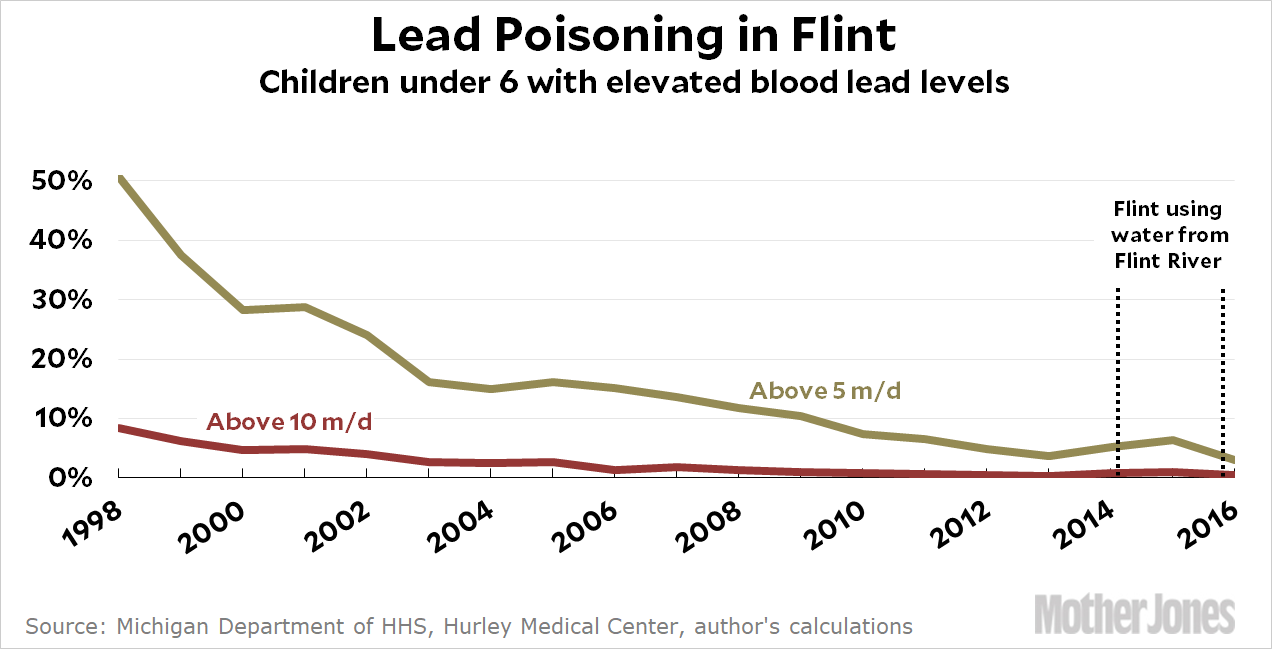
In 1976, the median amount of lead in the blood of young children was 15 µg/dL. This was considered normal and healthy at the time. In the Flint crisis, the kids who were exposed to lead were generally testing between 5 and 10 µg/dL.
Also, just to pile it on: levels of up to 10 µg/dL weren't considered a problem according to US guidelines until 2012.
This is not by way of meaning to be blasé about the situation. More to highlight that even the country's highest authorities on the subject were enough laxer about it until recently enough that you really do need to be on guard about it for yourself. A 7-year-old CDC guideline will almost certainly have trickled down to your pediatrician's practices, but it probably hasn't had enough time to have much impact on your local building codes or any other local government policies. 8 short years ago, what happened in Flint would not have been considered a problem.
There’s a lack of reporting on Flint, period. For whatever reason, lead and water contamination stories don’t stick in the news cycle. People just aren’t as concerned about it.
This is of course horrible. They’re not the only municipality with lead in its water. But people spend a lot more time and money on the painful wart on their neck than the removed plight of others.
That actually seems fairly reasonable to me. If there's something causing daily pain to me or someone in my family, I'm much more likely to spend time, attention, and money on that than on something that is another city's responsibility and is not affecting me directly.
This is a natural and beneficial form of decentralization. I don't expect you to be concerned that my grandmother broke her hip. It's properly a big deal to my family, but not even a blip for yours. I want daily/several times per week updates on her progress; you don't.
We all have a finite amount of time, attention, and money, and while I probably know more about the origin of the Flint water situation than the average American (owing to the latter being near zero rather than deep expertise on my part), I'll be honest that I'm more worried about the water quality in Cambridge, MA and in the schools my kids attend.
There are millions of unfortunate or even tragic events unfolding in the world in any given week. It's unreasonable to assume that everyone should care about all of them or judge the situation to be "of course horrible" when we don't. We'd get nothing done as a society if we stopped to mourn every tragedy everywhere or to get weekly updates on years-long remediation efforts.
I sincerely hope that the city of Flint is able to address the entirely city-inflicted (though funding related) water quality issues for its residents. If they aren't able to do it alone, I hope they ask for and get help from the encompassing county, state, or feds.
At the same time, I conclude that there's nothing with a productive return-on-time that I should be doing, because people who are far more informed, more educated on water treatment specifics, have devoted >100 times the amount of time as I have to understanding the issue, and are in a position (spatially and with authority) to make productive decisions are working on the problem.
Actually, water contamination by lead and other compounds is present all over the US. This isn’t an issue that should be likened to “other peoples problems” as it’s national. I would identify it as part of the growing infrastructure crisis, though, as a New Deal type project is needed to properly address this stuff.
Towns around Flint spent their own money to fix their own pipes. They sacrificed to do the right thing. If a place like Flint now gets upgrades for free, we're rewarding irresponsibility. The voters of Flint choose to be irresponsible for decades.
Do those other towns get paid for what they already did?
The big catastrophe that happened to Flint was caused at the state level (specifically, by a budget-cutting Republican statewide government). It wasn't anything the town of Flint had a say in.
Not really; one Michigan-specific consequence of the financial crisis was a takeover of city governments by state-appointed "Emergency Managers." These managers were given broad, non-democratic executive latitude. In Flint's case the appointees were Darnell Earley and Gerald Ambrose. They are currently being charged with a multitude of crimes for their actions which caused this (so are a dozen other employees, but they all reported to Earley and Ambrose) and they are responsible for the drive to "save" money, damn the consequences.
The emergency managers didn't tell them to save $100/day but failing to adjust the pH, they're just incompetent at their job. Democrats ran Flint into bankruptcy, but they're off the hook when the state has to try and clean up their decades of mess (including rampant nepotism).
The criminal charges have all been dropped give months ago.
I didn't say anything about Democrats or Republicans - both parties have blood on their hands in this case, and city-level planning decisions are often disconnected from party-defining policy issues anyway.
Regardless of which party it was, the executive failures - which is what you agree is the problem when you say "they're just incompetent at their job" - cannot be in any meaningful sense a local problem when the executive is being run by a state appointee and not an official elected locally or appointed by one. The emergency manager system is just another case of the nepotism you mention.
Completely false. Flint and Detroit governments caused this. Flint’s lack of money was because that government was so financially inept. Decisions made by Flint caused this.
The “towns around Flint” exist and are wealthy due to explicitly racist maneuvers during the White Flight era that intentionally impoverished inner cities and their black residents.
Is there reason to think that typical good practice isn’t sufficient to manage the risk of lead exposure in distribution plumbing? (Basically pH management and water testing by the water authority and cooking with cold water by the public.)
“Although many small water systems are run well, it's often the case that they lack resources to monitor and update infrastructure in a timely fashion or manage the water's chemistry carefully. In theory, larger city water systems adjust their water's chemistry continuously to prevent health risks, but, as we've learned from Flint, this is not always the case.”
So perhaps rather than a New Deal digging up of millions of miles of piping, we could raise awareness and compliance with standards proven to work? That’s seems wildly less wasteful.
Iirc, once the solder is exposed to the wrong conditions the damage is done. It’s a mechanical process after that point. But even if I’m wrong about that one, simple awareness isn’t enough and municipalities lack funding to properly monitor and treat their water supplies. Hence the need for a redress of the social contract at the national level.
So “we can’t afford spend $Y million per year on this problem so we instead need to spend $500Y million on a project to replace all the pipes”? That doesn’t sound sensible to this taxpayer.
Your taxes already have nothing to do with government spending. Their affect is to keep you from doing other things with your money. At best, taxes disincentivize bad actions and reward good through decreases/rebates. There’s the obvious tax incentive for marriage, for instance - not considering whether that’s a good or bad thing.
Just don’t end up voting to privatize your water or appoint private administrators to take over a city like happened in Flint, just because you thought reading the news on Flint would just be needlessly competing with water treatment experts.
It's not clear why, but it sounds like the new AG realized there was some irregularity in the investigation that could scupper the prosecution at trial.
Probably 90% of the country know the story of Flint’s lead contaminated water. It absolutely dominated the news cycle for weeks, and continues to make waves. It must be the most highly reported incident of lead contaminated water in history.
Sometimes it's remarkable to think almost everyone (certainly city-dwellers, at least) in their mid-50's and older grew up with low-level lead poisoning from exhaust.
I guess. . . as a city-dweller, it's still a daily thing for me. All that lead settled on the ground, and it's still there. So I need to be much more careful about letting my kids play in the dirt in our backyard than I do when we're visiting friends in the country. Some studies have suggested it's a bigger source of exposure in kids than lead-based paint or contaminated water.
It's also one of the main reasons why the CDC recommends that everyone take off their shoes when they enter the house.
The city leaded the water supply in april 2014, and the wikipedia timeline says that no one was reporting the elevated lead until february 2015. Even then, the city denied that there was even a lead problem all the way up through september 2015.
Do any medical professions know what "chronic" means in this context? Would 17 months be chronic for someone who was cooking and showering and drinking leaded water?
I have a book from the 1920's that describes what additives to put into water to prevent it from eroding the lead pipes. Of course back they were only concerned about the pipes and didn't know about (or at least didn't admit) the health problems. Lead used to be very common, up until the 1980s lead was used for nearly all pipes in some way (generally only in solder though so not much - though I don't know how harmful that amount is. Pipes in the ground are generally expected to last for a long time (last I heard Boston still had wood pipes from before the revolution in use), so it is safe to say all towns have lead in their water system somewhere.
Thus all water supplies should be managing to reduce the ability of their water supply to reduce lead. I would also suggest that you should go to your town board and say your number one issue is getting rid of all the lead - and you are fine with reverting major roads to gravel to pay for it. (and seriously consider what other services are can be eliminated to find more money)
You misunderstand the situation. As the other commenter stated Flint decided to restart their own water treatment due to costs. They were not prepared to fully treat the water from the nearby river. They also ignored the water plant manager.
A lot of people don’t realize there was (and maybe still is) a huge outbreak of Legionnaires disease. Somehow the city suppressed the news about it.
The contamination is the result of the water being drawn from the nearby river. The river water eroded the lead solder in the towns pipes. It started in 2014. All per Wikipedia.
Sewage sludge testing doesn’t support that lead levels were high enough for long enough to cause significant harm to children in Flint, Michigan. It’s understandable that parents would be concerned and tend to overreact, though.
The study that article links to doesn't make any assertion about the harm on children. The author of the mother jones article doesn't seem to cite a source for his claim that it probably didn't significantly harm children. According to the CDC and EPA, there is no known safe level of lead in drinking water, and based on the blood levels that study mentioned children were definitely exposed to lead. Also keep in mind that the way lead leeching works means lead levels in water will fluctuate and can spike to very high levels, so you will see a large variance in how much lead different children were exposed to.
Keep in mind that during the Flint water crisis everyone stopped drinking the lead contaminated water, so of course you aren't going to see a giant jump in the lead blood levels. That doesn't mean there wasn't a lot of lead in the water, and that doesn't mean it didn't have an impact on the residents.
I found it interesting that the article blames the behavior of these children on exposure to lead but contains no information about how much lead they were exposed to or how much lead was found in their blood, especially in the individual cases held up as examples. Of course the people responsible for the Flint Water Crisis deserve to be in prison, but if you claim that one year of lead exposure can lead to multiple suspensions and 70 unexcused absences, I want to know how much lead that is.
Specifics are in the Wikipedia entry for the Flint water crisis.
Of note, lead levels aren’t a constant. The lead is a result of deterioration of lead soldering in the pipes by water over time. It’s an unknowable process for when and what lead will break off into the water. People ingested very high levels of lead - that is safe to conclude.
Friendly reminder to test your water for yourself a couple times a year. Do not take anyone else’s word for it. You can get decent tests online for $20-30 that will catch the most important types of contamination.
There are people posting liberal or conservative political rants. People posting absurdities about how high lead levels have no effect on a human in any case. All category of senselessness is represented in posts higher than this one at this point.
And a comment with actionable information that can help people mitigate problems with the very issue being discussed is relegated to the bottom of the stack? I don't normally complain about HN, but it really is getting worse and worse lately.
Aren't you being insufficiently paranoid? No one should trust their municipal water authority but they can totally trust the makers of water testing kits? Obviously, everyone should reinvent all of the relevant chemistry and biology and manufacture their own water treatment infrastructure. [This is sarcasm. Your municipal water authority is probably fine. Everything involves tradeoffs.]
Given the available ppb information, I have a hard time telling if Flint had a lead crisis at all. Virginia Tech found that in 10% of homes they hit 25ppb instead of 15ppb standard. And one home had 13,200ppb (which is either testing error, or something special about the house).
Outside of the one house, this isn't enough lead exposure to see effects from.
EDIT: See thread below. Apparently it was not "Virginia Tech" that is the source for these measurements, as reported by the media, but a group calling themselves "The Virginia Tech Research Team". They maintain http://flintwaterstudy.org/ and you can evaluate them for yourself.
The "15ppb standard" isn't exactly what you think it is. The EPA "action level" (at which point they intervene, and the city is required to fix it) is if 10% of homes have more than 15ppb of lead. So if 10% of homes in Flint had 25ppb that's way above that action level. But, to be clear, being under that action level doesn't mean you are fine. The EPA and CDC explicitly say that no amount of lead in drinking water is safe.
The 13k figure is accurate. Lead leaking into water from solder erosion doesn’t follow a constant, predictable level. The lead breaks off at intermittent rates into the flow. Please refer to other comments and sources for more.
Please don’t let facts get in the way of a great narrative!
Here we have the Paper of Record saying they want to blame kids’ suspensions on a year’s exposure of barely elevated lead levels in water — levels which by the way probably put the average Flint house in the 90th percentile, but surely not the 99th percentile of houses nationwide. But national statistics don’t make a good story, you need a lens to present it through. So Flint might be that lens, but this is the media getting high on their own supply.
The real question is the issue of crime 50 years ago when lead was far more common everywhere. We’re crime rates higher in the past when lead was more prevalent?
The destruction of the two parent family probably has more impact on crime than lead.
I read a story (can't find it) about a contractor who intended to do a high quality job taking care of the lead pipes ... but the city of Flint instead gave it to a different contractor, who charged more, did a crappier job (leaving many problems unfixed), used obsolete tech, and took longer.
But, the chosen contractor was politically connected, so ...
The city of Flint was taken over by the state a long while ago. So the city would not have made that decision in any case.
The problem with Flint was that they thought having state government take them over and make all the decisions would result in better decisions being made. But that's not how it works. Sometimes, it just results in other people making bad decisions on your behalf.
In 100 years, Flint, Michigan is going to be one of those cases in US history books that shows the ugly side of the American spirit and how little faith we have in local government to do anything right (and how that's often the case).
The crime rate in Flint is actually much, much lower than it was in the early 1990's. Especially the amount of murders.
However, much of the crime isn't reported any more, or acted on. Flint has a ratio of almost 1 police officer per 1,000 residents, with is a quarter of a city like nearby Detroit.
Without cops to record the crime, much less act upon it, the numbers are artificially deflated. Someone could break into your home and since the cops don't come by for 6 hours t oinvestigate it just gets forgotten about.
Why wouldn’t it be possible to get worse? The murder rate of 19 per 50K is still fairly low in overall terms and could dramatically increase without triggering any “natural limit”.
Combine that with the adverse selection of population, it could get quite a bit more dire. If you had significant resources and flexibility, you’ve probably already moved your family out of Flint. As things get worse, people with “any” rather than “significant” resources/flexibility will move out. As you remove swaths of population who (for whatever reason) tend to commit less violent crime, your remaining violent crime rate gets worse.
What you described in the second paragraph was happening well before the water crisis. Which is why Flint is in the shape it is. How much the water crisis increased or contributed to this would be interesting to know vs people who did it before.
It can technically And definitely get worse but if you are using that statistic only you wouldn’t understand the totality of how bad it is in Flint. You really have to see it to understand how bad it is. My point is you cannot make it seem like all of sudden flint is going to become high crime rate going forward due to this.
That was not at all their point or what they were getting at. Things can always get worse, and this single statistic can be the tipping point to make it worse. I say this as someone who LIVES in the area. Betting you do not.
Glad to see Hacker News is again upholding Internet Rule 814: the comment section for any article alleging disparate impact of policy on a group presumed to be people of color will consist largely of posts attempting to contradict the article, rather than posts discussing what should be done if considering that the article's claims are true.
The contrarian dynamic applies to every topic. Indeed, your comment is a classic phase-2 contrarian: the one that shows up to object to the objections. Those typically say something like "I can't believe the comments here are so X", and achieve ironic standing by getting upvoted to the top of the thread (which happened in this case). The mechanism is so universal that I don't think specific explanations are needed.
But yes, race-related discussions are fraught, and there's little doubt that race-related, if not racist, beliefs and feelings lie behind some of what people say in them.
The problem is less that controversial subjects draw contrarians than it is that anything that even approaches race is controversial; even with subjects in which the facts and science are pretty much concluded - like, say, the devastating effects of lead poisoning caused by water resource mismanagement - if PoC are to be the benefactors of rectification of the issue, said issue becomes questionable.
Given the context (American society and history), the situation is unlike other controversial topics. It's like comparing critical decision-making to kneejerk reactionism; we just can't seem to help ourselves. I feel like that's worth pointing out, above and beyond simple exhaustion with the "Actually" crowd.
I think this misses how the contrarian dynamic works. It isn't that controversial topics draw contrarians, it's that all topics do. When people see something they dislike or feel they've spotted a flaw, they rush to point it out. Threads fill up initially with negative responses, not because the community is unusually negative or disproportionately disagrees with article X, but because contrarian responses are the fastest ones to form in the brain. They don't require much processing time or writing time. They're reflexive, not reflective. https://hn.algolia.com/?dateRange=all&page=0&prefix=true&que...
After that first wave of comments, we frequently see a second wave of objections that react in a reflexive way to the first wave. Although they take the opposing position—defending the article and criticizing the comments—it's the same contrarian dynamic, the same mechanism, driving them. Usually the second wave gets upvoted the most, leading to the paradox of the top comment in a thread expressing how bad the thread is, or the most popular comment expressing how wrong the populace is.
There's a place for such comments, and it wouldn't work to exclude them anyhow. But their rapidity means that they add less information. That's not because they're shorter (though it does take longer to add more information). The problem is how predictable they are. They're fast because they're largely precomputed—they're really responses to past things, stored up and ready to fire when a similar-enough signal arises. Comments like that make for repeats of past discussions, which are less interesting. They don't gratify intellectual curiosity. https://news.ycombinator.com/newsguidelines.html
Comments that add new information, rather than repeating what has been thought or felt or said before, tend to be reflective rather than reflexive. This happens when a topic sparks a new thought or feeling, or touches an unusual experience one has had. These comments add new information and encourage discussions that aren't just repetitions of old ones. But they require processing time: they have to be computed from scratch, not just fetched from cache. It isn't just that they take longer to write, but that it takes longer to form new pathways. It also consumes more energy, which means that reflective comments tend to come out quieter and more delicate than reflexive ones do. And they take more time and energy to read, too, so replies are more likely to be reflective in their own right.
The task of HN can be summed up as: how can we nurture reflective responses and give them priority over reflexive ones, given that the latter are both faster and stronger? How can we get into a reflective-reflective cycle rather than a reflexive-reflexive one?
I agree with you about race relations being a force multiplier on this (and also [1]). But I'm insisting on the more general issue of contrarian dynamics because it shows why you can't conclude that negative comments, which spring up like mushrooms when a thread is fresh, represent the community. It's a non sequitur, for example, to imply/conclude as you did in https://news.ycombinator.com/item?id=21474980 that HN's community must be racist because the comments found fault with the article. That phenomenon is general: the comments always find fault with the article [2]. The fact that the community upvoted your comment to the top (where it was sitting before I moderated it) suggests that much of it is aligned with your view. This interplay between votes and comments is typical.
Most of what we see on HN is so determined by the basic structure of the internet and the initial conditions of this forum that I appreciate McLuhan's "the medium is the message" more every day. It is far more deeply true than I ever realized.
[1] You're right that the context of American society and history makes the topic of race especially charged. But it's even worse than that here. HN's audience is at least half outside the U.S., leading to additional externalities and conflicts that look like something other than what they are, and so are particularly difficult to understand. This overlaps with the American context in inflammatory ways that make the threads both worse and harder to recover from. Basically everybody is fighting from their own, often very different, context and history without even realizing that they're doing it.
[2] That phenomenon is also far stronger than it appears to be, because as moderators we're constantly doing things to counteract it. If we didn't mark shallow dismissals and reflexive negations as off topic, which lowers their rank on the page, they would probably dominate every thread.
This has not been my experience. While it's true that some topics do seem to draw contrarian viewpoints immediately, not all do; and while reflexive reactions are most likely to be found immediately on almost all topics, they need not be negative. For non-controversial topics, the reflexive reactions tend to be memes (less common but not unheard of on HN) or affirmative standard talking points - suportive statements generated from common associations. For example, an HN post about a new organizational technique will often fill up with replies explaining how users implement those practices themselves, what tools they use, etc. Because these topics are generally uncontroversial, the defensiveness that is the impetus for contrarian reactionism doesn't arise.
The answer to the issue is fairly simple but relies entirely on the humility of HN's userbase, particularly in regard to topics that seem easy to expound upon "logically" but for which they generally are lacking in knowledge of or experience with.
Therefore, I have little hope.
I'll keep pointing out the fallacy when I see it, though.
I honestly didn’t have any idea of the demographics of Flint until you pointed it out. I did know the politics of Flint however. What I also know about Flint is that the government there has been historically inept and corrupt — a government elected by the people that live there. Of course my comment will naturally lead to an upholding of Internet Rule 815: find a way to blame Republicans and/or conservatives for the complete failures of governments that primarily represent people of color.
Flint was run by Democrats and they decided to end their water deal with Detroit, Detroit, also run by Democrats, decided to cut off Flint. Michigan’s Department of environmental quality, also not populated by Republicans, suppressed findings about Flint’s water and the federal EPA, led by a Democrat appointed by a Democrat president, knew about Flint water dangers for months and did nothing. The city of Flint destroyed its finances through the mismanagement of the Democrat leadership. The emergency manager, a Democrat, was kept in place by the Republican governor in order to be “bipartisan” and to ensure the locals were more comfortable than they would have been had a potentially more qualified, not necessarily Democrat, emergency manager been appointed. So the failure of that emergency manager is attributable to Snyder — but the reason the situation ended up existing in the first place was because of complete incompetence from the government that was elected by the people in Flint and exacerbated by the people that elected the government of Detroit.
Internet Rule 815: find a Republican or conservative anywhere near the scene of the crime and that Republican is the one deserving of all of the blame. This is closely related to Internet Rule 816, which is to immediately blame capitalism for the ineptitude of a government, especially one representing people of color.
> That lawsuit forced the state to establish the $3 million Neurodevelopmental Center of Excellence, which began screening students.
That name though. The Neurodevelopmental Center of Excellence is in Flint. It's like hosting an event called the Summit for Cancer-Free Japan, and holding it at Fukushima.


Either case hopefully they can turn things around for the kids who have to grow up in this situation.