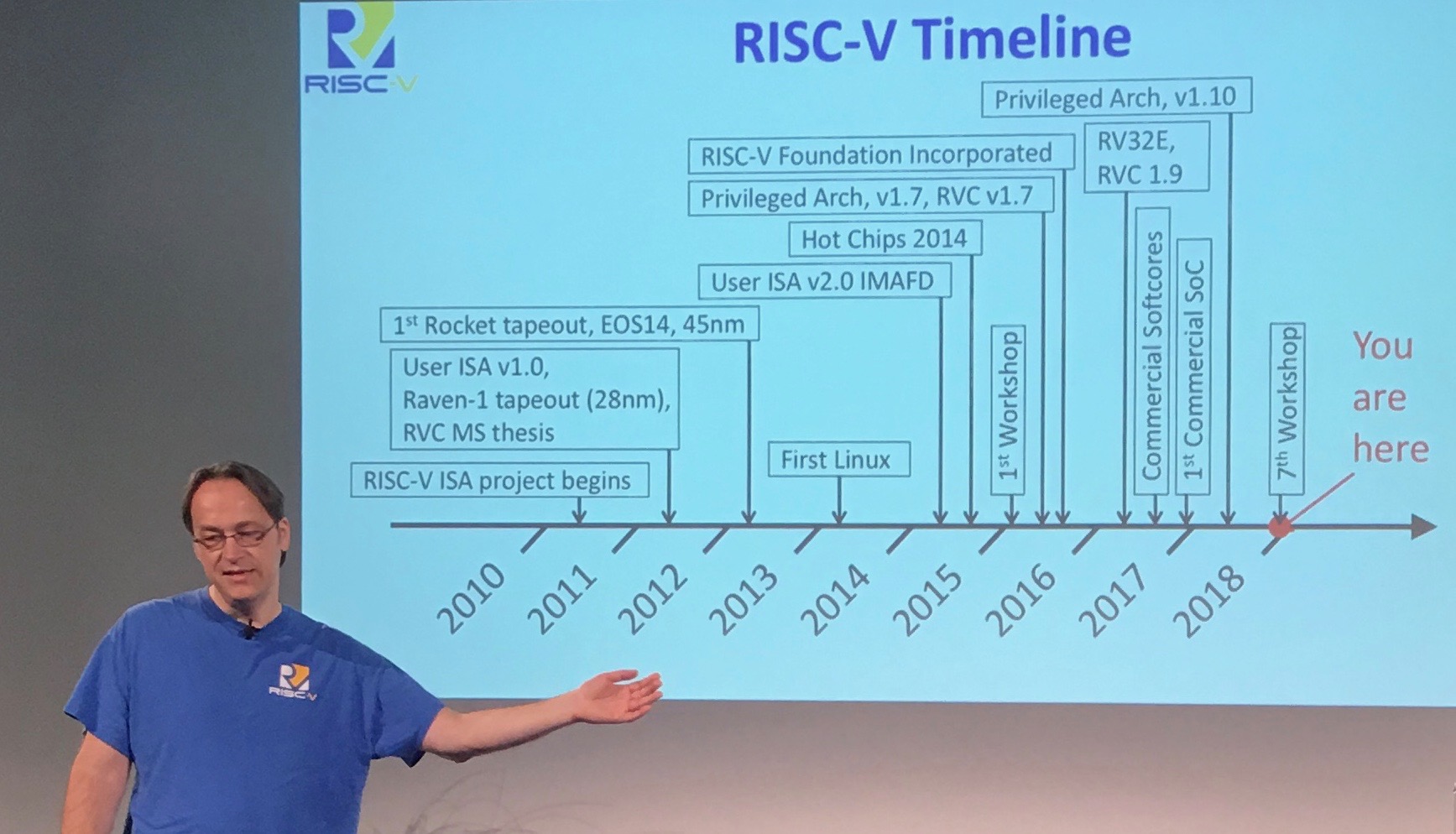
It's worth noting the age of RISC-V, according to Wikipedia (https://en.wikipedia.org/wiki/RISC-V) it originated as a 'short, three-month project over the summer' in 2010. So ~8 and a bit years old. It's taken a while to really take-off but now it does really seem to be picking up momentum. Though no serious use in production hardware that I'm aware of.
Perhaps a good comparison point is LLVM. It too originated as an academic project. Again looking at Wikipedia (https://en.wikipedia.org/wiki/LLVM) it started development in 2000, first release 2003, Lattner hired by Apple to develop it 2005, Clang released by Apple 2007 (so ~7 years from initial LLVM creation to serious production use potentially less depends when Apple were using it internally).
Not really, the foundries are on the cusp of fully validating rocket cores on the various processes, and you can just include them in your design like you would a Cortex-M or Cortex-R. They've recognized that 3-5 stage classic RISC cores are a commodity market now, and it's in their best interest to make it as easy as possible to add to your design.
Above those simple cores, we should expect to see more and more RISC-V cores hit the same level of "just drop it in for no licensing, already validated, the pieces like register files are already optimized for the process". BOOM is ~Cortex-A9 perf/gatecount/IPC, which puts it into greater than RPi territory (usable, but not really out crazy). There's still work to be done on the higher end still, albeit, but it's not like you can just go out and licence the highest perf ARM cores anyway (those are Apple's).
If RISC-V can create a low cost-of-entry development pipeline with freely available building blocks, then people will still flock to it over ARM even if the price goes way down. Its the same reason that Linux is far and away the most popular OS for hosting web apps: its just stupid easy to get one running quickly and for free. No paying for tools, no stupid licensing agreements, no arbitrary restrictions, and the freedom to change the code as needed.
Unfortunately I also think this may explode the number of "IOT" devices that will be just as badly designed as before (similar to what happened to web apps and phone apps in the last 10 years).
Its not just about price, its about control and time. ARM could make their product much cheaper and people might still pick RISC-V simply because dealing with ARM and getting a deal is quite difficult.
If you need a simple chip, and that's large parts of ARM sales volume there are free chips that you can fully control and its hard for ARM compete.
That said, the idea that ARM will go bankrupt is insane. Of course they will not, the market is not one big market but lots of small once and ARM has a massive head start in all of them.
I see no issue with both ISA existing for quite a long time. ISAs are like programing languages, after a certain size, they can not die.