For the past month I started doing 7 minutes of cardio every morning with a ridiculous YouTube video[1]. Just 7 minutes! It improves my mood level, energy for the whole day, I have better core strength, makes me want to move more overall.
I wanted to share this because to me it always looked like "doing sports" was to invest multiple 1-2h sessions per week and going all hardcore. Which is quite demotivating frankly speaking.
So if you are a couch potato like me then know that a bit of cardio is already showing good results. The best thing is that I am not exhausted afterwards so it can be done every day.
For strength training, I can only recommend the "minimalist routine" from the bodyweightfitness subreddit[1]. Basically, push-ups, rows, lunges and planks. Works all major muscle groups, needs very little to no material, and will not take more than a few minutes, every other day. A good example of the 80/20 law: that and a few cardio training (can be as simple as walking everytime you are given the opportunity) does not seem to be a lot, but it's way better than nothing.
I think you should add bodyweight squats or get creative with heavy objects you have around for extra weight. And if you can get a pullup bar, there is nothing replacing pullups for upper back strength. They help with everything including rounded shoulders( and you can do jump negatives to begin with).
> there is nothing replacing pullups for upper back strength
From a theoretical biomechanical perspective I would agree. My own subjective data, though, suggests that deadlifts cover approximately all of those muscles, and more. Also a barbell and some weights might be cheaper than a pullup bar -- at least if you plan on periodically repairing the door frame the pullup bar attaches to.
I've had a good experience with this type of pullup bar that pinches the wall (http://a.co/d/fL4oSCV). It's only left some very minor dimples in the dry-wall.
I picked up a pair of dumbbells recently. They take up almost no room, enable a ton of extra exercises, and can add resistance to bodyweight exercises you might already be doing. I highly recommend getting a pair to anyone looking to add a little extra to their routine.
I used to get injured a lot, now never. I swear by mobility exercises[1] -- they constitute the only change of habit I can pin that result on. They are distinct from both stretches and warming up (neither of which seem very necessary to me any more, except to the extent that I "warm up" by starting at a lower weight than what I'm eventually lifting.)
I've always really disliked gyms and I'm the opposite of a morning person, but a few months ago I needed to train for a very ambitious hiking trip with some fitter-than-me friends, so I got into the habit of going to the gym every day before work.
It turns out it's an incredible way to start the day, even for a night owl...the lasting effect throughout the rest of the day is very real. Also, as someone who is basically a zombie in the mornings, I essentially replaced the time in the morning when I'd be awake but sluggishly waiting for the coffee to kick in with a quick but intense stop at the gym, so I didn't need to totally rearrange my schedule.
I'm very much the same. I don't have the time or motivation to go full hardcore. Joining a gym, team, etc. Just can't do it. But I needed to do something. When my son was born I started dancing with him in my arms to this song [1]. I was so full of joy and that song is pure joy. I then added a song or two more until I have this completely unchoreographed 10-15 minutes of dancing. I do 3 or 4 times a week now. My son (now 20 months old) stands with me and dances like a complete goofball.
I have no clue if I'm doing it right or am going to get any meaningful exercise. But it makes me happy and has brought me a wonderful routine.
Yeah, as somebody who now does distance running, I understand why people develop a "no pain, no gain" mentality. To really excel, that can be very helpful. But it's entirely possible to get basic gains without having to grind it out.
Also, 'no pain no gain' only really applies once you've blown out all the beginner cobwebs and have a solid base of athleticism. Until you're comfortable cranking out a 5-k without stopping and without feeling spent (or whatever the rough equivalent in your sport is), you're going to make way more progress by taking it easy but just getting out there and doing it regularly. Basically, if going hard doesn't feel rewarding when you're first starting out, you're probably right.
The 30-20-10 intervals sound very much like the strides[1] many runners do at the end of an easy run or to warm up for a race/tempo run. It's interesting to me that the study found people enjoy them so much, because they are always the most tedious part of my easy runs which I often forget to do (whereas full interval sessions or tempo runs, while much more grueling, never feel boring).
Whichever works for you. Some people feel sick working out first thing in the morning if they don't eat something first. Some people feel sick working out first thing in the morning but only if they ate something.
> Some people feel sick working out first thing in the morning
I am and have always been one of those people. Even as an athlete in college (I rowed crew for a while) I absolutely had to eat something semi-substantial before morning practices. Which could be tough when we had to be on the water before sunrise.
One of the best tricks I used growing up was doing 10 pushups every time I died in games like counterstrike. The increased blood flow to the brain slightly increases your intelligence and decreases response times. It also acted as a gate to recklessness since you try harder not to lose. On top of that you get in pretty good shape if you game a lot.
Wouldn't that strain your arms so that your controls get worse in the next round? Though it certainly sounds a good idea to do some exercise in between such rounds. I am a top PES player ranking in the 1%, though I just sold the game so that I can get on with my life. Would have been a nice strategy.
I saw an interesting study that found in ADHD individuals, aerobic exercise immediately before a test improved concentration to beyond normal levels, while in non-ADHD people it made them perform worse. I will see if I can find it.
> The results of this study also show that the GC group has a performance that is 42% better than the GC-EF group. These data seem indicate that after an intense physical exercise, people without ADHD show impairment in attention performance. However, this hypothesis requires further studies, which include the assessment of the duration of this effect.
Thanks for posting this. Its crazy how I've noticed the difference at work when I worked out in the morning compared to the days that I skipped the gym. Doing 15 mins on the stair climber seems to put me in a positive mood/pattern for the day.
The headline is truncated and thereby misleading. The full headline is:
"Brief aerobic exercise immediately enhances visual attentional control and perceptual speed. Testing the mediating role of feelings of energy"
In other words, this study took some amount of cognitive enhancement across the subjects as a given and was designed to test for a correlation between that effect and reports of feeling energized by exercise, which the authors did report finding. If the numbers and methodology back that up, it suggests a couple of obvious (and not mutually exclusive) possibilities:
1) There is a primarily psychological mechanism, with the belief that a practice is energizing being a key factor. Note that the control group practiced relaxation techniques, which is arguably the opposite of an energizing practice.
2) Both the experience of feeling energized and the increase in cognitive performance are mediated by some physiological difference in exercise response. For example, it may be that some portion of the population has subclinical exercise intolerance (which is mostly studied in relation to cardiovascular disease, but has also been linked to mitochondrial dysfunction, neurological conditions, and sleep apnea).
I normaly ride my bike hard every morning to work (3,6 km). Compared to how i feel when i take the tram to work i definitely feel a lot clearer and sharper when i take the bike. Also, another benefit is that i can get to work in 10 minutes door-to-door with the bike, the tram takes around 20 minutes, and sometime i have to wait an extra 5 minutes if i miss the first.
I try to ride ny bike, but failing that the brisk 10 minute walk from train to work is usually pretty invigorating. When I take the car I am almost definitely grumpy by the end of the trip.
Biking to work is one of the best habits I've ever developed. In the beginning I could handle a couple of days a week. I've gotten to a point where I prefer it over driving, even on days I feel a little under the weather.
Protip: If you're mentally tired, do some unweighted squats and pushups, then wait a couple of minutes before getting back to work. Enjoy feeling refreshed!
I also find that whenever I feel sluggish, I get up and get a big glass of water. I then drink that on the spot and then fill up another one before getting back to my desk. Helps tremendously.
I love water, but still had a hard time drinking enough (and, of course, incorrect diet choices) to keep kidney stones away. Twice (with 15 years between).
Now I'm a water junkie. 3-4 liters a day, every day. Also cut out high-oxalate foods (RIP peanuts, I miss you).
Seriously, folks -- drink your water. Keep a water bottle handy, and make sure you go through it a couple times a day.
I was studying for the GMAT in Palm Beach in 08. And working out heavily at the gym. I noticed that i did much worse at test questions after a big workout. I'm sure you do better long run, but a heavy workout can tire you out enough to slow your brain a bit
Weightlifting tends not to be all that aerobic, and you can end up pretty delerious after very heavy movements. I would be in no mood to think hard after 5 sets of heavy squats!
Hi guys, we are building an app - TimeFit - that I think addresses this issue.
The short description of what we do is: During a break from work the app will give you advice on what physical exercises you should do, what exercises for eyes and what snacks to eat.
We have called a break during which you try to do the recommended activities a Power Break as it enhances your productivity and wellbeing. You don't need to do a Power Break every time you take a break but three or four times a day will give you a great boost.
Not quite "immediate" but I've noticed I feel far more awake when I go for a run or swim in the morning before work. Days I skip the morning workout I find myself drinking way too much coffee trying to clear the head fog.
While most people intuitively would agree with the headline, the study itself doesn't add a whole lot. Single study with 100-ish undergrads, evaluated only via the standard 'trails' test. Not a bad beginning, but a broader audience, a wider set of neuropsychiatric measurements and quantifying the duration of effects would be good to see.
Best investment I've ever made is a small-group training membership. The workout is good, but learning the exercises I can do in my bedroom when I'm feeling restless is priceless. Very enabling.
Essentially, the researcher introduced a Vigor Activity (VA) variable which assesses various aspects of your mental readiness. They monitored the values of VA pre and post workout. The mean value pre workout is 18.13, post workout 20.23. The values in control group are significantly different (also lower post workout) + the variance also decreases after the exercise.
I remember liking the physical exhaustion when riding to HS on bike. It didn't make me struggle to follow or sleepy, quite the opposite. Good warmup and draining.
That's basically my story as well. Lacking a control group me I have no idea what it did to my cognitive skills, but I do know that I'm a pretty good cyclist now.
(Edit: I definitely feel more awake after a morning sprint, but I'd rather watch this story of science about "energy levels" unfold in full glory than point out the banality of activity being the opposite of being asleep)
If this is something you actually want to change, a few ideas beyond showers:
1) bike slowly (mentioned below; some folks don't like it, but the "slow" speeds up over time. I keep my HR under 140 and don't really sweat unless it's very hot, and this does still improve cardiovascular base fitness)
2) wipes (baby wipes, deodorant wipes, whatever)
3) clean shirt in bag
4) use a pannier, not a backpack
5) if you biked really hard, 5 minutes before arrival slow down and let your heart rate calm and let the breeze dry you off
More and more places of work have showers available. Quite useful for biking in. Alternatively, you could go at a leisurely pace, but that's not as fun / makes it harder to justify the time spent.
I did that at Stanford. Waited until the class-change-time bicyclopalypse passed (everybody rode bikes at that time and it was a madhouse) then rode like a maniac, dropped my bike on the lawn and slid into the last seat in the classroom just as the lecture began.
I’ve often wished I could just drop for 20 beside my desk to get the blood pumping but that would be considered super-weird anywhere I’ve worked recently.
It's only weird the first couple of times you do it. After that, it will be your thing. People get used to things by seeing it frequently. It's like if someone wore a really stupid hat to work. The first time you see it, you think "Hmm... that guy is strange". After a while you still think the hat is strange, but it's normal in the context of the person. There may be people who discriminate against you, but likely the damage will be small (especially for something like push ups).
Not only that, but health and fitness is the 'in' thing right now. If the GP started doing something healthy they might get a few weird looks, but I promise other people will start doing them with them.
This. I do 8 sets of 15 pull ups/chin ups and dips in the office on alternating days. It was weird at first. Now it's my thing. Other people mention it in interviews sometimes.
In my last work me and a coworker started the 100 days push-up challenge. Soon our whole team joined.
After a few weeks many people from other teams also joined and it became a thing in the company.
Why is this such a big news? Its logical, any other result with moderate exercise wouldn't make much sense. Hard/long effort will tire you also mentally for some time, again makes complete sense. Deep breathing will also wake you up, to certain point, after that you become dizzy with too much O2 in your blood. Meditation or mindfulness exercise will slower your heart rate and make you feel cold. I could go on and on like this whole day.
Its nice if there is a scientific proof for logical behavior of reality but it shouldn't make big news for anybody here. If there is some proven discovery of at-first-glance-illogical behavior of our bodies or reality, now that's something newsworthy.
"It's common sense that the sun revolves around the earth".
Logic is only helpful if you have the right premises. You might well have that, but they could also be too simplistic. Case in point, meditating tends to make me feel not cold but warmer (specifically, if I have cold hands and feet, that goes away).
Then you're doing something different (not claiming wrong if it works for you) than what meditation generally is supposed to achieve. There can be various reasons, but its definitely not the standard output nor in me nor any person I know is meditating.
I am guessing you are not suggesting that the goal with meditation is to achieve cold hands, so maybe you are assuming that my heart rate goes up or something similar. However, I can assure you that is not the case.
There are theories that Raynaud's syndrome (unreasonably cold hands and feet) can be triggered by stress and so one could hypothesize that the opposite holds true as well. That may be related, or it may not be. I am just pointing out that such a simplistic view of something so extremely complex like our bodies can be misleading.
I am not writing about cold hands, feet or Raynaud's syndrome or any other health issues, don't know where you did take it from. I am talking about slowing heart rate, and subsequently the body will slightly cool down, depending on how much you slow down the heart rate. Of course extremities is where cooling down is felt first, but this is normal for any healthy human.
This is a normal reaction of any healthy body (lower heart rate -> lower temperature), ask any doctor or consult any relevant medical book. This experience also comes from my fiancee who is a doctor, with same reasoning. Something they use sometimes at their work (or reverse effect).
You might be doing something during your meditation that counters this natural effect (physically or mentally), I don't know and frankly it's not much relevant to the discussion. Or do you have any scientific resource that proves the opposite effect is true?
This may be hyperventilation [1], which is too little CO2 in the blood, not too much O2. Symptoms include dizziness and loss of consciousness.
I discovered this in 7th grade by doing about 30 seconds of rapid breathing followed by holding my breath. Reliably passed out in 5-10 seconds, regained consciousness in <15 seconds.


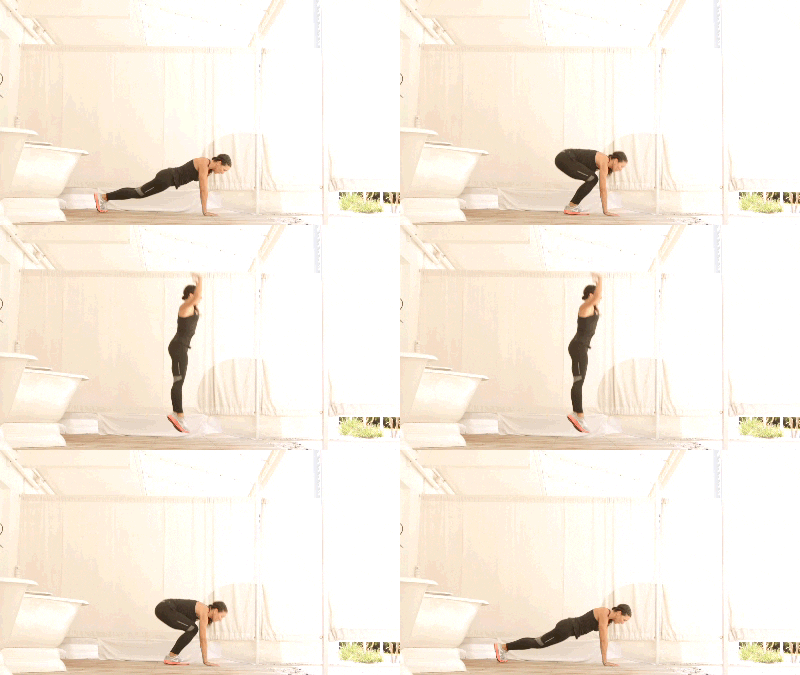
I wanted to share this because to me it always looked like "doing sports" was to invest multiple 1-2h sessions per week and going all hardcore. Which is quite demotivating frankly speaking.
So if you are a couch potato like me then know that a bit of cardio is already showing good results. The best thing is that I am not exhausted afterwards so it can be done every day.
[1]: https://www.youtube.com/watch?v=yL_dE81O_mw