Non-malicious startup idea: What if you bought houses in bad school area, created a great private/charter school in that area and sold your houses at much higher price? From OP's calculation, a great school may cause at least $200K price increase per house and depending on capacity of the school you need to build, I think this can turn out to be pretty good business.
> What if you bought houses in bad school area, created a great private/charter school in that area and sold your houses at much higher price?
It's not easy to create a good school. Certainly, simply throwing money at the problem doesn't work, as shown by an example of US public schools. The most certain way to achieve it is to heavily preselect the attending children, but that presupposes the existence of such quality base in the area around the school. The problem is that if it does, then their parents are usually already rich themselves, and so the house prices are already high.
Are these assumptions, that throwing money at the problem characterizes US public school, and that quality children usually have rich parents, anything like justified?
They must be. Public schools are underfunded. Also, who measures children by “quality”? Jeez. This part of SV culture I would like to unsubscribe from.
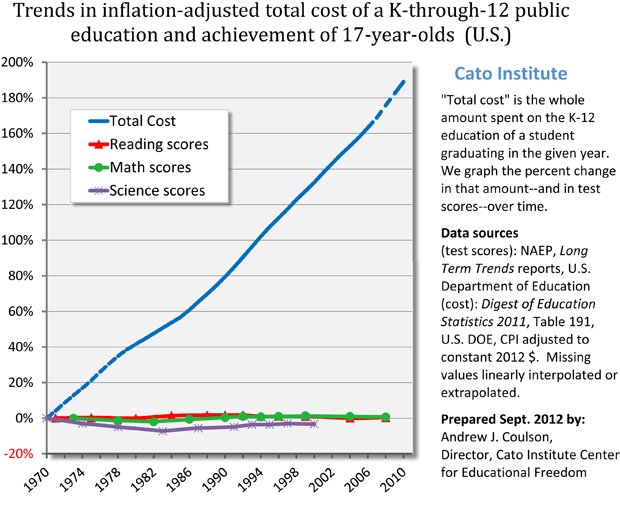
Compared to what? Spending per pupil in K-12 are up >2x compared to 40 years ago, adjusted for inflation. Worldwide, they are second only to Norway and Switzerland. Moreover, the poorer and worse performing schools typically enjoy higher spending per capita than richer schools. See e.g. [1]. For a specific example, look at the public schools in DC, which have absolutely atrocious educational outcomes, while enjoying double of the national per-student spending (which is already very high by itself). DC is literally spending 4x as much per student than US was on average in 1970s (again, inflation adjusted), and having worse educational outcomes than US in 1970s on average.
> Also, who measures children by “quality”?
Hardly anyone, which is why you have uninformed opinions about how increasing funding will improve outcomes. We already did it. It didn't work one bit[2].
Also what you linked (1) does not support your argument. "The U.S. public school system is characterized by large funding differences across districts, but what about differences in school spending within districts?" Sure, within a school district it's a different story, but people are very careful when drawing those borders based on specific agenda's.
Per student Instruction spending: Arizona $4,077 vs New York $15,746.
Per person income Arizona $25,680 New York $40,272.
> Per student Instruction spending: Arizona $4,077 vs New York $15,746
That's funny, because New York and Arizona perform about the same in the NAEP assessment. Clearly, New York has a lot to learn from Arizona, if it can achieve the same results with quarter of the NY's spending.
Even if they cannot improve their test scores, imagine how much the situation of students in poor families would improve if the $12k saved per student was simply given back to their families. Think of how many kids could be pulled out of poverty if their parents got extra $1000 per month per kid.
> Looking at Graduation rates Arizona is well behind New York.
Arizona is at 79.5%, vs. 80.5% in New York. I'd hardly call it "well behind". Moreover, the poor students have higher graduation rates in Arizona than in New York. And, moreover, the graduation rates don't mean much, as shown by recent DC graduation rate scandal.
> Looking at ACT and SAT scores by state Arizona is well behind when you adjust for participation and graduation rates.
What's the source of this data? Does it adjust for private vs. public school?
> New York is doing very well economically specifically because they are spending on education. Resulting in vastly fewer poor families.
New York does very well economically because of New York City, which didn't become the global economic powerhouse because of its high education spending. New York City public schools, with a handful exceptions, are well known to be quite bad, by the way.
> Now, you can argue New York is not getting value for money, but they are getting better educated kids.
I see no reason to believe that New York public school children are any better educated than Arizona.
> And, moreover, the graduation rates don't mean much, as shown by recent DC graduation rate scandal.
Did you miss it?
It is you who even brought up the graduation rates in the first place. If you believe that the numbers are not to be trusted, why did you even bring it up?
No single number is that meaningful on it’s own. But when a system has both lower standards and lower graduation rates that’s a clear sign of a problem.
Similarly, if your measuring graduates you need to ensure your measuring similar populations and one system is not simply dumping problems into a separate non counted category.
Doesn't the US have some sort of standard curriculum which defines what you have to do in order to graduate? Like you must have passing grades in at least N subjects.
> That's funny, because New York and Arizona perform about the same in the NAEP assessment. Clearly, New York has a lot to learn from Arizona, if it can achieve the same results with quarter of the NY's spending.
Given how much of school costs are labor costs, the main thing Arizona is probably doing “right” to produce those efficiencies is hiring people who live in Arizona.
It's not likely that New York can really learn much from that.
Public schools are not underfunded. The inflation adjusted per student k12 spend in the us has gone up over the last 30 years.
It seems like school teachers are dramatically underpaid (a matter of opinion but I feel it's probably true in the median), but not the system as a whole.
The public teachers don't have very high annual incomes, especially at the beginning of their careers. However, their wage is really good on a per-hour basis. A median teacher already makes more on their own than the median US household, while working considerably less than 2080 hours in a year. Additionally, the teachers typically enjoy really good pension benefits, which significantly improves their total compensation, even though it doesn't actually show up in the wage statistics.
It depends on who you ask. If you ask teachers, they'll tell you that they work 16 hours work days all year long, but try scheduling a teacher-parent meeting after work hours.
Its almost as if they are also humans who need to feed and enjoy themselves outside their job.
I know a few american teachers, grade thru hs. They report wages and supplies are a bit better off than in previous years, but that cricculum is so perscribed that they feel little leeway to actually 'teach'. They find themselves optimising for test taking and hate themselves a little bit for it. They are constantly under fire from other teachers with competing agendas, and beset by often abusive, sometimes nessarry, unions. It is a bad system that has evolved and the teachers are sad pawns in it. But there is still live to live, love to explore and things to strive for outside your job. Teachers have a heavy feeling of seeing their enforced ineffectiveness slowly degrade their community.
But screw teachers for not having extra time, amirite?
Wait, are you saying that being resistant to schedule work which both is recognized as appropriate for official working hours by the employer and which can be effectively performed during that time given the structure of the working day somehow contradicts the claim of necessary work that either cannot effectively be done during the official working day or is not recognized as necessary by the employer that must, therefore, be done outside that time?
Because from where I sit those don't conflict at all.
it really varies, its not fair to say that all schools are well or poorly funded. in california, it is dependent on local taxes for example. so palo alto has incredible schools, and LA and Oakland have some of the worst in the country
That's not true at all. You should look up the top spending per capita (large)[0] public school districts and you will find NYPS, LAUSD, CPS, and Baltimore school districts among them.
[0] there are lots of high-spending small outliers serving areas with total (adult+child) populations in the < 100k range
Palo Alto spends only 10% more than Oakland per student, which itself spends more than both national and state average. If Oakland schools are worst in the country, the funding has minor, if any, impact on it.
The difference is "PiE" Partners in education, which is a non-profit voluntary parent-led organization which supports "All" the extracurricular activities plus for in-class aides for all classes.
For most of california it is not at all dependent on local taxes. Local taxes only significantly affect "Basic Aid" (i.e. wealthy) school districts, 40% of which are in the Bay Area.
For the rest of the state, the funding is nearly identical on a per-student basis.
Regarding the second part, yes, the fact that academic achievement is highly influenced by socioeconomic status is well supported by research; a big part of the whole correlation is that higher socioeconomic status means better schools, but there's still a strong effect within the same school. There's a bunch of studies that try to estimate the nature/nurture split, but in any case higher socioeconomic status correlates positively with pretty much everything schooling-wise.
What if poor children tend to have distracting home lives, stressful situations, parents who aren't educated enough to help tutor, poorer diets, higher rates of disease and fewer positive peer and authority figure examples?
If these are what makes poor children perform poor at school, then the strategy of making good schools to boost house prices is not viable -- we simply have no idea how to make kids facing the problems described above achieve good scores, because if we did, we'd already be doing this. Moreover, this wouldn't attract wealthy buyers, because their children don't have these problems in the first place, so they won't get any improvement.
The point here is that we have no idea how to make a school good, other than by kicking out bad students (whatever the reasons for them being bad might be) and getting good ones. If you knew a way to take a random bad performing school in the country, and bring its students educational outcomes to above national average, you'd make lots of money contracting out consulting to local government.
> The point here is that we have no idea how to make a school good, other than by kicking out bad students
I would disagree with any metric claiming to measure school quality that is not constant when the demographics of the school change. If our metrics simply gauge the socioeconomic status of a school's population, we need better metrics. We also need to develop interventions that overcome the educational costs of poverty, perhaps, dare I say, by eliminating--or at least attenuating--poverty.
Who are you arguing with? You don't like poverty? Neither does anyone else.
And if the metrics don't appeal to your preconceived notion of how the metrics should work, you want to change the metrics? You want metrics to not notice changes in demographics?
> If you knew a way to take a random bad performing school in the country, and bring its students educational outcomes to above national average, you'd make lots of money contracting out consulting to local government.
Converting them to boarding schools and essentially cut off contact with the rest of the world may work. It would also be both really expensive and creepy, reminiscent of the times when native American children were forced to attend English-only schools away from their families.
It's perhaps worth to consider what does "quality children" mean in the context of a "good school" - and it could certainly be argued that one of the major criteria for parents moving in and choosing a school is to get their kids into a school where the other kids are of a comparable or higher socioeconomic status. The other things about the school are fixable by heavily involved parents, but you can't (easily) alter the peers which your kid has in school, only pick a school with "good" peers. Other things being equal, having your kid in a school with (other) poor kids puts him/her at a disadvantage, all kinds of poverty-correlated problems (e.g. parental neglect, parental drug abuse, nutrition problems, crime and imprisonment) drag down not only affected kids but also their classmates.
> Brown often works from 5 a.m. to 4 p.m. at her school in Versailles, Ky., then goes to a second job manning the metal detectors and wrangling rowdy guests at Lexington’s Rupp Arena to supplement her $55,000 annual salary. With her husband, she also runs a historical tour company for extra money.
So, basically, in her teacher job, she already makes more than 60% of Versailles, KY households. If her husband makes anywhere close to what she does, their household makes more than 85% of households in Versailles, KY, and that's not even counting her moonlighting.
Maybe they have some special needs, like e.g. disabled children, that make them need six figures income, then certainly I'm sympathetic to their plight, but if the argument here is that a household in Versailles, KY needs a six figure income just to survive, then well, I'm stunned.
The argument here is the teachers aren't well-paid in the US, especially given the importance of their profession and the level of education a teacher typically gets.
I can't speak for KY, but if you want to go into specific numbers, let's start here:
>In 2016, for instance, the average teacher’s starting salary was $38,617
Make that $45K in California[1].
In San Jose, where I currently live, median elementary school teacher salary is about $50K[2].
With this kind of salary, the median teacher will not be able to rent a one-bedroom apartment in decent San Jose, which typically go for well over $2K/month (about $2500 for 1B)[3], since landlords usually want to see monthly incomes of 3X rent (source: I'm renting).
That's barely double the minimum wage ($12/hr in SJ) for a median teacher salary.
Again: this means half the elementary school teachers in San Jose make under 2X minimum wage and most literally can't afford to rent a 1B apartment on their own.
That's before you add in student loans (education isn't free!), car payment/maintenance/insurance (we don't have a usable public transportation system here), etc - and that's assuming no kids.
You can always find an example of a teacher that's well paid, but there's a reason why the teachers were protesting in several states - and the reason isn't that they have too much money thrown at them.
If the teachers make $24/hr, that means they're working 11.25 hours per day, assuming a 185 day work year. Since a school day is just around 6.5 hours, that seems like a lot of after hours work.
If we assume they make all their salary in 8 hours/day, that's more than $34/hour. In a non-school work year that translates to about $70,000/year.
An annual salary of $50,000 translates to an annual salary of $50,000. It's fun to play with numbers and try to figure out hourly equivalents, but the pay is what it is. We can have all sorts of arguments about how much time teachers "really" work, how hard the job is, what fair compensation is, and so on, but they're different questions than "is an average Silicon Valley teacher's salary sufficient to cover average housing costs in Silicon Valley in 2018," which seemed to be the original question. The answer is: "no."
(For the record, the average salary for a public school teacher in Santa Clara County is $68K as of July 2018. The average rent for an apartment in Santa Clara County as of September 2018 is $2730, or 48% of that income; for a 1BR only, it's $2471, or 44%, still well over the 2.5x rent-to-income guideline that many rental companies use as a minimum. The median home price in Santa Clara County as of July 2018 is $1.3M, so I'm gonna say we don't really need to look at mortgages, okay? Okay.)
>If the teachers make $24/hr, that means they're working 11.25 hours per day, assuming a 185 day work year.
My apologies, but you have no idea how much work a teacher actually does. A lot of it is indeed done after hours, and yes, 11-hour work day is not atypical. There's lesson planning, endless grading, paperwork, and that's just to start.
But, as the other commenter here said - it all doesn't matter. $50K is $50K, and after all the juggling, a teacher in SV can't even rent an apartment in SV.
All that is to say that the US is really not solving its education problems by throwing money at it, as suggested by a parent comment, when a full-time teacher can't even rent an apartment with their salary in one of the richest and biggest metro areas.
(1) good/bad school area refers specifically to the ratings of the public elementary, middle, and highs school to which persons living at an address are assigned by geography (it's a measure of what you are entitled to as a result of living at a given address, not what happens to be nearby otherwise); starting a private school (whether a regular private school or a privately owned charter school) has no direct effect on that, regardless of its ratings.
(2) There's pretty strong evidence that school ratings mostly are a measure of the students assigned, so if you want to influence ratings of the local schools to manipulate real estate prices, you don't establish a new private school and try to make it good, you make a new private school and selectively admit low-performing students from the target area.
> From OP's calculation, a great school may cause at least $200K price increase per house
Say it with me: Correlation does not imply causation!
Correlation does not imply causation!
Correlation does not imply causation!
Correlation does not imply causation!
(And schools in the U.S. are funded largely by local property taxes. Therefore, the arrow of causation might very well go the opposite direction here: the places where homes are sold at higher prices are assessed at correspondingly higher taxes, and therefore those school districts get more money, and thus perhaps -- perhaps! Correlation does not imply causation! -- those more heavily funded schools are regarded as "better".)
How do you account for wild differences between schools in the same school district? Despite sharing a tax base, you see a sharp increase of the median house sale price across school boundaries.
Aside from differences in capital investments, generally the operational funding is allocated on a per-pupil basis.