Every time I see someone make the argument that "all cars will be electric by 20XX" I feel like they are incredibly sheltered from rural life. The US is HUGE! Sure the majority of commuting could be replaced by electric cars but I've seen no evidence of them being able to replace ICEs for the "I want to go skiing/kayaking/hiking (pick an activity where your car sits on the side of the road all day) 2 hours away and return on the same day" situation. There are so many changes to infrastructure that need to be made to get there. Sure ski resorts and malls and park and rides might put in 1000s of chargers in their parking lots eventually, but it certainly won't happen by 2023 or whatever this article predicts. Sure the cars might exist, but the charging infrastructure won't by then.
Electric cars can have ICE's strapped onto them, and it works really well. The Chevy Volt, for instance, is perfectly designed to handle the situation you described. It gives you 52ish miles of all electric range, so you can commute and grab groceries and do all of your normal driving on pure electricity. And for various road trips, it still gets 40-ish MPG for hundreds of miles without any electricity needed.
It also needs zero fancy charging infrastructure. Have a regular US household power outlet anywhere in your garage or home exterior? Then you have everything you need to charge it up every night.
We could easily eliminate 50+% of US personal vehicle emissions, simply by putting 2013-era PHEV technology into every single car /SUV / truck, and getting people to plug them into regular 120V US household outlets overnight. Even rural folks would benefit greatly from getting 1 or 2 free "electricity gallons" every night.
Pure EV's are obviously ideal, and way cooler. But even just a little bit of electricity in a PHEV goes a long way to reducing/eliminating emissions.
> It also needs zero fancy charging infrastructure. Have a regular US household power outlet anywhere in your garage or home exterior? Then you have everything you need to charge it up every night.
There will be significant additional load on the Electric grid. This will require the electric grid to be overhauled around the country. Couple this with "smart grid" mandates & you have yet another channel for government control via bureaucracy & regulation. Denizens of cities tend to be more numb to government control & people in more sparsely populated areas tend to be more willing to demand/defend freedom & liberty.
There are many new properties that need to add utility poles. Don't forget power loss over distance.
The big advantage of Gas is you can transport/store the product without the product losing energy.
> We could easily eliminate 50+% of US personal vehicle emissions, simply by putting 2013-era PHEV technology into every single car /SUV / truck, and getting people to plug them into regular 120V US household outlets overnight. Even rural folks would benefit greatly from getting 1 or 2 free "electricity gallons" every night.
Living in Tennessee, it's difficult to ignore the power lines everywhere in otherwise abundant greenery. Electric cars will only add more power lines & infrastructure.
> There will be significant additional load on the Electric grid. This will require the electric grid to be overhauled around the country.
Two electric cars in a household, both charging simultaneously, uses less electricity combined than just one standard clothes dryer or one central air conditioner -- the kind of appliances everyone already has in their home and runs regularly.
It's not nothing of course. And some parts of the grid will need capacity improvements. But we're only talking about 900 to 1400 watts per car here, and most of that only happening at night when there's lots of spare capacity already. I don't see any factual reasons this would crush the power grid -- cars simply don't use enough electricity to cause a major problem.
> For full electric with higher mileage 5000-10,000 kilowatts would be a lot more likely.
I don't think so. Sure, it's technically possible to use that much power, but most people aren't going to empty their Tesla battery every single day, for the same reason most people don't buy a whole tank of gasoline every single day.
You can charge a Tesla on a 1.4kw US household outlet, just like every other car. It will still give you 50+ miles a night. Bump that to just a 3.3kW charger and you'll be pulling over 100 miles of charge nightly. 3.3kW is more than enough to cover 92% of all commuters nationwide, according to USDOT.
Superchargers are awesome and all, and are great for roadtrips, but 99% of people will have no need to pull 17kW down in their home. That's an insane amount of power.
Speaking as someone who's worked in renewables and utilities, I can tell you that the exact opposite is true. Having a reliable load at night would flatten out the demand curve for electricity, making the grid significantly easier and cheaper to manage.
Those utility poles and power lines you worry about are there to handle peak load, which won't be impacted at all by EVs, which will charge predominantly at night.
A solid mix of renewables -- hydro or geo for base load, with solar for peak load and wind to top off intermittent and nighttime demand -- is most efficient when the demand is relatively stable. No more need to shunt perfectly good electricity into the ground just because it's night.
And boy oh boy does it make the grid economics of distributed solar better. If most of your home's solar production capacity is being soaked up by your car, the grid and utility doesn't need to support big buy/sell cycles on sunny days. Electric cars would stabilize pricing and are probably the only way SmartGrid can realistically work.
Unlike refrigerator compressors or clothes dryers, electric cars have a smooth rate of draw and, as small industries pop up to parasitize the big battery in your EV, we'll increasingly see EVs as a home's store of electricity. This will be good for the system in the same way that per-home cisterns dramatically reduce demand on the water systems here in Southern Europe.
The grid can manage electric cars. They can actually make the grid more stable since it's not difficult to ask the cars to slow their charging at certain times. You don't even have to build this into the grid layer: just take these network connected vehicles and tell them to stop charging for 5 minutes out of the hour.
You can even go so far as to have the cars soak up the capacity. If you have a 2kW capacity circuit in the house, you can have the car drop it's draw as the fridge compressor clicks in.
while i think you're incorrect on many points, i'll address one for example:
>The big advantage of Gas is you can transport the product without the product losing energy.
the cost of transportation and infrastructure like for example gas loading terminals and gas stations is higher for gas than electricity. That is the "loss of energy".
Indeed, even when using fossil fuel as the energy source for both a gas-powered and an electric car, the well to wheel efficiency is 14-33% vs 42%, respectivly.
> There will be significant additional load on the Electric grid.
True, but people will be charging their cars most often when they're asleep, so it's less of an impact on peak load. It may be more of a base load/duty cycle impact.
However, even then, this type of load is also easily interruptible and automatically controlled by modern hardware. This makes it more serviceable with renewable power, more easy to make price-sensitive, and more able to provide demand response. (Potentially to the extent of being able to put power back into the grid and act as a negative load.)
(That said, the original idea of a household outlet is a stretch... I understand charging a Tesla at 120V/15A to be glacially slow.)
> The big advantage of Gas is you can transport/store the product without the product losing energy.
So gas tankers and carriers run on unicorn farts now? ;)
> Living in Tennessee, it's difficult to ignore the power lines everywhere in otherwise abundant greenery. Electric cars will only add more power lines & infrastructure.
Continue at the current rate of emissions and pollution, and the only greenery left in Tennessee or anywhere else will be brownish algae.
> Have a regular US household power outlet anywhere in your garage or home exterior?
The irony here is that people living in cities, who would most benefit from the advantages of EVs, are also more likely to live in Condos or Apartments, many of which do not have outlets in their garage.
I had to rule out an EV purchase for just that reason.
The people who live in cities -- as the article points out -- will not need to own a vehicle. Living in a city will become even more attractive as it will be far cheaper to simply hail a fleet vehicle than to own your own car. When this shift happens, watch the urbanization rate across the developed world shoot up, as the price of suburban/rural living will finally begin to reflect its true societal cost.
Suburban and rural dwellers will still need their own car, but even then it makes more sense to have a PHEV than an ICE. And pure EVs with range extenders (parallel diesel/gas generators) make yet more sense, if the aesthetics and modularity problems can be solved. Yes, these solutions are more costly, but them's the brakes. Nobody has a right to live -- cheaply -- far from shared infrastructure.
I agree wholeheartedly with you and my next vehicle will be a plug in hybrid. That said, that isn't what the author is saying. He's saying that all private cars will go away because it will be so much cheaper to just call a self driving electric and I don't see it happening because people will never call a self driving car to the trailhead of a 14'er. It is just so much more convenient to have your own (PHEV).
Same. Self-driving cars/vans would be brilliant for trailhead use. In 2016, hiking Trans Zion, we paid US$120+tip to get two of us from our car to a starting point about 60-90 minutes away. Earlier this year, my brother and I hitched three separate times to save 10 hours of road walking in a storm to get back to our car after Buckskin Gulch. We were lucky with the timing of each ride.
I've been deterred from hiking the Grand Canyon rim to rim by needing to either hike all the way back, or have two cars and add a 5-hour drive. Salt Creek in Canyonlands is another where a shuttle is a help, or crossing from The Maze over the river to The Needles (avoiding many hours of driving back).
Being able to call a self-driving car to affordably make these trips would be great.
The cell coverage isn't even required. If there is no driver waiting for me, I could affordably schedule the car in advance to wait at the trailhead until I arrive: all day if need be. It'd be no more expensive than having rented the car for the day.
If you had a self-driving car, you could let it take you to the beginning of the hike, and then let it drive itself to the end of the hike where you could take it home.
As an outdoorsman this is exactly what I am excited about with self driving cars. It has the possibility of making going even deeper into the wilderness more practical. A self driving car can take you to the trail head, go charge, and then go wait for you. With 300 miles of range you can go most anywhere.
If by "almost everywhere" you mean Europe or Japan, please compare population density. If most of the US had the population density of Northern Europe, or US northeast, or Silicon Valley, it would have similar almost-omnipresent coverage.
US West is more like Siberia, or Canada 100 miles north from the border. There are not enough subscribers to economically cover with GSM / LTE, except in cities and along major roads.
I'm talking about places like India or even Myanmar. To be fair India has probably a much greater population density than the US so maybe you are correct.
Right. I don't necessarily disagree with any of that. I'm just trying to fight the notion that EV's "won't help rural folk", or that electric cars are not compatible with rural life.
If anything, rural and exurban folks will have the most to benefit from electric vehicles and PHEVs (even without any charging infrastructure), since they end up driving more miles on average than city residents.
> I don't see it happening because people will never call a self driving car to the trailhead of a 14'er. It is just so much more convenient to have your own (PHEV).
Self-driving cars can co-exist with short-term rentals. I live in Seattle and recently sold my car because ReachNow is good enough: it does short-term rentals by the mile, but when I go hiking I can do half/full-day rentals, and it still ends up being a lot cheaper than owning a car. And this is before self-driving and the cost savings of EV enter the equation.
> because people will never call a self driving car to the trailhead of a 14'er.
I disagree with this. Why not? Hell, reserve the car for two weeks and have it sit there at the trail parking lot, if you want the old school experience. Still cheaper (for you, for the environment) than full time owning a car which is unused 90% of the time.
Not all private cars will go away, but a significant fraction of car use cases will move to self driving services (especially the ones that involve drinking).
For some this will mean their optimum is less car ownership, and for others no car ownership.
The trend will be amplified in areas with limited parking and high costs of living.
Also, you can always rent a car to go to the trailhead, just like you do on vacation.
None of this is dependent on electric or even self driving cars, as it is all already happening today with ride services and ICE cars, but self driving cars shift the economics considerably away from private car ownership.
Change happens at the margins. For reasons that you and parent comments mentioned, we're not going to go to 100% electric anytime soon. But I think we will see a lot more city dwellers willing to go car-less, and a lot more suburban/rural families willing to go down from multiple cars to just one. That'll still be enough to shake out the less competitive oil companies.
One consideration is that if fossil fuel cars drop to a very low level in cities, the spending put into maintaining the fossil fuel infrastructure might become unsustainable. That would in turn drive up the price in rural area as well. In the end, it is very expensive to maintain parallel infrastructures as such and densely populated cities (unfortunately maybe) drive the trend of which infrastructure is going to win.
Two hours of driving is half a Tesla's capacity, so that scenario is already solved.
It's not going to get any less solved over time.
People will own cars individually for the same reason that people own horses now - they enable a specific kind of activity, or a native appreciation for the object in itself. Certainly motorsport is not going to die any time soon.
What percentage of automobiles are used for touring and racing? I'd guess it's around 3% looking at my state's DMV figures, but form your own opinions I suppose. (A good proxy: Motorcycles are owned largely by the kind of people I'd expect would continue to own cars - 140k out of 4.2 million registrations in my state)
There's about 1 non-passenger-vehicle for every 4 people. I'd guess we see vehicle ownership and registration by private citizens drop to about that number - so 50% reduction total.
A Tesla model 3 has a listed range of 220 miles and it declines in winter and with hills. Therefore I doubt one could actually go from downtown Denver to Vail (~95 miles) for a day of skiing and back in a day without charging at the resort. It certainly couldn't make it from Denver to Salida, CO (~140 miles) for a day of white water rafting without charging during the day. Sure businesses could install chargers in their parking lots but we have a LONG way to go for that and that doesn't help someone going to climb the tallest mountain in Colorado (115 miles) who will park at the trailhead. There are some answers here but personal vehicle ownership isn't going away for large portions of America any time soon.
I thought the article was arguing that electric self driving cars will remove the need for charging and owning, you'll just call a vehicle and it'll drive the route your talking about for roughly sixteen bucks each way. It probably won't be the same car but that's not a problem really.
"Sure businesses could install chargers in their parking lots but we have a LONG way to go for that"
Why's that? I've seen hotels in Spain with dedicated Tesla parking/charging stations. Gas stations will be retrofitted with charging/swapping options. Tesla/other may partner with other businesses to install charging stations on the street.
Cars will leave while you're hiking to recharge. National Parks may well install charging stations and have regular, automated shuttles running the most popular routes.
Plus you're talking about a very specific case to suggest this being an issue for "large portions of America".
>that doesn't help someone going to climb the tallest mountain in Colorado (115 miles) who will park at the trailhead.
just command the car to go on its own and charge at the nearest charging station while you're enjoying the trail :) This is just one illustration how two tech advancements - self-driving and EV - happening simultaneously would help each other and would result in practical revolution.
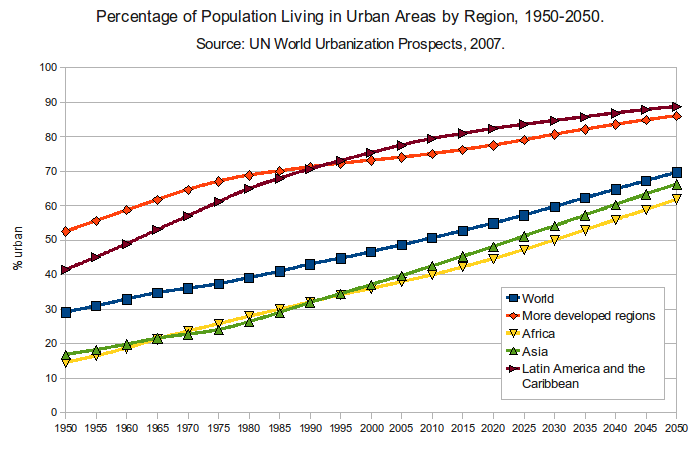
The vast majority of people are living and travelling within cities. You're talking about a small problem that's getting smaller every year. See this chart:
I wouldn't call the lifestyle of 20% of the planet a "small problem". Also, just because someone lives in a city (which can be as small as 2500 people and isolated[0]) doesn't mean that they never leave it.
This is one of the oddest false beliefs about electric cars. 1) they already have the 300+ mile range for the 4 hour round trip, 2) electricity is totally abundant anywhere. Far more so than fossil fuels.
Building charging stations is really really cheap, because the infrastructure (electricity) already exists everywhere. The reason they aren't everywhere as yet is because there are still relatively few electric cars.
I predict the opposite opinion will be prevail very soon: people will wonder why others even bothered wasting time refuelling their car and spending loads of money.
I don't keep up on EV development, but has the concept of battery exchange as an alternative to mobile charging stations made any progress? Seems like a big factor in the amount of time spent refilling vs recharging their vehicles.
As someone who lives in a very rural area away from the metro with an EV I say: so what?
Unless you're going 300mi+ in a day(which is 6+ hours of driving) you're fine. Even if you are large parts of electric charging infrastructure is coming online at a rapid pace.
Take for instance the Olympic Peninsula. Used to be really hard to get to via EV. There's now a Supercharger in Sequim and Aberdeen with another planned for Forks. If you have electricity all the fundamentals for the infrastructure are there.
I have a friend who lives really in the middle of nowhere. It's 70 miles to the nearest town with a big box store. 100 miles to Reno. He said if he had an electric car with 150 miles range it would totally serve his purposes. The local gas station has an issue. They have to charge higher prices. So most residents buy their gas on their weekly shopping trip to Fernley/Reno. There is the potential if that station closes, then electric cars become vastly more attractive.
Exactly. As someone who grew up in northern Utah it is hard to imagine owning an electric car right now. But most people don't live in northern Utah. Now that I live in DC, I would love an electric car since most of my gas money is spent hanging out in traffic anyways. Big cities, where most of the population lives, is where EVs will really make their debut.
> Sure ski resorts and malls and park and rides might put in 1000s of chargers in their parking lots eventually, but it certainly won't happen by 2023
We drove a plugin hybrid to go skiing last winter.
Once we got to the hotel we were surprised to find a level 2 charger. We plugged in and 30 percent of our miles while up there were pure electric.
If anything, given that ski resorts tend to serve higher income clientele, they are likely to be ahead of the curve with charging stations, especially if they can charge $ for it.
It'd be cool to see National Parks add charging stations. Nearby, any site handling RVs would have some base infrastructure to add charging to their repertoire.
The US rural population is 15% of total population and declining ( "About 46.2 million people, or 15 percent of the U.S. population, reside in rural counties, which spread across 72 percent of the nation's land area" https://www.yahoo.com/news/census-rural-us-loses-population-... )
Next rural population has plenty of vehicles that use gas that could be electric. For example, 4wheel ATVs. A farmer that has an electric ATV could power the ATV with a solar array. Or an electric tractor, water pumps, etc
Lots of opportunity to take ICEs out of the mix. Not just the pickup truck.
The thing you have to remember in energy and transportation is that capital costs are high, and margins are thin.
What do you think happens when a new innovation comes in and takes 20% of your market share? This is what happened in oil with fracking. Venezuela collapsed and everyone else is on the brink.
Replacing 20% of IC cars would be just as catastrophic for oil incumbents as fracking.