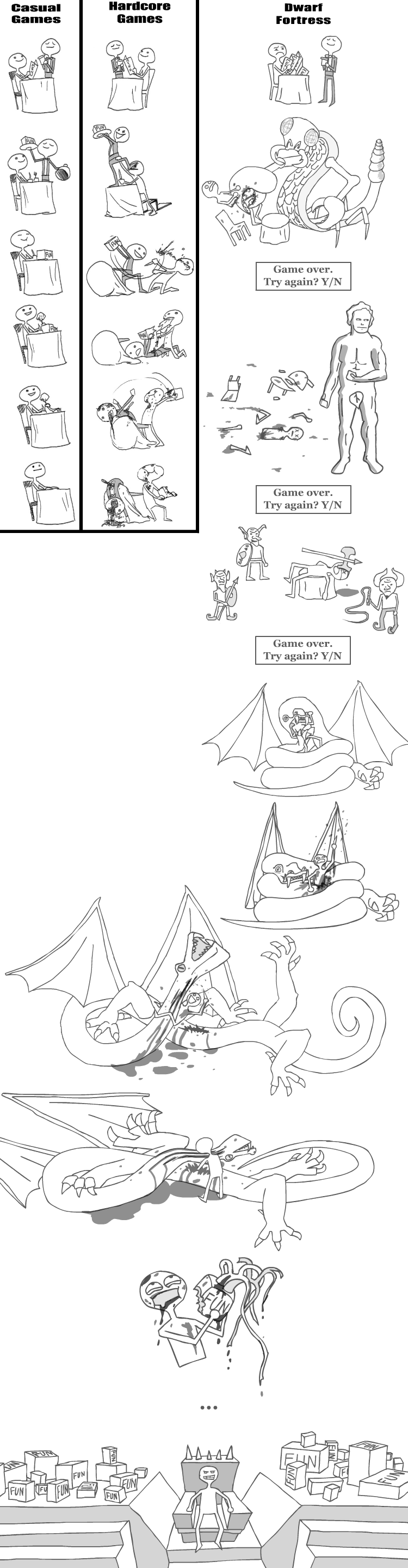
One of the things that I find interesting about Dwarf Fortress is that (to use programming jargon) it's sort of a declarative game rather than an imperative game. In e.g. StarCraft you select an individual unit and demand that it move to a specific point on the map; in Dwarf Fortress you configure which dwarves are allowed to perform certain tasks, then you place a task in a queue, and some dwarf somewhere will (eventually (hopefully)) take care of it (until they get distracted by a party, or decide to go fishing, or get hungry and wander off to the dining hall, or fall asleep in a stockpile, or drop anything they're carrying and run screaming from the forgotten beast hurtling down the hallway at them). It's a fascinating difference in paradigm, and I wish more games would explore the idea of actors in the world being chaotic/free agents which will only somewhat prioritize your wishes.
There is a great and popular game called Rimworld[http://store.steampowered.com/app/294100/] that does this. It's a colony management game where the default mode is colonists acting according to priorities and rules you set. You can override if you want but you quickly realize this is only for rare situations. It's really a fun game and a much easier learning curve than Dwarf Fortress.
RimWorld is kindof a cross between a sci-fi variant of Dwarf Fortress and Prison Architect, whose art-style it ripped off wholesale, with the permission of Introversion. I figure Prison Architect is surely worthy of a mention in this thread. (http://www.introversion.co.uk/prisonarchitect/pc.html)
Like DF and Rimworld, PA has that 'imperative' style, where your prison staff are given instructions, but may have problems carrying them out. Also, with the real-life setting, it might help stimulate some thinking about the nature of the penal system and the prison-industrial complex, while, at the end of it, still being a fun game.
Rimworld's play style is actually very little like PA beyond the general indirect management conceit. Even the way building constructions work is different enough to affect your gameplay (PA does all-in-one foundations, RW is more piecemeal).
Most games have a smaller learning curve than dwarf fortress.
That's also the point.
Dwarf fortress is actually a good study on community structuring via challenge based gating. Before the many tutorials, if you could hack df or aurora, you were a particular type of gamer, and the challenge itself was the fun.
I really wish people could know themselves through the game the way I got to.
I'll share an anecdote from my gamer bro in his early twenties. He likes Rimworld, but his complaint is that it's way too shallow compared to Dwarf Fortress. Here was his example:
"I decided to play a game of DwarfFortress in an evil biome. Only I didn't realize the weather was also evil. Within 30 minutes all of my Dwarves were dead from an acid rainfall, cause of death: drowning in their own puss."
$30 for a game that's early access, may never be finished.
$30 for a game that already has more content than many AAA games I've played, is still actively developed, is in many ways more advanced than most AAA games (in terms of the simulation and emergent gameplay). If it were abandoned RIGHT NOW, nobody would ever notice that it wasn't "completed".
I've personally got more value out of playing it than I get from most $60 games and I haven't even played the last two updates yet (which were HUGE).
The expensive packs are expensive because they let you add custom stuff to the game (e.g. Characters named after you) and not meant for the average player.
Those DLC packs are actually more like Kickstarter rewards. The text of the Pirate King DLC is this:
> This DLC gives you the right to enter a name and character backstory into the game, with skills, appearance, and special work requirements. In addition, your character will appear as the leader of another faction!
and follows with a note that says it does not affect game play, only gives you the right to add your desired content to the game.
It's more finished than many "properly released" games. There are many games released to early and quite expensively as EA, but Rimworld really isn't in that category.
Early access is a descriptor that isn't too useful except to say the developer doesn't consider the product finished for a 'first' release. Some developers will label a game as completed when it has serious issues that prevent most from having fun. Other developers will label a game incomplete even though there are dozens of hours of enjoyment to be found. A better judgment is to ignore what is promised, and instead ask if the game as it currently exists justifies the price. In the case of Rimworld, that was a yes for me. It may not be a yes for others. That's fine; we all have different preferences.
Take a game with a lot of free updates, such as Terraria. Consider the game the day it was released. What if it had been labeled 'Early Access' and incomplete because it doesn't have all the features that were given in post-release updates? That wouldn't make it worth any less on the day it was released.
The problem, as I see it, is that the nuance you're talking about isn't visible from the Steam store page. When I see a game that's Early Access, there's not a lot to indicate to me:
a) How far through the QC process the game is
b) Whether the game is going to change dramatically in the next 6 months
c) Whether the game is about to be a cancelled project.
d) Whether there are features/portions of the game that will just _not_ work with <insert OS version/hardware/network configuration/...>
Basically, Early Access is too big a tent to be meaningful, except to take as a caution of "you might be paying for vapor."
That's interesting, I've never seen a pre-release DLC that expensive. I wonder if they are going for a kickstarter-style 'fund us' approach with that pack.
no, i didn't. i did scroll down on the store page to see what the DLCs were about but didn't see any comparison. makes sense in hindsight considering that they don't actually change anything about the game.
I remember a strategy game called Majesty that worked in a "declarative" way as well. You didn't order your units around, you could just place bounties on things and your soldiers would go out and kill/destroy them
Yeah, your level 5 wizard would try to take on a vampire on his own, and quickly expire, instead of leveling up on rats like he ought to. Loved that game, and loved the voices. Don't buy the iOS version though.
Assuming it's the same as the Android version, it's superficially polished and internally hollow compared to the original. I posted more here: https://news.ycombinator.com/item?id=13760412
The mobile version seemed like it would be fun if it was your first experience with Majesty. It doesn't hold a candle to the original, though. Fewer heroes, monsters, missions, and worst of all, dramatically simpler and less character-ful AI, with few apparent behavioral differences between classes.
Also the art was entirely redone in the generic cartoony style of every other mobile RTS. I suppose it's more approachable than the original's 2000-era pixeliness, but it didn't seem like an improvement to me.
It's still better than 99% of all mobile games, but that's not saying much. The original is on Steam for $10 including the expansion and various bugfixes; I played it through again last year and I think it still holds up wonderfully. http://store.steampowered.com/app/25990/
I LOVED Majesty, getting high level wizards was my favorite thing, and could honestly be quite tricky considering how blatantly suicidal they often were. XD
The saddest part was encountering enemy units who had magic reflection.
The original Tropico game from the series somewhat felt like this, especially when it came to construction. Unless you were cheating, you could only declare where a building would be built - you had no power to instantly "plop" a building into existence - you had to then wait for your builder units to eat, sleep, get to the site and build.
It made you careful in where you place things. Placing an airport far from home? Good luck building that!
> Placing an airport far from home? Good luck building that!
Would you have to first build a road out there with public transit service stops, and then bootstrap an increasingly-large set of airport hotels for the work crew to stay at, before attempting the airport itself? If so, that sounds like my kind of game.
To make large buildings in distant places you would build roads, then work crew related buildings, then whatever you wanted, including the needed housing for the new city area you ended creating in the process.
Another interesting game is knights and merchants, armies are under your direct control but require supplies, that need to be physically carted off to them, so you needed to either use hit and run tactics, or build infrastructure near the frontlines. Also traffic in that game can literally kill you, as your badly designed city becomes so inefficient that people die of starvation.
Several of Peter Molyneaux's [1] games have a similar mechanic where you set conditions for independent agents to (hopefully) do what you need done (My experience was playing Populous II Trials of the Gods [2]). His most recent creation, Godus [3], also uses this scheme.
Black and White stands as one of my favorite games of all time for this reason. I'd argue it was the pinnacle of this behavior as far as Molyneux's games go because of the creature. It had a sophisticated AI that enabled it to actually be taught what was good and what was bad through experience. If it ate a villager you smacked it around and it'd learn it shouldn't do that. If it helped water your crops then you'd rub its belly and it'd know to do more of that.
It was especially interesting because in order to train the creature what behavior was or wasn't desired you had to catch them in the act doing that thing. Since the creature was an independent actor who you could only influence, you had to rely on the randomness of the AI to do certain things so you could teach them what was good and what was bad. E.g. you can't teach it eating villagers is bad unless you catch them in the act and smack them around. Such a shame they almost completely did away with that teaching-through-doing part of creature-training in favor of simplifying down the creatures behaviors to basically sliders like "good vs bad" and "friendly vs aggressive" in BW2. Still waiting on a proper spiritual successor to BW1... what a brilliant game.
The first Populous game did that too. It's very simplistic in Populous, though - it's mostly about flattening terrain so they can build or calling them to battle and helping them by smiting your opponents in various ways, and their actions are similarly basic. Then again given the machines it ran on, it's not unsurprising.
The attempt to manage a dungeon and direct all your minions at a certain goal, compined with the idea to automate your defence (through traps and alarms) somehow evoked a similar joy to programming for me. It's especally ironic on how many misbehaviors of the creature agents I tried by locking (ha!) doors in front of them.
Also, the general game style (aesthetics, soundtrack and the narrator) remains unmatched to this day.
Was going to mention Dungeon Keeper in this thread, another one of Molyneux's masterpieces, and probably the most relevant comparison to Dwarf Fortress IMO.
Similarly to DF, you just allocate tiles to be excavated, and can paint allocations on rooms, but never issue direct orders to minions. (Though you can possess them and take a first-person perspective, which is an interesting twist).
The Close Combat series is entirely based on this idea. You give commands to squads, but the individual soldiers respond to the conditions on the battlefield, the orders they have being but one part of that.
Close Combat is one of my favorite series ever. The morale and fatigue mechanics were some of the best I've ever seen. And the graphics were fantastic for the time, really excellent aerial photography-inspired hand-made maps and sprites.
There was nothing like setting up a textbook ambush, and then having your inexperienced gunner on an MG42 panic and run off when you gave the order to fire...
Yeah i remember that one. You could order a squad to move somewhere only to find them hunkering down behind a wall or something because they were afraid that some sniper was out there.
I think the map was even "deformable" in that if you ordered a tank to move somewhere it could break down walls and such to get there, walls that soldiers could have used as cover while moving around etc.
Note though that the graphics was top down 2D, so it was "cheap" to replace a standing wall tile with a broken one.
I remember buying Close Combat a Bridge too far at Virgin Records many many years ago. All those bright red and blue tracer lines suppressing my units and launching fog. I remember how underwhelming the tanks felt sometimes
It's one of my favorites as well. I haven't run it in several years, but last I tried it you could get custom screen sizes by manually editing the configuration file.
The tanks definitely felt underwhelming sometimes, but overwhelming other times. It depended a lot on the environment, the type of tank, and the enemy units, which seems pretty realistic. It was interesting and terrifying how invulnerable some of the better German tanks could be.
Dungeon Keeper used to play quite a lot like this as well. It was an interesting aspect that set it apart from other strategy games that were around at the time.
Yep. You needed imps to dig out rooms, reinforce walls, and carry corpses (turned into zombies or something in the graveyard room) and loot (used to pay of your other monsters and cast spells, iirc) back to your dungeon.
You could do things like pick up imps to make them prioritize a task, or slap them to make the work faster (took a slice of health out of them though).
The main reason I've pointedly avoided trying Dwarf Fortress is that it feels like a game where you can get noticeably better results through micromanagement than through high-level management. (For instance, "something bad would happen to that dwarf, but I can avoid it by reassigning that dwarf to different tasks".)
Thats an interesting point,
I think DF is more macro than you seems to think,
Micro is limited at dwarf profession (you can set profesions fixes, or by skill level)
Another great game was Banished, i tried when it just came out, It is still updated by developers?
Actually in the year 2017 there are loads of games with this indirectness, even quite a few new ones. Google it and you'll find quite a few interesting ones. E.g. gnomoria, or prison architect.
This. There are plenty of games based on Dwarf Fortress and indirectness, though many of them seem to suffer from lack of depth.
DF is nearly endless in terms of new content and events; once you figure out a pattern for setting up your fortress and finally feel like you're winning, something new comes along that you didn't expect. Once that feeling of "anything could happen" is lost in a game, it's tough to continue.
Factorio is a good example of this. It satisfies the desire for challenge and survival like DF, but the challenge drops off drastically once you have a good setup.
It's tough to match the content of Dwarf Fortress for a game that hasn't been around for 15 years though.
> It's a fascinating difference in paradigm, and I wish more games would explore the idea of actors in the world being chaotic/free agents which will only somewhat prioritize your wishes.
I really wanted to love banished, and I did love it for a while, but I found that once you learn how to create a stable town, you can apply almost the exact same strategies in every single game played no matter what the land looks like, as well as every time you branch off to expand an existing town into a new piece of land.
The mods didn't really do anything for me either, I felt like they just increased complexity and unbalance without really adding challenge or fun.
I haven't ever actually played dwarf fortress, but from what I've read, the inherent unpredictability of the world, your dwarves, and other creatures seems like nothing that any other game can even dream of.
Plus the AI in Banished liked to screw you over, and not because it was trying to help. When one villager is dying from cold and just needs a single piece of firewood, another villager will take the last 10 from the stockpile and hide it in their house.
Why not both? For example, the game of Risk where each battle is a game of Starcraft, and then Call of Duty at an even lower level. Maybe different players play the role of general or soldier etc.
> It's a fascinating difference in paradigm, and I wish more games would explore the idea of actors in the world being chaotic/free agents which will only somewhat prioritize your wishes.
Your comment made me think of neural nets. My knowledge is admittedly quite surface level but there seems to be an analogy to the emergent behavior of trained network. Also, I'm thinking about the recent (latest?) SimCity with it's much discussed ability to track each individual actor, which apparently became a computational crutch that limited the size of the cities you could build.
It seems like there are some interesting game mechanics possible (as you suggest) that could also benefit from the recent GPU enhancements for neural nets.
I think it's kind of a spectrum of emergent gameplay. There are games with more than that than others, depending on how detached your commands are from the actual action that is taken.
Kingdom is a beautiful game which is declarative. You run around on your (asthmatic) horse marking where you want buildings and your peasant workforce struggles to build them. It works well, but the rules are almost too simple. "Winning" the game is easy, but if you make one single wrong decision e.g. marking a wall for rebuilding at the wrong time of day your entire fortress will collapse. I believe some issues were fixed in Kingdom: New Lands, but it was a bit of a stain on an otherwise lovely game. At least in DF, usually it's your fault when things get Fun.
For example, in Kingdom, you get more minions buy throwing gold to beggars. There are spawn points on either side of the map. Your fortress is symmetric and you can also pay for tools like bow/arrows or hammers. There's a tool collection point on either side of the centre. One rule you figure out in Kingdom is that minions pick up the first available tool they come across. That means that if you want archers, but you have a hammer waiting pickup (and your new recruits come from the wrong side of the map), you're going to get an engineer.
Watchtowers are automatically restaffed by your soldiers. Watchtowers cannot be destroyed. If you overextend and build towers too far away from your castle, then you'll enter a vicious circle where your new archers will immediately go to man the towers and die when the hoarde arrives. As the towers are always there, and you can't mark them for demolition, it's possible to get into a situation where you can't resupply faster than your men run to their deaths.
I had hoped that this is what Spore was going to be like. I guess the good news is that I discovered Dwarf Fortress and thus have spent the rest of my gaming life quite happy. Remember kids losing is fun [0]!
Have you ever played the game "Knights and Merchants" (1997) -- it was such a fun game, as you had your little serfs who had to do all the work, but you also had your little armies that you could fight another player with.
The AI was flawed, the serfs, once the population got to around 100 or so, would starve to death frequently as they couldnt figure out how to get to the inn to get food and drink...
It was especially fun and funny when playing against a friend in the same room, you've built your village to the point where youre able to raise an army to smite your foe - but the AI goes bonkers, the serfs start to die off and your economy is ruined to the point that even two soldiers can show up and raze your entire town...
Ill never forget the laughter we had at one's serf's death knell "HNUUGGGHHHH" as they die, and the giddy feeling you had if you could take them out with just a few soldiers.
There is a remake with an improved AI and online multiplayer! If you're interested: http://www.kamremake.com/ it's free, but you need to have the original game to play the remake (which you can buy on steam, if I recall correctly).
Interesting point but it's not exclusive to Dwarf Fortress there is a whole category of this kind of (management, simulation) games from SimAnt to Football Manager.
I believe that we will see more games that have AI-ish systems. Randomization in games like Don't Starve is one of the mechanics that keeps the game going.
Sticking to your StarCraft example, the Total War series is a good example of a "declarative" game. You can initially start ordering your troops to engage costly battles, but as their morale falls, they'll be less committed to an engagement and may rout (fall back) without being told to do so.
I recently went on a hunt to find a game similar to the old Settler series, and found a game called Banished, where you have manage a small town against the elements. I put 10 hours into it so far and really enjoy it, check it out if you haven't already.