Generally a sign saying you need 4wd in the US really means you need a lot of ground clearance. Your car probably would have high-centered, that is stuck resting on the middle of the car with the tires in the air.
The annoyed ranger was probably just tired of pulling stuck tourists out.
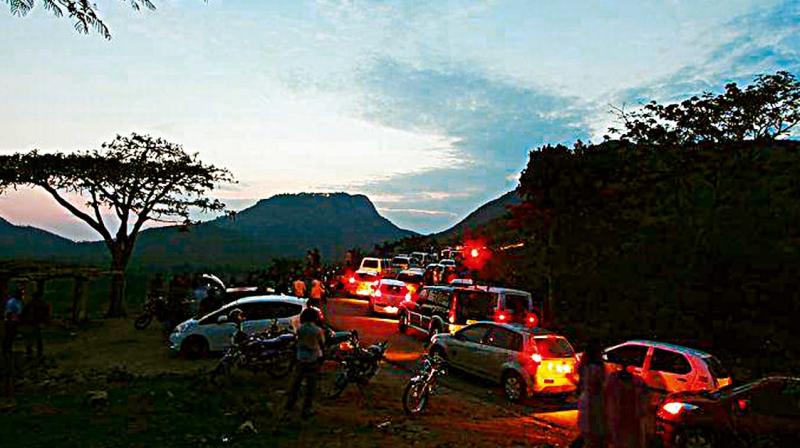
Normally I would 2nd this, but it does not apply on this particular 4x4 road. It really sucks when opposing traffic appears as it's barely wide enough for 1 vehicle in most parts:
The road gains 800 vertical feet (243.84 m) in 0.6 miles (0.9 km) at a 25% average grade, with steeper grades in sections. This is a paved public road but it is open only to 4 wheel drive vehicles. It is the steepest road of its length in the United States.
That doesn't seem that bad for normal traffic, conditions permitting - unless the steeper gradients are markedly so. I'm sure they have their reasons for 4wd only though - picking too many tourists out of the ditches or whatever.
There's quite a few roads in the UK with 1:4 gradient, and one just down the road from me at 1:3 whose only restriction is no trucks and vans. Going downhill on the motorbike makes it feel like you're falling off! :)
There's an annual charity event that involves the rolling of over 30,000 Jaffas (spherical confectionery-coated chocolate confectionery) down the hill.
There are roads in Spain with 1:4 gradient, too. 200 of the world's best cyclists rode up some of them in today's stage of the Vuelta a Espana. I'm no slouch cycling up hills but my jaw dropped seeing today's footage...
That footage is from a rally but every weekend, fwd cars with 800/1000cc engines and a peak torque of about 70 Nm do it just fine. Most of the cars have 2-5 occupants decreasing the already low torque/kg, and almost the whole climb is done in a bumper to bumper traffic(no momentum for the climb).
The Waipio Valley road, as I understand it, is mostly paved but extremely steep and narrow/twisty. So the 4x4 requirement is probably more about being able to control speed without burning up brakes and dealing with often wet conditions.
However, in the general case throughout most of the US West, "4WD roads" do indeed tend to be as much about having high clearance as about having 4WD per se. It's also just a way of saying that, if you just have a random rental car and aren't used to driving very rough and often narrow/exposed roads, this is probably not a good idea.
In Death Valley you rather need more spare tires (if you go e.g. to Racetrack; seen a car that got 2 punctures at different locations). Otherwise high clearance is needed only if you go off-the-beaten track; even Titus Canyon is fine on a normal road vehicle.
I've always wondered why this matters. I've got car insurance, I've got additional rental coverage on my credit card, and there are plenty of other vendors from whom to rent cars if you want to blacklist me.
Having violated this all the time I've been to Hawai'i I can understand why do they do that - for example, if you continue on the road to Hāna/Maui beyond, down to the southern side of Haleakalā the road becomes really dodgy, later turns into gravel and there is no water/gas for xy miles available, so for casual American tourists it might be pretty scary. Also, driving the north-western part of Maui is on a very narrow road over cliffs and fallen rocks (not as bad as parts of Tenerife though). I actually had an encounter on a pretty tall cliff where I was driving Subaru Forrester and some US female celebrity named Kim was driving the opposite way in even a larger car; we drove past each other with smiles in about 1mph to avoid collision and she must have been right on the edge with her car while I was almost scratching the right side rocks. Even Saddle Road between Maunas on the Big Island could be pretty demanding to casual tourists in fog and really slippery when descending down to Hilo in strong rain, which is like always (saw a crash once). There are also some scary roads on Kaua'i and O'ahu. In US it's so much easier to get a driving license than in EU, so your casual drivers are not used to fast and safe driving like in Germany, many off-road segments like in Spain or navigating chaotic situations as in 3rd world countries, and your society is generally on the safe side (even excessively so).
They probably don't want you taking a road you shouldn't, getting hurt, and then suing them because they didn't warn you about the dangers. Or they get tired of having all their cars smashed up. Insurance covers it, but it's still annoying.
Well, they still have trouble with you if you get stuck or wreck the car, so it is easier for them to just list the "forbidden" roads. Not sure, but your insurance might be void if you crash the car where you were not supposed to drive.
Also 4WD cars generally have a super low gear for crawling at low speeds & high torque whereas AWD cars usually don't have a similar gear. Low gear is critical on steep grades, particularly descending them so you can go down safely and slowly without riding your brakes and overheating them.
It was some US-made SUV (Ford or GM, can't recall which one) with fairly high clearance - I specifically booked it so that I can go everywhere (Waipio, Mauna Kea etc.). The road to valley was fine, it was also dry and the only possible issue could have been crossing a few streams at the bottom of the valley, but SUV had no problem there as well (clearance was sufficient). I experienced far worse roads on Tenerife while blindly following a route computed by then NOKIA maps that took me to super steep straight-up roads where my car ended up spinning all wheels unable to move up ;-)
>Generally a sign saying you need 4wd in the US really means you need a lot of ground clearance
The Subaru Outback (AWD) has 8.7" of ground clearance. The Ford Explorer ("Intelligent" 4WD) has a ground clearance of 7.8".
If "Intelligent 4WD" means some kind of differential, then it really is just a marketing term at this point, though I learned about the distinction between 4WD and AWD when I bought a Subaru.


The annoyed ranger was probably just tired of pulling stuck tourists out.