Roots? The reasons behind the design have all fallen by the wayside.
The need to keep weight over the rear tires to increase traction was killed off long ago by increases in tire performance and the development of limited-slip differentials. Design and market changes have rendered the once functional shape purely aesthetic. Today's cars are neither fuel-efficient nor speed daemons. And the engines are water-cooled. So the aerodynamic shape has lost it's function. If it is holding true to its mechanical roots, those roots are long dead.
So what's left? From a mechanical point of view it is a rear-engine car fighting to become mid-engined without admitting the change. The shape's only function is aesthetic. Anyone claiming its shape or design layout is mechanically relevant comes off like those poodle owners who insist the silly haircuts are to keep the dog warm while swimming. If you like the look then you like the look. Don't try to justify your taste with engineering gobbledygook.
The debate over whether mid-engine is superior to rear-engine is not an open and shut case. Although proponents of either camp would have you believe otherwise. The advantages of mid-engine are en vogue, so I won't repeat them here, but here are some advantages to a rear-engine car that are often dismissed:
Under acceleration, a rear-engine car has an almost absurd traction advantage over any other engine packaging configuration. For example, under acceleration, the 911 has a 74% rear bias, where the Cayman has a 67% bias.
Under braking, a rear-engine car has better weight distribution as well. Again, the 911 has a front rear distribution of 58/42 versus 64/36 for the Cayman.
I'm not nearly well versed enough in vehicle handling dynamics to hammer out a full-blown debate, but I have read very compelling arguments from both sides of the debate. I transisioned from the "mid-engine is the only compelling packaging format" camp to the "maybe the rear-engine format isn't completely insane" camp.
> Under acceleration, a rear-engine car has an almost absurd traction advantage over any other engine packaging configuration. For example, under acceleration, the 911 has a 74% rear bias, where the Cayman has a 67% bias.
Under acceleration, a rear engine car has an almost absurb traction disadvantage on the front wheels, too. There go your steering and braking.
Suspension design should be the main determinant of traction, not weight distribution. Hence other brands' insistence on neutral 50/50 front/rear ratios.
then again that's only relevant if you insist in using an absurdly sub optimal traction configuration.
longitudinal weight distribution is completely irrelevant for 4wd cars, where none of the listed advantages matter and all the disadvantages with handling do
yes, 4wd system absorb some additional power but that's largely irrelevant because:
- they can be active and only engage when needed
- they absorb some fixed amount of power that become marginal for a very high powered engine
- you're at wheel traction limit most of the time anyway at low speed, so absorbing power doesn't really matter
- at high speed power absorbed by a 4wd system is largely dwarfed by drag
longitudinal weight distribution is completely irrelevant for 4wd cars, where none of the listed advantages matter and all the disadvantages with handling do
Four-wheel-drive doesn't help when braking. Less weight on the front wheels (and thus more braking power on the rear) should make cars less likely to understeer.
either more weight increase grip or it doesn't, you are arguing both: the weight that you moved to the rear and allows to shift balance of brakes back comes from the front tires, reducing their grip by the same amount it increases rear tire grip
it does however increase the leverage of front tires on the car center of mass - but then that weight at the end makes getting the car straight after a corner an issue because for the same reason you get higher rotational momentum
The rear engine design of the 911 is still competitive in motor sports [1], as is somewhat befitting of the designation as a sports car. As noted in the article, the weight distribution gives the car a distinct set of cornering characteristics and experienced drivers are often able to employ them to competitive advantage.
The thing you have to remember about LMGTE is that, like most modern GT series, it is heavily governed by Balance of Performance regulations. Cars are handicapped so that there is relative parity between all of the models competing. This means a car being competitive doesn't necessarily prove the design's superiority.
The situation with rear engined Porsches is similar to the one with FWD touring cars. Sure with enough work you can make it perform admirably, but if you were starting from a clean slate you would never deliberately design a race car that way because you'd just be making things harder on yourself than you need to.
From F1 to the 24 hours of Lemons, all racing series are heavily regulated to make things interesting until someone crosses the line first. Even Green Monster had to have wheels not wings strapped to Art Alfons' turbojet.
Agreed. Another factor for the transition to water-cooled was because horsepower sells cars. Put simply it's thermodynamics: there's only so much heat an air-cooled engine can dissipate before it self-destructs.
To expand on that a little: The air cooled heads could not dissipate enough heat to support a 4 valve per cylinder configuration and the noise and pollution goals could not be met with air cooling.
Sorry, but this is wrong. An air-cooled (technically oil cooled) car has no problem with the transfer of heat. Porsche themselves ran the 917/10k with a flat-12 air cooled twin turbo engine that could make 1000hp reliably.
The transition to water cooling in the 911 was done for noise and emissions purposes primarily. A side benefit for them was the ability to buy off-the-shelf HVAC componentry and not have to engineer a heating system based on exhaust heat exchange.
It's very easy to get equivalent horsepower out of an air-cooled engine than the current water cooled models. There are plenty of air-cooled turbos pushing 600hp, and the Singer Vehicle Design 911 engines are producing 400 hp based on the original air-cooled 911 engine.
It's also the gigantic whirring fan on air cooled engines that is removed with water cooled engines which lowers the noise down significantly.
One of the initial engine designs for the 911 was a twin-fan engine. Apparently it made such a racket that the porsche engineers nicknamed it 'the threshing machine' and Butzi Porsche canned it on the spot.
I don't think I've ever seen a water cooled engine that doesn't have a radiator fan (or two). Older ones are crank driven, these days they're electric.
Sure, and the crank driven fans have been replaced by much quieter variable speed electric fans as you noted. These are also more efficient as they can be switched off during highway driving. There are also the thermo-couple engine fans where the amount of fan-clutch engagement is driven by engine heat. My other car has one of these and sounds horrendous when driving in heavy traffic on hot days, but is mostly silent all the other times.
But the big difference between a Porsche air-cooling fan and a crank-driven engine fan is that a Porsche fan is overdriven and much larger (diameter and blades) than a typical water cooling fan which is typically under driven and has fewer blades.
True (heat kills engines) but of course heat is a function of efficiency, how much of the energy in the gasoline is converted into mechanical energy versus the amount of energy consumed. So more efficient engines heat can deliver the same horse power with less heat, or more horse power with the same heat.
That's true, but there are hard limits to the heat conversion efficiency of an otto-cycle internal combustion engine [1].
Given two engines, both optimally designed to approach those limits, air-cooling is not as practical or as efficient as water-cooling. This means that for a given displacement, you'll hit the boundaries of air-cooling before you will water-cooling. If you want to continue to increase your power for a given displacement, you have to find a way to dissipate the wasted heat energy. That leads you to water-cooling.
It's not that water cooling is that much more efficient, but that it scales more easily. With air-cooling, you have limited space around the cylinders for cooling fins. The head is particularly problematic because of the valve gear. With water-cooling, you can increase the dimensions of the radiator in three dimensions to improve heat dissipation capabilities.
Since you seem to know a lot about rear-engine cars, perhaps you can clear something up.
I've often seen air-cooling listed along with what you did as benefiting more than water-cooling in a rear-engine layout, but that never made any sense to me. Is this a myth, or is there any sense to it?
An air-cooled engine willing to run at much hotter temperatures doesn't need, cannot use, a big drag-creating radiator at the front of the car.
But once you put the engine in the back, there are all manner of advantages. You can get rid of the driveshaft (weight) lower the hood (visibility) and be more creative with shape (aero). For Porsche it was all about reducing drag. The original even had covered wheels.
> An air-cooled engine willing to run at much hotter temperatures...
Are they "willing to run at a higher temperature?" I feel you're begging the question, but I'd be delighted to be shown I'm wrong. The engine has cooling requirements, and they're met by careful ducting and a fan that the engine runs directly, or indirectly.
VW Beetles and early buses ran a fan off a generator or alternator via a belt from the engine, and VW type 3 and 4 engines (and at least later, if not all air-cooled Porsche 911s, (and 912s?)) are run off the engine crank. The engine needs to be cooled, needs airflow (ask a knowledgeable BMW airhead motorcycle owner). So, "why not put then engine up front" could be answered with "we've contained all cooling requirements in the engine itself, so we put it where we want."
As I read more about this there are lots of interesting considerations[0]
but I don't see "willing to run at a higher temperature" as a consideration, yet.
If you want to get all definitional, then one might say the porsche/VW were also liquid-cooled. They had oil which did move some heat around. So the line is really whether or not the engine has a separate cooling loop, usually filled with water.
There are a couple different temperatures to speak of. There is the overall engine temp, which may well be very similar to a modern engine. But there is also the temperature of the cylinder walls deep inside. An air-cooled engine relies on metal to conduct heat away from the heart of the engine. A water-cooled engine puts a pipe of cold water right alongside the cylinders to physically move heat away. So the internals of an air-cooled engine go through a much wider temperature range during normal operation. With differential metals that means gaps... gaps between the cylinder wall and the piston. That in turn means increased wear and emission-related problems. An air-cooled engine is willing to suffer these issues for the advantage of decreased weight and complexity. An air-cooled engine not willing to suffer this internal heating would be a very slow and heavy engine.
Having a hotter cylinder wall can also impact choice of fuels (need higher octane) and compression ratios (need less) as the hot walls might ignite things before the spark.
  In 1969 on the 911S, a front mounted radiator-style cooler
  was mounted as standard equipment in the front right fender
  well. In 1973, the newer trombone, serpentine, loop or
  cooling pipe cooler as it was called, replaced the radiator
  style cooler. This style of oil cooler was used through 1983.
Ha! What the hell!? The 911 never actually was a purely air-cooled car, like the Beetle?
And now that I check wikipedia, I learn that the Beetle also had an oil cooler! My god, I've been living a lie.
Except for those engines that don't use oil. (Think toy airplanes.) And oil coolers are also found in some water-cooled engines. My old bike (2000 Honda VFR800) used both water and oil-filled radiators.
Toy airplanes do use oil, it's just mixed in with the fuel.
Many water-cooled cars do have an oil cooler, but it's not the primary means of cooling the engine. In those cases it's more about keeping the oil at a constant temperature.
Oil cooled cars have sump capacities 2x water cooled cars.
Good thing you checked Wikipedia :) I was just about to point out that VW Beetle motors had a smallish oil cooler in (or near) the fan shroud at the front of the engine.
You eliminate weight and complexity by using air cooling. No water pumps, radiators, expansion tanks and ~6-10 L of coolant. The water pumps use power from the engine, the casting of the water jackets results in a heavier engine, and the radiator and coolant all add weight.
In the case of a rear engined car, eliminating water cooling helps even more because of the need to transport the coolant all the way to the front and back again. Mind you, Porsche eventually accepted this compromise, and to be fair, they were already doing it for oil lines.
Absolutely. Porsche's own Cayman shows what the 911 should be (although in a bit smaller package). But purists demand the 911 to only be updated, not re-designed. It is their halo car and won't change it. Still, even though the design is now obsolete, the cars are still wonderful. One can jump from 911s of various eras and notice the improvements. If you drive a 930 (911 Turbo from 1975 to 1989 https://en.wikipedia.org/wiki/Porsche_930) and then drive a 993 Turbo (911 Turbo from 1996 to 1998 https://en.wikipedia.org/wiki/Porsche_993) you can feel the difference. The 930 is crude and unforgiving. With turbo lag measured in seconds. I remember counting to three before the turbo kicked in and slammed me into the seat back. Driving it requires cojones because the rear of the car will go around if you lift or break mid-corner. Its not a car for the faint of heart. Now, the 993 Turbo is a tamed sheep when compared to the 930. It features a coil spring suspension in the rear that absorbs bumps much better than the torsion bar version found on the 930. The 993 Turbo is a four wheel drive vehicle. The system does wonders for its driving dynamics. You still shouldn't lift or brake mid-corner, but now the car is more forgiving since the front tires are desperately trying to carve into the road. I've personally taken corners at around 90MPH on a 993 Turbo (racetrack driving) and the car inspires confidence.
If you are looking to buy a Porsche make sure to figure out what you want to do with it. if you are just going baby it and admire it with a beverage of your choice in hand then any version is fine. If you plan to drive it on a daily basis then a newer model is required (the A/C on the air cooled versions down right sucks). Performance driving? Anything from the 1999 and forward will do because its a much better chassis. Racing? Get yourself whatever GT3 (https://en.wikipedia.org/wiki/Porsche_911_GT3) you can afford. All of the above? Then buy a newer model.
Turbo or no turbo, that is the question. Turbo models require more maintenance and leak more oil than regular ones (all Porsches leak oil). The power delivery depends on the year you buy, but on newer models its pretty good. The problem with the turbo is that you can easily add in more power by raising the boost (increasing the amount of air being forced into the engine). But this requires the amount of fuel to be increased as well. You can safely increase boost by a couple of pounds, but once you want to really get serious, multiple upgrades must be made. Including the transmission, clutch, wheels, and lots of support equipment. Its not unheard of to spend about twenty thousand dollars on simple upgrades. A friend has about two hundred thousand on his (800HP beast of a car). It all depends on how deep your pockets are.
Few people understand that, in a turn, the throttle is the most accurate and delicate steering control (and, from my point of view, the only one you should use). And, on a car with a bit of mass biased towards the rear it works opposite what people are used to with front-biased cars. Accelerating (or not decelerating) around a turn isn't "natural" until you understand why.
I've always found it enjoyable to understand the dynamics of these cars. If you can swing it, doing Nürburgring on anything with decent performance is an absolute blast.
> And, on a car with a bit of mass biased towards the rear it works opposite what people are used to with front-biased cars.
What do you mean? Why does the weight distribution result in "opposite" throttle/brake response when cornering? I don't think it does.
All cars behave the same when accelerating or decelerating in a corner. Throttle moves the weight to the rear wheels inducing understeer (until you overdo it and you get power oversteer) and brakes move weight to the front inducing oversteer (until you lock up and get understeer). It doesn't matter what the engine layout looks like or what the weight distribution is.
It's certainly true that the weight distribution in a rear/mid engine car feels different but only because the center of mass is in a different place. Once the rear gets sliding, it's feels really aggressive because there's more mass going (like driving a hammer, handle first) but with some finesse on the controls it can be balanced out. Most purpose built racing cars have engine behind the driver (and center of mass near the driver's ass) to allow extracting the most grip out of all four tyres, given enough driver skill.
You had it: Center of mass. Think about the forces on the front and rear tire patches as you navigate a turn with subtle throttle modulation.
I am not talking about gross control, only fine control.
It's like sailing without using the rudder to make fine course corrections. Not a perfect analogy but it is about balancing forces.
Another thinking tool: Imagine a dumbell where the weight of each disk isn't the same. One is 5lbs and the other 10lbs. It's a 15lbs dumbell but it is unevenly balanced.
Attach a cable to each disk. Now start spinning it with the heavier disk in front. Then do the same with the heavier disk in back. Think of acceleration and deceleration and the resultant torque about the cernter of mass.
"Few people understand that, in a turn, the throttle is the most accurate and delicate steering control (and, from my point of view, the only one you should use)."
His point is that by modulating the throttle you can move the weight of the chassis around. Doing so affects how the vehicle steers. The statement is a bit exaggerated but nonetheless based on facts. It all depends on the car you are driving. Sometimes the brakes do more than the throttle during a turn.
You enter the turn with the steering wheel. Once setup you control the turn with throttle (or braking) and how the car behaves is related to, among other factors, mass balance.
To be clear, people talk about "weight transfer". That is not what happens at all. Weight transfer would require masses within the vehicle to move. What does happen is that the resultant vector of all force vectors acting on the vehicle shifts to have a forward or rearward component depending on what the car might be doing. At a basic level it's about good-old F = ma. There is no weight transfer in the strictest sense (unless you have a super loose suspension with four feet of travel or a partially filled fuel tank).
So, in a very direct sense, driving is about manipulating force vector directions and magnitudes through acceleration (the physics kind, meaning in any direction).
Accelerating through a turn does not shift weigh to the rear. No significant mass transfer takes place while accelerating or braking. We say "weight shift" because that's the way it feels to the driver, but this is not what's happening.
When accelerating forward during a turn you are increasing the force vector at the point where the tire contacts the road. This results in increasing forward velocity around the path the car is travelling. Since centrifugal force is proportional to the SQUARE of tangential velocity a mass imbalance to the front or rear can have a very different effect on car dynamics.
A rear-biased Porsche 911, on deceleration around a curve will be subjected to a torque about the center of mass that has the rear end pulled towards the center of the travel arc. A car that is front-biased will do the opposite, the resultant torque will pull the front towards the center of the arc being negotiated.
Because of the square relationship to tangential velocity and the "unusual" dynamics of a rear-biased 911 people who do not understand the physics involved get into real trouble while negotiating turns at speed. If you decelerate quickly this square-of-the-velocity related torque about the center of mass will spin you in a microsecond.
Of course, there's a lot more to it, such as suspension geometry and tire patch dynamics, yet the fundamental physics are not that complex and can have major effects on what a car does during high performance driving.
The throttle is a major influence in turning because of it controls acceleration and it's relationship to dynamic forces is proportional to the square of velocity.
EDIT: Corrected friggin iPad-induced typos.
Also, to complete the story: When you exit the turn you exit with the throttle first and then the steering wheel. In other words, on a front-biased vehicle you can start to feed-in throttle somewhere past the apex to use the square-of-velocity torque relationship to start to carefully straighten your motion path while not really moving the wheel. At a certain point you start to release steering pressure to smoothly transition into a straight path. If all of this is done smoothly it feels amazing.
The Cayman is missing the rear seats of the 911, which still drive sales more than 50 years after Porsche decided that their new model would be a 2+2.
Sure the seats are small and mostly useless, but they do increase the ability to use the car on a day to day basis.
There's little doubt the Cayman can be a better car (in part because it hasn't gained mid-life flab, but also because it is mid-engined) If Porsche still built a small, nimble 911 it would be much like the Cayman. But as the range-leader, it had to grow bigger and bigger and now does not resemble the market space the original model occupied.
The AC on the 1990 onwards cars is OK, and it can be fixed with aftermarket parts on the earlier cars.
Drove the 991 911 and it was very safe. Had all the electronics turned off and had to step on the throttle real hard to provoke it to slide on a skid pan. I was not really impressed with how it drove compared to my wife's E92 M3. The Cayman/Boxster, on the other hand, was pure joy and I've been lusting after one ever since. Even though it was down in power the car was easy to get into a slide and you can hold it there for hours at a time. Definitely going to try to own one someday.
It also provides a smaller frontal cross section, the flat-six engine provides a lower centre of gravity, and the packaging allows a 2+2 layout when most of the competitors (front, front-mid and mid-engined) are only 2 seaters.
The reasons for the rear engine was not primarily to increase traction - it provided simplicity, lightweight and better packaging. The simplicity and lightweight have fallen by the wayside but the packaging still remains. The 911 remains a car which is practical to use as a daily driver.
Throughout this article and many others in the substantial volume of articles written about the 911 talk about 'the purists' in disparaging terms, as though they are some unappeasable group. 'The Purists' are a straw man that must be run through before a model can introduce changes.
It's more than a bit disingenuous, though.
'Purists' never complained about going from Torsion bars to coil-over, or from k-Jetronic (CIS) to Motronic, or even lengthening the wheelbase and using aluminium suspension parts. 'Purists' never complained about extra power or displacement or bigger brakes.
The reality is that regulations are what have driven most of the changes - from the body structure to the engines and electric steering to things like the rear bumper height. Everything from Targas to impact bumpers, exhaust thermal reactors and catalytic converters, flashing seatbelt lights and quiet inductions and exhausts are not done because that's what the buyers want, but because that's what the Ralph Naders of the world want. Maybe they're necessary. That's not the point. The 'Purists' are just those people who point out that these things haven't necessarily made the car better.
Funny how the 'Purists' these days are more likely to want a Singer than a brand new 911, because the Singer is a small, light car with a modern efficient engine and big modern brakes and suspension. In fact, if you list the differences between a Singer and a new 911, you get a list of all the things the 'Purists' have simply pointed out haven't necessarily been changes for the better.
So enough with 'the purists' already. They're just an imaginary group made up to skip over the fact that some change was actually for the worse when it came to the primary purpose of it being a sports car.
Amongst 911 owners the 'purists' are those driving machines that do not have room for golf clubs. Any golf-capable Porsche is a compromised vehicle unsuited to the name.
Some 'purists' in a local Porsche club with whom I chatted a few years ago actually preferred the front-engined 944 and 968 when viewed as pure sporting cars. Perfect balance and spot-on handling ( though I have never driven one ).
But strangely many of them still lusted after a 911 as a challenge, to try to tame "the beast".
There is no question a well sorted 944/968 can out handle and out race a 911.
It's not just the challenge of driving - well, they are very different in many different ways, and that's the sort of thing people like when it comes to making a special purchase. A 944 is very conventional in comparison, even if it does have a rear mounted gearbox.
Heya. I'm the editor of Ars Technica UK, where this story was originally published.
It's not native advertising. The author just really likes the 911. Ars doesn't do native advertising/advertorial. We do some sponsored stuff, but those posts are clearly marked.
Is there somewhere on Ars' website where I can read the "Ars doesn't do native advertising/advertorial" policy?
As a jaded, cynical reader, the trap I fall into is that if content clearly marks itself as an advertorial, I know what I'm dealing with and can take it with the appropriate grains of salt. On the other hand, if content that seems advertorial comes from a site I normally trust, but with no markings at all, I'm left wondering if it's a benign "I just really love this thing and wanted to write about it", or if it's a really clever native ad invading another space that used to be on the other side of the wall.
What I'd love to see from Ars and other responsible journalistic outlets is a) a policy about native advertising that's easy to find and b) at the editor's discretion, if there's an article that may seem particularly advertorial-ish, a pre-emptive disclaimer that says "Hey, even if this seems like native advertising, it isn't. Here's a link to our general advertorial policy, and here's a link to the author personally gushing about how much he or she loves the Porsche 911 and talking about why they wrote this article."
And yes, I know that it sucks that you guys, as responsible journalists, have to bear the negative externality of irresponsible journalists publishing "18 insane things you wouldn't think the Toyota Tacoma could do...#7 will blow your mind".
Yeah, I don't think we have such a public statement at the moment - and maybe that's something we should rectify. All I can tell you is that native content/advertorial would be very, very clearly labelled. We would never try to sneak anything through.
In general, Ars is _very_ above board. Our reputation and authority are everything. That's why we're one of the very few publications that doesn't do native advertising - we're just not sure how you can do that, and still somehow expect the reader to trust what you write.
But yeah, I appreciate that just saying "trust us!" is a bit difficult on the Internet today :)
If you skim through the comments on what they're calling "Cars Technica" articles, you'll find heavy criticism (especially on the earlier articles), some of which is along the lines of native advertising or sponsored content allegations---not helped by Porsche and Audi being advertising partners. The Ars writers and editors are however on record saying that they are absolutely not using native advertising or sponsored content (except when there is a clear banner declaring so).
Personally, I find that the further Ars gets from it's traditional domain of computers and consumer tech, the worse the quality of the article. In the case of the automotive articles, I don't think the editors or writers have sufficient subject matter expertise to write the well-informed articles that are common for Ars' computer and consumer tech coverage.
Also, I think there's a genuine issue in journalism / online readership that remains to be addressed - the prestige payment scale.
Basically my view is that internet hosted articles are a low form of journalism, so it's reasonable to expect UPROXX to get basic facts wrong XX% of the time, or a Huffington Post author to employ fallacies here and there to support a position, or some other kind of issue where quality and integrity are at odds with driving traffic. It makes for good training though. That's when it's possible to advance to the next tier.
An Ars Technica or Engadget is above the basic tier, but only in the sense that they have a better reputation, drive more traffic, and therefore pay better. The usefulness of this tier varies - those with chops will continue to develop. Eventually, a featured writer or contributor will become known for their work at the site.
Then comes the top tier, the legacy media outlets that are forced to compete with the lower two tiers mentioned. They are at the height of the prestige and pay scale environment, at least in theory. I've seen several authors move from 2nd tier outlets (Ars Technica, DealBreaker) up to the 1st tier (Washington Post, Bloomberg) which look like the reward for many years of developing a journalistic style, reputation, and pool of knowledge to weave into works as a whole.
I think it'd be a pretty worthwhile review of careers for authors in certain fields since a 20XX time until the present. Unfortunately I don't have the free time or interest to do it myself. It's just a musing, I suppose.
You can expect pretty much any of the automotive coverage (I'm not singling out this author in particular) on ArsTechnica to be essentially native advertising. Auto makers carefully parcel out access to their products and materials (all the photos in this article are helpfully credited to Porsche) to publications they can expect favorable coverage from.
Native advertising, or just a couple people in the office who own Porches and really like the cars. Bias can be internal. They are nice cars. Mechanically ridiculous imho, but lots of people just like them. Some of those people write about it.
/*
Native advertising, or just a couple people in the office who own Porches and really like the cars. Bias can be internal. They are nice cars. Mechanically ridiculous imho, but lots of people just like them. Some of those people write about it.
*/
I think this might be it.
The article is hard to distinguish from advertising, but also journalists can fall for the wrong car.
The 911 is not about rationally thinking through the pros and cons of the technology. It is a lifestyle product that sells to drivers who want to buy an image. A rational discussion must lead to error and end in /dev/null.
This or any car related article/site/TV/Web show is native advertising (but not like Buzzfeed native advertising) because author probably in one camp. Some examples: Porsche, Ferrari, Muscle Car, European, American, Japanese, Modified, Old School Cars.... If you dont know the scene just dont comment like it's Buzzfeed piece!
Agree, and is interesting. Porsche seems to face currently the multiple problems of being an expensive car with a little dated design, ridiculously inflated maintenance and repair costs, that drinks a lot of fuel in a world plenty of speed limits and that, well... is a german company.
Is having a Porsche a positive symbol and chick magnet currenty in Greece, Ireland, Portugal, Spain, France, UK... or is more a sort of middle age men's embarrassment?
Maybe lots of advertising and community managers could fix the problem again. Maybe they just had passed their prime time. Who knows?. I personally do not want this car.
Smell? The whole article reads like one large implicit "this is paid content" disclaimer. Which is so much better than the usual camouflage of hiding the ad behind some toothless faux-critical negative paragraphs to tick that "balanced" checkbox.
If you're reading a blog post about a product, use the rule that the maker/distributor of that product was involved in the production of the blog article, unless you have compelling evidence to the contrary.
ARS Technica and Anandtech are BYTEs of our era. Some kind of balance btw hardcore and popular/easy-to-read. I never experienced that. Having said that..
I really couldnt get what you wanted to say! That title is true regardless of the piece is adv. or not. Still same sporty beefed up Beetle philosophy. So what??
One of my (bigger) regrets is not purchasing a '64 911 with a blown engine in 1982. It was a California car (with no rust which is rare here in central PA) and the paint was horribly faded but completely intact. As an 18 year-old, I couldn't fathom spending $2000 on a car with a blown engine. Now that I'm a bit older, and have rebuilt several cars from scratch, I wish I'd taken the plunge - back then you could rebuild a VW or Porshe engine for well under $500 in parts.
The new saline spray is horrible ... it will eat cars that were impervious to the rock salt and aggregate they used to spread. I'm looking out the window at an almost pristine '71 Super Beetle that will be going back into the garage for the winter sometime in October.
Where in PA are you? I wonder if we can create an HN meet-up this far from Silicon Valley.
Oh man, I grew up in Central PA (Chambersburg). I now live in DC, but I get back to see my parents very frequently. Find my email in my profile and keep me in the loop if you do this.
I've recently been playing the old Need For Speed: Porsche Unleashed, which made this a really enjoyable read, and actually a bit useful for what it says about the handling and weight distribution of different models.
Of all the classic games that I wish would be brought to modern specs that's it.
For those not indoctrinated Its a love song to Porsche, you drive and race every model from inception to late 1990s.
It still holds up pretty well and it's amazing the detail they put into cataloging cars, upgrades, etc. - every car and generation feels completely unique.
Ah, the memories! I still remember getting 1:52 (I'm pretty sure it was either 1:52 or 1:27) in Pyrenees (IIRC, snowy track with rocks protruding on the road) with flat tires and the Carrera RS, beating the 'standard best time' by quite a bit. And every time I play a racing game on my iPad I ask me why we don't get as much quality as NFS:PU had.
the only "snowy track" is the Alps. Pyrenees has a lot of white gravel next to the road, which might be what you're thinking of (but there's also green grass, dry pavement, and fall colors on the trees.)
I wonder if there's a framerate issue or something that makes times not really comparable system to system. I can run that course in about 2:15 in much faster cars than the Carerra RS (2000 911 Turbo, GT1, 935, all carefully tweaked/upgraded) -- with an analog racing wheel and tons of practice. I've seen youtube videos of people coming in at around 2:05 in those cars by running insanely tight lines. I can't imagine how you could be even faster than that in an RS, with a top speed that's slower than what I take most corners at in my GT1.
And yeah, it's a hugely high quality game, particularly for the era. It was clearly a labor of love. I've got a handful of games from the 1990-2000 era that I still play because nothing else captures the magic quite the same -- DooMII, Descent, and NFS:PU.
I think it was Pyrenees anyway, maybe the snow is my faded memory indeed. I have no idea how I managed to do it, aside from running extremely tight lines and not braking (or actually, stopping the gas) for the entire track. I used a Microsoft Sidewinder gamepad, it had a gyroscope so it worked wonders for racing games. It might be a framerate issue (I played on a P2 with some GeForce, not sure about model.)
If you appreciate great engineering as well as design, any one of the air-cooled cars is a remarkable car. I think most will agree however that the 2.7L engine was a low point in quality.
Yes, many completely ordinary cars today can match or out-accelerate a lot of the older cars mentioned in the article but that is only a single measure. If you're a "car person," you owe it to yourself to spend some time driving a 911 so that you can truly map that image to a physical experience.
That said for the 911, each of the cars that enthusiasts tend to love has its own character. You can give them all very similar performance specs on paper and driving something American, Italian, or German will still be a completely different experience; overall, the fastest car will not necessarily even feel the fastest; the slowest car that you can consistently drive the hardest might prove to be the most fun to drive.
I have a vintage 911. It is fun as hell when the thing is running right, but it is never running right. Even the years they call "bullet proof" don't hold a candle to the reliability of a modern Japanese sports car (which I've also owned).
When you start to pull the car apart you see all the hacks that had to be done to modernize the car to keep the original chassis design alive. My favorite is the air conditioning. It is obvious that air conditioning was not part of the original design. Another favorite is the oil cooler under the front fender. There are oil lines that go all the way from the back of the car to the front just for cooling. The original car didn't have them because the engines were much smaller and ran cooler.
If anyone is considering buying an air cooled 911, I'd say unless you've cashed out a bunch of stock that is blowing a hole in your pocket, stay away. With the current cost of parts any common problem with the cars could easily be a $10k fix. Ask me how I know.
For me it was a Subaru STI. I enjoyed it more in almost every way than the Porsche, other than how it looked. My father has a nice 90s Miyata. I've driven it quite a bit and for the money it is a pretty well thought out and fun vehicle. He's got less into the whole car than I have in my Porsche engine and trans.
They discontinued it for the most basic reason any company stops producing a low-volume product: the demand just wasn't there. And it still isn't as much as predicted, as is evident by the slightly underwhelming sales of the Subaru BRZ and Toyota FR-S/86.
Thanks for commenting. Yes, the A/C is useless (pre-1984) then almost useless until the 964 and the 993 got it right.
As for a $10K repair bill, it's certainly possible, especially if you recently bought the car and/or get hit with some internal engine/trans problems.
These air-cooled 911's seem to be worth keeping on the road at least. There are many examples of other still high-end cars that just depreciate relentlessly until the last owner gets hit with a repair bill that's more than the car is worth and it goes to the junkyard.
I found myself thinking something today that I've thought to myself before when looking at a particular car. It basically boils down to, "I can't believe how ugly they made the Gen Current Mustang. I mean, I guess I shouldn't be surprised, the Gen Current - 1 has the same problems. But the Gen Current - 2, now that's not a bad looking car."
Repeat for the last 15 years.
There is a certain continuum of conservativism that one brings to their appreciation for fashion. Some people want ever-lasting stability. Some people want to understand what they have on their hands. And some people want to immerse themselves in the bewildering stream of ever-changing trends.
I see some merit in each. Ultimately, I'd like to be most comfortable in that river of change, but hell, I got work to do.
What's missing from most cars today, and most drivers experiences, is a manual transmission. I hadn't driven one in about 15 years, and when I decided to buy a sportier car for fun driving, it was really hard to find one in my (cheap) price range. Are cars with the paddle shifter thing anything like a clutched manual transmission? It always seemed to me that they were just throwing software into the mix.
You can get a used Cayman S with six speed manual transmission for under 30k USD nowadays, if you're still looking. It's mid-engine as well, so it has better weight distribution than the 911. It's a shame that they have to gimp the Cayman platform so it doesn't take away sales from the 911, though.
The 987.1 (pre-'08) Cayman S that you'll find for under 30k is plagued by the IMS bearing issue that ruined 996 prices and early Boxsters, though. I'd spend ~40k and get a 987.2 instead. It'll hold value enough to make the price difference worth it, and even if a low percentage of engines actually fail, the peace of mind is very nice to have.
Plus they fixed a lot of other issues (better air-oil separator, more oil pumps, power steering heat soak) that will crop up if you ever take one to the track.
Overall I agree, though, it's a shame they keep holding back on the Cayman to keep the 911 on top. The 911 is an amazing car but there's no reason they should need to keep hacking around physics to keep the rear engine dream alive.
I think the IMS issue may make the 987.1 Cayman and 996 911 cars some of the best deals out there today - it seems like the IMS issues don't affect too many cars (and the issues may have been over-reported on Porsche forums), and there are solutions like the IMS Guardian (http://theimsguardian.com/) to detect IMS failure before it happens.
To me, a 996 sounds like a great deal today because prices are driven down by people who don't like the IMS issue and the egg-shaped headlights.
I'm wondering if early Boxsters and 996s might be good values now because there are fixes for the IMS bearing issue on the market. I've read it can be done with a clutch job.
Totally agree. There's nothing like the feeling of dropping down a gear and hearing the machine come on boost. That whole experience alone is a pleasure to drive a manual.
Magnus's collection is beautiful and I love his aesthetic, but I can't help but think it is the ultra wealthy buyers who own a dozen 911s who are driving up the prices into the stratosphere. It might be sour grapes, but honestly, how many Porsche's does one guy need?
There's not really enough ultra wealthy collectors to buy up the sheer amount of stock.
It's part fashion, it's part bubble, it's part QE. But the people driving up the prices are just regular guys buying the cars they've wanted for a while. Once supply dwindles, price goes up and creates a positive feedback loop.
It will all calm back down in a few years, where values will stay is anyones guess.
In my opinion I think it's generally the hipster crowd latching on to a new cool. It happens to every sub-culture. Obviously there is a limit to the supply of old things but I think you will find that once the new shiny cool of vintage old stuff dissipates the crowd move on and guys like Magnus are still there decades later doing their thing.
The custom motorcycle scene is a good example of this. So much new stuff flooded the market and everyone, including the new guys got bored. The shift to the old vintage and "garage" built stuff became the new hotness and now the old guard are having to pay stupidly high prices for half a cracked case and two burnt out pistons.
New comers with money buy up everything. Eventually though, either they don't have a clue what they are doing and/or give up soon after and just store the shit with the other failed quarter/mid life crisis dreams.
The fact that you've attached "hipster" to anything involving internal combustion engines means that you're just using "hipster" to mean "the other", like how neocons use "communist" or neoliberals use "fascist" to refer to each other.
I do think there is a subculture of "hip" motorheads. Look at Zeitgeist (bar in SF) for instance. I think Magnus is someone who qualifies as being able to push fashion trends.
Like brc said, the guys who had Porsche wall posters in high school in the 70 and 80's finally got wealthy enough to afford their dream cars. I think something similar happened with the muscle cars. Once the prices started to climb, then other forces also came into play as well but it was the initial yearning for the dream cars of their youth that started it I think.
pg has mentioned the 911 (at least the vintage versions) in his essays about good design, which usually is timeless. While the upcoming 2017 revision will be disappointing to me due to ditching the naturally aspirated engines in all but the track (GT3) cars, here's to another 50 years of 911.
I can't find the quote to link to, but back in the 90's Harm Lagaay (head of Porsche design) was asked why the doors hadn't changed in 30 years. He said "It's a good door."
One of very few sports cars left available in a manual transmission. (And I know, automatic and clutchless manual transmissions are really good now, but if I got a 911 it would mostly be for fun, and I find manuals more fun. I totally understand if you feel differently.) Anyway, it looks like another though is the new 2016 Jaguar F-Type. They're actually adding a manual option for 2016, which you don't see too often! (My F-Type would look like this [1]; sadly their links aren't as pretty.)
As an aside, I think the Jaguar does a better job with the two-tone colored interior. You want accents, but not to be punched in the face with redness (as a punch in the face would often be, I guess). The Porsche actually has an even redder option than this, where basically every surface is red. :/
Perhaps this deserves a post on the new AutoTempest blog[2]...
Toyota GT86/Subaru BRZ are fantastic cars that can be bought with a manual transmission, for those with shallower pockets. Still, would really recommend.
Oooh and the GT86 comes in a convertible^! Nice; thanks for sharing. My first sports car was actually a 1990 Toyota Supra Turbo Targa, so the GT86 has a bit of a sentimental bonus for me too. To be clear, as much fun as it is 'building' brand new 911s and F-Types, if I were to ever buy one it would probably be a few years old. At the moment I'm quite happy with my 2003 Z4 3.0i.
^Edit: looks like the convertible is actually just a concept at this stage. Still, perhaps soon!
GT86/BRZ are getting very very popular because they are cheap and offer something that was hard to get for years now - no-nonsense performance and handling, without lots of fancy tech. Simple, 2.0L naturally aspirated Boxer engine, rear wheel drive, fantastic 6-speed transmission. And then you can start working from there, if you have the dough to spend, or if you don't then it's still a superb car which is incredibly enjoyable to drive.
The purists just want to make sure that 911 continue its nickname of widowmaker.
911 is a very beautiful and legendary car with good heritage but it is known to kill people.
I'm glad for the regulations and car have been much safer than ever. I think if you want a track then you should buy one not a civilian car that can take you sideway cause you've managed to push over your driving limit.
A bit off topic, but it was nice to read this name, a fellow who was the topic of some great articles in Sports Car (not cars) Illustrated back in the late 80s. If you ever get a chance to read them they were great fun.


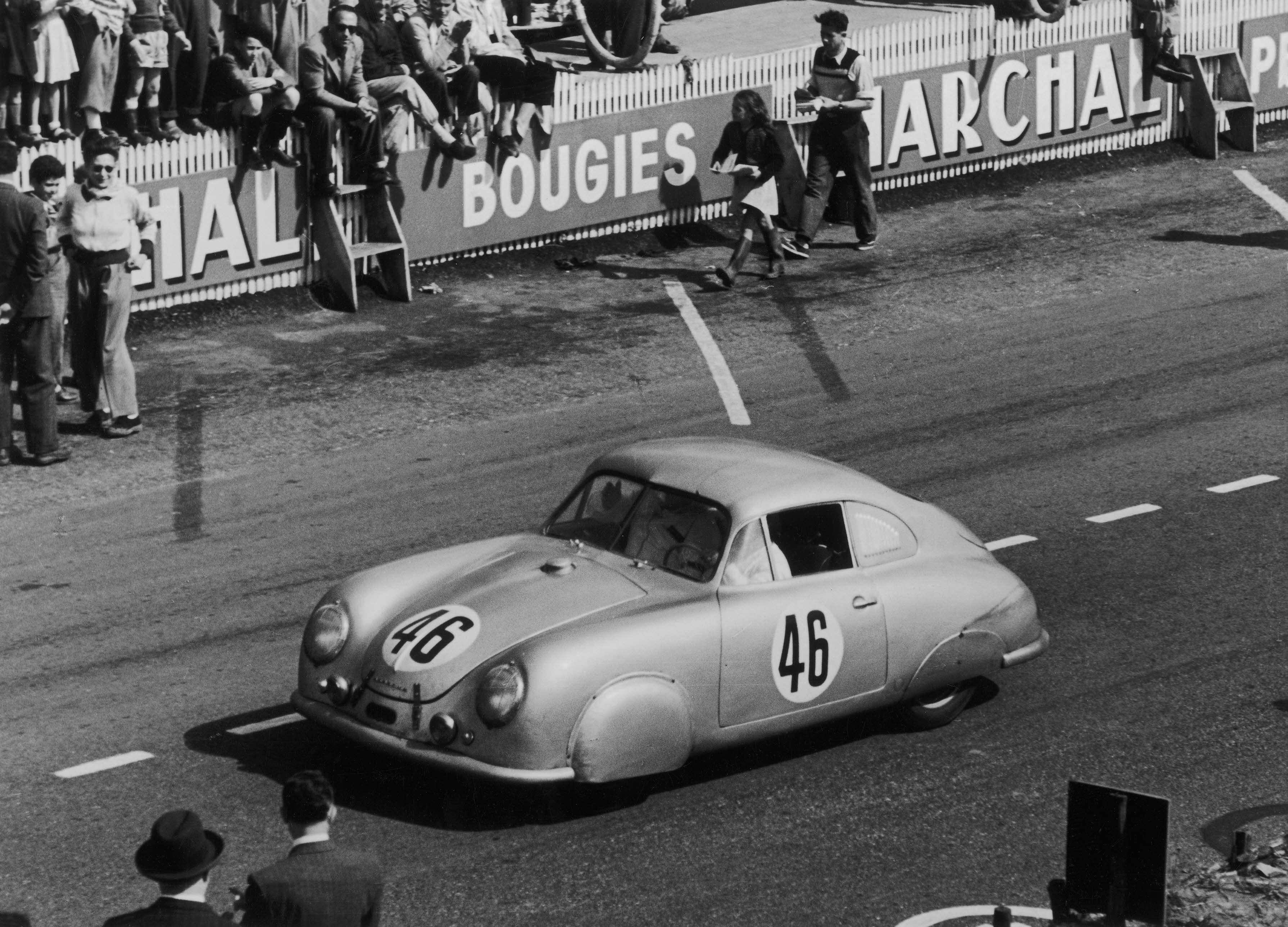
The need to keep weight over the rear tires to increase traction was killed off long ago by increases in tire performance and the development of limited-slip differentials. Design and market changes have rendered the once functional shape purely aesthetic. Today's cars are neither fuel-efficient nor speed daemons. And the engines are water-cooled. So the aerodynamic shape has lost it's function. If it is holding true to its mechanical roots, those roots are long dead.
So what's left? From a mechanical point of view it is a rear-engine car fighting to become mid-engined without admitting the change. The shape's only function is aesthetic. Anyone claiming its shape or design layout is mechanically relevant comes off like those poodle owners who insist the silly haircuts are to keep the dog warm while swimming. If you like the look then you like the look. Don't try to justify your taste with engineering gobbledygook.