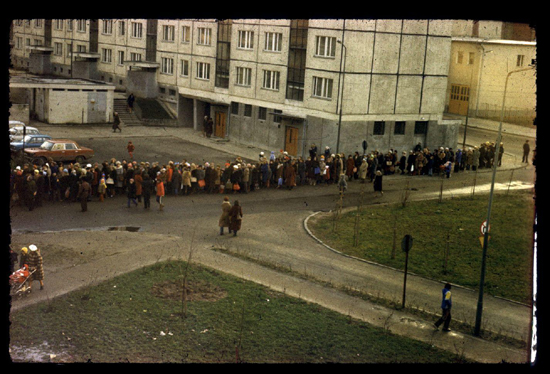
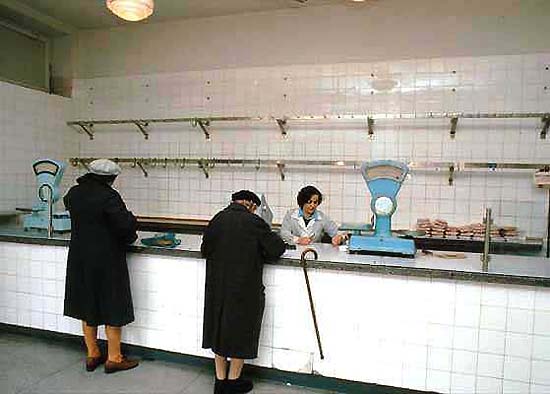
Growing up with my grandparents in the 80s in Moscow, I remember standing in line in front of a place literally called 'Store' for hours. Nobody knew what the line was for or what it was the store was getting in that day. Some people spend the night waiting just to be in front. After standing in line all day, finally by dusk a truck pulls up. Everybody looking in anxiety and worried about not being enough merchandise, still not knowing what was inside. A few men start unloading the boxes inside the store. All of a sudden people at the front of the line start spreading the rumors, "it's bananas!", "what is a banana?" I thought to myself. I was 5 years old and had no idea what it was. We made our way from outside, into the store. The store was full of empty shelves, there was literally no inventory. Finally we got the cashier, it was our turn and my grandpa got handed a big box and he handed the clerk money. "Hurry" my grandpa said, we rushed out of the store and started walking back home. "There's no more!" I heard somebody shout out of the store. There were still at least a hundred people in line. We kept walking, not looking back. We got home and opened the box. It was full of green bananas. We tried to eat them, I loved it. Only later in life I found out bananas supposed to be yellow and not bitter :)
Yes, indeed, the "магазин" or the "гастраном" :) I also still remember the experience of having to bring a 3 liter pickle jar to buy milk from a barrel on wheels. It's funny because sometime we would see the barrel pull up, but we wouldn't know what they were selling. Could be mil, could be beer, could be kvas (not sure how to translate). We would rush in, because what ever it was, it's better than nothing ;)
I also remember a really funny story from my friends dead about his visit to Cuba. He went there in the early 80s, I am guessing. He went there with a delegation on some kind of diplomatic mission. Up on arrival he bent over to pick up his bag, and, as luck would have it, ripped his pants. Now, as you might imagine, being a proper Soviet and all, he was only traveling with that one pair of dress pants. So he asked their translator if there is any way they could go to a store of some kind to purchase another pair, before his fancy diplomatic meeting.
So they went to the store, supposedly the main fashion store in the center of the city. When asked, the clerk told them: "Oh, no, we haven't had dress pants in for at least 3 weeks." My friends dead, desperate, asked: "Well, what about just needle and some thread?" Clerk: "Well, we have thread, but needle? Hmm, we haven't had those in years now." Eventually they ended up finding a seamstress who fixed the pants, but it was all very hush hush, because it was a crime for her to offer a private service, or for them to solicit it.
It's more popular further to the East (than Poland), still I remember we'd brew it at home back in the day, as a little boy I liked to pretend it was beer
Speaking of beverages, everyone from the former Soviet bloc surely remembers these machines :)
For what it's worth, that's how a lot of people get their kvas/milk today in eastern Ukraine. At least in the smaller cities I lived in (Gorlovka, Makyevka).
you're kidding right? People who lived through it don't find it funny... As my mom always said "Communism is such a great idea, but they should test it on mice first".
Not kidding, genuinely intersted. I think you have answered the question.
The reason for asking is occasionally I read about stories of people who are sad that they no longer live in a communist country. There was a movie made about that storyline as well.
I always thought that - given the mass movements of people after the borders were opened - everyone would have seen it as a gigantic waste of years of their life and would hate the very mention of it. But I've only met a handful of people who lived under communist regimes and usually they don't want to talk about it.
I only lived through the tail end of it, I was borne in Kiev in 1984 and moved to US in 1996. Politically I am libertarian, very much so. I think every one should do their own thing, marry who they want, smoke what ever they want, and take care of them selves and their family, and not expect the government to do anything for you. Maybe I am wrong, maybe I am just swinging too much in the other direction after communism, but it is what it is. My parents are largely the same, they hate communism, hate Russia, and would never want to come back to communism. My grandfather was a Military Colonel, but on the medical side, he was a Doctor. I guess he could be considered a "party" man, but he hated the party and the government. He loved his work, and cared deeply for the soldiers he was helping, but he couldn't stand the communist party. He was incredibly happy to see the day Ukraine became independent.
My grandma, on the other hand, loved the communist party. She was always well taken care of by the system, and she thinks communism is awesome, or at least that's what she says. In reality what she is missing are the good days, when she was younger, had lot's of friends, and had a generally good life. She never experienced the really horrible side of the Soviet union, so she only has good memories. That said, if I was to ask her if she thinks I would be better of in a communist state, he answer would be "God NO!" She is a realistic woman. She knows intellectually that the Soviet government was evil, but their current situation in Ukraine is very bad as well, and she can't help but be nostalgic.
Bananas were a common good sold in Moscow back in 80-s. Every time my grandpa was on his business trip to Moscow he brought a bunch of them. Green, but in a few days they go yellow and sweet enough to eat.
Lines formed nowadays for buying a newer version of iPhone remind me those days back in USSR. No kidding. :)
They got more common over time indeed, but most things you could buy abroad just weren't available. Mostly tropical fruits and vegetables that wouldn't grow in most of Russia and since there was little import of anything... I remember tasting Kiwis for the first time after we moved to Europe.
As far as standing in line for the latest iPhone: no thank you indeed, been there done that :)
Growing up in not-quite-communist-just-socialist India, we had 'ration shops' (they probably still exist in rural India). Similar principle, but most people used it for optimizing their budgets- buy certain things at ration shops and other things at privately owned grocery stores/farmers markets. For poorer people, ration stores were a very useful way of saving money. I think kerosene, which is a fuel used by low-income sections of the population is still rationed in this manner. It is not uncommon to find lines of people at parked trucks towing kerosene tanks with their ration cards and plastic containers for filling up with kerosene.
'Ration cards' were even the main form of government identification till they opened up the economy, streamlined tax, etc. in the 1990s. They still are, for older people and in rural areas.
Oh man, I laughed at your story. I am amazed at how you are able to find irony in such a tough moment. Or perhaps kids are just able to enjoy even the smallest things.
This is definitely a story to tell (someday) your kids and grandkids during summer breaks, around the fireplace.
Did you see the abacus being used in "stores" or restaurants back then?
John Stossel visited a govt restaurant back then and the waiters were lazy even when the cameras were around.
I do remember reading that many people who fled East Germany wanted to go back. I'm guessing it was mainly adults.
One couple who left Soviet Russia mentioned on a daytime talk show the one thing they did not like about the US was the higher taxes. (Book: For Good and Evil by Charles Adams)
I've seen abacus being used. Most stores sold everything over the counter (as opposed to pick-stuff-up-and-bring-to-the-register-yourself, which was called "Self-service store") but often there has not been a cash register behind the counter. In order to buy something you had to stand in line to the counter, ask the clerk for the goods you wanted to buy and the clerk would put them aside and tell you the total price, then you had to go to the cash register line and pay the price to the cashier, then come back with the receipt to the clerk (they'd allow you to cut in the line for this) and pick up your purchase. In big stores there were multiple counters so you would get all the receipts at once by telling the counter's numbers and prices to the cashier.
Cashiers usually did not have to use an abacus since the cash register worked as a calculator but the clerk had to calculate the price of your purchase and for that she often used an abacus though some stores had an electronic calculator at the counter.
The whole system was very bizarre. I am not sure why they had to do this. One theory was that it was to prevent people who were handling food items at the counter from touching money but this also happened in the stores that sold non-edible goods. They did minimize the number of the cash registers I imagine, since one register could be shared between multiple counters. Could be easier to account for fewer registers?
The bit about getting a work permit is a little weird. At that time average monthly salary was ~$5. His Dutch parents could literally just send him lunch money, and it would be enough to for an upper class lifestyle at the time.
Flower/grape/whatever picking for a month in the west was enough to finance rest of the year.
It was as bad as in Greece right now, everything worth something got sold to multinationals for pennies on the dollar. All the famous polish brands absorbed into mcdonalds/cocacolas/pepsis of the world.
> The bit about getting a work permit is a little weird. At that time average monthly salary was ~$5. His Dutch parents could literally just send him lunch money, and it would be enough to for an upper class lifestyle at the time.
I've never depended on anybody for my living expenses after I turned 17 and to ask my parents for money simply never even occurred to me.
Also, once you were legally employed you could drop the exchange requirement (which in terms of western money was substantial, you are looking at the $5 as the black market exchange rate, unfortunately for westerners living in Poland the exchange rate was substantially worse which meant that doing this legally would cost many 100's of $ per month).
> Flower/grape/whatever picking for a month in the west was enough to finance rest of the year.
Yes, because the money brought in from the west was exchange piecemeal on the black market.
> It was as bad as in Greece right now, everything worth something got sold to multinationals for pennies on the dollar.
The rape of Poland by the Western countries was - and is - an absolutely horrific crime. Not that anybody will ever by punished for it but it is incredibly bitter that the first contact between Eastern and Western economies led to yet another round of those people being taken advantage of. The damage from this lasts to this day. If that story interests you research 'polinvest' and several other nasty schemes that were pulled off just after the change.
> All the famous polish brands absorbed into mcdonalds/cocacolas/pepsis of the world.
What made me curious in this story is the fact that you and your wife decided to move to Poland. I thought life in Netherlands would be much better. You must have had a strong reason to want to live in Poland.
G. did not like living in NL all that much so we decided to move to Poland. I sold my company, packed all our stuff into/onto an old trailer that we bought, hooked it up to the car and drove to Poznan.
Now, whether or how this law was actually enforced is another matter, but at the very least not having a "normal" source of income was frowned upon, so I imagine already standing out as a foreigner you might prefer to keep a straight record.
He would have to change on the black market, though, a little risky if you don't know Polish. The official rate was much worse. But yeah, the rate was absurd, especially when the inflation kicked in in late 80s.
My father worked for a few months as a farmer in Austria, and paid back 30-years mortgage for that money.
When I was just a couple months into being a teenager, I went to Russia in 1993. We were the first group of Americans allowed into the Udmurt region, and we traveled from Saint Petersburg to Izhevsk to meet our host families for a short stay, and then to Moscow before leaving the country. It was the first time in my life when I saw anything like that. I remember a few times when I said things that I still cringe at saying to this day. Prior to entering Russia, we stayed in Stockholm. Stockholm was a shining jewel compared to Saint Petersburg, which itself was a shining jewel compared to Izhevsk. I remember I asked out loud if a hotel was going to "be like Sweden", completely oblivious that I was embarrassing the Americans and Russians around me. Things like this that still make me cringe today. The city of Izhevsk was famous for being the home of the inventor of the AK-47, as well as the Baikal munitions plant, which supplied a lot of the world's Soviet ammunition. I remember seeing a group of children, perhaps six or seven years old, running through the street and drinking from a bottle of vodka. A few months later, our Russian host-family counterparts came to stay with us in the States for about as long as we were in Russia. My grandmother gave me a hundred dollars (kind of a big deal in '93 heh) to take my counterpart shopping. When we were at the store, I remember talking about buying some toys and taking my counterpart to the toy section at Walmart. You know what he did instead? He bought Levis and cans of coffee for his family. I still cringe every time I think about how I behaved back then, but for sure it taught me an enormous amount about the world in a very short time.
I'm from Poland, born in 74, so I remember that time well.
1987 was 3 years before bankruptcy of the communist government and fall of iron curtain. It was still bad as author described. I remember the long lines to bakeries, I remember the grey block of flats (these are still there, and even though painted in other colors are dull as hell!).
But... we, children, did not know there is a "better life" out there. Sure, everybody had someone in the West (mostly in US), we got an occasional package for Xmas with chocolate and some clothes.
But we, children, did not care for the West that much. We were outside playing stupid games like hanging out on carpet hanger next to block of flats (and screaming "cinema!" when one of the girls revealed her underwear while doing some risque maneuver). We jumped rope and "rubber". We played war (zee Germans vs us). I would come out in the morning or right after school and stay until dark, at which time my mom would call "comeeee baaaaaack!" from the window.
So yes, it was dark middle ages, but somehow simple and pleasant. This is in contrast to my children today rarely venturing outside and playing some phone crap all day long.
For adults that might have been whole another story. The promise of the West likely has been large. But I still want to bet guys were busy chasing the ladies, the family was the focus, and people who wanted to be happy were happy.
So not romanticizing the system too much - I am a successful software engineer working all other the World for "the man" and like it - it was not that bad as people might think. Some of us were quite happy, despite system's shortcomings.
Your description of life for kids in Poland reminds me a lot of my own childhood in Finland -- except that I was on the other side of the Iron Curtain, and there were no bread lines. (Quite few grey blocks of flats though...) I also remember driving through East Germany and visiting East Berlin in the mid-1980s and getting thoroughly freaked out by what a even child could recognize as a monochrome totalitarian dystopia.
It's the US, with its pervasive fear that kids must be supervised at all times or they'll immediately be kidnapped and sold into sex slavery or something, that's the real outlier here. See http://www.freerangekids.com/ for a movement that's trying to roll this back, with some success.
The way you played wasn't much different than how I played growing up in the US less than 30 years ago. After school we'd be outside riding bikes or playing games with friends, often until dusk. We mostly stayed on the block, but our parents were fine with us wandering as long as we stayed in the neighborhood and didn't cross any of the busy streets.
I still don't understand the fear that's gripped much of the western world about not letting kids go play outside by themselves.
For as long as I can remember I've had an interest in going to live in another country. But the older I get and the more I get to understand people and the more I travel, the more I start to hold myself back from actually moving to another country. Even if just for a year or two. I think I realise more and more that cultures really are different, vastly more than I once thought. It has me wonder what I would actually end up gaining from such a move, countries with language barriers even more so. Yet, I cannot stop thinking that by NOT doing it, I'm missing out greatly...
We're on our fourth country, and we've traveled to many more. I think what you learn is that there are many ways to do different things. Other cultures get some things very right that your home culture gets wrong. Your home culture gets some things right that other cultures get wrong. But overall, the main takeaway is that it broadens your view of the world and it opens your eyes to possibilities that you would not otherwise see. You get some of this from travelling, but not nearly as much as what you get when you go and live in another place with a different culture.
I'm from Western country and I was/am living in Eastern culture (China)
I'm still learning about Chinese concepts of family and "filial piety". Thanks to long (and sometimes hot) discussions with gf, I feel now that my behaviour towards family and close friends have changed in better way - I understand/feel without thinking that there are situations where my concept of being adult and self sustainable person with own opinions should give way to another person even if I'm right (and they are wrong) because they are elders in the conversation. I understand in better way that there are social constructs that even if not best, they keep people close to you (that's important part) in greater mood than if you constantly try to set your opinions on them.
Sometimes you don't want to tell people close to you that your tooth hurst so they are not worried.
Even though there's a lot of wrong with social behaviours in China on a greater scale (look up problems with "good Samaritans" for simplest examples), the family scale I feel is much better and greater than what I learned/grow up with in West. I feel that if we could learn from Chinese concepts of family, we would be much better in West.
While saying above, I have to think that it still can be coming from my raising and history and I'm still learning about historical/philosophical entires in our social life, so I hope I didn't offend anyone with above.
Please, do it. Even if it is for just one year. Costa Rica, I hear, is a great place and you can live very comfortably for a modest cost, and it is close to the States (if you are in America).
I moved from my country to the states a few 15 years ago; I cannot imagine my life otherwise. I would move again to another country if the conditions are right (and the conditions are not even much).
There was also a big issue of huge cooperation of the clergy. Don't know the concrete numbers but Anne Applebaum explains it in her "Iron Curtain: The Crushing of Eastern Europe".
Our catholic church was the most penetrated one in the whole Warsaw pact.
This means people literally didn't have anyone to trust. Just try to imagine that. Three generations of people shaped by this feeling, ending up completely paranoid or indifferent/escapist.
I've read this before. Has this already been posted to HN?
I am trying to convince my native born Polish girlfriend to move back for a year to live/work/travel. I figure I will pick up the language far quicker than my current pace.
She's a little apprehensive about our earning potential there. The Polish Zloty does not appear to be the strongest currency and the average wage is half of some of it's other EU cousins.
Poland is still very closed society. You will be fine in large cities (Wroclaw, Krakow, Poznan, Warszawa, Gdansk), but unlikely to do well in small and medium cities.
Wages are way smaller than in EU countries, prices are pretty much the same. Real estate might be the only exception, but not by much.
Polish is a very hard language to pick up. Not only tongue twister, but full of exceptions and mind twisting rules. A pretty good example is counting objects, e.g. apples: 1-4 jablka, 5-21 jablek, 22-24 jablka, 25.. jablek. Yes, good luck with that!
The good news is most young and some mid-age people speak English, large cities welcome foreigners, and - if you have decent profession - you will do ok.
I was discussing this with my partner last night trying to understand the pattern/logic behind it. Would you see this similar pattern when counting oranges or coffee cups?
I can understand it. Moved out around 9 years ago and I really wouldn't go back for a longer period. Tech jobs I see are not that exciting, unless you work in some startup-like company. (although it got way better in the last few years, can't deny this) And there are just so many things I see every time I go back, that I don't want to experience in normal life. If you're successful after moving and don't have strong family/friends ties, it's hard to find good reasons to go back.
I think its important for Hacker News readers to read this because techno-communism is becoming a very serious force in western politics. It needs to be tempered with a historical context.
The problem we should focus on is over-centralization, which comes easily out of a competitive OR cooperative society.
Yes to holistic measurements, efficiency and equality. But do that on a meta, protocol level that allows for diverse decentralized systems to evolve while still integrating information.
On that note, if one go back to old guy Marx we find that he was no fan of centralization. His thinking was towards workers owning the factory they worked at.
Then again he also apparently had himself talked in circles to make his findings fit the labor theory of value.
Still, while mostly we hear about worker exploitation etc he did dial in on the issue of debt and banking. And how there was a second struggle between industrial capitalists and financial capitalists.
From that an later sources it may well help to think about a economy as a systems of flows. Goods in one direction, and money in the other.
And much like with all asynchronous flow systems, there has to be buffers to even out peaks and slumps.
Banks do that for the money flow via their issuance of debt.
> Then again he also apparently had himself talked in circles to make his findings fit the labor theory of value.
And what are the record and movie companies imploring us with, when they say we shouldn't copy ("pirate") songs, movies or software? They say that the value of the product came from the work of the artists or programmers, and they deserve to be paid for their efforts. Well what is that but the labor theory of value?
Even corporate America has cast off the subjective theory of value. The labor theory of value was and is correct, but more and more we see things with a new form. A commodity used to be a scarce thing, but nowadays people increasingly create "commodities" which once built are infinitely reproducible for almost no cost, or actually no cost. To where it is not even a commodity any more. So even Marx's theory of the 19th century commodity is upended. Not only that - these new commodities are reusable - from hiphop artists sampling older songs, to developers reusing components. Production is changing, so theories of production must change also. Neither the marginalists nor Marx described what is going on now and will be increasingly so. Although in the sense that Marx posited that production would be radically changed in the future from the 19th century factory system, in that sense he was correct.
Not sure what you are ultimately aiming at but although flows is a good way to think of traditional economics, economics as commonly understood is fundamentally flawed and unable to serve the purposes it is supposed to.
Effectively the money flow regulates ALL aspects of our society. The problem with this is that its like doing medical science where the only aspect of the body anyone really understands is the cardiovascular system.
We need to integrate more physical and social sciences and better values into our economic systems.
The moneyflow religion must be converted somehow into a dynamic technological decentralized automated system incorporating data and feedback loops ensuring human and environmental health. And this needs to enable freedom and the ability to evolve.
But elitist VC or technocratic engineers rationalizing the flawed, limited belief system around the one-dimensional money system is not constructive.
>think its important for Hacker News readers to read this because techno-communism is becoming a very serious force in western politics. It needs to be tempered with a historical context.
Tempered why? The worst thing he could say about Poland was a corrupt police. Constrast with the hundrends of innocent police killings in the US, or the hundrens of thousands incarcerated for BS charges (like drug pocession or three-strikes) and it's not that different. Widespread surveillance? Check, and even more detailed.
Of course there are differences too. E.g. now nobody is guaranteed to have a job or a home, and inequality can be much higher than in those old times (where a party functionary just made something like a few times more, not several orders of magnitude more, like a CEO does).
Come on! Did you live through Soviet style communism? Please don't glorify that BS unless you have. A party functionary would be entitled to free servants to help them move, clean there garden, do all kinds of physical labor for them. Those servants were called enlisted soldiers. A party functionary would be entitled to a yearly, 3 month vacation on the black sea, where they would live, in a palace by the sea. And when I say a palace, I mean literally a fucking palace. There were very privileged people in the Soviet union. Now it's true that even those people would constantly live in fear, because on minute you could be on top, and the next you are dragged off by the secret police.
And guaranteed house? Like the house that my best friend grew up, with his mom, his dead, and his sister, all sleeping in the same bed in their 250 sqft studio.
No, but I lived through a military dictatorship sponsored by the US (though, admittedly, 30+ years later Clinton on an official visit did say the US was sorry for its support of it) imposed on my country so that a large percentage of my countrymen who preferred socialism wouldn't attempt to try it.
Oh, and it was preceded by a prolonged civil war (provoked by the UK, and with the right-wing side given arms and support by the UK and US in a typical Cold War scenario), followed by 15+ years of imprisonment, exile and even torture for tens of thousands of the most prominent left sympathizers, among them war heroes who had just before fought heroically against the nazis, like this guy:
>And guaranteed house? Like the house that my best friend grew up, with his mom, his dead, and his sister, all sleeping in the same bed in their 250 sqft studio.
And in our modern day and age, in advanced countries, there are tons of people living all 4-5 of them on the same trailer house. Or even worse, being homeless. And that's in a place like the US. In Mexico, Latin America, Africa, Asia etc it can be much worse.
So, while bad in itself, I'd say a guaranteed 250 sq ft studio for 4 people, plus a job for all of them, plus the basics, plus education, etc, sure beats people living in the slums in 1/3 of the modern world, e.g. as in:
So you lived through a military dictatorship sponsored by US and UK, and during that time tens of thousands of your countryman died due to the government. So obviously the Soviet system, which under the rule of Stalin killed millions of people (as in close to 50 million) during that same time is much better. Yes a job for everyone, even if that job is digging up ice dirt in the Siberian Gulag until you die from exhaustion. Come on, have some perspective, both systems are totalitarian regimes with horrible outcomes for the populations. In your case they were killing, torturing, and exterminating the left leaning intelligentsia. In the Soviet Union they did exactly the same thing to all the right leaning intelligentsia, actually all intelligentsia, because smart and educated people might see through all the bull shit the party was shoveling down people's throats. At the end of the day, in both cases a ton of people died horrible deaths simply because of what they believed in. How is one system better then the other? Well, other then in absolute terms, because at least in your case they didn't manage to killing quite so many people, but the outcome is the same. I am amazed that someone who lived through one totalitarian regime would be so in favor of another! Any system that subverts the rights of an individual under some bullshit pretense that it's for the "good of the nation" is absolutely wrong!
>So you lived through a military dictatorship sponsored by US and UK, and during that time tens of thousands of your countryman died due to the government. So obviously the Soviet system, which under the rule of Stalin killed millions of people (as in close to 50 million) during that same time is much better.
As an aside, the oft quoted “50 million” number is BS. It counts famines, deaths in the war, etc. That said, the regime did execute a million or so directly. OTOH, it was a period of revolution and turmoil (even if it was skewed by the rise of bureacrats, etc). Death toll should be compared to things like the Civil War, not to peacetime statistics.
That said, I never mentioned USSR, and the “soviet system” (or rather “socialism” is not a single thing, nor where the conditions the same in every place. Poland was different, Czechoslovakia was different, East Germany was different etc.
>Yes a job for everyone, even if that job is digging up ice dirt in the Siberian Gulag until you die from exhaustion.
Are you really familiar with the history of those states, or just repeat what you’ve read or seen in movies about very specific periods and very specific countries? Because that reflects a tiny percentage of the Eastern Europe population, and for a specific period of time. If we’re allowed to cherry pick periods, we can say “yeah, land of the free, unless your job is picking cotton under Jim Crow laws”, etc.
>In the Soviet Union they did exactly the same thing to all the right leaning intelligentsia
Actually they did it more to the left leaning intelligentsia there too. Because the problem with USSR wasn’t that it was “too left” and thus despotic, but that it wasn’t left enough (e.g. the revolution turned right into a self-preserving regime). Those who were in the right (mostly wealthy families etc) had mostly immigrated to the west early on. It was the "more leftists" that got the shaft from Stalin and co (of course usually undersevedly labeled as "right").
>At the end of the day, in both cases a ton of people died horrible deaths simply because of what they believed in. How is one system better then the other?
Well, with that metric no system is good. Capitalistic colonial powers, for example, have enslaved 2/3 of the world, hundreds of countries and billions of people, and have caused more deaths than Hitler and Stalin combined (including the genocide of native americans).
>Any system that subverts the rights of an individual under some bullshit pretense that it’s for the “good of the nation” is absolutely wrong!
Well, and what about individuals in other countries, bombed, killed, having dictatorships imposed upon them by the same government?
Or are only citizens “individuals” and foreign people don’t matter? Even so there are a million black people in jail in the US, aren’t they individuals or don’t they have rights? Or its that they are disproportionally criminal to the white population (which again has a disproportionate incarceration rate compared to the rest of the world). I won’t even mention the death penalty, which the civilised Europe has left behind.
Maybe we should chalk that system as “absolutely wrong” too?
> As an aside, the oft quoted “50 million” number is BS. It counts famines, deaths in the war, etc.
The number I quoted is adjusted for the war related deaths. As for the famines engineered and caused by the Soviet Government, please do not minimize those deaths by saying they do not matter. Members of my grandfathers family died during that time because of the famines and because of how the Soviet government was literally stealing the food from Ukraine.
> Poland was different, Czechoslovakia was different, East Germany was different etc.
I did not live in Communist East Germany, Poland, or Czechoslovakia, but I am sure many people on this board have. And I am sure that most of them have stories to tell about how terrible those governments were. You haven't lived though any of those regimes either, so please do not pretend like you know best.
> Are you really familiar with the history of those states, or just repeat what you’ve read or seen in movies about very specific periods and very specific countries?
I was borne in Ukraine in 1984. I lived through the tail end of it, but my Mom and Dad, as well as my grand parents, lived through the thick of it. Not every one was send to Siberia, but many people were. My grandfather was a Ukrainian military doctor, so he was part of the "party," but he was a very conscientious man, and his hart would bleed for the poor conscripted soldiers he was treating. The Soviet government would literally use them as slave labor. When Chernobyl meltdown happen, my grandfather was sent to triage the injured. He was stationed miles away from the reactor, treating the injured soldiers coming back from the power plant. They were dying from radiation poisoning, and the Soviet government would just send new once in there, to die.
You see, in the communist country, a human life is worth nothing. If it's easier to send a 1,000 soldiers to die, they will do that, no questions asked. I know, soldiers are sent to die all the time, but these poor guys didn't have a chance, not a chance. I realize that US did the same in Vietnam, and it's wrong. But 2 wrongs don't make a right.
> Or are only citizens “individuals” and foreign people don’t matter? Even so there are a million black people in jail in the US, aren’t they individuals or don’t they have rights?
Again, you can't argue that because US has it's problems, and is doing a lot of really wrong things, now and in the past, that somehow this makes all the horrible things that the Soviet government did just pitchy. I lived through the tail end of communism, my parents lived through a lot of it. We moved to US as soon as we could. And with all it's problems, I would take US over USSR any day of the week.
I understand that you lived through a dictatorship, that Greece is right now in a complete financial ruin, in large part due to the idiotic way the EU is setup, and that you probably want to blame EU and US for all of it. But don't look to Russia and the olds style USSR for answers, the answers they have are the wrong answers. My fear is that if Greece does not recover from it's problems soon, they will be tempted to do a deal with Russia and Putin. Your opinions are not unique in Greece, I believe. I really hope that doesn't happen.
In any case, you are not going to see it my way, and I am not going to see it your way. So let's part here.
At first I didn't believe the UK bit but then I read the book by Mazower, "Inside Hitler's Greece". Everybody who thinks their colonial outrages were limited to the Fuzzy Wuzzies and the Mau Mau should read it.
>US police is notorious for its brutality, but are these killings ordered by top officials in chain of command?
Directly no. They are just nurtured by top officials in chain of command, who could have stopped this shitty behavior in a day if they wanted to, but instead either ignore it or even encourage it.
From people arming police departments with military grade equipment and allowing SWAT teams etc to be used for BS offenses, to right-wing politicians speaking of blacks, latinos etc as lazy, criminals, gloryfying the use of police force, etc.
Not that I'm a fan of those "eastern bloc" states, but I want to put things in some perspective. Saying "they just earned 20 bucks a month" is not enough -- one also has to know how things were for the majority of people in these countries before socialism, in order to compare.
> Saying "they just earned 20 bucks a month" is not enough -- one also has to know how things were for the majority of people in these countries before socialism, in order to compare.
Well, before the war literacy rate was low and noone had a TV set, the socialist state has come and these things took a fortunate turn ;)
Or if we truly want to put things into perspective, prewar Poland, while obviously poorer than Germany or the UK, was better off than Spain or Portugal (not to mention eg. [South] Korea). A few decades later did young Spaniards dream of picking strawberries in Poland, or was it the other way round?
Well, it's hard not to notice that most of these examples happen to be from before the war... closer to the Victorian era than modern times. So that's getting kind of ahistorical.
Secret service functionaries in communist Poland assassinated nearly 100 people in 1980s alone; mainly oppositionists, priests (the most famous father Popiełuszko wasn't the only one), who were unarmed and not affiliated with organized crime.
Furthermore, you wouldn't go to jail for as little as mentioning Fred Hampton (or Wacko siege) in public - let alone trying to write about it... and an anti-government organization such as Black Panther Party, armed and openly denouncing the state, now that's something utterly unthinkable in any "people's republic", they would all get killed. Solidarity was a trade union which formally called for improving socialism.
Don't get me wrong, I am not saying that the US was or is a paradise on Earth, you are obviously right to point out that Eastern bloc did not have a monopoly on political killings or unlawful surveillance.
But to insist that this was ever on par with Soviet-controlled countries in terms of freedom and lawfulness would be a doomed task... you'd quickly start scraping the bottom of the barrel in search of counterexamples; that's sort of like "project Steve" ;)
Fortunately, there a few of these paradises still available.
Productivity and creativity vary a great deal. It is only fair that compensation varies a great deal too.
We have systems to day that make it possible to deliver value to millions of people. Those who create and make use of those systems are the ones creating that value.
Those who do not don't have some inherent right to what others have produced. But they do get a great many things for a lot less money because of those technologies. And many things that wouldn't exist at all without them.
Which is why even the poor are better off escaping from communism and the foot traffic usually indicates that.
"Cheka (ЧК – чрезвыча́йная коми́ссия chrezvychaynaya komissiya, Emergency Committee, Russian pronunciation: [tɕɪˈka]) was the first of a succession of Soviet state security organizations. It was created on December 20, 1917, after a decree issued by Vladimir Lenin, and was subsequently led by Felix Dzerzhinsky, a Polish aristocrat turned communist. By late 1918, hundreds of Cheka committees had been created in various cities, at multiple levels including: oblast, guberniya ("Gubcheks"), raion, uyezd, and volost Chekas, with Raion and Volost Extraordinary Commissioners. Many thousands of dissidents, deserters, or other people were arrested, tortured or executed by various Cheka groups. After 1922, Cheka groups underwent a series of reorganizations, with the NKVD, into bodies whose members continued to be referred to as "Chekisty" (Chekists) into the late 1980s.
From its founding, being the military and security arm of the Bolshevik communist party, the Cheka was instrumental in the Red Terror. In 1921 the Troops for the Internal Defense of the Republic (a branch of the Cheka) numbered at least 200,000. These troops policed labor camps; ran the Gulag system; conducted requisitions of food; subjected political opponents to secret arrest, detention, torture and summary execution; and put down rebellions and riots by workers or peasants, and mutinies in the desertion-plagued Red Army."
Can we count blacks, latinos, indians etc killed by cops without a crime in that statistic as well? And even white people, from the Kent State shooting to Wacko?
Or stretch it a little to include kids send to die in wars half a planet away, while young people all over the country were protesting against them?
1240 is the estimated unusually high number for 2015 and US population is just over 318 million: that's a rate of one in 256,000 (or, 4 per million).
The population of Poland rose from 30 to 38m 1961-1990, so let's assume an even 30m on average for the 39 years covered by the GP. The 10-54k killed in that period come out as 256-1384 pr year, or one in 117,000 to one in 21,000 (or 8-47 per million).
So, even being very generous with the numbers, communist Poland killed its citizens at a rate of twice to more than ten times the rate the US does.
Including military deaths, there has been just over 100k US deaths, WWII to date, that's an average of 1430 to add to the 1240 for 2670/year, or one in 119,000 -- still (just) better than the Polish lower bound.
That was in some special periods -- not all the time. He mentions a special circumstance in the article (don't remember which is it).
But did you note that he went from Netherlands and applied for a job there? Obviously Poland was nowhere near as affluent as the Netherlands, but also obviously he didn't apply for a job in a place were waiting in line for bread was something that happened regularly everyday.
There are poor people in the US living in comparable (or worse) conditions than people suffered in some of the countries of the "communist block".
I know some older people from the "block" (from Albania and Hungary for example), and some of them look back into that era as "the good times", considering that they were teachers, engineers and other such jobs, and now they clean floors or poor concrete in construction sites to make a living.
Not to mention that not all places were the same quality of living or freedom-wise. Czechoslovakia for example were in far better condition than Albania or Romania.
There are people in the USA who have bad outcomes, for sure. But to compare that to soviet-bloc countries is an insult to those who suffered under those totalitarian regimes.
It wasn't just the injustices, the corruption, the shortages or the inability to trust anyone - it was also the fact that there was nothing you personally could do to change or improve the situation.
Poor people in the USA still have freedom of movement, freedom of association, freedom of speech and stores stacked full of cheap food. They also have - no matter how difficult - the ability to change things and improve the lot of themsleves and their families.
Of course there are people who were disadvantaged by a change in the system. And of course that changeover was inequitable. But the improvement at scale for the people as a whole is inarguable.
It always concerns me to see attempts at historical cleansing and ignorance of the horrors of the past.