Hans Moravec introduced the idea of the "landscape of human competence" , a topology representing the peaks and valleys of human capabilities. Art, writing, coding, game playing. Elevation corresponds to cognitive difficulty, and the landscape maps to everything humans are capable of doing. AI is represented as the rising waterline - when Moravec created the idea, AI was more or less constrained to a few scattered lakes, with humans clearly demonstrating superiority nearly everywhere. After transformers, the waterline began to rise, and today we no longer have a vast contiguous majority, but are left with a scattered handful of islands, and the waterline continues to rise.
It's not arrogant or incurious to acknowledge the flood, but it might be to deny that flood is happening.
If you think there are fundamental human qualities or capabilities that AI can't ever have, you might put in the work to articulate that, instead of projecting negativity onto people who have watched the vast majority of the human competencies landscape get completely submerged over the last 10 years. The islands we have remaining don't really suggest any unifying principle underlying things that AI is still bad at, but instead they highlight the lack of technical capabilities and various engineering tracks to solve for. Many of the problems are solved in principle, but are economically infeasible; for all intents and purposes, you might consider those islands completely submerged as well.
I think you would need to work very hard to prove that the topology you are describing is well-formed enough for this analogy to make sense. For one: "cognitive difficulty" is not really a crisply defined quantity such that expressing it as a function of some input vector makes obvious sense (to me anyways). What's the cognitive difficulty of deciding what to have for dinner? What's the cognitive difficulty of making my 5 year plan? What's the cognitive difficulty of imagining a nice gift to get my wife for her birthday? There are so many things humans do which are heavily 'contingent' (in the sense of having sensitivity to the local culture, history, personal experience, etc) that the idea of being able to assign everything a single, decidable scalar to represent 'difficulty' seems like an extremely tall order to me. And that's setting aside whether the ambient vector space of 'human capabilities' is even really a sensible construct (a proposition that I also doubt quite heavily).
All this to say that describing what's happening as a 'rising tide' seems misleading to me. Techno-sociological development is super messy already, let's not make it more complex by pinning ourselves to inaccurate and potentially misleading analogies. The introduction of the car did not 'push humans higher onto a set of capability peaks', it implied a total reorganization of behavior and technologies (highways, commuting, and suburban sprawl); using the terms of your analogy humans built new landmasses on top of the water.
A hiker on a mountain might as well imagine that at the end of their journey they will step off onto the moon. But it's just a mirage. As us humans have externalized more and more of our understanding of the world into books, movies, websites and the like, our methods of plumbing this treasury for just the needed tidbits have developed as well. But it's still just working off that externalized collective understanding. This includes heuristics for combining different facts to produce new ones, sure, but still dependent on brilliant individuals to raise the "island peaks" which ultimately pulls up the level of the collective intelligence as well.
1. Implying that there are only "a few islands left" shoes a strong bias towards assuming that only thins humans do in the digital realm is relevant, when in fact, the vast majority of things humans do are not in the digital sphere at all.
2. It's pretty clear when most people say that machine intelligence is close, right now, they are alluding to LLM or Deep Learning based approaches. I don't think you should assume they mean machines will catch up in a 100 years. They seem to imply it will be by 2030 or sowmthing.
To address both points - there appear to be no individual, well defined tasks that humans can do that you cannot train a machine to do. Some tasks are inefficient, uneconomical, and other impractical, but there appear to be no tasks that in principle machines cannot do. What is missing is broad generalization, human equivalent time horizons, continuous learning, and embodiment.
Robotics has passed the point of superhuman performance for any given task. Software has passed the point of superhuman performance for any given task.
Regardless of the particular technique or embodiment, the constraints aren't "is it possible in principle" but "is it too expensive" and "is this allowed by the pertinent principles and regulations and laws"
We don't have AGI that learns and adapts in real time like humans. We do have incredibly powerful algorithms that can learn from whatever data we throw at them, but many domains where it's impractical, ruinously expensive, illegal, or otherwise not possible to use AI for some other good reasons.
The few islands left to humanity are not fundamental barriers. We haven't solved intelligence, or achieved RSI or ASI or AGI yet; those were never the important thresholds.
AI has always been a question about good enough, and it looks like we've gone solidly past the good enough line into "we can probably automate everything" even if we don't solve the big problems over 5 or 10 years or beyond. I think it's very unlikely we don't solve intelligence by 2030, but even if AI stalls out where it's at right now, and all we get is the incremental improvements and engineering optimizations on current SOTA, we have enough to automate anything humans do at levels exceeding human capabilities.
What AGI and ASI do is make humans economically obsolete. Good enough AI means there might be some places where humans are needed for generalization and adaptability until the exhaustive tedious work gets done for a particular application that enables a robot or software system to be competent enough to handle the work.
While a 2 dimensional projection of intelligence may be a satisfying rhetorical device, I think it’s an extremely mathematically naive interpretation.
Not only is intelligence probably most accurately modeled as something extremely high dimensional, it’s probably also extremely nonlinearly traversed by learning methods, both organic and artificial. Not a topology very easily “flooded”.
It wasn't a formal model or a theorem, it was an observation about reality. Humans are indeed gradually being overtaken on almost all fronts by AI. But by all means, if you want to take issue with Moravec's framing of the issue, feel free.
Explaining it as something like "realizable instantiation of physical computation occurring in the universe mapping to an ultra-sparse, discrete point cloud embedded in the Euclidean parameter space of all computable functions" could definitely be more precise, but you're either going to need a topology like a landscape or a bumpy sphere to visualize it, and then you're going to need to spend more time showing the effects of things like scaling laws, available compute, where the known boundaries of human intelligence lie, and so on, and so forth, and by then you've lost everyone, probably even the ML professor.
It's a good enough metaphor that maps to a real thing.
> It's a good enough metaphor that maps to a real thing.
My entire point, which I’m not sure you addressed is that no, it’s not a good metaphor. Water “floods” a 3d topology in a predictable manner with regards to the volume the topology can contain. The entire argument is that progress is observable, predictable, and limitless, and the “islands” are a rhetorical device. My argument was turning the rhetorical device around and pointing out that we know so little about intelligence and AI that describing it in this way is not meaningful beyond sounding intellectual.
What's the value of academic publishing over the arxiv model of freely publishing, free access, and a global, vigorous discussion across a wide range of platforms, with experts, researchers, amateurs, institutions, and the peanut gallery all having the opportunity to participate?
What possible value does a journal like Nature, for example, bring to the table by claiming a paper for themselves and charging people for it, given the alternative?
I don't see any value there. Maintaining an exclusive clique by using artificial scarcity while coasting on the dregs of reputation remaining to a once prestigious institution is what a lot of these journals are doing.
The world has changed. There's no need for that sort of pay to play gatekeeping, and in fact, the model does tremendous damage to academic and intellectual integrity. It allows people to get away with fraud and it makes the institutions motivated to hide and cover it up so as to not damage their own reputations by admitting anything slipped by them.
If you contrast the damage done by journals, with regards to suppressed research, gatekept access, money taken from researchers and readers alike, against the value they might plausibly provide, the answer is clear.
They're not needed anymore. The AI era, since 2017, has thoroughly demonstrated that journals are materially incapable of keeping up, that they're unable to meaningfully contribute to the field, and that their curation or other involvement has no effective practical value. The same is true for other fields, but everyone involved wants to keep their piece of the grift going as long as possible.
We don't need them, anymore. I suspect we never did.
The value is the ability to do science as a career without being independently wealthy.
Politicians, administrators, donors, and taxpayers don't want scientists deciding on their own how to spend the money. They want control over what gets funded. They want funding decisions with justifications they can understand. But they don't understand the science itself, so they need "objective" metrics to support the decisions. And because those metrics matter, people will inevitably game them.
The only winning move is not to play - leave behind all the Windows and Apples garbage, and life gets remarkably better. I'm almost 6 months in switching from Windows to Linux and it's so awesome that my computer doesn't fight me anymore. I've done 10% of the troubleshooting under Linux that I had to do under Windows, and that was just early on; once things work, they stay working, and there's no sense of dread about what was going to break next after every patch Tuesday.
My mother calls up geeksquad when she has a problem with windows. Who do you call when you have a problem with debian or ubuntu or arch setup to use kde or gnome or xfc using wayland or x11 with systemd or launchd or ...
When her printer dies, does she go to the store and buy a new one, or does she get online to research what's compatible with her distro?
The expertise required to cover the surface area known as "linux on the desktop" is going to make that a much more expensive call, and a "i can't help you with that" from anywhere she can buy a printer in person.
Maybe at one point in time; I've had objectively fewer issues with Linux than I had with Windows, and they only happened because I was doing nerd shit; in normal person average user mode, I haven't had any issues whatsoever. I installed linux on a laptop, and it's been an absolute joy to use. Network, printers, browsers, regular apps, all that stuff just works. Windows would reliably fuck up something important on a weekly basis, whether it was drivers, security, printers, app compatibility; I'd spend a minimum of 30 minutes a week simply overcoming some arbitrary bullshit Microsoft decided to inflict on me.
I honestly think there are many distros that are more than up to the task of handling normal users and providing an objectively better, easier, less hassling experience than windows out of the box.
Windows is horrifically awful. Everything it does is completely, thoroughly enshittified. User experience and quality control are a distant memory. If you're so jaded to it and just letting it happen, I highly recommend getting on Linux ASAP- it's not like it was 5 or 10 or 20 years ago; the desktop experience is just good. If you absolutely need Excel or some other Windows software, look for the cloud version, find an alternate workflow.
>>Who do you call when you have a problem with debian or ubuntu or arch setup to use kde or gnome or xfc using wayland or x11 with systemd or launchd or ...
Any AI. they all have libraries worth of troubleshooting sessions and successful linux troubleshooting workflows and documentation and so on in the training data. Agentic training and operator training flows often include Linux environments, specifically. Any IT person worth half a damn is going to be using AI and will be more than capable of resolving anything it is possible to resolve. Support your local independent IT businesses, too.
But again, get the Linux PC working and I'd bet a good donut that it takes less work to maintain and is easier to use - even for our moms.
I think you're incredibly disconnected from how most people use computers, and how most people hate computers, because they're a means to an end that often just get in the way.
My mom isn't going to use AI, or go to a library and read books, or read documentation about who knows what, to fix her computer. She's going to do as most people do: if something goes wrong, you take it to a place to fix it. And, that's good. Computers should be boring things that help you get actual things done, with the OS being something that lets you open apps, just as all the subsystems in your car are just something that lets you push the gas and get somewhere.
> that it takes less work to maintain
What is "maintain"? This concept does not exist for the average user. What they see is that their system sometimes reboots, or takes a bit longer to turn on, for some sort of update. Who knows, it just does that sometimes. There's literally nothing beyond turning it on and off, and opening apps.
It's not not true, it's just that things are getting lost in the excitement. There are some specific cases where there's a big boost, it's just not exactly what people are hoping.
>>>The "1/6th" specifically appears in community comparisons to DeepSeek's mHC (multi-lane highway connections, a prior technique for better depth-wise information flow in deep models). Several Chinese-language sources and downstream discussions (e.g., translated articles, YouTube breakdowns, and blogs like houdao.com) state that Block AttnRes achieves comparable (or better) performance to mHC while using only one-sixth of the data read/write volume (or memory bandwidth pressure) during inference/engineering deployment.
There are specific cases where that speedup does occur; it's not going to translate exactly into local models or other architectures or hardware.
No. It seems to me that the comment is objectively incorrect.
The original comment was talking about inference and from what I can tell, it is strictly going to run slower than the model trained to the same loss without this approach (it has "minimal overhead"). The main point is that you wont need to train that model for as long.
I think what they're getting at is that for a given unit of compute, this method achieves 125% performance.
If model A reaches performance level 100 using 100 units of compute using old methods, and you train model B using AttnRes, aiming at performance level 100, it costs you 80 units of compute.
It probably doesn't map precisely, but that's where people are diverging from the claim - it doesn't explicitly say anything about reduced inference or training time, but that's the implicit value of these sorts of things. Less compute to equivalent performance can be a huge win for platforms at scale as well as for local models.
> I think what they're getting at is that for a given unit of compute, this method achieves 125% performance.
This is not what they're getting at; I explained exactly what they're getting at. I mean, your equivalence of "loss" (what authors actually measured) and "performance" is just bizarre. We use benchmarks to measure performance, and the numbers there were like 1-5% better (apart from the GPQA-Diamond outlier).
Overwhelmingly, no. You may have mistaken this for a lab's reading group, but most people here just skim the README, maybe read the abstract or figures. Expecting them to do more is uh... a bit strange?
But also you can forgive people for equating loss with performance, which are admittedly different but related ideas.
Not in the same way. The degree to which the symptoms manifest can range from mild to extreme, but it's dependent on the person, and each person can have symptoms exacerbated to more or less the same degree. A psychotic break can result in you believing you're chosen by god to shovel snow off the sidewalks for your neighborhood, and for the rest of your life, you will deeply and genuinely believe that to be true, and accordingly orient your life around it. You might be very normal appearing in almost every other way, but have that one singular delusion that overwhelms your capacity to think rationally about it. You might end up confabulating that you are individually responsible for making the weather warm during spring, summer, and fall, and responsible for the lack of snow.
Other delusions, hallucinations, hearing malicious voices, hearing voices which you feel you must obey, end up with individuals who have the same relative level of schizophrenic dysfunction, in terms of the way the brain operates, but the nature of the delusion can make them dangerous - "god told me to direct traffic on the freeway" or "god told me to slay demons disguised as humans".
The particulars of the case make a huge difference in how much medicine and treatment can help them live independent, normal lives. This potential treatment would be wonderful if it restores normal brain function. It also hints at why antipsychotic and other drugs which increase inhibitory signaling were partially effective.
Heck, it even has explanatory power for the different triggers of psychotic breaks - once a threshold of activity gets passed, the brain loses its ability to discriminate between legitimate, reality grounded signals and feedback that should have been inhibited, and once those neural connections are made and "configured" to operate as part of the default mode network, that person will have permanent cognitive problems.
His proximity to Bruce Lee earned him more or less permanent kung fu cinema fame. Walker,Texas Ranger and other work he did definitely boosted it, but the memes clinched it.
Not so slowly. They've gone from a more or less respectable smaller country to more or less politically, culturally, and economically irrelevant in less than 10 years. I even question whether it's rational to allow them to have nukes; they should probably be required to give them up to some country that has a shot at remaining a stable and predictable geopolitical entity over the next century.
Their cultural decline seems to have definitely accelerated recently. Even 10-15 years ago it seemed like there was so much more British influence in the media, a lot more films and television set in Britain. It seems like the London Olympics were a kind of last hurrah. Even here in Australia which has always historically had more British influence than anywhere else it's receded - there's very little focus on their internal politics, much more on the politics and culture of the United States, even more than you'd expect given the population difference.
There are two kinds of "isolationism". In the first, the person becomes a hermit refusing to interact with anyone.
In the second, a cult grabs hold of the person and isolates them from their families and loved ones so they can brainfuck them. And, I suspect this has happened to the UK. England doesn't want to be a land for the English, because to do so would make them racist. They have strength in their diversity. Blah blah blah. And the English can't be allowed to talk with anyone else or they might realize how fucked-in-the-head all that nonsense is. They are under the spell of a cult, not as individuals, but collectively. And that cult won't be done with them until it's taken everything from them and coerced them to sign a "billion year contract". And to top it off, you're blaming it on them.
Don't mistake Brits' general disinterest in engaging with foreigners whose perspective on the UK begins and ends with lecturing us on "England for the English" with us not being able to talk with anybody else...
In case it wasn't clear, my comment was sarcastic. To be absolutely clear, I don't agree with racial discrimination.
So that we don't talk past each other, here is a summary of my perspective of the discussion so far:
NoMoreNicksLeft dropped an unhinged rant about "England for the English", including a clearly sarcastic and mocking reference to "They have strength in their diversity".
joe_mamba chimed in with "diversity is bad", and added that Germany has the same "issue".
DeathArrow expressed incredulity at witnessing open racial segregationism on HN.
You replied to DeathArrow with "diversity of opinions is good". It was unclear whether you were defending the expression of segregationism on HN, or disagreeing with the premise of it. In any case you didn't signal that you recognized the extreme irony.
I attempted to point out the irony with as few words as possible, and apparently failed to communicate well enough.
Ah I think I understand. I definitely think the point is worth making that England seems to be one of the only places on earth that doesn't value - or even recognise the existence of - its own native population, even as a point of debate. It's definitely nothing to do with segregation, which is just something else.
No one in most countries would argue that their native population doesn't exist as a category. In fact while in the US the native Americans have been treated very badly in the past, that hopefully doesn't happen too much today, and they are quite honoured in some ways.
Yes, but the comment DeathArrow responded to, which is apparently what started all this bickering about racism (collapse that comment to see what I mean), was not.
joe_mamba's use of "diversity" reads as being about diversity of opinion; it only appears to be about race given the context you pointed out.
Seriously, what part of "United people are dangerous for the elites" suggests that the people should segregate themselves and each other?
I have a hard time believing that, sorry. joe_mamba literally quoted the same use of the word "diversity" that I did, and concurred with the sentiment - that it "leads to division". And went on to add that Germany was also "under the spell of a cult".
You're suggesting that joe_mamba simply used a paragraph of barely-veiled racist drivel as a jumping off point to make a completely unrelated and totally-not-racist point about how diversity of opinion is harmful and "leads to weakness"? And agreed with the "cult" rhetoric for good measure?
Why exactly should we ignore the context? An excess of charity, perhaps? How are we supposed to interpret "similar issue in Germany" without the context?
The biggest racial discrimination in today's UK is their inability to arrest and put an end to grooming gangs. Get educated on the subject to understand whats being insinuated by the slogan they have "diversity" as their strength. Most of western Europe & UK are unable to handle crime committed by certain groups, for fear of being labeled racists. Well, there is a teacher in UK in "hiding" because he offended the wrong people. In summary, UK neither has the soft power nor the moral authority to influence anyone in the today's world.
the UK has incarcerated plenty of participants in grooming gangs from a diverse range of ethnic groups (and elected none of them President).
No matter how many accounts you create to amplify the Epstein-associate media message that only other ethnicities participate in the systematic sexual abuse of children and get away with it, you're still not getting an invite to the island...
It used to be widely known that tech nerds are socially impaired.
Then they built the future and earned a lot of money and status, and now Silicon Valley is a hotbed of neofascist thought.
Turns out that if you give enough power to people who wrangle machines, they start thinking about wrangling people the same way.
Nerds are extremely dangerous. Through their work they quickly absorb the axiom of "predictability is good, unpredictability is bad" and from there to conclusions like "heterogeneity is dangerous and unpredictable" and "behavior of actors in a distributed system must be constrained". Put DevOps in charge of society and expect to get humans treated like cattle, not pets.
Are you saying that merely stating the practically proven fact of "diversity leads to political and social division" makes someone a neo fascist? Or did I misunderstand your comment?
This was already happening, it's just they were on your team and you were happy. One of the most obvious things to have happen is the overriding power of the left in tech and all the right (and centre-left) people warning that when the pendulum swings all the left-wing people who love giving authority more power will regret it. As though all authoritarian left wing countries in history were not evidence enough, they have to learn the lesson the hard way.
Firstly, I don't appreciate, at all, being told what "team" I'm on, or the smug tone that I'm now "learning a lesson". When you come on HN, leave that sort of thing at the door, please. I'm being polite but I'd like you to imagine this worded in the strongest possible way that is acceptable for whatever culture you happen to be from. Include swear words if it helps.
I don't know of any "big tech" going out of its way to enforce left wing values. Bandwagoning on large scale social movements, sure, in a "play it safe" kind of way, the same way literally every company gets all rainbow-y during Pride month - it's profitable, or they wouldn't do it. If you resented that, what you resented was having a minority opinion.
The relatively recent shift towards right wing values is also rooted in self interest. It doesn't indicate some kind of change of heart, it simply signals recognition of a power shift - the opinions of people / users / customers now matter less than the opinions of certain authoritarian right wing governments.
Unless you think I appreciate your first paragraph, it's a bit hypocritical to do something I don't appreciate while berating me for same.
> I don't know of any "big tech" going out of its way to enforce left wing values.
I believe you, and I think that is exactly the problem.
> The relatively recent shift towards right wing values is also rooted in self interest
I agree, but this is why neither left nor right should be cheering for corporations enforcing hate speech rules (set by whomever is in power), shadow bans for the right wing voices, bans for people questioning the efficacy of the covid vaccine, or for questioning vaccine mandates, etc etc. The opinions of authoritarian left wing people for 10 years are now being ignored (well, not in HR departments and all the other places left wing authoritarianism exists) and the left seems to view that change as a rise in authoritarianism.
It's irrational to allow anyone other than yourself to have nukes. That's the whole point of having them, and the reason why nobody is going to bother asking for permission. No country with any self respect wants to end up becoming another Venezuela.
North Korea is still standing and even got Trump to play diplomacy. Only reason Iran got attacked is the fact they didn't have nukes yet.
Venezuela showed everyone what happens when you're a toothless country. USA shows up at your door uninvited, fucks your shit up, takes your oil and kidnaps your president for good measure, just to tack on some extra humiliation.
Don't get me wrong, Maduro deserved an even worse fate than what he got. Couldn't have happened to a nicer guy. It's still a cautionary tale for nations worldwide. It can happen to you. China continues to erode the economic power of the USA. They could very well discover one day that their military might is all they have left. Who's to say they won't suddenly decide to capitalize on their advantage before it evaporates?
As Venezuelan nothing angers me more than someone naming Maduro as our president, and that in some way I should feel bad about it. The guy and his government were pure evil.
You guys should have been the ones to personally get your hands on him. Hope you're doing alright now. Situation is far from perfect but at least one tyrant is gone.
We have tried so many times, and tbh if Venezuelans were the ones doing it this time so many civilians would have died. Because the military people that can do something about it, are so comfortable with all the stuff they have.
It should be UNSC acting on the arrest warrant from Den Haag sending the president snatchers, but that version of world police didn’t live up to expectations, so back to big shaitan ut goes
No one should feel bad for Maduro, but the reasons Maduro was evil had very little to do with the actual reasons the US grabbed him. Trump's motives were pure greed, and that's a terrifying reason for kidnapping a foreign head of state. And at least as far as I've seen, it didn't even help. Literally every other part of his regime is still in place isn't it?
Iran would be attacked even with nukes. If you promise relentless war- and nuclear attacks via proxxies - you basically show that game-theory does not apply to you. Religion explicitly states that MAD does not apply to them too. And they life by that.
So Iran with nukes, would be nuked 1 day after. No matter the cost.
Its similar to the a medieval pope having nukes, and everyone else being heretic witches. You just pick the size of the stake you burn on at that point.
What the west wishes the world to be and how they think everyone does see the world, does simply not apply. No matter how Nash pure. The All defector defects in all games..
I wish you had traveled the world and would have seen whats really on the ground, instead of staying in your bubble and earlying out with a "everyone is just like me".
The us is the most harmless empire that ever was.
The most extreme case in the us evangelical bullshit is a daily buisness case.
Literal neo-nazis have existed within the administration at relatively high levels (and likely still do, though they've gotten better about not outright bragging about it like some of those dipshits). People at even higher levels talk about conversations with literal neo-nazis, how they listen to their podcasts, etc. I'm not using this in the "I think everyone that has even remotely fascist tendencies is a neo-nazi" manner, I am using it in the "No these people are literally self described neo-nazis" manner.
The reality of the USA post WW2 is one that is full of plenty of shame. It still might be the most harmless empire there ever was, but that's a relative statement - the US has done * a lot* of harm. Perhaps a lot of good, too. Maybe even more good than harm. But almost all of that harm was unnecessary. But the past is not the future, and the present shows us marching to a darker and darker future.
Better to raise the alarm now and stop that descent rather than letting it continue.
The UK has been declining for at least 50 years, it isn't a new phenomenon. It's only really relevant culturally; after all EU countries are forced to speak English or they wouldn't be able to communicate, even after the UK's departure from the Union and some unsuccessful attempts at increasing the place of French.
Not having the UK in the EU makes English a better choice, not a worse one. It was one of those things where the UK had a 'home court advantage'. This is one of the strangest fringe benefits and of course there were some countries that tried to jockey for position but fortunately that didn't go anywhere.
While it's the defacto public language (and the one of the required languages). These days all EU communication is done though either the translation service or governmental variants of it making it pretty much irrelevant due to most official languages being served (there seem to be some exceptions but they are minor in the grand scheme of things).
Not that I necessarily disagree but rationality doesn't enter into it. I mean Pakistan is probably less stable than the UK but I guess they're allowed to have nukes now?
That's mostly because of London's financial center, where a lot of foreign money is laundered; the city's GDP is comparable in size with small EU countries like Belgium or Ireland. If you take London out of the equation, what's left has an average GDP of only 30k per capita [0].
A quick comparison with [1] (using 1 GBP ~ 1.30 USD) shows that London would rank #8 in Europe (between Denmark and Norway), while the rest of the UK would come in somewhere around #25, between Spain and Italy.
Sure, if you exclude the wealthiest parts of the country then it does look significantly poorer. Just as if you exclude California then the GDP of the US drops significantly. The point was whether the UK is economically relevant, not whether the economy is ethically sound (which is quite a nebulous question I'm sure you'll agree).
I don't personally like their government but at this point they certainly have the appearance of long term social and political stability. More than most western countries for the time being.
The only real difference between Obama's foreign adventures in Libya and Trump's in Iran was that Obama lied to the security council to get their approval first.
Trump isnt all that different in character to previous administrations he just takes bigger risks and doesnt bother with the mask.
The person I was replying to was talking about China's own long-term social and political stability, not their foreign policy. If you're suggesting that Obama's boondoggle in Libya was the catalyst that led to Hillary Clinton's loss in 2016 and Trump's first presidency, that's intriguing speculation. But I don't think his foreign policy is relevant to the overall topic since it was largely milquetoast for the American public at the time, and certainly didn't cause any immediate domestic instability like we're seeing with Trump.
I've been hearing that since the 1990's when it first started to become apparent that their economy was on track to overtake the rest of the world within a few decades.
It hasn't happened yet. Is there something you perceive as especially problematic now, as opposed to the last 30 years?
I've never once heard it from somebody who correctly anticipated China's rise though. The imminent collapse story just quietly changes every 5 years or so.
If the US has an imperial rival one thing you can almost guarantee is that the predictions of economic collapse will be as frequent as they are absurdly overblown and as always, This Time It's Different.
> the one child policy has backed them into a corner
A policy that ended a decade ago, and was only ever marginally successful (even at the height of the restrictions their birth rate was nearer 1.4 than 1.0)
The one child policy was only for cities anyway. Agricultural areas were permitted, even encouraged, to have more children. There were other exceptions, like twins (obviously), if the first baby was disabled, etc. Later on, couples were allowed two children if both parents came from single-child families.
Totalitarianism aside, I'm not sure about the stability either. Personally I suspect Xi Jinping's reign will end with some kind of bang, either an economic one or something relating to invading Taiwan.
Taiwan's biggest problem is that the average age is currently ~45 and in 15 years it will be ~55. It's going to be hard to keep the economy going once half the country's retired.
Yes obviously. We would erase President Xi and his family as well. What are they going to do, cross the Pacific? Our total willingness to do is unconditional.
> Totalitarianism aside, I'm not sure about the stability either. Personally I suspect Xi Jinping's reign will end with some kind of bang, either an economic one or something relating to
This is an entirely delusional twitter-brain take.
Despite its problems, the UK is still a sixth largest economy, a cultural powerhouse (how many Hollywood actors are British?), with a lot of soft power, a capable and currently renewed nuclear arsenal (Astraea and Dreadnought are on track), a globe-spanning network of alliances (from AUKUS to Japan deploying to the UK first time in their history to being one of the closest and most unwavering allies for Ukraine), and a constitutionally healthy and adaptive system of government (we just passed another constitutional change and it's not a big deal, we can just do that).
Frankly, this meme stinks of projection. Going from a shining city on a hill to a place where public executions by state backed paramilitaries are just another partisan talking point, that starts Special Military Operations with no plan or goal, that threatens to annex territory of its allies in about a year is an achievement. I guess projecting this free fall on the UK makes living through it more bearable.
True, but the the UK has under 30% of the population of the US and less than 6% of the population of China.
If you compare per capita, it's a very different story. USA is around $93k, UK $61k and China $15k. So about 2/3 of the USA's and more than 4x China's. This was using my figures calculated from your table and the population figures I found elsewhere.
An actual source of GDP per capita [0] puts the USA at 9th globally, UK at 20th globally and China at 74th.
When you factor in that the US's GDP figures are quite skewed because there are lots of multinationals headquartered in the US. If you ignored just the Mag7, who all derive the majority of their income outside the USA, the USA would be significantly further down that GDP list.
>Despite its problems, the UK is still a sixth largest economy, ... Going from a shining city on a hill to a place where public executions by state backed paramilitaries are just another partisan talking point, that starts Special Military Operations with no plan or goal, that threatens to annex territory of its allies in about a year is an achievement.
Why would you use the economy to defend the UK's status and then point to a bunch of non economy stuff to try to knock the US? The US is the largest and has been for awhile. Isn't that what mattered to you? Plus, pointing out that a bunch of prominent UK residents leave to participate in US industry hardly seems a point in favor of how well the UK is doing.
They didn't put it very well but they're right that being the 6th largest economy, and likely to become the 5th or 4th quite soon puts a hole in the "economically irrelevant" accusation.
It's not "knocking the US", it's an example of the (likely, projected) decline. The size of the economy is an example of why "irrelevant" is delusional. Two different points.
The "prominent UK residents" don't "leave" the UK. Benedict Cumberbatch lives in London, despite constantly starring in Hollywood films. It's an example of the UK culturally punching way above its weight in proportion to its population.
> it's an example of the (likely, projected) decline
Again, you just used the present size of a nation's economy to argue that a nation isn't in decline when someone was talking about the ongoing decline of a nations politics, economy, and culture. It seems odd to me you're able to, for other countries, understand that the present moment can be viewed with both historical and likely future context.
>The "prominent UK residents" don't "leave" the UK. Benedict Cumberbatch lives...
Plenty move, but that wasn't the point I think anyone was making. If I wanted to say they were moving to the US, I would have said that instead of "leave to participate in US industry". And all of that ignores that the original commenter was talking about the decline of British media rather than saying that they're aren't talented Brits. It's not like they they're saying the UK had a bunch of great actors ten years ago and they suddenly died. Them working in American industry rather than the UK producing it own is, I'm pretty sure, the sort of point the commenter you replied to was making.
The Yanks see in the UK their own inevitable decline. The British Empire disappeared, and every time they turn on the TV and see their retarded paedophile in chief struggling to express even one single coherent thought, they must surely know they are witnessing the end of their own empire.
They're just lashing out, emperor has no clothes, their empire is collapsing, and those who are paying any attention at all, are fully aware of it. All they have left is to go on the internet and shit on Europe for daring to regulate their precious social media companies (that elsewhere they generally admit we would be better off without). They are desperately clutching onto this tech-company-based nationalism. It's absolutely pathetic.
It’s kind of sad to read your arrogant and xenophobic rantings. I’m not sure you’re really down for the sort of inclusive and open minded discussion that normally takes place here.
I would normally agree but if you see Brexit and the kind of "people" that are getting ready to take over power (Reform UK), I do have to say I understand some of this sentiment.
Living here the decline is tangible. And this is West Oxfordshire; not one of the poorer parts of the country.
An example in microcosm: a local village suffered road flooding due to failed maintenance of water pipes. Our rent-seeking privatized water company effected the minimum repair required by regulation.
The next section of old pipe burst almost immediately, flooding the road further for most of January, utterly destroying the surface, through the road base in many places. Even at a crawl it's difficult to avoid tyre damage.
Over a month later the water repairs were effected. Then shortly after some local roadwork notification signs were put up.
Those expecting repairs to the moonscaped road were disappointed: instead the relentless bureaucracy of British local government installed traffic calming measures on top of the broken road, as the work had already been booked and could not be stopped by any means as even basic roadworks lack any degree of dynamism in their execution.
All this still needs to be made right. These small scale failures will compound and compound until the entire state is drowned in the consequence of its incompetence.
We need to recognise the difference between the GP rant and what you're describing. The austerity is undeniably still reverberating through the country. It will take years for this ship to turn around, although it is being turned around. For example, in just about a month we're getting European-style rents with the Renter's Rights Act, which is transformational. We can and should do better, and everyone can contribute to solving those issues, but after a decade of nothing the necessary changes are finally being implemented.
But the rant is entirely counterfactual. Britain is a very rich country with beautiful and recovering nature, a healthy and educated population, one of the more capable armies in Europe, a functioning deterrent, and a relatively healthy political system. We just got two new parties becoming credible threats to the "main" two (regardless of the parties' views, the political competition itself is a much healthier situation than the American duopoly)! We just abolished hereditary peers, which is a constitutional change (and it can just be done)! Below the everyday media noise, we're doing alright as a democracy.
The UK is still a respected "brand" in most of the world despite what chronically online people say. British education is the most sought-after in many countries for example.
It's important to realise that the US is full of fascists obsessed with the perceived decline of Europe. They love to shit on Europe. I think it's about distracting themselves from the abject moral, political and economic failure of voting for Trump twice.
> An example in microcosm: a local village suffered road flooding due to failed maintenance of water pipes
Your example only compares against the UK past.
It has zero relevancy because it says nothing about relative change against other countries.
Anecdotally for the USA, I went to New Orleans last year, and I was stunned at the rotting infrastructure. Coming from New Zealand, the USA seems to be trying to copy the trajectory of Argentina.
Then again, I see serious problems in my hometown (e.g. sewage treatment plant) and country (e.g. big problems with rail, ferry, air, electricity, 3 waters). Apart from the societal issues that it seems all countries are facing.
I know what a rebuilt city looks like, because I come from one. Hurricane Katrina was 2005. Christchurch Earthquake was 2011. In my opinion, my home town has recovered better and faster from destruction than New Orleans has.
I also live within a floodzone. There is a high probability I will learn how we deal with flooding in the future (different flooding - shallower and lacking the winds and hopefully better pre-planning for avoiding harm).
> everything looked brand new
Absolutely not, to me.
And the conversation is regarding infrastructure. A bunch of Christchurch infrastructure is brand new.
Fyi, this is not true. California has them but they are not routine, and are a function of internal political dysfunction that is quite unique to California. The grid here is still extremely fragile, and vulnerable to e.g. cyberattack and other disasters, but let's not get carried away.
Given that the nukes that the UK has is Trident, which is a US system that the UK cannot use without US cooperation [0], it seems entirely appropriate that the USA gets to decide if the UK has nukes.
[0] Yes, the UK can fire them without US approval, but the actual hardware is maintained and supported by the USA, and they have to be shipped to the USA regularly for maintenance. If the USA decided that the UK should not have nukes, there's not a lot the UK could do about it, the Trident system would have to be scrapped entirely and replaced with some completely different system. Which the UK doesn't really have the capability to do and it would cost a fortune to acquire that capability.
That's only the delivery method, the warheads are UK-designed and built.
So yes, if the US withdrew support then the existing nuclear program would be pretty fucked for a while, but the US couldn't unilaterally de-nuclearise the UK.
Who else on the planet would have the effective power to possibly even think about who should and shouldn't have them, while plausibly being able to do anything about it?
Then you're in no position to throw rocks. The US is currently humiliating itself on the world stage in a fashion that makes Brexit look positively sage in comparison.
Given how the situations w.r.t Ukraine & Iran escalated, the US is the only country that has specifically and publicly demonstrated it's inability on both counts.
We can't give Ukraine their nukes back because they were decommissioned (and they were rotting at the time), but there'd be no nation more deserving.
Corollary: no individual nation is able to shoulder such responsibilities.
The US has layered contingency plans for every conceivable mission against every conceivable foe. It's been like that since WWII. Iran hasn't made any meaningful impact on US forces, but Iran is essentially crippled. Of course they were going to launch some drones. Of course that was expected.
> The US has layered contingency plans for every conceivable mission against every conceivable foe.
Sure man, you can believe whatever you want to believe if it makes you feel good. I will trust what I see, which is that Iran is continuing to threaten shipping through the straight exactly as predicted by every expert who ever studied the topic. That will have and continue to have large impacts on US and global economy. It’s basic economics.
The best part is that Ukraine wanted to sell us their anti-drone tech to us a year ago and Trump and co didn't see fit to pursue it.
Did they not know that the Shahed-136 has seen massive fucking use in Ukraine by Russia? Did they not think that Ukraine now being able to shoot like 75%+ of them down might be an indication that, if we are planning to start some stupid pointless war with the country that makes these drones, it might be a good idea to have that same capability?
Or did they think we have an infinite ammo cheat, and we can just launch an infinite number of missiles that cost millions of dollars to shoot down a drone that costs tens of thousands?
We had literally years of intelligence on the capabilities of these drones. The admin claims "We thought it was Zelensky being Zelensky. Self promotion" - but we know how successful their anti-drone capabilities are. We have the data! YOU JUST HAD TO TALK TO THE PEOPLE TO VERIFY IT. The sheer incompetence of these people is astounding.
> It’s pretty damned hard to completely secure any area from a potential attack when all one side needs is a drone.
Right. So maybe get a good plan before showing up and bombing all the things? We are not setting the bar, Trump told us why he expected to do in Iran. It was about as realistic as Putin’s fantasies about Ukraine surrendering on day 3.
Funny that's what Israel kept saying about Hamas too. "We'll have killed all of them any day now". But really they were mostly blowing up civilian buildings and , well, civilians. But I'm sure in the case of the US its not propaganda /s
> they should probably be required to give them up to some country that has a shot at remaining a stable and predictable geopolitical entity over the next century.
I really hope this wasn't posted by an American....
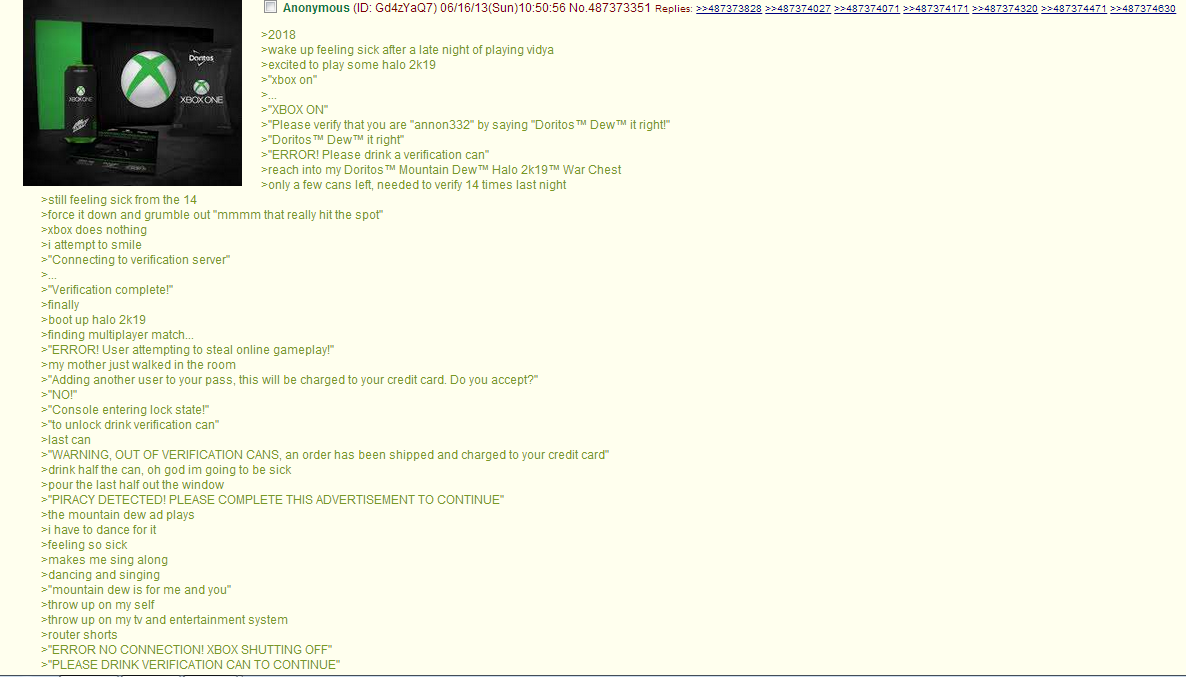
Fiften Million Merits. The one where advertisers literally torture a man with loud high pitched noises because he refused to view ads and didn't have enough money to skip them.
I think the last 2(?) seasons lost the essence of what made Black Mirror great but the older ones are excellent. Older episodes often felt directly applicable to the evils of technology we use today but these newer ones seem to be more generic Sci-Fi, season 6 didn't feel like Black Mirror at all to me.
I haven't actually watched the last two seasons yet but the first ones are amongst the best stuff I've ever watched on a screen. So thank you for the heads up.
Common People is utterly terrifying. Woman falls into a coma, so startup uploads her mind to the cloud so it can stream her mind back to her. Then they start to enshittify the poor woman's life. Can't even sleep because they're using her brain as a CPU. She gets mercy killed while blurting out ads for antidepressants to the person doing it.
Metalhead is also among my favorites. Those kill bots put Skynet to shame.


It's not arrogant or incurious to acknowledge the flood, but it might be to deny that flood is happening.
If you think there are fundamental human qualities or capabilities that AI can't ever have, you might put in the work to articulate that, instead of projecting negativity onto people who have watched the vast majority of the human competencies landscape get completely submerged over the last 10 years. The islands we have remaining don't really suggest any unifying principle underlying things that AI is still bad at, but instead they highlight the lack of technical capabilities and various engineering tracks to solve for. Many of the problems are solved in principle, but are economically infeasible; for all intents and purposes, you might consider those islands completely submerged as well.
reply