It is a good decision. He traded on insider information, he should not be able to get off because he tried to be clever and traded a different company’s stock.
Some observations. That guy must be a very decisive (or impulsive) person. He heard the news and decided on the alternate stock trick, found an alternate stock, found a suitable option on that stock and executed the trade all within seven minutes. Perhaps the merger was in the works for a while and he had been thinking and planning this for a while and just pulled the trigger when he heard the merger was approved.
Also, hners should know that they are getting a lot of value by reading that article. Apparently it was written by a team of eight lawyers, seven of which are partners! Considering the billing rates of toplaw partners, this humble article may easily represent 10k dollars of billable time!
Oh believe me it will be the case. EV technology is moving so fast and as a result ev depreciation is so high they will be glad to sell you the car after two to three years, even if the contract does not currently provide for it.
Perhaps they do not want to put it in the contract now because they have some increasingly desperate robotaxi dreams, but it is clear to me that the robotaxi aint happening with the current hardware, and in a couple of years even elon will have to admit that.
> EV technology is moving so fast and as a result ev depreciation is so high they will be glad to sell you the car after two to three years
Doesn’t this imply even-faster falling prices for ICE vehicles? We’re nowhere close to the Norwegian death spiral [1], but at 7.3% of sales growing at 2.6 percentage points YoY from a 1% base [2] we’re 5 years from their 20% fleet penetration rate [3], which implies a lot of gas cars being sold today will be scrapped versus resold. (I own a gas car. I expect to drive it until write off / they start penalty taxing gas.)
The answer is that aw jones was the first to use the long short hedging strategy. That is why his fund is called a hedge fund and is considered the first of its kind. Others have used shorting before but he was the first to use the strategy of specifically entering a short position to protect a different long position. Well, he was the first one to officially theorize it and market it, at least. That is why when carol loomis described his fund, she coined the word hedge fund.
It is funny how there are so many articles purporting to explain the economics of a Birkin handbag, without actually explaining it. Here it is, I will actually and finally explain the economics of a Birkin handbag.
It is all about convincing the buyer to consider a consumer good to be an investment. People treat consumer goods and investments very differently mentally and rightfully so. A consumer good is something you use for you own enjoyment or necessity. An investment is something that is supposed to pay you back more in the future. You do not get to use or enjoy the stocks and treasuries in your investment account. But you do hope that they will bring you more money in the future.
So what if consumer good can also be an investment? It seems like a great deal. First of all you get to enjoy it. If you are woman (or a man that likes to wear handbags, I guess) you can walk around with your Birkin bag and show it off while it appreciates.
Stocks and bonds are the often recommended investments, but you need a large and complex political system to ensure your stocks and bonds are worth the money. They are after all just pieces of paper (and nowadays you usually do not even get to hold the paper yourself), but to get these pieces of paper to convert to ownership rights of large enterprises you need, as I said a large and complex political and legal system.
A Birkin bag on the other hand, is something you can keep close to you. In your closet.
So the sales potential of something that is both a consumer good and an investment is great. Hermes saw this potential and decided to make the Birkin that thing.
If the Birkin can be sold for more in the secondary market than what it sells for in store, it becomes an investment all of a sudden. And then you get all kinds of new demand. So Hermes made that happen by good marketing and (probably) by buying out Birkins in the secondary market.
But that is also a very unstable situation. If you can just buy a Birkin in a store and then turn around and sell it immediately for a profit, everyone would do that and the secondary market price would collapse. And that is where the exclusivity comes in. The plan for Hermes is that they would only sell Birkins to rich people that do not need to resell their bags in the secondary market even if there is a profit. Thus, the ideal client is a woman that feels good that her Birkin investment is appreciating in value but has absolutely no desire to sell it because she does not need the money and she loves her bag. She just likes to consider how much money she is making in her mental profit and loss statement by keeping her bag, while continuing to wear and use it.
So that is why sales of new Birkins are so restricted and are based on a personal relationship between a salesperson and a client. The salesperson judges the client on whether they are the type of client that will turn around and flip the bag. And meanwhile the company, Hermes, judges the salesperson on whether they can keep their clients in check.
Of course some bags get flipped, and that is necessary to keep a resale market going, and thus to keep up the evidence of higher resale values. But it is important to keep the flips to a very small number.
It is a very clever system, but it was not invented by Hermes. It has been tried before with art, fine wine and ferraris. And for those of you that might think that the Birkin madness is somehow related to women's lack of financial sense, keep in mind that Ferrari was doing the same thing with limited addition Ferraris marketed mostly to men long before Hermes hit upon their Birkin scam.
The problem, from the point of view of the consumer, is that it is a very unstable system. It seems great and safe to have your investment in your closet, but keep in mind that the value of that investment is being kept alive by Hermes doing hard work and spending a lot of money to keep up the secondary market for Birkins. If Hermes changes strategy or some new CEO makes some mistake, then the value of your Birkin will disappear in a second and you will have no legal recourse. If the fashion changes, the value of your bag may plummet even if Hermes does their very best to do everything right. Etc.
So my recommendation for someone considering a Birkin or another consumer good/investment combo is to stick to actual investments for investing and to actual consumer goods for consuming. An asset that produces value (such as stock in a good company) is a naturally appreciating investment (as it produces value) and it does not need to have some kind alternative reality created around it by a corporation in order to appreciate.
Of course one has also to make sure he/she is a good citizen and exercises their responsibilities to keeping up their nation as a stable democracy with a stable well functioning legal system and well established property rights.
See also: guitars. People were always willing to pay $$$ for 1950s Gibson Les Pauls, holding them as investments. So someone smart at Gibson realized they could make perfect reproductions of those guitars, and persuade people they should also be held as investments.
Yes! Gibson recognized they were getting cut out of the vintage market and started making not only the reissues (RIs), but also the limited edition copy-of-famous-person's-guitar. What gets me is that Reissues these days are priced so close to vintage instruments. It's so hard to justify the purchase.
I think there is slightly more to things like this (and Ferraris and Rolexes and so on). People often think of these as _investments_, not merely a way to show off, because they have very skilfully been marketed that way.
Your link does not say what you purport it to say. It limits things to particle pollution. It makes sense that tires will create more particle pollution, but gasoline creates a lot of gas pollution as well.
Interesting. This article you linked states that tires emit not only more particulate emissions than tailpipes during driving, but also more VOC emissions!
> Another area of research centers on the impacts of aromatic hydrocarbons — including benzene and naphthalene — off-gassed by synthetic rubber or emitted when discarded tires are burned in incinerators for energy recovery. Even at low concentrations, these compounds are toxic to humans. They also react with sunlight to form ozone, or ground-level smog, which causes respiratory harm. “We have shown that the amount of off-gassing volatile organic compounds is 100 times greater than that coming out of a modern tailpipe,” said Molden. “This is from the tire just sitting there.”
I'm starting to see more and more homes in the area where I live, Southern California in the LA region, switching from green unsustainable lawns to some form of hardscape/ xeriscaping.
one of the rising trends is the use of old tires as a ground cover source. These have been shredded and processed with a small amount of coloring into something that very strikingly resembles and spreads like wood chips until you pick them up and feel them in your hands.
Of course it better solution would be to not have tires that are so toxic to begin with, but there are very few products into which the most unusable kinds of recyclable plastic streams can be fed, and tires are one of them.
Certainly most particulate matter, and it's not even close. Comparing particulates to gas emissions is difficult, so there's no way to say what's "most".
Either way, my greater point still stands: switching to EVs isn't a cure-all to breathing around cars.
Sure, I suppose this is where I find umbrage with the claim. Instead of “most” maybe try “a comparable quantity of”? (I’d cut to the chase by clarifying tyres and brakes are the principle source of particulate matter, a pollutant with proven harms.)
This is very interesting. I just have one minor nitpick. Broadcom did not buy Avago, Avago bought Broadcom. They then changed their name to broadcom as it was more recognizable in the industry (while keeping their old stock ticker AVGO as that was more recognizable in the financial industry).
This is entirely a tangent but the rise of Avago from a minor second rate spin off from a spinoff from HP to one of the biggest and most profitable companies of the world (and one that is many times the size of current HP), is one of the most unusual mostly untold stories of the modern business world. It is a story of success (by Avago and Broadcom engineers and management) and incredible incompetence (by hp management that let them go for a pittance).
Oh wow, I was just transplanting some TC702 amplifiers to save the doubler in an old 50GHz HP signal generator... would that have been designed by these guys back when they were part of HP?
EDIT: that's registration-walled, but this HP Journal article isn't. https://archive.org/details/Hewlett-Packard_Journal_Vol._42_... The amplifiers in question are blue-colored in the background, and the doubler that uses them is the spiritual successor to the rear-most golden module.
EDIT2: yep, the timeline lines up. The HP journals with these amplifiers were early 90s, and "This division became part of Agilent Technologies when HP spun off its test and measurement business in 1999. Later, in 2005, Agilent spun off its semiconductor products group, which became Avago Technologies. "
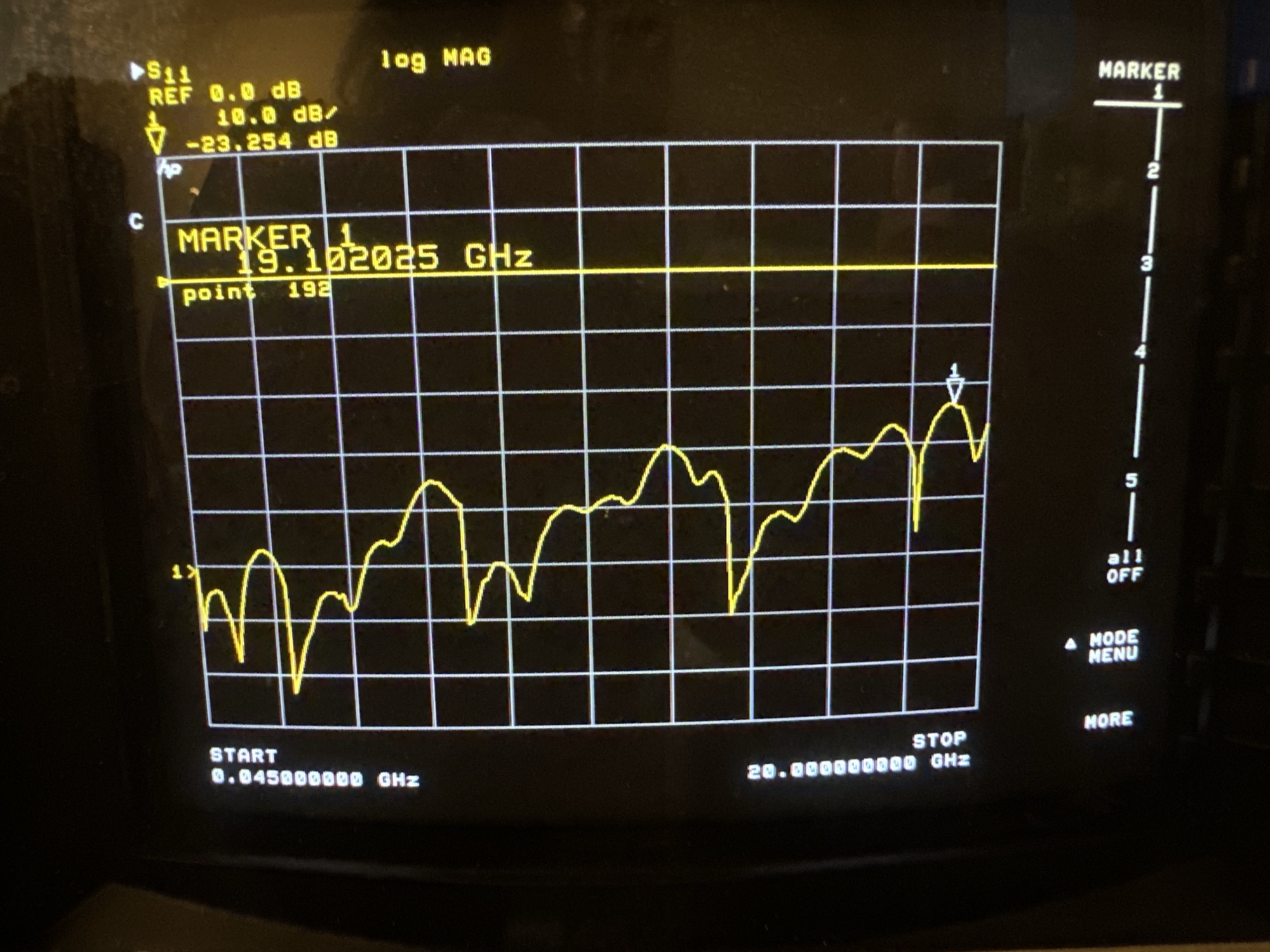
One of the few places you run into fellow 8510C users. How stable do you find your calibration on the 50GHz 83650 setup? My 20GHz one with the 8341B is very, very, very drifty for the first couple of hours after powerup (i.e. a good load goes from -60dB to about -15dB half an hour after calibration), but I'm not sure whether it's normal or something up.
That doesn't sound right at all. I mostly use mine as a TDR (50 GHz with 83651B) but I can generally reload saved calibrations from months ago, less than 5 minutes after a cold start, and still see < 50 dB return loss through 20 GHz if I look at the same load.
I'd go through the receiver channel tests in the manual and try to isolate the problem to the test set or IF box. Does S21 drift as well?
Yes, I'd expect better (though maybe not necessarily 50dB+). Troubleshooting:
1. First suspect is always a bad calibration -- they tend to be unstable in addition to incorrect, but if you have anything with known(-ish) S parameters you can check for correctness too.
2. Second step is to put it in TDR mode and watch to see where the TDR changes. That's where your problem is.
3. A trip through the test set with a torque wrench is a good way to not just check the connections but also calibrate your intuition about the couplers/mixers, which should help interpret #2. You can loosen connectors in sequence and watch them spike on TDR to zero in on the actual problem.
As it happens, I was comparing my 8510C + 8517B to a FieldFox recently and I took some drift measurements, although those were on a short rather than a load. The 8510C blew the FieldFox out of the water, lol. Given the TDR, this might be because the standard itself was temperature sensitive and the FieldFox ports are piping hot, but still.
Thanks, it's really useful to have a reference point. Having played about a bit with which device is left to warm up, I'm fairly sure it's the 85102 (IF box) that's drifting. I've also tried my old 8350B sweeper instead of the 8341B and although the pattern's very different (different band-switch points) it drifts about equally badly. The odd bit is that it looks like it's related to the sweep position - I get a sawtooth effect as it drifts, like so: https://www.jamiecraig.com/wp-content/uploads/2024/06/image....
Oh, you're in RAMP mode! Yeah, that drifts too much to hold a load calibration. This is expected behavior, it's designed to trade away precision to get speed. This will be worst on the 8350, which is completely unsynthesized, and on the upper end of each band on the 8340, which is also unsynthesized. You should see much better stability at the low end of each ramp band on the 8340 (which is synthesized) and you should be able to get that good stability everywhere if you use the 8340 source and put it in STEP mode to synthesize every point.
If you can get your hands on an 8360 source, it will synthesize both the start and end of RAMP sweeps (starting on the second sweep -- it looks to see how far off it was and corrects it), and you will also have significantly faster STEP sweeps.
If we could get an ice-9 that raises the freezing temp of water by only a couple of degrees, that might be hugely useful in a world of climate change. We could keep our glaciers and the wonderful year-round fresh water supplies (rivers) that they enable.
Here is a video of a guy that tried to automate a grinding machine by installing an electric motor. Initially the movement was very unsatisfactory, it was not smooth, or very jerky. He then received an upgraded motor that included a “jerk control” feature and the movement of his machine became smooth.
It came as a surprise to me but it seems like jerk is something that can be felt in real life.


Some observations. That guy must be a very decisive (or impulsive) person. He heard the news and decided on the alternate stock trick, found an alternate stock, found a suitable option on that stock and executed the trade all within seven minutes. Perhaps the merger was in the works for a while and he had been thinking and planning this for a while and just pulled the trigger when he heard the merger was approved.
Also, hners should know that they are getting a lot of value by reading that article. Apparently it was written by a team of eight lawyers, seven of which are partners! Considering the billing rates of toplaw partners, this humble article may easily represent 10k dollars of billable time!