Mainstream economics reads like a flat earth Facebook group when you see how many times it's failed to predict booms and busts despite being considered acceptable as such.
I think we spend too much time trying to ascribe an internal consistency to famous people. Finding internal consistency with somebody doesn't change the destructive trajectory of their politics.
Indeed, any sufficiently mature ideology can be rendered self consistent, either on its own or by applying layers of apologetic obfuscation. Yet innumerable self consistent ideologies are mutually irreconcilable. Self consistency is the lowest of low bars for any ideology to surmount.
There is a common progression, though, from certain 'outsider' ideologies when one is an outsider to a particular form of conservatism when one gets power.
I mean, this is pretty obvious, right? Power-hungry people only hate it when other people have it.
The value of your labor is how much the company is able to leverage it for a return. It has next to nothing to do with where you live. It's on the company to answer this question, not you or some third party to the negotiation between you and your employer.
Internal monolouges enable structural inequalities and broken paradigmes. Memetic constructs form the basis for all societal constructs, so I think maybe you are under selling the importance of thoughts in this case.
Your first sentence is quite a claim. Do you have evidence that this is what enables structural inequalities and broken paradigms? Maybe it would be more reasonable to say such internal monologues help perpetuate these things. It seems to me that the structural inequality comes from first.
Internal monologues absolutely keep people poor. Failure to effectively negotiate is nearly 100% about internal monologues, particularly once the time has come for negotiation.
Perhaps. Wouldn't you agree that internal monologues often reinforce structural impediments, though? I.e. "I couldn't possibly do ACTION, I'm just an ADJECTIVENOUN".
Let's be realistic, while you can see denialism of science across the spectrum, there's only one side of it that denies it in the face of extinction-level events. Scientists can't hope to transcend politics (an unrealistic and meaningless goal anyway) when the Right is so given to removing them from the discourse. They need to enter politics and lean in with everybody else.
The right's skepticism is a response to academia becoming two things: 1. monolithically leftist and 2. activist in nature.
Nobody is arguing with basic research. But when a peer reviewed gender studies journal publishes a rewriting of Mein Kampf, I think it's fair to suspect that a lot of non-science masquerading as real science is indeed pouring out of Universities.
This analysis confuses cause and effect. Science became "leftist" because the right rejected the findings of science in areas like climatology in favour of its own pseudoscientific nonsense. Consider how the Evangelical right decided to even reject bedrock ideas like evolution because it conflicted with ideology.
Complaints about "gender studies" are mostly a red herring. Social sciences are not the same as geology, climatology, or biology and don't inhabit the same departments in most universities.
But they are still "scientists". If all this peer-review, academic infrastructure, and "science" lets all that crap get published, well who's to say it's keeping the crap out in other fields? Scientists are supposed to be the gatekeepers of truth, and seeing them fail in such an obvious and public way really drags everyone down.
>This analysis confuses cause and effect. Science became "leftist" because the right rejected the findings of science in areas like climatology in favour of its own pseudoscientific nonsense.
Academic institutions have leaned left since at least the 60s, back when leftism was an actual counterculture movement. This has nothing to do with climate science.
>Complaints about "gender studies" are mostly a red herring. Social sciences are not the same as geology, climatology, or biology and don't inhabit the same departments in most universities.
Gender studies is fully related to the discussion, because it is an exclusively leftist pursuit, intrinsically linked to modern "liberal" policymaking, and respected institutions tacitly enforce their pseudoscientific, sexist, racist, and classist drivel by allowing them space and funding, while making no such allowances to anything related to right wing politics. Right leaning ideas are effectively forbidden at the majority of so called elite universities in the U.S.
How can you expect scientific departments to be unbiased when their administration and sources of funding are openly and strongly politically leaning and active?
Further, and most importantly, do you really believe that climate science is immune to dogma and the statistical abuses that are responsible for the replication crisis evident in other empirical disciplines? Even asking such a question is career suicide - which unfortunately justifies some degree of right wing scepticism of modern academia due to politicization.
>The conspiracy you imagine of academic administrators shutting down research that undermines climate change because of gender studies is inane.
You've misrepresented my point. The point is that the existence and condoning of politically slanted departments like those of gender studies is further evidence of a strong liberal bias in academic administration, which will inevitability bleed into management of climate science because of how politicized it has become.
You've failed to establish how the existence of gender studies departments means we can dismiss the findings of the physical sciences, including climate change. It is still an inane point.
>You've failed to establish how the existence of gender studies departments means we can dismiss the findings of the physical sciences
I am not advocating for dismissal, I am merely suggesting that social and political pressure for certain results from the hiring and financial appropriation practices of a politically biased administration can introduce aggregate bias in published results. And on the subject:
>The majority of academic scientists identified as Republicans, up through the 80s
You've failed to establish how even a republican leaning scientific establishment is immune from the whims of administration resulting in, say, only publishing results that support the politically correct positions. It is a fact that the overwhelming majority University administration's lean strongly left - and when science is politicized, there's a strong chance that, again, such administrative bias will affect results in seemingly innocuous ways. Not to mention that most environmental scientists have personal left leaning biases and experience social and professional pressures which also may be reflected in results.
Significance testing, publication of only positive results, and model design are three methods by a which slant may be unintentionally introduced and, again, we know that these problems have lead to the replication crisis explicitly identified in other empirical sciences - why do you think no one is willing to ask the same, legitimate question about climate science, particularly when climatology by nature is not a reproducible discipline?
> we know that these problems have lead to the replication crisis explicitly identified in other empirical sciences - why do you think no one is willing to ask the same, legitimate question about climate science
Oh, for Christ's sake. If anything, climate scientists talk about this more than most other specialties:
"Perspectives on Reproducibility and Replication of Results in Climate Science"
It took literally 10 seconds of Googling to find that. Writing this comment is taking several times as long.
Perhaps the fever swamp that's constantly wondering if climate scientists understand basic science should perform basic due diligence on their own mental models of how the world works.
The source you linked discussed reproducibility of modeling and analysis of historic data. It makes no mention of the problems responsible for the experimental replication crisis that I'm describing in other fields - it wouldn't make sense to because climate science is not and cannot be experimental. Which makes the science more vulnerable to bias because there is fundamentally no way to prove beyond statistical estimated whether it is right or wrong.
Why do you refuse to admit the possibility that political and social pressures in such a strongly politicized field can bias climate science? All of the ingredients are there, and the only reason such an assertion is contentious is because of these very same political norms. It begins to resemble dogma, when any criticism is treated with such disdain.
There is indeed a lot of magical thinking going around.
The political left calls GMO crops dangerous and fear mongers without a shred of scientific evidence. Or they spread fear about the pharmaceutical industry -- and how those evil drug researchers are trying to get people addicted to their drugs for profit.
Then when regular people decide not to trust any drugs at all -- including vaccines -- people wonder how that could have possibly happened, after demonizing the entire field of research for decades.
And on the political right we of course have wilful disinformation about climate change.
Can you name some prominent elected officials on the left who fear monger about vaccines? I assure you that I can provide quite a long list of elected republicans who've said some bananas things about climate change for instance.
I'm not even on the right, but I certainly take issue with a lot of the ideas coming out of gender studies (and similar) departments and how easily they are accepted as truth and how quickly they spread. Many of those ideas, if taken seriously, seem to have the possibility to rearrange society in a pretty awful way. In fact, anecdotally, they already seem to be having a pretty negative effect on our world and their influence seems to be on the rise. Now, I'm not quite as concerned about this as climate change, but it's still a real issue. Do you not see this as a real issue?
I am not saying that criticism of gender studies is absurd, I am saying that conflating climate science with gender studies is absurd.
The validity of the social sciences as "real science" has long been in question, long before the concerns of modern day politics. This problem is inherent to these fields, because instead of studying the objective physical world they study literature, history, politics, art, etc. Many social sciences are more accurately called liberal arts in my opinion, and they co-opted the word "science" to lend themselves credibility.
Then on the other hand you have climate science, which does study the objective physical world. The science around this involves collecting data and building models to describe the physical world instead of speculating about the nature of mankind. It is an apples to oranges comparison.
Just to illustrate, forget about climate science and gender studies because they are politically charged. If the above poster had criticized something like the study of French medieval literature and used that to argue that particle physics is a systemically flawed and biased field, I would also call that comparison absurd.
The argument is not: Social science is nut trustworthy so no science is trustworthy.
The argument is: Social scientists pushed to be put on the same level as natural scientists, but then they pushed a bunch of politicized bullshit and tarnished the reputation of all scientists in the public's eye.
It doesn't matter what is true or not, people in general are stupid. The masses on the left trust scientists, since they feel that these bullshit pushers are pushing bullshit in the right direction (Not related to climate change). The masses on the right doesn't trust scientists for the same reason. The solution is not to teach people to properly evaluate the validity of different scientific claims, that is impossible, the solution is to build up the trust of scientists in everyone's eyes as much as possible by kicking out all the bullshit. Good arguments actually works, but if you try to feed them 50% bullshit they will refuse to swallow even the good parts since they stopped trusting you.
> Social scientists pushed to be put on the same level as natural scientists, but then they pushed a bunch of politicized bullshit and tarnished the reputation of all scientists in the public's eye.
I largely agree with this, but I think the masses on the right approach it more like the first argument:
> Social science is nut trustworthy so no science is trustworthy.
More accurately, it seems to me that it has become "social science is not trustworthy and I don't agree with the field's mainstream ideas, so I can consider any science I don't agree with to be not trustworthy". So when climate science suggests that climate change is a problem, and the proposed solutions do not agree with right-wing economics, the natural conclusion is for them to reject climate science. This conclusion has been reached by right wing governments across the world, so it certainly seems that those who follow the ideology tend to reach it.
I think it happens both ways with people of all political persuasions, saying "I agree with these conclusions so this science is trustworthy" or "I don't agree with these conclusions so this science is untrustworthy".
I’m just waiting for someone to throw in ‘cultural marxism’ in this thread. Sure, you may believe that some departments at university skew left but I still need to see evidence that this is a fact for all universities across the board and that it’s systematically introducing bias into research.
Dude, relax. Can you post proof to the contrary? If you cannot, then your position is indeed weakened. In any case, those links are in line with my own studies at four colleges and universities in Norway. If you can document something that disproves those links, I'd be quite happy to see them! :)
I think we've provided some evidence that suggests there at least might be a problem.
Publishing a rigorous scientific paper saying "well look, here's the problem" is going to be difficult, given the issues such a paper would address. It could be career suicide if handled indelicately.
Given that we have weak evidence that there is a problem, the burden of proof is now on you to provide stronger evidence that there isn't a problem, unless we have a strong prior for there not being a problem or something.
Applying higher standards to things you disagree with is a great way to end up biased. If you require a well reviewed research paper showing that there is a problem, you should also require a similar paper showing you there isn't a problem.
At the very least trying to provide a counter viewpoint to the evidence you've already being presented with would be polite.
Goes over the issues related to politics, conservatives aren't as under-represented when you include STEM fields, but pay special attention to the disciplinary variance.
>Focusing specifically on social psychology academics, a 2014 study found that "[b]y 2006, however, the ratio of Democrats to Republicans had climbed to more than 11:1.
Also note what fields are facing the most obvious replication crisis.
I expect you'll want to do your own research, but that should get you started.
I was not talking about bad science in general. I could say that in general, science seems to be in crisis [1] and pinning it down to people whose political affiliation does not suit your needs is reductive. Also, because there’s some different distributions does not mean leftwing = bad.
Another interpretation could be: the GOP platform is highly anti-science and most scientists wouldn’t want to be associated to such a horrendous organization which doubts scientific consensus regarding an issue that’s threatening the whole of civilization.
You put it in your question, right? I’d like to see a study that EXPLICITLY correlates political views and activism with measures of ‘bad science’ like no citations, impossible reproducibility etc
I found a preprint of a study examining exactly that. I haven't had a chance to really read through it in depth though, so I can't speak to whether or not it's actually a good paper.
My naive first skim seems to demonstrate that political slant does have an effect on reproducibility, although it doesn't matter if that ideological slant is conservative or liberal.
It's not much, but it was tricky to find and it is what you're looking for. More research is needed.
Academia is neither monolithically leftist, nor is it activist by nature.
You have only to spend 5 minutes in a typical economics class to understand that that field favors neoliberal ideas. If you sit down and have a conversation with an actual leftist (particularly a marxist) professor, you'll hear something that nobody outside of the system seems to discuss. Marxism is very uncommon in most departments.
> Nobody is arguing with basic research.
Are you kidding me?
There are places in the US where powerful organizations and even state legislatures are actively trying to prevent schools from teaching evolution. Look at this development from two years ago: https://thehill.com/homenews/state-watch/316487-new-wave-of-...
At the federal level, we have congresspeople carrying snow into session so they can deny that climate change is occurring. I regularly see arguments online include discussion of how NASA and NOAA are doctoring the evidence. I wonder where they're getting THAT idea from...
So yea. People absolutely ARE arguing with basic research. Large numbers of people. Significant fractions of the population.
From your link: Affilia: _"Journal of Women and Social Work is a quarterly peer-reviewed academic journal that covers social work practice(s) and feminist analysis of gender inequality."_
How is this related to science (much less basic scientific research)? Even if it WERE a scientific journal, an anecdote about being fooled by a hoax doesn't invalidate the scientific research being done today.
I should think that attending any school of economics would give you that idea, but enter just about any faculty of the humanities or the social sciences, and the picture quickly becomes quite different.
I happened to go back to school fairly recently. I was required to take some humanities and social science classes.
I'd say there's a lot more diversity of opinion in the rest of the departments than there is in econ. I didn't get any sense of political agenda in the history department, and the sociology department seemed to be deliberately avoiding it.
I actually started university under the assumption that professors would be dogmatically pushing their agenda. I was wrong.
Gender studies is not science so I’m not sure how that fits into the discourse.
Not to mention that it’s not even that good an example to prove anything about academia - it’s a minuscule subfield with little funding in comparison to any other academic discipline. None of the major public universities I attended even had a gender studies department - at best it was a specialty within sociology/anthropology with a dozen grad students or so. The only thing in which gender studies has a disproportionate representation is as the favorite example in the rhetoric of anti-academics.
Please show how physics/biology/math/geology/climate science/etc is “monothically leftist and activist in nature”.
That's not obviously a win. We already have many people wasting a lot of time on unproductive political discussions. If scientists spend less time doing science that only they can do and more on political stuff that anyone can do, it seems like we're worse off?
There may be good ways to participate, but you need to be more specific than "lean in with everyone else".
(I exclude voting from this. Increasing turnout obviously requires all hands on deck. But that doesn't take much time.)
> There's only one side of it that denies it in the face of extinction-level events.
If you're going to push forward with language like that, don't be surprised when science becomes a political issue.
Climate change isn't an extinction level threat.
1) The rich countries can almost surely make it through with, worst case, major inconvenience and deaths of lots of foreigners.
2) We've had the technology to go carbon free for a long time now (in nuclear) and generally the environmentalists say that nuclear power is at least as bad if not worse than climate change. France has been basically emissions free for quite some time now.
If you want to argue that climate change is a major threat, go ahead. But if it is an extinction level threat, the nature of that threat is being communicated truly terribly, to the point where I doubt anyone on the right has heard enough of it to reject it. I've heard a lot of horrible predictions, none of them are scarier than all the other things that could go wrong over the next 100 years. Even the last 100 years had WWII in them. 100 years is a long time.
I think pushing science as an ally of the left (or a proponent of the politics of the left) risks further alienating right wing voters. There is already a correlation between education and party support. The "coastal liberal elite" pejorative is, in part, a rallying cry against people who make them feel stupid. No one likes to feel stupid.
It's similar to accusing people of racism. Very very very few people who are called racists would agree with that, and the ones who would you're not going to win over anyway. People shut down when accused and get defensive. If the goal is to make progress (in the traditional sense of "liberalism", to reduce human suffering through gradual reform) rather that "to be right", then calling someone stupid or racist or saying that all of human knowledge contradicts their claims isn't really a good way to get there.
Scientists getting into politics opens them up to the attack that they are pushing an agenda out of political rather than professional beliefs or truth-seeking behaviour. See Trump's attacks on Mueller's team because many voted for democrats. His attacks are probably in bad faith but the point stands: give people something to attack other than a belief they're wrong about and they'll happily switch to that.
If your stance is that you can't risk alienating people who already have decided what you do is without value and based on lies then I don't know what to tell you because you have already lost.
There are two ways to get people to do the right thing, however right is defined. You can convince them to do right, or you can force them. If you've decided that you don't care if you alienate them, then you've settled on forcing, and there's no reason at all to continue talking.
I totally understand that feeling I believe we all get when someone acts like a jackass and you don't mind alienating them, but every liberal democracy is built on a foundation of presuming that people can be convinced rather than having to be forced. That may not be true all the time, but it seems like we should at least act as though it is true.
If we're not going to act as though it's true, then we should call a spade a spade and say that it's ok to use authoritarian methods when they serve what we know to be right. Rule by strength of arms seems like a bad road to go down, though.
You can't reason someone out of a position they didn't reason themselves into. Or to quote Upton Sinclair “It is difficult to get a man to understand something, when his salary depends on his not understanding it.” If someone is against Global Warming at this point it is not because they've seen evidence that convinces them otherwise, or they are naturally skeptical. Those are just justifications for doing what they want and if you remove those justifications they will just choose new ones.
Now the fact that you immediately leap to authoritarianism is just plain stupid. No one at all is advocating for that in the linked piece or any of the comments. Passing a carbon tax for instance is not authoritarian if done through the democratic process.
I agree completely with your first paragraph, but then why bother engaging? My point is that there is no reason to write articles or have conversations that risk alienating. The people who can be convinced won't be more convinced by the kind of language that alienates people, and it's not worth even talking to the people you believe can't be convinced.
The kind of language that alienates better serves the purpose of creating a group of people that is an enemy that can be fought against, which goes to my point about authoritarianism. There are lots of instances in a democracy where you put your foot down as a group and decide that certain behaviors are unacceptable. I just think it's morally important to distinguish between the times that we're using reason to drive policy and the times that we decide that we're officially so right that it's ok to use the power of the government to force people to behave in what we believe to be their own best interest.
FWIW, I absolutely believe massive change needs to happen on the climate change front. I just think that calling the other side deniers and anti-whatever is entirely counterproductive and only serves to deepen divisions. Policy can be made without creating a bogeyman, and if a policy requires a bogeyman, it's way more likely to be authoritarian, in my estimation.
Not by being mean, but by exaggerating the scale of expected catastrophes, by talking about imminent doomsday, by demanding "moral" change in form of "eat less meat, do not fly, have less children" instead of investments in new technologies, climate change "witnesses" do much more harm than deniers. They discredit the ecological movement and make it look like a crazy religion preaching the end of the world.
The unreasonable perseverance on CO2 levels not only distracts attention from truly severe issues, like loss of amazon rainforests, but makes them worse by introducing policies like biofuel quotas.
No, I'm pretty much going to keep thinking man made climate change is a thing, given how easy it is to demonstrate the basic principle of greenhouse gasses and how easy it is to measure greenhouse gasses.
That being said If climate science becomes more about punching the other side into submission than about looking for truth I am going to take new research as to the effects and pace of climate change less seriously.
If a field was built on a less solid foundation, like say economics, started doing that? Well yeah, I'd absolutely start taking everything they say with an even bigger grain of salt.
I think the American political right is in general more accepting of science than you might believe. Many of them are scientists themselves.
I think the older generations, the poor uneducated families, and the bitter religious folks have more disbeliefs in science than 'the right' in general.
> Climate change is far from this nation’s most pressing national security issue.
That is an admission by the Republican Party, in its public policy, that climate change is not a myth. It just means they've decided not to care about it in regards to national security.
I also found this:
> Information concerning a changing climate, especially projections into the long-range future, must be based on dispassionate analysis of hard data.
Again, that is an admission that the climate is changing and that scientific research and data can give us information about it.
So as said elsewhere in this thread, we're back to politics determining decisions about what to do about climate change; the Republican Party's official platform doesn't seem to deny that the climate is changing.
This is just my opinion but I think a lot of Republicans don't think that climate change isn't happening at all.
I am guessing from their admission that they acknowledge climate is changing, but refusing to list it as a priory is that where the difference in opinion between Democrats/Republicans lie.
When it comes to the root cause of the climate change, how much humans are accelerating/impacting the change and how we can reduce the impact are all topics where the different political party's opinions differ.
"The concept of global warming was created by and for the Chinese in order to make U.S. manufacturing non-competitive."
"The whole climate crisis is not only Fake News, it’s Fake Science. There is no climate crisis, there’s weather and climate all around the world, and in fact carbon dioxide is the main building block of all life."
"Obama's talking about all of this with the global warming and … a lot of it's a hoax. It's a hoax. I mean, it's a money-making industry, okay? It's a hoax, a lot of it."
I can do this with any given Republican who's been in a leadership position.
I won't, though, because you're clearly dissembling and not engaging in good faith.
Someone replied to "The public position of the Republican Party is that climate change is a myth" with a link to their web platform stating something different.
I think it's not really fair to counter that by quoting Trump and closing with the assumption of bad faith.
All the statement says is that climate change is not an issue, and that any discussion of it must be guided by data: there is no acknowledgment of the reality of climate change.
On the other hand, all of the Republican leadership cast doubt on it. And as a result the large majority of Republican voters reject the idea of anthropogenic climate change.
This does not add up. If American political right is so accepting of science, how does the denial of climate change by their elected leaders not push the right to vote them out?
I'm quite sure 40% of the US population that voted for the GOP does not fit the description you have provided.
Let's rephrase: the political right that is in power. If this political right is accepting of science, they clearly not have chosen or voted for leaders in their party that promote this.
Indeed. But we need to go further than that. There are (a few) scientists which identify with the Right, or worse, challenge some climate change facts. They should be fired, we can't have science legitimize fascists movements or throw doubt on established science facts.
Uh. This is exactly what is wrong with scientist pairing their results and methodology with politics.
> They should be fired, we can't have science legitimize fascists movements.
Ok, if you want to get rid of a strong scientific community continue on with this fantasy. Propagandists making things up should be exiled.
The climate change assertions should be challenged. That's apart of the scientific method. You don't publish directly to a respected journal. Also, correlation does not imply causation.
Their unbiased* findings should assist in the creation of solutions which involve policymakers. It's not a scientists' job to make a decision that affects everyone.
Unbiased means: As unbiased as you can get. Get it peer-reviewed. Work with others to test out effective change strategies to avoid unintended consequences, present options, accept failure. (Yes, that last one is the biggest thing)
China's population is concentrated in one part of the country. That makes it easier to serve them more efficiently with mass transit. This isn't true for the United States. The population resides on the coasts, which you can serve with high-speed rail, but connecting the two coasts with the inland population centers via rail is a much, much bigger project.
Yes, this excuse has been given for the past 50 years. Usually, in reference to Europe.
That might explain why they’re building 25,000 miles of high-speed rail in China, but it doesn’t address why the US has zero.
You’re being sort of vague with the numbers of course.
If you actually look at population densities in Spain, for example, and compare them to California or New York, what do you think we’d find?
For some reason, people like yourself want to average Montana, North Dakota, California, and New York. The US does not have a uniform population density.
People also want the federal government to fund the construction of this infrastructure, which is a very hard sell (and possibly unconstitutional) if you don't average all of those states in some way. Most of the opposition to Amtrak and existing infrastructure projects like the Gateway Project is coming from those states, who don't see improving rail service in the Mid-Atlantic and New England as something they want their tax money spent on.
We need to fix that problem, and that means not simply writing them off as irrelevant because of their lack of population. Australia is likely facing the same problem.
I tried a simple estimate on how much a HSR line would cost from Chicago to Denver. About $20-30 billion. It's a 1000 miles of flat nothing, so it's cheap per mile.
Chicago --> St Louis --> Kansas City --> Denver is about 1000 miles.
Building a railway from coast to coast has already been done in the 19th century. An HSR line is just a railway line built to higher standards:
- larger curve radiuses (spelling?). Not much of a factor when a line mostly crosses sparsely populated, flat areas.
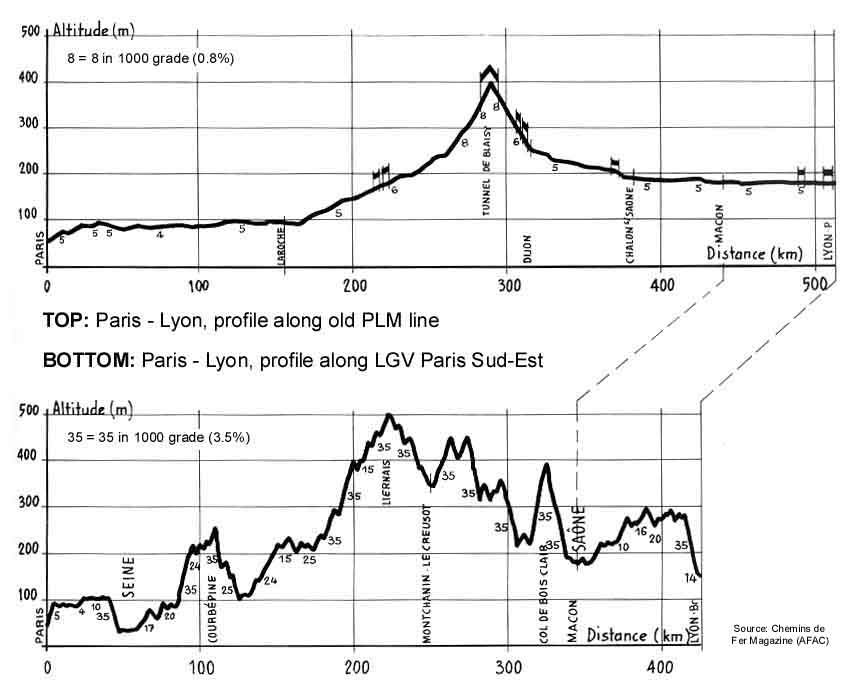
- less steep inclines (but if a steam engine can climb an incline, so should every modern train)
- Switches that allow high speeds on the diverging branch. But again, if the population is sparse, you don't need many of them.
And when building a part of the line to HSR standards is too expensive, the HSR train just turns into a regular train while using it. The only part that's expensive even if the geography is great is electrification (having to carry fuel or batteries limits your speed).
Switzerland does not use HSR despite prioritizing rail. I couldn't find numbers, but AFAIK it's very densely populated if you exclude the uninhabitable parts of the alps. Germany is slightly less densely populated and does use HSR. France has less than half the density and its HSR is significantly faster than Germany's. It does not look like HSR requires a high population density. The opposite is the case: HSR works better when it can go long distances without stopping and re-accelerating.
And even if HSR does not make sense everywhere, that is not a reason not to use it where it does.
High speed lines can have steeper profiles than normal lines because the greater kinetic energy and loco power makes them less troubled by slopes. Eg this compares the profiles of the old Paris-Lyon route with LGV Sud-Est:
Even better. Though this particular example compares the difference between a general-purpose railway line designed for steam traction and a passenger line for electric ones.