Let me preface this by saying that I believe climate change and decarbonization to be one of the critical challenges of our time. That said…
This article’s title and its content are completely at odds. Here’s a critical passage:
> As the ice sheet melts, its surface will be at ever-lower elevations, exposed to warmer air temperatures. Warmer air temperatures accelerate melt, making it drop and warm further. Global air temperatures have to remain elevated for hundreds of years or even longer for this feedback loop to become effective; a quick blip of 2 degrees Celsius (3.6 degrees Fahrenheit) wouldn’t trigger it, Höning said. But once the ice crosses the threshold, it would inevitably continue to melt. Even if atmospheric carbon dioxide were reduced to pre-industrial levels, it wouldn’t be enough to allow the ice sheet to regrow substantially.
> “We cannot continue carbon emissions at the same rate for much longer without risking crossing the tipping points,” Höning said. “Most of the ice sheet melting won’t occur in the next decade, but it won’t be too long before we will not be able to work against it anymore.”
So…we potentially have hundreds of years to bring temperatures back down before the “tipping point” triggers? Forgive me for not being super alarmed.
100 years ago we’d just barely started dumping carbon into the atmosphere. That is a long time.
EDIT: to be clear, yes of course it not enough to stop dumping carbon into the atmosphere in the next hundred years, but it does give us (potentially) decades to figure out large-scale carbon capture and sequestration even if we exceed the thresholds described here (1000 gigatons).
No, the story is that we begin the melting by raising the earth's temperature a little. You'd think that if we reduced our carbon emissions, the ice would stop melting.
> But once the ice crosses the threshold, it would inevitably continue to melt
Bear in mind that the atmosphere retains carbon dioxide for ~50 years, that other melt events are dumping methane into the atmosphere from permafrost. It's not just one factor heating the planet.
>You'd think that if we reduced our carbon emissions, the ice would stop melting.
People think of climate change like a river. You reduce emissions, you reduce the size of the emissions, you reduce the size of the problem.
But it's more like a bathtub. Emissions are the water filling the tub, but the real problem is the water level already in the tub. If you reduce emissions, you reduce the size of the flow into the tub. But....water is still flowing in and the water is still rising.
If we had zero emissions it would take earth systems much much longer than 50 years to bring things back down to where they were.
I don’t understand the bathtub analogy, but I will say it should be a goal of humanity to control the climate of the entire earth. The alternative is we don’t and are forever at the whim of what Earth and the solar system decides to throw at us.
I’ve found this argument to be appealing to people on both sides of the climate change debate.
I agree tbh, a modern focus is one of conservation; what better way to guarantee the ongoing proliferation of various species other than being able to control the environment they live in.
Controlling the climate (and by that of course we mean very carefully holding it at what it should be) benefits all life on the planet.
Good thing plants eat carbon dioxide then, so we don't need to wait for it to break down by itself. The more CO2 in the atmosphere, the more plants grow and convert it to oxygen.
Plants only store the CO2 until they decompose a relatively short time later. The only way to end up with a net decrease in CO2 this way is to bury the plants deep. Of course that is the process that initially created coal.
The amplitude of the world's natural CO2 cycle is on par with about 1.5 years of anthropogenic emission. Which is certainly impressive, but it's cylic and fairly steady. Plants are not growing fast enough to support the fantasy you describe.
Said another way, within two full human lifetimes the planets climate could further be irreversibly changed locking in 23 feet of sea level rise from Greenland alone.
Though, generally for emissions we are talking about a first order derivative. Just because you've slowed down from 100 to 50 does not mean you won't still run out of roadway.
So, if we are a hair away from that tippingpoint, and magically go to zero emissions, we'll still hit the tipping point. Hence, it's not two lifetimes, but that is the total runway left so far for this.
You can also consider the other extreme where CO2 is dumped into the atmosphere that everything shortens up. Another analogy, boil some water, put it off the burner, drop a small amount if ice in the water. The water won't cool off fast enough for the ice to not melt. It may take 10 minutes for that to happen, but the point of no return was when the water started at a boil.
You and the models of climate 200 hundred years hence have no actual idea of what will occur. You will be dead, however and this is certain.
It is baffling to me that it is a concern to you or frankly anyone that is not of extraordinary wealth.
Why? I tell you why: all effective measures at "reducing climate change" (very status quo) will unquestionably make life more laborious and less comfortable for the lower 98% of humanity. Our sacrifices will permit the 2% (or fewer) extravagance beyond what we've ever seen.
The permafrost will melt unleashing massive forests worth of growth, huge swaths of frozen soil will become inhabitable and fertile.
The ancestors of the Americas lived on the coast, 400 feet below today's surf. No one lamenting the old huts weve lost along the way
I think you successfully got my goat. But a few things to consider:
(1) The climate models of the 1970's were actually incredibly accurate, 50 years
later.
(2) We are pretty close to 2 degrees now (AFAIK we are at 1.6 currently and rising). The current models have us breaching 2 degrees in the next couple decades, if not already breached. (Any reason to believe our current models for the next 20 years are far less accurate than the models of the 1970's for a longer time scale?)
(3) We need warming of 2 degrees for up to two centuries to lock in the melting of Greenland's ice sheet.
(4) Once we breach 2 degrees, the timer starts. How likely do you think it would be that we would stop emissions to arrest that growth? How difficult would it be to even get back under 2 degrees (to then actually _lower_ the temperature).
Hence, unless we want to not only figure out a way to eliminate emissions, but also reverse those effects; we are best staying under 2 degrees. The time threshold for staying under 2 degrees is quickly passing, and that is not a problem for "hundreds of years from now". If you care at all then about your grandchildren having anything resembling the comforts of you; perhaps you would also be concerned about the implications of breaching 2 degrees and how important it is to stop that increase before we even consider how to reverse those effects.
Last point, considering it is the 2% [0] are the ones doing most of the emissions, then this concern over the change for a more laborious and less comfortable life for the 98% seems misplaced.
[0] It turns out it's actually the top 10~20 percent that do most of the emissions, with more from the smaller fraction. The point is all the same though.
In short - the emphasis from this statement is extremely misleading: "hundreds of years or even longer for this feedback loop to become effective."
The feedback loop will take time to trigger, but the conditions for that feedback loop to be triggered can be locked in before that time. As proof, if we emit a near infinite amount of C02 emissions to produce a run-away hot-house earth, those conditions will be locked in very quickly. In other words, if temperatures rise enough, there won't be enough time (even in a couple hundred years) for them to fall back quickly enough. That's just logic, math & thermodynamics.
> You and the models of climate 200 hundred years hence have no actual idea of what will occur
This seems like an "attack the messenger" argument. If there is enough global heating to melt the ice sheets over Greenland - the climate would be different. 1000 years ago, the climate of the Earth was not melting the ice sheets of Greenland. Now that they are on track to melt, that is different.
I only said the climate would be changed. Beyond this, the article is very well presenting a model of what would happen to Greenland's ice sheets over centuries.
Otherwise, in my comment, I'm paraphrasing the conclusions of the article and giving explanatory examples which are based on thermodynamics and what was concluded in the article. It's not my opinion (and so making this personal is irrelevant). Otherwise you're free to contradict the validity of the model, you could have a very good research paper if you could nitpick how the article is flawed.
Otherwise, saying "the models have no idea" is either nihilistic or ignorant and is very reductive.
It's like saying, "I'm projecting my finances to go to zero in a year based on the current trajectory. Bah, why change anything, who knows what will happen a year from now!"
> It is baffling to me that it is a concern to you or frankly anyone that is not of extraordinary wealth.
- Why would the non wealthy be any less concerned about their great grand children than would be the wealthy?
- Is concern for future generations of humans and every other species on the plant baffling to you?
> Why? I tell you why: all effective measures at "reducing climate change" (very status quo) will unquestionably make life more laborious and less comfortable for the lower 98% of humanity. Our sacrifices will permit the 2% (or fewer) extravagance beyond what we've ever seen.
That is your opinion. To share my opinion, I find that "comfortable" way of life to not be entirely satisfactory. That way of life (industrialized capitalism, eg: Japan or the USA) leads to high rates of suicide, depression, poor environment (polluted airs, roadways, rivers) to all be very unsatisfactory (IMO). I recall how clean the air became when there were no jets and no cars on the road for as little as one week, and that was quite pleasing.
You're also assuming that the needed changes are going to require _your_ personal sacrifice. If we, as normal people, can effectively adopt mass transit, electric cars; the rest of the needed changes are from industry.
> Our sacrifices will permit the 2% (or fewer) extravagance beyond what we've ever seen.
This is provided with no evidence and is not a logical conclusion from any of your previous statements. It's already the case that a minority are causing an disproportionate amount of emissions. In some ways, how is this not already the case? If that is already the case, then the "sacrifices" are not relevant to the "extravagance" of the 2% (our sacrifices are not a necessary and sufficient condition for that extravagance, the two are independent of each other given that extravagance seems to exist today without those sacrifices)
> The permafrost will melt unleashing massive forests worth of growth, huge swaths of frozen soil will become inhabitable and fertile.
I think you meant habitable? Beyond this, this seems like a disingenuous argument since you stated earlier that no model knows what the climate will be like in 200 years - therefore how can we conclude the permafrost would melt?
Though, taking the nihilism aside, permafrost melting would be another tipping point. This article describes another tipping point that also exists.
But, the growth of forests is not a given (so, it's not necessarily the case that we can all just shift north & south). For example, there is a C02 level (around 1300ppm) that could be reached that could cause cumulus clouds to no longer form [0]. At that point, we're not getting massive forests but instead earth would be on track to be a hot-house planet (eg: Venus)
> The ancestors of the Americas lived on the coast, 400 feet below today's surf. No one lamenting the old huts weve lost along the way
No, but it is lamentable that Buffalo, Wolfs, bears have nearly disappeared along with bio-diversity and a lot of first growth forests. Looking at satellite pictures, it's quite amazing how much clear cutting has taken place; and travelling through those clear cuts is depressing. I personally lament this loss.
So, just as we can lament the destruction of environment from those 400 years ago (more 200 years ago really), people 200 years in the future will lament us ruining the environment for them. We may disagree, but I prefer to be a steward of the environment rather than wreck it for the sake of marginal "comfort".
Stopping emissions (which isn't even in the Overton window) means CO2 concentration will slowly reduce.
"Between 65% and 80% of CO2 released into the air dissolves into the ocean over a period of 20–200 years. The rest is removed by slower processes that take up to several hundreds of thousands of years, including chemical weathering and rock formation. This means that once in the atmosphere, carbon dioxide can continue to affect climate for thousands of years."
During the time of elevated CO2 levels, the temperature continues to rise.
Previous research identified global warming of between 1 degree to 3 degrees Celsius (1.8 to 5.4 degrees Fahrenheit) as the threshold beyond which the Greenland Ice Sheet will melt irreversibly.
We're already at 1.2c above pre-industrial levels. Although it will take a long period of exposure to warm air for the ice to melt, we've already been doing that for a long time. It doesn't seem reasonable to say we have hundreds of years to figure out a solution.
> It doesn't seem reasonable to say we have hundreds of years to figure out a solution.
We've also known about the global warming problem in great detail for well over 50 years at this point. Since then we haven't figured it out but made it worse -- most of our cumulative emissions have happened in just the last 50 years. Why do people still think we can figure this out in a matter of decades without having to drastically change our fossil fuel habits?
Because people haven't come to terms with the fact that humans are not Children of God nor disembodied Cartesian rational calculators, but actually a loquacious and smartish hominid, designed by selection for small group interaction. There is nothing to suggest this species is capable of planet-level cooperation towards a communally-decided end.
Add to that the fact that path-dependent history has placed that species today in a situation where it's organised into huge 17thC mutually-hostile groups ("States"), incapable of anything more than opportunistic cooperation because of their religious and anachronistic founding concept ("sovereignty"). Most people have no idea that this contingent organisation is not the natural and inevitable state of the world, so aren't open to the possibility that it dooms them to sclerotic inability to face today's challenges.
You make interesting points but I would disagree about global cooperation.
Every day we cooperate in an intricate dance with people all over the world, from different ideologies and legal systems, to operate our supply chains and information networks.
All we need is for the green option to be in everyone’s self-interest and the system will rapidly self-optimize.
We’re already getting there with green laws being globally popular, carbon taxes, and clean tech getting cheaper.
Well it's too big a discussion to litigate here, but I don't agree that market forces + self interest have in fact been successful. Most significant problems have merely been postponed, precisely because we just don't have the cooperative mechanisms available to deal with them. Many of our ecosystems (ie. the actual physical world, rather than the virtual worlds of finance and markets) are on their last legs.
I also think the very concept of 'self-interest' is incoherent (as is 'national interest'), but again that's too large a topic for an HN comment.
My argument is that market forces have done a brilliant job in marshalling far-flung and diverse interests to optimize for the sum total of our self-interests.
For instance, I'm using this device for fun and profit and it was made by actual communists on the other side of the planet.
People until recently have not thought of the ecology as being in their personal interest in a direct and concrete way, only a vague and diffused good. Tragedy of the commons and all that.
But that's changed because now being green can be cheaper (carbon tax, cheap solar panels, other tech progress) and cool.
The market deals with all long-term significant problems this way - leave it until it's urgent, then absolutely smash it. This isn't perfect but it's probably the only way to get 8 billion decision-makers to coordinate on anything.
My point isn't for perfection, but that we simply don't deal with many global problems at all, ever. They're not left 'till they're urgent - they are ignored until they overwhelm. This is a universal, physical, biological process that happens to all organisms whose unchecked growth damages the environment they have evolved to exist in. Abstractions like 'market forces', 'self interest' and 'decision-makers' have no causal force. They are like money - concepts that skate impotently over the surface of physical reality, until their bearers are borne away.
Anyway, 'arguments' (especially those of economists - the theologians of our era, whose intellectual fairy-castles will in my view come to be seen as equally empty) are irrelevant. Rationalism lost (a historical reality economists never grappled with). Empirical reality is all. Time will tell.
Kick the can down the road. Nothing to see here. Let our progeny figure out how to clean up the mess we created. We're doing the same thing with our debt, too.
I'm just going to put it out there - our progeny is going to hate our guts.
Then again, maybe afterward humanity will hold us up as an example for what not to do, how not to solve global problems. They'll be able to use history to quickly and effectively shut down the naysayers. Of course that's assuming they bother to learn anything from history...I mean we sure as hell haven't!
As a fairly new parent, I'm not thrilled about the world my daughter will inherit. I struggle with a lot of questions like whether I should raise her to be a "good" person or a "successful" person.
But, I've heard that studies show that younger generations are more concerned about the environment. Both in that they are showing an interest in the subject at younger ages and they are more likely than older generations to acknowledge it as an issue that affects them.
This suggests that our children may not only be better equipped to handle these issues than we are (assuming we continue to advance science and technology without major catastrophe in the meanwhile), but will be more interested in pursuing these problems both personally and professionally and, in the worst case, more willing to make the necessary sacrifices to see actual change.
While I certainly hope we can do more and that I can have some confidence my children will actually be better off than myself, changing the way the world thinks is a very slow and difficult thing to do. It may be the case the best we can accomplish is to hold it together the best we can while teaching our children to care about the world around them, and, when the time comes, step aside to let them solve these problems.
I'm concerned that the "concern for the environment" is mostly green washing. It's cool to be "concerned about the environment." It's far less cool to do anything about it that's consequential.
Sure, but that's kinda the point. Changing society's beliefs and especially behaviors can take generations.
Today's adults are talking about it, but not doing enough about it. But for many of them it only became a problem after decades of not really hearing or caring about it. They have decades of experience not worrying about it and not seeing any consequences of it.
Today's kids have been hearing about it for most or all their lives. They'll grow up seeing more evidence of what's happening and how it will impact them. They won't know a world that's not talking about it.
Is that a guarantee they'll do something about it? Of course not.
Well, once the CO2 is in the air and stays there, the warming will happen. Then hundreds of years later the threshold is passed and then even removing it from the air (something we can't do) won't help anymore.
Once we've emitted enough CO2 to reach 2 degrees warming, it will almost certainly happen that all the ice melts. And there's a point where that will be certain, even if we learn how to remove all CO2 we emitted from the atmosphere. Is how I read it.
The ice on this island is enough to cause about 7m of global sea level rise on its own, iirc.
Well, if that’s an accurate measure of sea level rise, then ocean salinity would drop significantly and cool the planet very rapidly, and by quite a bit. Not sure what outcome of that would be, but dramatic sudden cooling would likely devastate agriculture.
Are you thinking of this theory? Greenland Melts ==> North Atlantic Salinity Falls ==> North Atlantic Ocean Currents Disrupted ==> Local Cooling of Northern Europe
If so, sed 's/cool the planet/cool Northern Europe/' Though yes, it'd be locally pretty dire for agriculture. Maybe they could switch to farming fish in all the newly-flooded lowlands...
The snowball Earth's (both of them) were caused by excess serpentine weathering. Serpentine is one of the most common minerals in the Earth's crust — like 80% of it. The serpentine is covered in limestone (and other things) which prevents warm-saline erosion of the serpentine, directly. If you look at the tailings from the coal mines in the TVA, you could "just" ship those tailings to the Gulf coast (using the old train systems) and cause a major glacial period, quite quickly, by grinding up the tailings & dumping them in a mile wide strip from Corpus Christi to Miami.
> Serpentine is one of the most common minerals in the Earth's crust — like 80% of it.
Serpentines are common but they do not make up 80% of the crust. Feldspars are the most common minerals in the crust and they make up less than 60% of it [1].
Temperature is a function of elevation. It's saying that if you move the surface down by removing the top layer of material (ice), the temperature at the surface increases, all else being equal including the temperature at sea level.
The effect is real, and big enough to feel with the naked skin. One generally says one kelvin per 100m elevation, although the Greenland surface will be different from that rule of thumb.
> One generally says one kelvin per 100m elevation
That's not true in Europe nor Asia nor South America nor Africa, although I didn't climb mountains specifically in Greenland to be factual. Better value is cca 0.6C per 100m, or 6C per 1km (sorry, no conversion to feet/yard vs F and similar fun games for lazy sunday afternoon... seriously, with all the love, fix this shit guys, we are not living in 15th century when similar stuff was common and accepted).
It depends on many factors including humidity and local meteorology.
That part discussed about moving surface down doesn't make sense - you can lower glacier only to base rock/soil level. But at this level, where glacier starts, its already the dreaded temperature they want to avoid, so glaciers should be melting from the bottom with this logic. If they mean that once ice melts the rock temperature rises well yeah, that's a no brainer, its a different surface. Ice has surface temperature below/around 0, any rock hit with sun can easily surpass that even during winter.
I know reality is more complex out there, one of my todos is to have sleepover (no tent) on nearby Mer de Glace in Chamonix, France. Just me, gazillion stars, mountains crumbling around me and glacier cracking beneath my ass.
>But at this level, where glacier starts, its already the dreaded temperature they want to avoid, so glaciers should be melting from the bottom with this logic.
Yes, that's generally what happens to glaciers even ignoring climate change. The bottom melts, but is replaced by snow/ice that accumulated on top. Glaciers grow top down, not bottom up. But, if you lower the top so it's warmer, less ice accumulates, which can't replace all that melts, and so you get net shrinking.
I agree that this is probably what the article tries to say.
There is another possibility, though: Maybe it's saying that a large area of Greenland's ice surface is at an elevation where the glaciers are barely staying neutral. If that's what it tries to say, then having all of that area sink by 3m means that a large area goes into decline and stays in a state of decline. The surface sinking by 3m, 10m, 20m or 50m would then be much the same, just different speeds of irreversible decline.
Every time there's an article about climate change, it's always about how we're "close to the point of no return." It's felt like the Truck Almost Hitting The Pole GIF[1] for like 10 years now. Has anything actually gone past the point of no return?
I'll almost be relieved when we're officially inevitably fucked... at least these "nearly there!" articles won't keep popping up.
The way to visualize this is that the truck is instead a hundred-mile long train whose engine is in the back and we are all on it in different cars.
The front of the train has already hit the pole. Cars nearest the front are already crumpling, killing thousands and leading millions to migrate farther back into the train.
Meanwhile, those of us fortunate enough to be in cars farther down the line are starting to get cynical about doomsaying because when we look around us, all of our cars seem mostly fine. Sure, maybe we hear a little rattling (food prices, heat waves, more hurricanes every year), but that's just random chance, right?
And, sure, maybe it seems like more and more people keep showing up from cars closer to the front with the luggage and settling into our cars, which are—if we're totally honest—starting to get a little crowded.
But the train is fine, right? We look out the window and the scenery is still trundling by just fine so there's no reason to stop the engine, right?
>The front of the train has already hit the pole. Cars nearest the front are already crumpling, killing thousands and leading millions to migrate farther back into the train.
Bearing in mind that extreme weather events have been killing people in large numbers since there have been people to kill in the world, please name at least one specific event or group of weather events that have unambiguously killed thousands of people as a result of man-made climate change. I'm honestly curious about what they might be, because I've seen many (in my mind partially dishonest) narratives in which a hurricane occurs, as hurricanes have occurred since the length of human civilization, and it's called a man-made climate change even despite a lack of concrete distinction.
> name at least one specific event or group of weather events that have unambiguously killed thousands of people as a result of man-made climate change
Name at least one person who was unambiguously killed by smoking.
That's because you're reading about different 'points of no return'. Originally, we were trying to keep the world as we knew it. There was a big push for 'absolutely no more than 350 ppm!'. That came and went. Then it was '1.5c', or a world that looks vaguely as healthy as what we have now, but every scientist who's actually done the research knows this is a pipe dream'. Year by year, we're slowly dooming ourselves to a worse and worse fate. It's still worthwhile to act, because things can always get worse. What happens when Pakistan and India are nuclear armed nations each others throats over water rights to the Indus river?
Nobody says 'game over' because that's not helpful. It can always get worse, and hope and action is the only way it ever gets better.
I imagine to the people watching and warning it's a lot more visible and obvious. I also think there's varying degrees of fucked, so we're already fucked, but we can be more fucked so even as things indeed get fucked we still read articles about how there's still fucking on the docket.
We already are officially inevitably fucked. If you corner a climate scientist in private and point out the real implications of their work, they might even admit it.
The problem is you can't admit that we're officially inevitably fucked in public. If you did that, funding for climate science and climate mitigation would dry up, because there's nothing we can realistically do about it. Trust in governments would evaporate - the purpose of a government is to keep us all safe, but if we're all fucked anyway, it'll quickly become every man for themselves. Currency would lose its value, because it assumes that there will be a future better than the present where you might want to buy things. So everybody has an incentive to parrot the "Things are looking bad, we have a serious problem, but if we all band together and lower our emissions we can solve it!" line.
It's not quite this binary. Yes, we're fucked. But the less we do, the worse we're fucked. It's better to have a glimmer of hope and use that to unfuck what you can.
That's true but also risks misallocating resources to efforts that won't make a big difference now when we should be focusing on mitigation rather than avoidance.
If we had taken Al Gore's warnings in the 80s and began an aggressive push to move off of fossil fuels then, we could perhaps have avoided the whole climate change problem. We didn't, and we can't now. Instead, the rational approach is to accept that the climate will change, there will be consequences of this, and then do our best to avoid the worst effects of the consequences. That includes:
We should be building seawalls and flood barriers around major low-lying areas.
Every major city should have an evacuation plan for how to get everyone out in a natural disaster. If the road capacity for this doesn't exist, we should build it. We need systems in place to deal with mass migration. We need housing tech, ways to quickly build housing in new locations because the population is soon going to be forced to move to new locations. We should be researching ways to add back the seed diversity that we've extinguished over the past 60 years, because major agricultural staples are soon going to be out of their climate windows. We need local renewable energy - the biggest benefit of renewables isn't going to be reducing carbon emissions (it's too late for that), it's divorcing ourselves from global energy supply chains that are going to get increasingly unreliable.
My wife works in climate investing, which was a sleepy backwater when she started 12 years ago but now is the hot field to be. There's billions of dollars in capital chasing hare-brained carbon capture schemes that have basically 0% chance of working. That capital should instead go into mitigation efforts, programs that accept that we're fucked but try to avoid the worst effects of that. But if anything, government policy is going the opposite way - we're making it harder to migrate, refusing to build housing or transportation infrastructure, telling people they're on their own when a hurricane hits, and centralizing seed ownership under Monsanto.
> Instead, the rational approach is to accept that the climate will change, there will be consequences of this, and then do our best to avoid the worst effects of the consequences.
Imagine one of the consequences of all the ice melting is the salty ocean is diluted allowing for planet scale algal and fungal blooms, extincting phytoplankton overnight. What if the only hope our species has for survival is not to accept climate will change and la la la continue dumping greenhouse gasses into the atmosphere, but instead to immediately stop doing that and for the next 30 years at any one time maybe three quarters of the global population goes without electricity.
Then we're fucked, because (as the article notes) the melting is already baked in from current carbon emissions, and in any case all evidence is that our species is not going to stop doing that.
In practice, phytoplankton is not going to go extinct overnight. People underestimate the resilience of evolution. Maybe 95% of phytoplankton might go extinct overnight, but the survivors (by definition) will be adapted to the new, less salty ocean currents. So then we get planet-scale algal and fungal blooms, and we should be asking ourselves "What then?" Maybe we'll want to harvest algae and make food out of it, or maybe we want to get the hell away from coastlines. The jet stream's probably going to shut down, so all those folks in Northern Europe may want to consider evacuating to Africa.
The point is to adapt to the world as it is rather than the world as we wish it to be or as we remember it. People who do that will survive and pass on their genes, and people who don't will die and drop out of history.
What are you doing in your personal life? I've strongly considered moving to the great lakes region, but most likely caring for my parents will keep me in the south east.
For your personal life mainly. I guess I'm most curious about whether you're planning on where you're living etc in the context of various forms of climate breakdown.
I'm also curious how many personal changes you've made (flying less, vegetarian) when it seems like we need massive government intervention to move the needle.
I am unclear why anyone ever trusted government or believed government would be the avenue for resolution of this problem
You either understand history, or you trust government, you can not both understand history and trust government..
The second people put their trust in government was the second humanity was fucked. In the best of time Government is like fire, is a troublesome servant and a terrible master.
>the purpose of a government is to keep us all safe
When has that ever been the case... The purpose for government is to provide a framework for non-violent dispute resolution, and to safe guard natural rights and property), and maybe form a national defense force. Not to provide individual safety and security.
>>Currency would lose its value, because it assumes that there will be a future better than the present where you might want to buy things.
No fiat currency actually needs the future to look worse than today to encourage spending today and discourage saving for tomorrow. This is why fiat currency required inflation, and why deflation is feared above all else with fiat currency. You have to have spending today, you have to have people spending in multiples of what they really have in currency (i.e debt spending) and you have to have that in perpetuity.
In short, Fiat Currency is a legal pozi scheme that is destined to fail at some point anyway....
> The purpose for government is to provide a framework for non-violent dispute resolution, and to safe guard natural rights and property), and maybe form a national defense force. Not to provide individual safety and security.
Providing for national defense, non-violent dispute resolution, and protecting natural rights and property sounds an awful lot like "keeping us all safe". I'm not sure what else you think that could mean.
Well in the context of this conversation it seems to be extended to solving climate change, and in other context it extends to personal defense (i.e the belief the police are a individual protection force) or to provide services like School, healthcare, etc etc etc...
In very general terms, I meant that the implicit social contract is that "If you follow the rules of society, you do not have to worry that you are going to randomly die." That could be in the sense of monopolizing physical force so that roving gangs can't kill you, or it could also be in the sense of ensuring that a random natural disaster doesn't kill you or you don't starve to death.
When that social contract is broken, people tend to ignore the other half of it, which is "if you follow the rules of society..." Empirically, it doesn't seem to matter whether the root cause is starvation or war or violence, the result is still civil disorder and anarchy - which usually just intensifies the survival challenges.
>>I meant that the implicit social contract is that
The social contract does not exist.
>> That could be in the sense of monopolizing physical force so that roving gangs can't kill you, or it could also be in the sense of ensuring that a random natural disaster doesn't kill you or you don't starve to death.
Here you are expanding government well beyond my definitional parameters. Government can not prevent and does not prevent either one of those. We also have plenty of examples in modern times of government failing pretty publically at those things
>>When that social contract is broken, people tend to ignore the other half of it, which is "if you follow the rules of society..."
Incorrect. Society stops following the rules when the rules become either too draconian or as we are seeing more recently selectively enforced to the point where the people that follow the rules are the ones being punished by government in general, and people that do not are rewarded by government either directly or indirectly which is what we are seeing to some degree today.
People desire to live in a civil society because that is what is in their best interest to do normally. Civil Society is normally the best for not only survival but to thrive and enjoy life.
Civil society is not created by government, nor can it be created from government violence. The break down of civil society normally comes when the government starts to protect those that are not civil
Well.. the second law of the thermodynamics guarantees that.
> The problem is you can't admit that we're officially inevitably fucked in public.
I see several people attempting to start a career off of just that, some of them are quite successful, even. It helps if you add a lot of theocratic and pseudo-religious ideology into your message. People need _something_ to latch on to after all.
> because there's nothing we can realistically do about it.
We are a dynamic species. My proposition is we are currently living through a sort of "modern dark ages." Government imposition and corporate monopolization are at all time highs, to the extent that most new wealth is captured and not used to create new technologies and to progress the species. This is an artificial situation and it is not sustainable.
If you let this cloud your judgement of what is possible you may arrive at this position and feel it is logical. I suggest to you that it is actually a form of insanity or odd religious fervor to actually believe this.
Perhaps, in afterthought, more generously it's a desire to not lose any current level of comfort that you enjoy while "realistically" being able to solve the problem. A solution to this problem will obviously require drastic and hopefully generally positive change, something we've been known to do sporadically many times before.
> there's nothing we can realistically do about it
There is something we can do about it: we can keep improving, evolving, getting better. The solution will only be found in the future, with tools maybe outside of our grasp today.
Nothing is inevitable, until it happened. Till then, you and every other pessimist cand still be proven wrong. My money is on the creativity and ingenuity of the race that started in the trees, went to the moon and is currently birthing an even greater intelligence.
A lot of this can be explained by our moving of the goalpost towards still attainable goals. At the moment it's the 1.5C goal, that is becoming more and more unrealistic. But of course we will aim for 2C after that, because its still better than 2.5C, etc. This communication strategy backfires to some degree, but it is not inconsistent.
This article talks about 7m of sea level rise over the next couple hundreds of years. That's pretty bad, but its easy to imagine something even worse.
> Has anything actually gone past the point of no return?
We won't know when we pass points of no return until well after we're past them (and even then, living in denial may be an understandable option). To know if the brakes will work, you have to actually step on the brake first.
But we have lost a lot of biodiversity as a result of global warming, yes. Things like palsa bogs which won't come back for a long time even if climate returns to preindustrial tomorrow.
Oh that’s a funny read. Somehow 2023 is the closest we’ve ever been to global catastrophe? I’m not saying it’s out of the question this year but those jokers really think now is worse than at any point in the cold war? Really? Well you know what they say about broken clocks…
15 to 20 years ago the world was on the brink of collapse due to peak oil. And well that didn't happen..... I'm not trying to dismiss the climate change issue, but remember the media loves sensationalist articles, as that's what sells views. And what's more sensational than selling the story that we are on the brink of extinction?
Case in point, if you've watched the news over the past week you'd expect Paris to be a warzone with protests everywhere and the city burning to the ground. A freind visited last week, going to all the usual tourist places, and said they didn't see a single protest or building burning. There was uncollected trash though - in neat piles next to the bins.
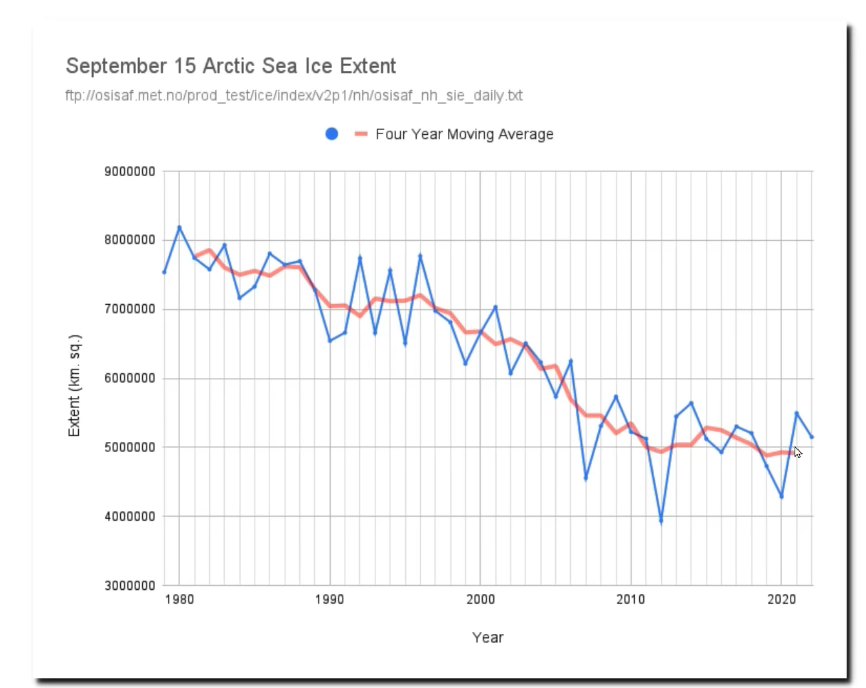
"If it bleeds it leads". 20 years ago the world was being told that by now there'd be no ice in the Arctic at all. Yet, here we are. Last year was the highest level of ice for the last 12 years and ice levels are stable for the last decade:
Also, the trend on graph only looks alarming because it's been truncated and covers a relatively short period of time. Go back to old IPCC reports and the graphs show levels were much lower than today and then grew rapidly at the start of the 70s.
The headline is talking about a point of no return for a specific threshold or feedback loop, and there seem to be no end of those, for decades to come. As for the "we're fucked" point of no return, we'll still need to first precisely define it.
The mass of the Greenland ice sheet is about 2.5 E15 tonnes. The average melt rate between 2003 and 2016 was about 2.5 E11 tonnes/year. At this rate it would take 10,000 years to melt completely.
But the melt rate is increasing with increasing average temperatures. Wikipedia quotes a melt of 5 E 11 tonnes in 2019. Perhaps the doubling time is about 10 years? At that rate it'd take about 5,000 years to melt away.
Five thousand years is a long time only if the melt rate remains the same. If the melt rate continues to double every decade, then 12 doublings increases the melt rate to 4000 * 5 E 11 = 2 E 15 tonnes/year. Then the Greenland ice cap could be gone in about 120 years.
> But the melt rate is increasing with increasing average temperatures. Wikipedia quotes a melt of 5 E 11 tonnes in 2019. Perhaps the doubling time is about 10 years? At that rate it'd take about 5,000 years to melt away.
At that doubled rate it would take 5,000 years, but if that rate doubles every 10 years, at the rate 10 years from now, it would take 2,500, at the rate 20 years from now 1,250, at the rate 100 years from now about 5.
Does anyone have suggestions for how an individual can feel like they’re actually doing something. I already make donations to organizations that advocate for climate activism, vote at local and national level for candidates what support climate action, and in my own live I try to be conscious about the environment impacts or my lifestyle and purchases. Despite all that I still feel like I'm changing nothing. I still feel like there are theses colossal and obvious problems bearing down on our species and all I can do is watch it happen. I hate this feeling of helplessness.
I work in climate change. I changed my job in order to do so. The pace of change feels glacial (badum-bum). The same can be said of politics, and everything else that involves way too many interests fighting over a very small set of resources. You will never not feel helpless.
Greta Thunberg probably felt helpless. But she turned that feeling into anger, and that anger into action. Henry Rollins said he stays angry, because he doesn't want to accept what's wrong with the world. (I don't think he has as positive an impact as Greta, though)
You, yourself, cannot fix the world's problems. Neither can Greta or Rollins. But if you really feel like you're not doing enough, then hold yourself accountable. List the things you do every day to affect change. Just write down what you're doing. Then when your inner voice says "What the hell are you doing about it?", answer it. If your inner voice says "That's not enough", then do more. Or don't! But be at peace with your decisions.
It's absurd That any serious climate scientists should take seriously the media pretensions around making an emotionally charged adolescent into a messianic figure, and consider that a useful thing for real climate investigation and some practical policy.
Either many people who work in climate change have some serious critical thinking problems in this field, or the core ideas of good scientific thinking have gone down the toilet for climate change.
> Greta Thunberg probably felt helpless. But she turned that feeling into anger, and that anger into action.
Serious question.
What impact has she had? I haven't seen any changes from her actions. People knew about climate change before she came around. What changes did she create?
The best thing you can do in continue to innovate and build more efficient things. We can use that technology to stop wasting resources, stop pushing negative externalities to the environment, and rapidly bring the entirety of the planet out of abject poverty where they are more concerned about where dinner is coming from than their environment, local or global.
The most important innovation is behavioural: if we collectively stop travelling by ICE to a remote office, we can meaningfully and significantly reduce global emissions.
WFH isn't just a pandemic response measure, it's a climate change measure. We should all fight to WFH, even if we hate it, to reduce carbon emissions.
So I looked through Climatebase, and I found it hard to evaluate the companies listed. There's plenty of listings, but no (easy) way to say, "Show me one entry per company, for every company hiring engineering leaders." I either got drowned in "this company has 35 reqs open, so here's 35 entries" or "you've narrowed your filters so much that you only see two companies".
Not quite easy to figure out "Which set of companies are hiring for a role I can fulfill?"
This is the only correct answer from all of these. The highly educated are far more likely to make a significant difference especially if they have knowledge that spans multiple fields.
What are you talking about? “Work on climate” means “build the infrastructure to enable the transition away from fossil fuel dependence,” not… whatever imaginary demon you’re fighting with here.
Daydream: Chain all the politicians to rocks within a foot of sea level, so they'll actually care.
More practically, try to downsize your life and carbon footprint. Avoid the performative virtue of buying lots of "green" things. (Many goods like EV's have a huge carbon footprint to manufacture. And eco-tourism via airplane is right out.)
And maybe donate to a non-profit or two that are trying to mitigate the harm that climate change is causing to people much less fortunate than you.
Keep in mind that personal carbon footprint is an invention of fossil marketers, and a lot of that is intentionally ineffective distraction.
You can't build long-distance UHVDC power lines yourself. Really big changes can only be done at the state level. If you need a new car, an EV is still better than a new gas car, but having public transport and rail network is even more efficient. But you can't create a properly functioning well-funded transport system yourself.
As an individual the best you can do is insulate your house, and if you need heating, get a heat pump. Domestic heating/cooling energy use is significant, and needs to be electrified before it can be decarbonized.
Some things like rooftop solar panels + batteries do work, but that is offloading switching costs to individuals, while the fossil industry is still getting subsidies. Grid-scale solar farms and storage are more cost effective. Wind farms are even better, but you can't build ones tall enough in your backyard.
> Chain all the politicians to rocks within a foot of sea level, so they'll actually care.
The policies which are currently in place are not there because of the desires of some handful of politicians but because of the desires of the masses. If you'd banish all the current politicians, their replacements still wouldn't be able to enact policies of rapid decarbonization, degrowth and an actually enforced major reduction in consumption of energy, goods and transportation, because their constituents wouldn't accept that.
Turn off the feeds; don't listen to the talking heads. I'm not saying to be ill informed or under informed, but curate your information feeds such that they're challenging you to do due diligence; read journal articles that cite sources and avoid anything that has an advertisement like the bubonic plague.
Distend social media and focus on high-quality, low-throughput content. Rationality is not based in the vox of the masses.
I bought some forest land, and I'm restoring it to riparian habitat. It's not world changing, but if a few hundred acres can be returned to a natural state and grow large, carbon sucking trees, I feel like I'll have done a net good over my life.
This required giving up on some other goals though. I don't know that there's a lot you can do that is sacrifice free.
I've also gone to a mostly vegetarian diet -- preferring to source meat only from local farmers I've met in person. If I haven't met the farmer, I won't eat the meat. This reduces the amount of meat I eat, but still lets me seek it out. Maybe this helps, maybe it doesn't, but it's a pretty easy rule to follow that doesn't require me to be a strict vegetarian. I can have my beef stew as a treat, but also know that I'm not contributing to a massive industry of wasteful excess with every meal.
Climate change is genuinely one of the few things where grassroots movements (pun not intended) can have an outsized impact. Kill your lawn, replace it with native plants, and you can create an absolute oasis for animals that are losing more of their habitats year after year.
This can be a refuge for thousands of animals, give you tons of cool stuff to watch go on in your back yard, and it'll almost certainly save you money as the plants won't struggle to grow and thrive in your area.
> how an individual can feel like they’re actually doing something
That's going to depend on the individual. Some people feel just fine driving a hybrid automobile every day as their big contribution. Some people quit eating meat, quit flying, quit driving altogether, and some even protest. Of course there are many options and many different levels of guilt and helplessness that individuals deal with.
But perhaps you could address your need to feel like you're doing something. You don't have to do anything. You can give yourself some slack. This isn't a problem that you caused, and it's not a problem you're going to solve.
What do you do when a loved one is in the later stages of terminal cancer? Do you fret and feel like you need to do something? Do you yell at the doctors to try one last thing? Do you cry over loss? Maybe but eventually in a healthy person that will all end. Once someone is in hospice, it's time to work toward acceptance and appreciation and to try to enjoy the last bit of time left as much as one can. We're in a sort of planetary hospice situation right now.
Made this account just to say: with regards to climate change, it's tough because your impact is largely limited to voting + "negative actions" such as flying or driving less, eating less meat, etc. Voting obviously doesn't happen often, and attempting to reduce your carbon footprint is awesome but imo not exactly morale-boosting.
That said, there are other related causes you can give time and effort to that have a direct positive impact, such as volunteering in ecological restoration in your free time. Protecting native biodiversity and restoring ecosystems— which are becoming every-more-threatened due to climate change, habitat fragmentation, and invasive species— is very rewarding work, and more accessible than most people realize. No prior experience or tools needed, just time and energy.
You can search for "environmental volunteering" or "ecological volunteering" for wherever you live, and decent odds there are options for you to choose from.
Otherwise you have to make green choices a win/win or change people’s minds.
EVs are a good example of a win/win. Most people weren’t willing to sacrifice range or power in their vehicles. But now that the range and power is there and electricity is cheaper than gas it’s more of a win/win.
The engineers have alternatives to more than enough cases where greenhouse gasses are produced or released.
The "political" problem is how to solve the economics problem. As long as society "subsidizes" damage to the environment, by not charging the damagers, then damage will continue to be extremely lucrative and near impossible to stop.
But the incentives for Big Energy to resist change are so huge, that I don't see a timely solution without explicitly co-opting them.
I.e. solving their economic problem to solve our environmental problem.
Get every Big Energy CFO into a room and establish what kind of incentives they would need to find hard CO2 drawdown legislation a financially attractive opportunity worth pursuing with greener alternatives en masse.
New massive subsidies for Big Energy would not be a fair use of citizen's taxes. But the alternative of continuing to "subsidize" their destruction of the environment is far more costly.
And the side benefits of greater energy security and independence, international stability, etc., would be worth a great deal too.
Well, yeah, there is also the chance that we don't solve it at all. I just don't think you can design a political solution to this. Other than mass killings and I'm not for that at all.
We have to develop technologies that improve our efficiencies and reduce our emissions.
Consume less, buy less material stuff, eat less meat/fish, have less than 3 children, set a good example without becoming annoying to family and peers.
Don't over stress it though. You can't change the world but you can set great seeds with examples.
What sacrifices can you do in your own life? That is certainly the easiest and most certain way you can contribute. The impact will be limited no doubt, but the most obvious place to start.
> What sacrifices can you do in your own life? That is certainly the easiest and most certain way you can contribute. The impact will be limited no doubt, but the most obvious place to start.
Respectfully, I think a better plan is to work hard to reach a position of power and/or leadership, and then make changes that affect millions. Minor changes in my household have relatively zero impact in the big picture.
I think you'll find it very difficult to convince people to make a sacrifice that you are not willing to make yourself. Or are you talking about forcing them?
That's really not true, and we have the largest experiment on collective behaviour in history to show this. COVID lockdowns had an _enormous_ impact on carbon emissions.
Everyone should fight to WFH, even if you hate it, because the benefit to reducing carbon emissions is known and significant.
I really dislike those arguments. It's like why bother voting, one vote does not change much.
You can be conscious about your consumption and set great examples. Or you can decide you don't care and keep ordering stuff on amazon every day, shove meat and fish everyday in your mouth, change car every few years while flying regularly and pretend is somebody's else problem.
They use satellite data to check that various countries and companies keep their promises. E.g., a country receives money based on the promise that some rain forest is protected, then they are paid to check that no logging takes place there.
That's one of the few use cases for software that I believe can actually help.
I didn't realize it was a per capita problem. Maybe we can breed our way out of it so the global emissions per capita will be better and the environment will be happy.
Not sure why you are being sarcastic. No one wants to reduce their emissions (maybe a small number do or perhaps only in the abstract. Most like their steak and international travel. I know I do) so how do we make it fair? I cannot see any way that is fair that isn’t based around some per capita distribution. Of course this will be impossible to do exactly, but we should aim for an approximation.
Coal is the dirtiest power source available. Globally, electricity is among the largest source of emissions. China has a strong commitment towards renewables, but for various reasons they also love coal. A brand new power plant is a long term commitment: these things last for decades. Building a new one today means burning through coal for 30+ years.
The best use of the world's resources would be to ensure no new coal plants are built, regardless of each individual country's emissions problems.
Furthermore, China is ahead of most countries in Europe on a per capita basis. Making excuses for them just because they aren't at the top on this metric is kinda bullshit.
Had to look that up, a quote from the now-destroyed Georgia Guidestones, apparently. Hard to tell what your message is when there's literally nothing but the quote to give you context.
This is the best answer. Voting and consuming differently are not impactful enough. Only mass labour movements will get the wheels turning. The proof is all there in recent history.
buy stuff as if the garbage man does not exist...in 1880 they didn't have trash removal
buy one set of clothes you wear pretty much every day until they fall off of you
buy a few tools that will last you forever
no more disposable anything, remember the trash man doesn't exist
wash clothes by hand
cook everything yourself, even better grow your own food
sorry no biking, rubber is an industrial process...you walk everywhere just like great grampa did
no need to worry about fossil fuels...you won't be using them in any capacity other than maybe a nice fire in the winter in your wood burning stove which will be the only "appliance" you own (good news - they last forever!)
etc etc
this is probably what sustainable living looks like until we get star trek matter synthesizers
you'll never get a date living like this but you'll also never again worry about 98% of the crap of modern life
sorry no biking, rubber is an industrial process...you walk everywhere just like great grampa did
This is ridiculous. If petroleum were used solely to produce bicycle tires and things like seals for appliances, the world would be unimaginably 'greener'.
That entire list is just disingenuous, defeatist nonsense.
It takes ~50 kcals to walk 1 kilometer, and approximately 25 kcals to bike 1 kilometer, and approximately 10 kcals (electric + human) to use an electric bike to move 1 kilometer.
I put ~1,000 kilometers on my electric bike last year, which is a net savings of ~40,000 kcals. That's not an insignificant amount of energy saved per year. And many of those trips I had a passenger, a load of cargo (like plants from the nursery, soil, clothing, groceries, etc.) that was too large for me to carry.
So, while an infrequently used bike is probably a loss, sustainability-wise, there must exist a break even point. 40,000 kcals is not nothing. It's not huge, but it's not nothing.
And compared to owning a car? A car might be 500-1000 kcals/kilometer or more. Doing the same math with a car (1,000kms) is like, 500,000-1,000,000 kcals for a small car , 50,000 for walking, and 10,000 for electric biking. No matter what, the savings of walking or biking are monumental compared to a car.
And if we really, really had to we could find ways to dramatically reduce manufacturing, transport, and packaging costs for electric bikes.
Get the best minds in the world together and ask for an action plan for salvaging climate within two generations...100% chance it will be some variation of "live like its 1880"
This would mean massive deforestation to heat and build with wood. That means much more carbon than most people currently produce with less land taking it in. Burning wood ain’t the answer. Also, 1800s was the era where coal became available for businesses and the wealthy, and that’s also a bad idea. To suggest no major energy source would likewise be bad as billions would die.
> Despite all that I still feel like I'm changing nothing.
You're doing the right thing. Saving the planet isn't sexy. It's getting a few more years out of your old car instead of buying another. It's skipping a few generations of iPhone and making your current device last longer. It's skipping that vacation to Aruba this year. It's researching dozens of brands at your supermarket and being a patron of those with better practices, rather than those you prefer.
I mean whatever about the physical reality, politically the ice sheet is guaranteed to melt. There is essentially zero chance of humans coordinating a global response to climate change that achieves anything until things get much much worse
Humans have already achieved that many countries stopped growing their emissions unchecked and are trying to reverse the trend.
By means of initial subsidies renewables are now producing cheaper energy than fossil sources. This causes the normal market forces to act (economies of scale, tipping points, etc.) which make it very likely that renewables will be the predominant energy source of the 21st century.
And still here we are, and no one yet has found an effective argument that convinces people that: yes, this climate catastrophe is real, on track to happen, and within our lifetime.
We, as humanity, know what causes it, why it happens, what can be done to stop it, and even a few things to revert parts of it. The knowledge is there. Scientists proved things. Engineers built stuff.
The literally only thing is that we are currently unable to stop this madness because of a lack of… motivation to do so.
There are numerous reasonings why this is the case, from inequality to geopolitics over profitmaximization up to straight out lying and denial. Many indeed have a point somewhere. It’s just that it doesn’t matter if they have a point - the global problem must be stopped, now.
Maybe… while many of us here on HN are busy prompt engineering AIs… could we use that momentum to craft arguments for every single person not willing to act for humanity?
Unfortunately, the only proof I see is that you’re expecting too much from humans. We’re just not very rational, and have a problem doing the right thing. We believe in unproven stories about gods, kill millions of people for temporary greed, power or believing the wrong lies, and we lie and deceive to gain power or wealth, and have a hard time sharing with those in need (actually sending fugitives back to sea knowing they’ll drown). We’ve pretty much destroyed all life on earth, and are close to destroying our ability to survive. Sometimes people surprise you in a positive way, but overall it’s pretty sad. Maybe it’s unavoidable, as these are the ‘qualities’ that made humans successful, but it seems they’ll now destroy a large part of us (not for the first time, but at an unprecedented scale).
And still here we are, and no one yet has found an effective argument that convinces people that: yes, this climate catastrophe is real, on track to happen, and within our lifetime.
Everyone who 'doesn't believe in' climate change has a vested interest in maintaining the status quo - they profit from fossil fuels or from misinformation, or they're narsessistically enjoying other people's discomfort from their arguments, or they're just stupid. There is no point trying to convince them. We have to fix the problems without their help.
These reports are the modern versions of the men walking around the city with sandwich boards proclaiming the end of the world [1]. When you asked them what it was which made them believe so you'd get some rambling story of how the lord had given them signs in their breakfast porridge, ask these climate prophets what makes them believe the point of no return has come and they point at their models which have shown them the end is coming. The difference between these two is that the former at least got a good breakfast out of their medium.
Is the climate not changing then? Of course it is, always has and always will. Do humans not influence the climate then? Of course they do, especially since the industrial revolution. Does this portend a catastrophe? Well... there opinions vary. I'm convinced the changing climate will poise some problems which will be dealt with - just like humans have always dealt with the changing climate. The difference here is that there are more humans - which could make things more difficult - who have more advanced technology - which will make things easier. Assuming cooler minds prevail and the sabre rattling around the world does not lead to a bigger conflict I'm convinced humanity as a whole will make it through whatever changes the climate makes to come out richer and more advanced still.
Would we be better off if we were not as reliant on fossil energy sources? Yes, we certainly would given the pollution - and I'm talking about true pollution here, not CO₂ - involved in the winning and use of these sources. Build more nukes, get serious with fusion, develop a sane form of hydrogen storage, go for it. Not because of the climate boogeyman but because of the above reason as well as the fact that these energy sources are concentrated in some of the more troublesome regions in the world where they have already led to numerous conflicts.
Do I trust climate models? No, I do not and with reason. I did study this stuff a few decades ago when the models were 'less advanced' than they are now. I know
of too many fudge factors in these models, too many adjustments which are made to make them follow the observations where the reason for and effect of those adjustments are not understood. From what I have been able to keep up with things are not much different now - apart from far faster computers and more complex models with more parameters and their accompanying fudge factors.
For reference, high tide where I am is ~20ft. Winter storms bring it up another 20. This will definitely require moving inland, but definitely not a “thanks for all the fish” scenario.
The greenland ice sheet is but one of the tipping points. The real problem of course will not come from warming or sea level rise per se, but from hundreds of millions of people whose homeland becomes uninhabitable for some reason or other. Some of those people have nuclear weapons.
There are a lot of reporting going on about taking ice samples from these areas. What do those ice samples say about the last few thousands of years. How temperature fluctuated, can they estimate the ice sheet coverage for the last x thousand years and if so, what does it say? What if it melts, can it ever freeze again, creating the same block of ice as before?
This doesn’t make sense. Volume is measurable. Satellites do it. There’s little prediction, it has already been done. Predicting when something will happen, in the future, is much harder.
For example, you could measure a hamburger in front of me. Predicting when, and if, I’ll eat it is much harder.
Not that hard. You will eat it before it gets bad, possibly before it gets cold. If you are having a burger at a restaurant you will eat it before the restaurant closes. I predict you will eat it in about 1 hour. Seeing your post was 19 hours ago I doubt you still have the burger in front of you.
Well, you proved my point. With time, you can get within the usable life of the burger, with a bunch of assumptions, like me not being vegan, or the server accidentally giving me someone else's order. Compare this to a 0.01% error bar for the mass/volume measurement of the burger, with a cheap scale. One is measurable, and known, where the other requires imprecise prediction that doesn't realistically have a bounds.
Going back to the original comment, just because they can measure the ice with extreme precision, doesn't mean they can put a date on the when secondary affects will cause them to disappear. Just because you can know the precise mass/volume of the burger, doesn't mean you can put a time on when I'll eat it. Measurement is direct. Prediction is indirect.
I'm not moving the goal post. The fact that all of these details are required, making the prediction of future events difficult, compared to the triviality of directly measuring a physical quantity, is the entire point of this discussion.
Obviously we need communism to fix the weather. Give up your car, your meat, your vacations, limit your indoor heating and for Christ sake, don't have kids (not that you Gen-Zs had that option anyways ..).
Scientists (TM) and the private plane travelling climate circus are sure that this will cause the temperature in the year 2100 to be reduced by a whole one hundredth of a degree.
Soros is saying [1] if not solved withing ten years, it will cost exponentially more to restore the balance. Bellow in [1] there is a video proposing a device to recreate the albedo effect using see water.
For Soros climate change is the biggest security thread, only after this he talks about wars and geopolitics.
I am always confused as to why they don't include a graphic that shows how a melting glacier or ice shelf translates into worldwide ocean level rise. The common intuition is that Earth's oceans are vast so any amount of above sea level mass going into them isn't going to change sea level that much.
I haven't yet seen a graphic yet that explains the calculation, and I'm left cynically thinking that they are mistakenly using a Mercator projection when calculating the contribution for Greenland.




This article’s title and its content are completely at odds. Here’s a critical passage:
> As the ice sheet melts, its surface will be at ever-lower elevations, exposed to warmer air temperatures. Warmer air temperatures accelerate melt, making it drop and warm further. Global air temperatures have to remain elevated for hundreds of years or even longer for this feedback loop to become effective; a quick blip of 2 degrees Celsius (3.6 degrees Fahrenheit) wouldn’t trigger it, Höning said. But once the ice crosses the threshold, it would inevitably continue to melt. Even if atmospheric carbon dioxide were reduced to pre-industrial levels, it wouldn’t be enough to allow the ice sheet to regrow substantially.
> “We cannot continue carbon emissions at the same rate for much longer without risking crossing the tipping points,” Höning said. “Most of the ice sheet melting won’t occur in the next decade, but it won’t be too long before we will not be able to work against it anymore.”
So…we potentially have hundreds of years to bring temperatures back down before the “tipping point” triggers? Forgive me for not being super alarmed.
100 years ago we’d just barely started dumping carbon into the atmosphere. That is a long time.
EDIT: to be clear, yes of course it not enough to stop dumping carbon into the atmosphere in the next hundred years, but it does give us (potentially) decades to figure out large-scale carbon capture and sequestration even if we exceed the thresholds described here (1000 gigatons).